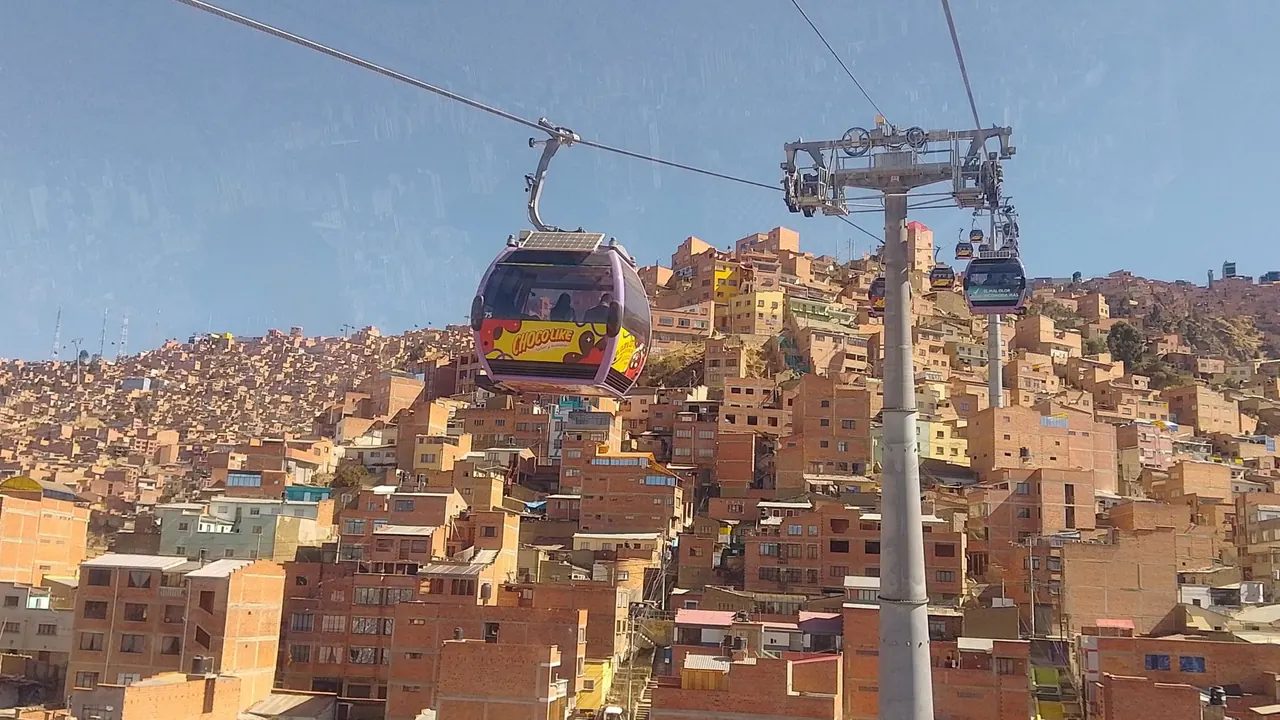
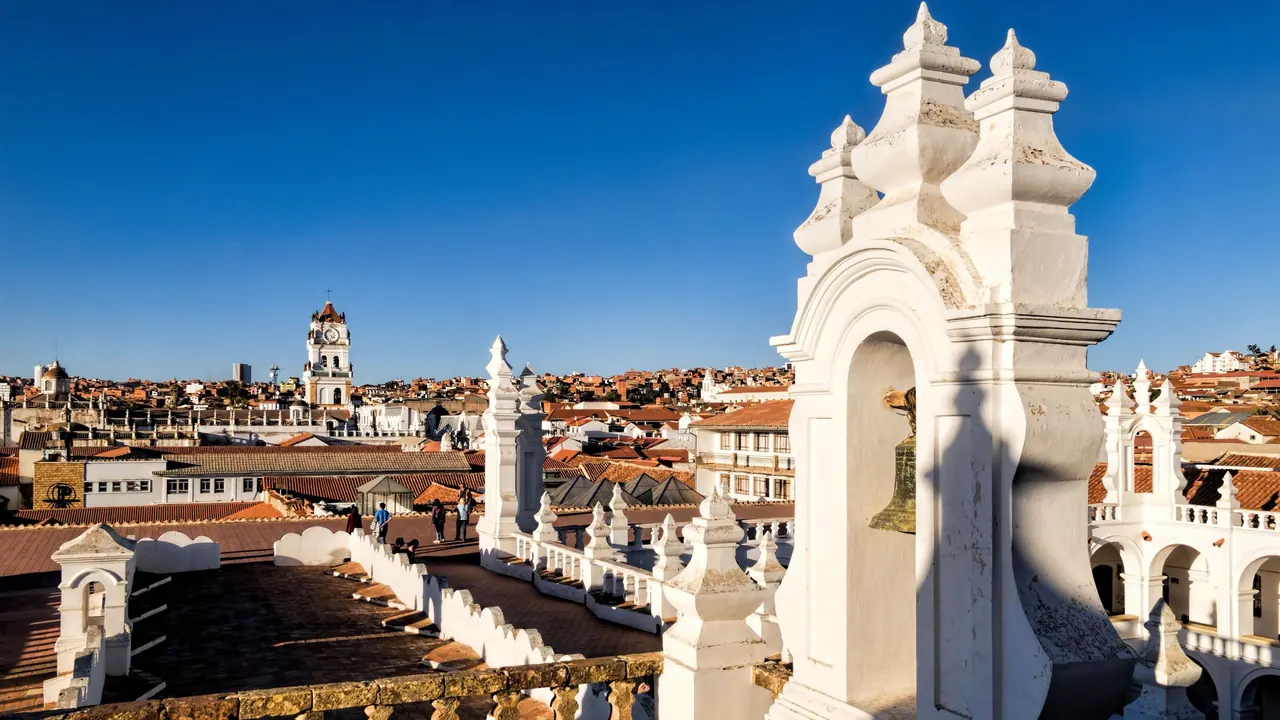
Photos: La Paz by Arabsalam, CC BY 4.0, cropped; Sucre by Dan Lundberg, CC BY-SA 2.0, cropped.
La Paz or Sucre?
Our verdict in twelve categories, each scored against the same fixed benchmark cities, and the climate month by month, so you can choose for your trip.
Choose La Paz for
- nature and the outdoors
- shopping
- day trips
La Paz is for travellers who come to Bolivia for the mountains. The canyon setting under Illimani, the glaciers of the Cordillera Real, Huayna Potosí and the Death Road ride are all within reach, and the city around them has more to eat, more to buy and more going on after dark than Sucre. In return you get cold nights, steep streets, heavy traffic and altitude that has to be taken seriously, so it suits fit adults who want adventure rather than rest.
Choose Sucre for
- families
- getting around
- wellness
Sucre is the gentler choice, and the better one for history, slow travel and children. Its whitewashed colonial centre is better preserved and easier to walk, the climate is noticeably milder, and the lower altitude makes the first days far less punishing. It is the place to stay put for a week or two and do day treks into the Cordillera de los Frailes. Families and anyone who wants calm rather than adrenaline will be happier here.
Scoreboard
Twelve categories on one fixed scale from 0 to 100. The shaded stretch is the gap between the two.
Your match
Pick a travel style or drag the sliders, and both match scores follow your weighting.
Too close to call, level with your weighting
Wins on nature and the outdoors and shopping with your weighting.
Wins on families and getting around with your weighting.
What matters to you?
Category by category
What the scores mean for a trip.
Beaches & swimming
Swimming is off the menu in both. Bolivia is landlocked, and each city offers only a hotel or municipal pool. La Paz at least has Lake Titicaca about two hours away for boat trips and views, though the water is far too cold to swim in, so anyone who wants sand needs a separate leg on the Pacific coast.
Food & drink
La Paz has the wider table. The salteña breakfast, purple-corn api and corner anticucho grills are backed by the huge Rodríguez and Lanza markets, with their many potatoes and Yungas fruit, and a small group of restaurants in Sopocachi and the southern zone cook ambitious food with llama, quinoa and Amazonian fish.
Sucre eats on a smaller, more regional scale: spicy chorizo chuquisaqueño, mondongo and set lunches above the Mercado Central's juice counters. Its distinctive extra is chocolate, from the old makers around the main square. Beyond that the choice is thin, though at Sucre's lower altitude you are more likely to have an appetite from day one.
Culture & sights
Sucre has the finer historic centre. Its whitewashed UNESCO-listed grid around Plaza 25 de Mayo is one of the best-preserved colonial towns in South America, and the Casa de la Libertad, the Recoleta and the Jalq'a and Tarabuco weavings at the Museo de Arte Indígena make a rich, compact set that fills two or three unhurried days.
La Paz has a much smaller colonial core in a chaotic city, but the carved mestizo baroque front of San Francisco, Calle Jaén and the ethnography museum are well worth seeing. Its real strength is living culture: the Witches' Market, cholitas in bowler hats, the cholet mansions of El Alto and the cable-car view over the whole bowl.
Nightlife
Neither is a party city, but La Paz has more choice. Sopocachi's small bars, craft beer and late cafés, the traveller bars near Sagárnaga and weekend clubs in the southern zone add up to several kinds of night. Cold air and altitude still send most visitors to bed early.
Sucre's night out is a student one: a few streets of bars and a couple of clubs near the plaza that fill on Fridays and Saturdays and go quiet midweek. More often the evening ends with a singani after dinner.
Nature & outdoors
This is where La Paz pulls well ahead. The city fills a canyon under snowcapped Illimani, with the Cordillera Real's glaciers, Huayna Potosí, Chacaltaya and the Valle de la Luna all close by, and the Death Road ride drops from snowline to cloud forest in a day. The catch is that everything starts above 3,500m.
Sucre's country is drier and gentler: red and ochre hills, the striped bowl of the Maragua crater and Jalq'a villages in the Cordillera de los Frailes, best seen on guided treks of one to three days, with nights in community lodges on the longer routes. It is rewarding walking, but there are no high peaks or glaciers.
Day trips
La Paz has the stronger single outing in Tiwanaku, a major pre-Inca site with the Gateway of the Sun, about an hour and a half across the Altiplano, plus El Alto's huge market on the doorstep. Titicaca, Isla del Sol and Coroico are better done with an overnight stay.
Sucre's best day out is Tarabuco's Sunday market, with Yampara textiles and dress, followed by short trips to the odd Castillo de La Glorieta and Yotala. Potosí, about three hours away, is better treated as the next stop.
Good for families
Sucre is far easier with children. At about 2,800m rather than 4,000m on arrival, the altitude is much gentler. The centre is calm and compact, and Parque Cretácico, with life-size dinosaurs in front of a wall of real footprints, is a proper highlight. Basic medical care and uneven pavements still make it best for older children.
La Paz is hard going with young children: altitude sickness is a real risk, and the steep streets and fierce traffic leave little room for them. The cable cars and the Mallasa zoo are the main treats, and teenagers who cope with the height will enjoy the landscapes.
Getting around
Sucre is the simpler city to get around. Nearly everything lies within a few blocks of the main square on a legible colonial grid, and taxis are cheap for the rest. Only the climb to the Recoleta tests the legs.
La Paz is sprawling and steep, with daily traffic jams and minibuses whose destinations are shouted from the door. It does have Mi Teleférico, a network of urban cable-car lines that is both the easiest way to cross the city and a sight in itself.
Shopping & style
La Paz offers more to browse. The lanes around Sagárnaga and Linares are full of alpaca knitwear, textiles, silver and instruments, the Mercado Negro is a maze of everyday trade and El Alto's 16 de Julio fair sprawls over dozens of streets. Quality varies, so look carefully.
Sucre's shopping is narrower but focused: fine Jalq'a and Tarabuco weavings in fair-trade shops near the indigenous art museum, plus chocolate from the old makers. Neither city has any fashion or luxury shopping.
Affordability
Both are among the cheapest cities on the continent, with very cheap market lunches, salteñas and taxis. In La Paz the bigger costs are guided adventures such as climbing Huayna Potosí or riding the Death Road, where a reputable operator is worth paying for. In Sucre, colonial guesthouses make long, slow stays very easy on the budget, which is why language students settle there for weeks.
Live music & performing arts
Folkloric music leads in both, but La Paz offers more. Its peñas stage the morenada, caporales and diablada, the Teatro Municipal and National Symphony provide a modest programme, and the Gran Poder festival fills the streets with tens of thousands of costumed dancers and brass bands each year.
Sucre has dinner shows and weekend peñas on a smaller scale. The elegant Teatro Gran Mariscal hosts occasional symphony concerts, and the patron-saint festivities bring dancers onto the streets.
Wellness & relaxation
Neither has a spa culture, but Sucre is far more restful. Its mild climate, shaded colonial courtyards and the sunset view from the Recoleta arcade make it the place where travellers stop to recover after the Altiplano.
La Paz works against relaxation: noise, fumes, poor sleep at altitude and a restorative routine that amounts to coca tea and an early night. Leafy Sopocachi is the calmest base, and the Urmiri hot springs are about two hours away.
When should you go?
Pick your month. The climate figures are measured averages, not a forecast.
La Paz in July
Sucre in July
Daytime high, °C
Rainfall in the month, mm
Where the figures come from
La Paz has no weather station within reach, so its figures come from a gridded climate model rather than a measured record, and read a broad area rather than the city itself.
Temperature and rainfall are climate normals, averaged over the years shown. La Paz: 2001-2020 normals, NASA POWER reanalysis grid, no weather station within 90 km. Sucre: 1991-2020 normals, Sucre (5.4 km from centre).
Neither city has a beach season, and the useful question is when it stays dry. Both follow the same Andean pattern: a rainy southern summer from December to March, with January the wettest month at around 136mm in La Paz and 125mm in Sucre, and a dry, clear stretch from May to September, when Sucre gets almost no rain at all. That dry season is the best time for both, especially for treks, climbs and mountain views around La Paz.
What sets them apart is warmth. La Paz stays cool all year, with daytime highs around 14°C and cold nights, so walking the streets is comfortable but you will want layers in every month. Sucre is consistently about six degrees warmer, with afternoons near 21°C year round, which makes it pleasant for strolling in any season and the obvious place to warm up after time on the Altiplano.
Which traveller are you?
On an outdoors trip, La Paz is the clear pick. Glaciers, a climbable six-thousand-metre peak, Chacaltaya and the Death Road ride all start from the city, whereas Sucre offers gentler guided treks through the dry hills of the Cordillera de los Frailes.
On a family trip with children, Sucre is much the safer choice. Its lower altitude, calm compact centre and the dinosaur footprints at Parque Cretácico suit young visitors, while La Paz pairs a high-altitude arrival with steep streets, fierce traffic and little made for children.
For a relaxing and wellness trip, choose Sucre. Neither city has spas worth travelling for, but Sucre's mild climate, shaded courtyards and quiet plaza invite a slow week of rest, while La Paz is loud, fume-filled and tiring at altitude.
Before you go
| Measure | La Paz | Sucre |
|---|---|---|
| Official language | Spanish, Aymara, Quechua, Guarani | Spanish, Aymara, Quechua, Guarani |
| Currency | Boliviano (BOB) | Boliviano (BOB) |
| Sockets | AC50 Hz | AC50 Hz |
| Driving side | Right | Right |
| Time zone | UTC-4 | UTC-4 |
| Emergency number | 911 | 911 |
| Elevation | 3,640 m | 2,810 m |
| Main airport | El Alto International Airport (LPB)6 km from centre12 non-stop destinations | Alcantarí International Airport (SRE)25 km from centre3 non-stop destinations |
| Public holidays this year | 12 days | 12 days |
By the numbers
| Measure | La Paz | Sucre |
|---|---|---|
| City population | 755,732 | 360,544 |
| People per km² | 1,601 | 204 |
| Museums within 10 km | 21 | 4 |
| UNESCO World Heritage sites within 50 km | 1 | 1 |
Where else could you go?
Every comparison below shares a destination with this one, so you can follow La Paz or Sucre somewhere new.