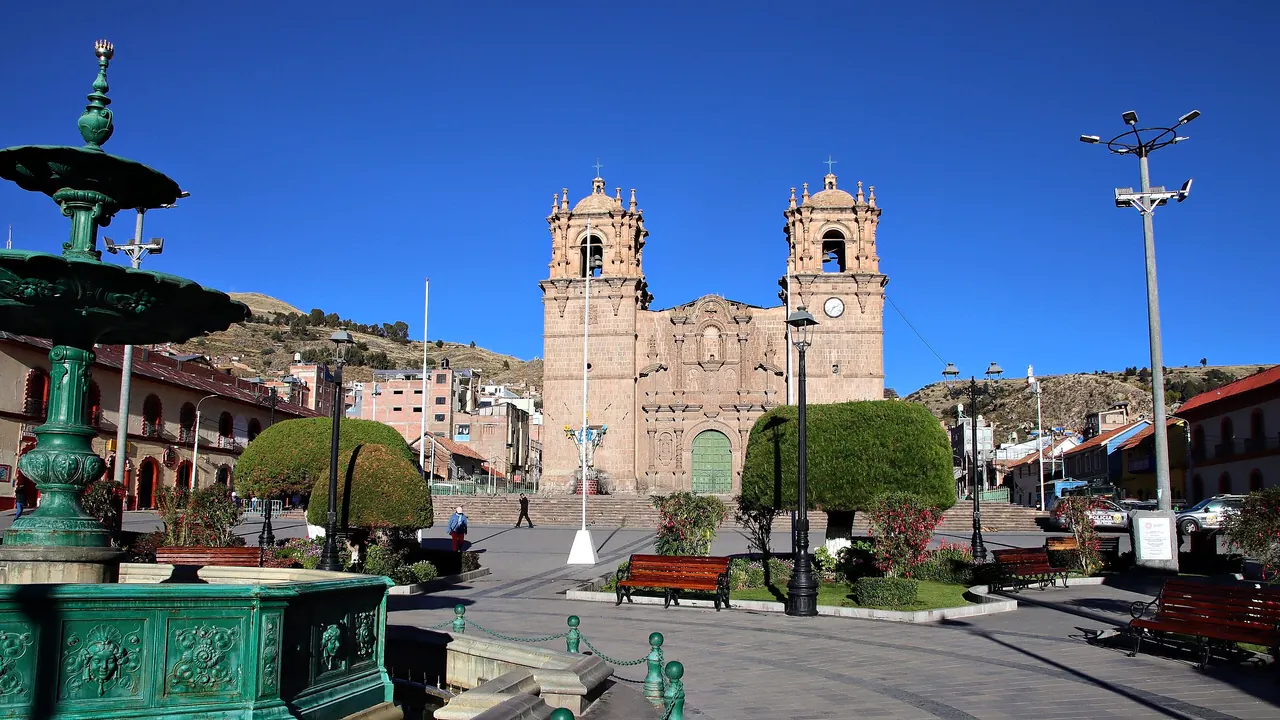
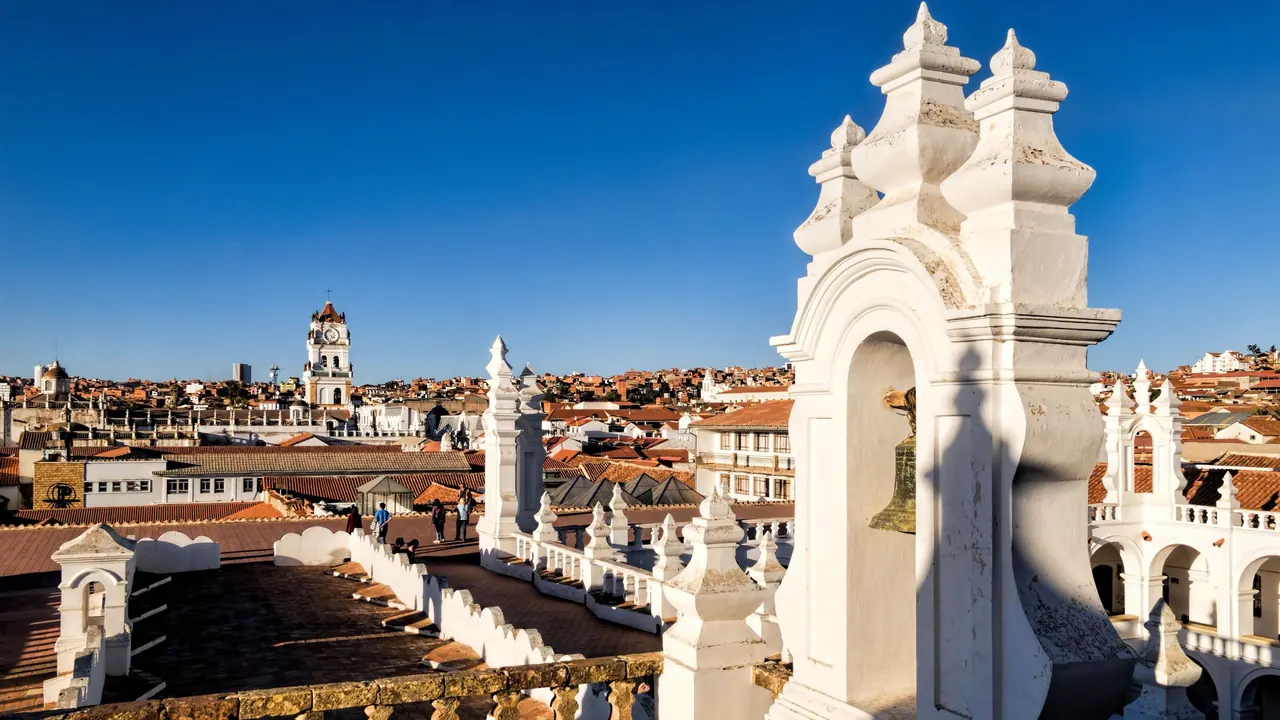
Photos: Puno by Draceane, CC BY-SA 4.0, cropped; Sucre by Dan Lundberg, CC BY-SA 2.0, cropped.
Puno or Sucre?
Our verdict in twelve categories, each scored against the same fixed benchmark cities, and the climate month by month, so you can choose for your trip.
Choose Puno for
- day trips
- live music and the arts
- nature and the outdoors
Puno is for travellers who have come for Lake Titicaca. The town itself is plain, but it is the natural base for boats to the reed-built Uros islands, Taquile and a homestay on Amantaní, with Sillustani and the colonial churches of the southern shore close by on land. Pick it if you want landscape and lake culture, can handle the altitude and cold nights, and especially if your dates take in the February Candelaria festival.
Choose Sucre for
- culture and sights
- families
- getting around
Sucre suits a slower, more comfortable stay in a handsome town. Its whitewashed colonial centre, independence history and indigenous weaving museum give it far more to see within its own streets. It is also lower, milder, easier to walk and kinder to children. It is the better choice for culture, families and anyone who wants to rest for a week after the harsher altiplano.
Scoreboard
Twelve categories on one fixed scale from 0 to 100. The shaded stretch is the gap between the two.
Your match
Pick a travel style or drag the sliders, and both match scores follow your weighting.
Wins on day trips and live music and the arts with your weighting.
Wins on culture and sights and families with your weighting.
What matters to you?
Category by category
What the scores mean for a trip.
Beaches & swimming
Neither city is a place to swim. Puno at least has water, but Lake Titicaca is too cold for more than a quick dip from an island cove on a sunny afternoon. Sucre lies in a landlocked country and has nothing but hotel and municipal pools.
Food & drink
Sucre has the more rewarding food of the two. There are morning salteñas, spicy chorizo chuquisaqueño, the fruit-juice counters of the Mercado Central and the old chocolate makers around the main square, so a stay brings a string of small pleasures. A few restaurants near the plaza also aim a little higher.
Puno's cooking is narrower and centred on the lake: trout in every form, quinoa stews, alpaca and coca tea to help with the altitude. Its market breakfasts are worth getting up for, but the traveller restaurants on Jirón Lima soon start to repeat themselves.
Culture & sights
Sucre is the clear choice for sightseeing. Its whitewashed centre is good for slow walking, and the Casa de la Libertad, the cathedral museum, the Recoleta and the Museo de Arte Indígena fill two or three full days.
Puno's own sights take an afternoon: the baroque cathedral, the Kuntur Wasi viewpoint, a couple of small museums and the Victorian steamship Yavari. Most of the culture people come for lies out on the lake in the island communities, which is a boat trip rather than a walk around town.
Nightlife
Neither is a party city, but Sucre's students give it proper weekends, with bars and a couple of clubs near the main square staying open past midnight on Fridays and Saturdays. In Puno, the freezing nights, the altitude and early boat departures mean most evenings end with dinner, and the town only really comes alive at night during the festival season.
Nature & outdoors
Both sit in striking high country, but the landscapes are very different. Puno's is all water and sky: Lake Titicaca under hard bright light, reed beds full of grebes and ibis, kayaking off the Capachica peninsula and short but breathless island climbs.
Sucre's country is dry and folded, with red and ochre hills. The main draw is walking, above all guided treks of one to three days through the Cordillera de los Frailes to the Maragua crater, with the Siete Cascadas waterfalls for an easier half day. Choose Puno for the lake and its birds, and Sucre for the trekking.
Day trips
Puno wins easily on outings, because the town works mainly as a base. A short boat ride takes you to the reed-built Uros islands and a longer crossing to Taquile, while Amantaní is usually done with a homestay night. On land, the burial towers of Sillustani, Chucuito, the churches of Juli and Lampa are all within reach.
Sucre's list is short: the Sunday market at Tarabuco, the odd palace of La Glorieta and the village of Yotala. Potosí, about three hours away by road, works better as the next stop on your route than as a day trip.
Good for families
Puno works best for families as a brief stop on the way through, not as a base. Climbing to it slowly from lower towns gives children time to adjust. For them the highlight is out on the water: the boat to the floating islands and a scramble up a reed lookout tower, which older children enjoy most. Back in town nothing is built for children, and unheated rooms make the cold evenings feel long.
Sucre is a place where a family can stay longer. Besides the dinosaur park, the main square is an easy place to let children run about, and local people make them welcome wherever you go. The altitude still slows young children for the first day or two, narrow pavements are awkward with a pushchair and medical care is basic. School-age children who like markets, history and walking get the most out of it.
Getting around
Both centres are compact, but Sucre's regular colonial grid is much more pleasant to walk, and cheap taxis and a tourist bus out to the dinosaur park cover the rest. Puno's few central streets are close together too, but heavy traffic, uneven pavements and the climb back up from the port make walking tiring, and local transport means crowded colectivos and tricycles. You don't need a car in either city.
Shopping & style
In Puno you shop for knitwear, and in Sucre for woven art. Puno's long craft market by the port is piled with alpaca sweaters, ponchos and chullo hats, with cheap acrylic and fine baby alpaca hanging side by side, so feel each piece before you buy. The finest work comes from the islands, where you can buy from the Taquile knitters themselves.
Sucre's fair-trade shops near the indigenous art museum sell Jalq'a weavings, with their dark backgrounds and imaginary creatures, next to Tarabuco's bright geometric pieces. Chocolate from the city's old makers is the other thing to take home. Neither city has any fashion or design shopping.
Affordability
Puno is cheap wherever locals spend their money: the market counters, the family guesthouses and the shared boats to the islands. The lakeside hotels and the traveller restaurants on Jirón Lima charge well above that, so where you eat and sleep makes a real difference here.
Sucre makes your money go further still. Even a comfortable guesthouse in a colonial house costs little, museums and churches charge modest entry fees and taxis are cheap, while the restored boutique hotels near the plaza remain inexpensive by world standards. Because everyday life costs so little, a long stay barely strains the budget, which is why language students settle there for weeks at a time.
Live music & performing arts
Puno has the stronger claim, and almost all of it comes from February. The Festival of the Virgen de la Candelaria fills the streets for days with tens of thousands of masked dancers, brass bands and panpipe ensembles. It is one of the largest festivals in South America.
The rest of the year, Puno offers little beyond Andean music at dinner. Sucre's weekend peñas, folkloric dance evenings and occasional concerts in the nineteenth-century Teatro Gran Mariscal give a bit more variety, though neither city has a full programme.
Wellness & relaxation
Neither city has spas beyond a few massage rooms, so this comes down to how easy it is to rest. Sucre is the place to slow down, with its mild climate, shaded colonial courtyards, benches on the plaza and sunsets from the Recoleta arcade. In Puno the altitude makes the first days tiring rather than restful and the centre is noisy with traffic, so calm means dusk on the islands or sitting in the sun with coca tea.
When should you go?
Pick your month. The climate figures are measured averages, not a forecast.
Puno in July
Sucre in July
Daytime high, °C
Rainfall in the month, mm
Where the figures come from
Puno's temperatures are measured 42 km from the centre, at Juliaca.
Puno has no rain gauge within 25 km of the centre, so its rainfall comes from a gridded climate dataset read at the city rather than from a gauge further away.
Temperature and rainfall are climate normals, averaged over the years shown. Puno: 1991-2020 normals, Juliaca (42.3 km from centre). Sucre: 1991-2020 normals, Sucre (5.4 km from centre).
Both cities follow the same Andean pattern. The dry season runs from May to August, when the rain almost stops, and the wet summer months fall between December and March. Puno is the colder of the two, with daytime highs of around 18°C all year and dry-season nights that drop below freezing. Its rains are also heavier, peaking at about 169mm in February. Sucre is a few degrees milder, with highs from about 20°C to 23°C, and its wet season is gentler, peaking at around 125mm in January.
Neither city ever gets too hot for walking, and neither is a beach destination at any time of year. For Puno, May to September is the time for island crossings and hill walks under clear skies, as long as you pack for the cold evenings. Sucre stays pleasant over the same months, and in October and November it warms slightly but the first showers arrive.
Which traveller are you?
On a culture and arts trip, choose Sucre. Its UNESCO-listed colonial centre, the Casa de la Libertad, the Recoleta and the Jalq'a and Tarabuco weaving easily fill several days. Puno's own sights take an afternoon, and its real draw is the February festival.
On a family trip with children, Sucre is far easier. It is lower and calmer, and the dinosaur footprints and models at the Parque Cretácico are a real highlight. In Puno, the altitude, cold nights and lack of anything aimed at children make even a short stay hard work.
On an outdoors trip, Puno has the edge if you care most about the lake. You can kayak among the reed beds, watch the grebes, climb the island trails and make boat trips across Titicaca. Sucre is better for multi-day treks in the Cordillera de los Frailes.
Before you go
| Measure | Puno | Sucre |
|---|---|---|
| Official language | Spanish, Aymara, Quechua | Spanish, Aymara, Quechua, Guarani |
| Currency | Sol (PEN) | Boliviano (BOB) |
| Sockets | ABC220 V, 60 Hz | AC50 Hz |
| Driving side | Right | Right |
| Time zone | UTC-5 | UTC-4 |
| Emergency number | 111 or 911 | 911 |
| Elevation | 3,830 m | 2,810 m |
| Main airport | Inca Manco Capac International Airport (JUL)44 km from centre1 non-stop destination | Alcantarí International Airport (SRE)25 km from centre3 non-stop destinations |
| Public holidays this year | 17 days | 12 days |
By the numbers
| Measure | Puno | Sucre |
|---|---|---|
| City population | 128,637 | 360,544 |
| People per km² | - | 204 |
| Museums within 10 km | 1 | 4 |
| UNESCO World Heritage sites within 50 km | 1 | 1 |
Where else could you go?
Every comparison below shares a destination with this one, so you can follow Puno or Sucre somewhere new.