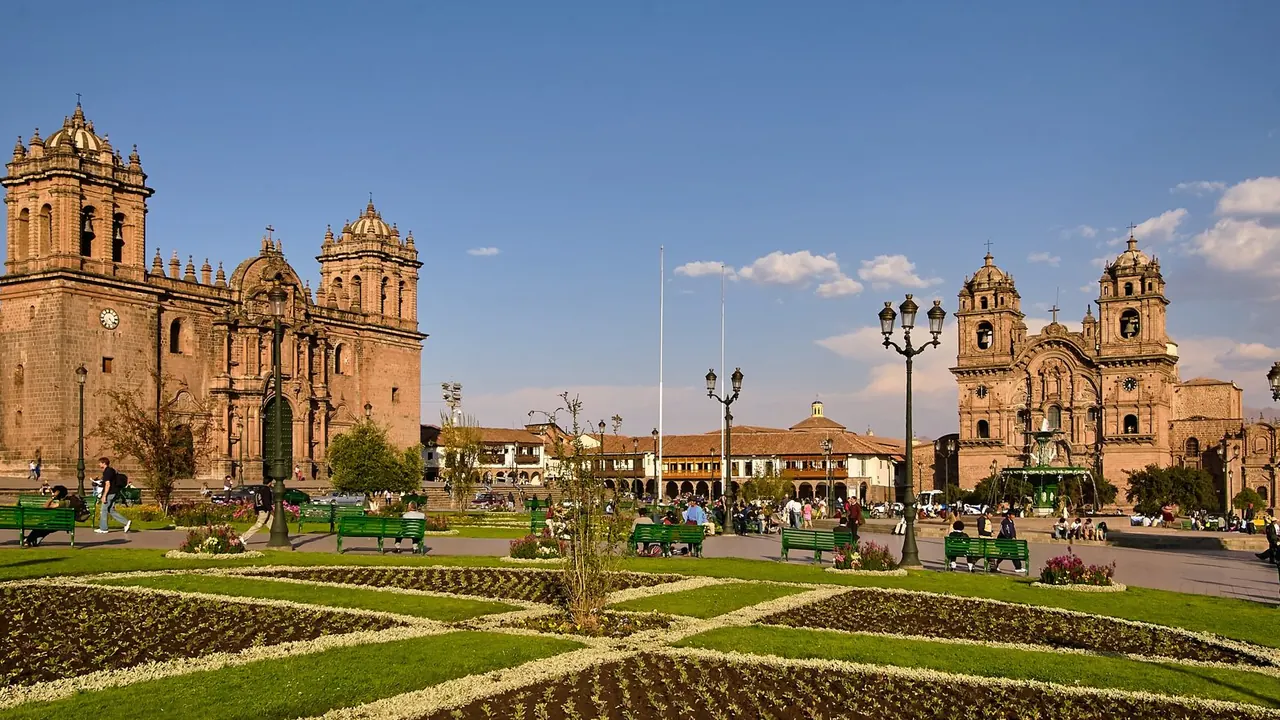
Photos: Cusco by Pedro Szekely, CC BY-SA 2.0, cropped.
Cusco or La Paz?
Our verdict in twelve categories, each scored against the same fixed benchmark cities, and the climate month by month, so you can choose for your trip.
Choose Cusco for
- day trips
- culture and sights
- wellness
Cusco is the stronger pick for anyone who wants the Inca world in depth. The old capital still stands in its street walls and temple foundations, and the Sacred Valley's citadels and terraces are an easy drive away, with Machu Picchu at the end of the line. It also has the gentler side the other city lacks: riverside lodges down in the valley for a few quiet days. Expect to pay more, mostly for the Machu Picchu trip.
Choose La Paz for
- prices
- live music and the arts
La Paz suits a traveller on a tight budget who likes a city that is busy with its own life rather than tidied up for visitors. You get cable cars over a canyon, the Witches' Market, cholitas in bowler hats and the Aymara buildings of El Alto. It also suits climbers and thrill-seekers, with Huayna Potosí and the Death Road on the doorstep. There are fewer sights and day trips, and the days are colder.
Scoreboard
Twelve categories on one fixed scale from 0 to 100. The shaded stretch is the gap between the two.
Your match
Pick a travel style or drag the sliders, and both match scores follow your weighting.
Wins on day trips and culture and sights with your weighting.
Wins on prices and live music and the arts with your weighting.
What matters to you?
Category by category
What the scores mean for a trip.
Beaches & swimming
Neither city has any swimming to offer, and a beach means a separate leg on the Pacific coast either way. The difference is the water you can look at. Around Cusco there are only glacial lagoons in the hills, while La Paz has Lake Titicaca two hours away, which is cold but good for boat trips and views.
Food & drink
Cusco has a little more range at the top end. Novoandino tasting menus around the Plaza de Armas and in San Blas, along with a few serious tables in the Sacred Valley, make native ingredients the focus of a special meal. The San Pedro market and the local picanterías cover the hearty everyday side. Avoid the tourist menus nearest the square.
La Paz eats more on the street and to a daily rhythm: salteñas mid-morning, anticuchos on the corners after dark, set lunches at the long tables of Mercado Rodríguez and Mercado Lanza. Its ambitious kitchens are fewer, mostly in Sopocachi, but Tarija wine and singani give it something to drink that Cusco lacks.
Culture & sights
Here Cusco is far ahead. It is a whole Inca city with a Spanish one built on top: Hatun Rumiyoc's mortarless walls, the Santo Domingo monastery rising from Qorikancha, a cathedral full of Cusco School paintings, and the zigzag ramparts of Sacsayhuamán above town.
La Paz has a smaller colonial core, with the mestizo baroque front of San Francisco, Calle Jaén and a good ethnography museum. Its real pull is the living city: ritual offerings in the Witches' Market, the cholet mansions of El Alto and the view from the cable cars with Illimani behind.
Nightlife
Neither is a big night out, and in both the altitude and early tour departures cut evenings short. What differs is who you drink with. Cusco's bars and clubs are packed into the streets off the Plaza de Armas and are run largely for backpackers, with hostel pub crawls and late weekend hours.
La Paz is more local. Students and young professionals fill the small bars and late cafés of Sopocachi, and the bigger clubs are out in the southern zone, so you will need taxis between areas after dark.
Nature & outdoors
Both are superb mountain bases, but for different things. Cusco is trekking country: the Inca Trail, Salkantay and Ausangate for several days on foot, Humantay lake and Rainbow Mountain for a hard day, and rafting on the Urubamba and Apurímac.
La Paz leans to climbing and adrenaline. Huayna Potosí is a six-thousand-metre summit within reach of a novice with a guide, and the Death Road ride drops from snow to cloud forest in a day. The canyon setting under Illimani means the scenery starts on the city streets.
Day trips
Cusco has far more within a day's reach. The Sacred Valley, about an hour away, packs in Pisac's citadel, the lived-in Inca grid of Ollantaytambo, Chinchero's weavers, and Moray with the Maras salt pans. Tipón and Andahuaylillas make a quieter day to the south-east. Machu Picchu is possible in one long day, though many stay overnight.
From La Paz the one essential outing is Tiwanaku, the great pre-Inca site across the Altiplano. Lake Titicaca, Isla del Sol, Coroico and Sorata are all worth going to, but they work better as overnight trips than as day trips.
Good for families
Both are tough with small children, mainly because of altitude sickness, steep streets and narrow pavements. Cusco has the easier way out: families can base themselves in the lower Sacred Valley, where there are llamas and alpacas to win children over. La Paz has fiercer traffic and an airport at about 4,000m, but its cable cars and the zoo at Mallasa give younger travellers a couple of real treats.
Getting around
Getting around is a similar effort in both, with steep climbs and cheap taxis, but the systems differ. Cusco's centre is compact enough to walk end to end, and trips out depend on minibuses, tours, drivers and the Machu Picchu train. La Paz spreads across a canyon, and its Mi Teleférico cable cars are the easy way to cover it, gliding over the daily traffic jams that the minibuses get stuck in.
Shopping & style
Cusco is the better place to buy something fine. The cooperatives in Chinchero sell textiles coloured with natural dyes, and the San Blas workshops make ceramics, carved saints and silver, though much of the stock around the main square is the same factory knitwear.
La Paz is more of a rummage. You get the stalls of Sagárnaga and Linares, musical instruments and Witches' Market charms, and the vast 16 de Julio fair in El Alto selling everything from car parts to antiques. Quality varies widely, so look closely.
Affordability
La Paz is clearly the cheaper trip. Hotels in the centre or Sopocachi, market meals, cable cars and Tiwanaku all cost little, and the main expenses are optional ones, such as a guided climb or the Death Road ride.
Cusco is also cheap from day to day, but it has costs that are hard to avoid. The Machu Picchu train and entry, guided Inca Trail permits, and the boutique hotels in colonial mansions take a big share of any budget.
Live music & performing arts
Both rely mainly on Andean folk music and dance, and both have the most to offer at festival time. Cusco's shows and dinner bands are mostly staged for visitors, but Inti Raymi at Sacsayhuamán and the masked dancers of Qoyllur Rit'i are remarkable. La Paz has peñas that also draw a local crowd, a modest programme at the Teatro Municipal and from the National Symphony Orchestra, and the huge Gran Poder parade of dancers and brass bands.
Wellness & relaxation
Cusco is the easier place to recover, mainly because you can get away from the altitude. The Sacred Valley lies well below the city, so spending the first nights there helps both sleep and acclimatisation. The hot springs at Aguas Calientes fit naturally into a Machu Picchu trip, and Lares is further out for a soak on its own. The city itself is less restful, with cold nights and pre-dawn tour departures setting the pace.
La Paz has no such escape close at hand. It sits higher, sleep is often broken for the first few nights, and its nearest thermal pools, the Urmiri hot springs, are about two hours away by road. The calmest places to stay are the lower southern suburbs, a little below the city centre and away from the steep streets of the old town.
When should you go?
Pick your month. The climate figures are measured averages, not a forecast.
Cusco in July
La Paz in July
Daytime high, °C
Rainfall in the month, mm
Where the figures come from
Cusco's station stands 151 m below the city centre, so the centre is likely a little cooler than the figures say.
La Paz has no weather station within reach, so its figures come from a gridded climate model rather than a measured record, and read a broad area rather than the city itself.
Temperature and rainfall are climate normals, averaged over the years shown. Cusco: 1991-2020 normals, Cuzco (3.7 km from centre). La Paz: 2001-2020 normals, NASA POWER reanalysis grid, no weather station within 90 km.
Both cities follow the same Andean pattern: a dry season from May to September with almost no rain, and a wet season that builds from October and peaks in January, when Cusco gets about 159mm and La Paz 136mm. For trekking, ruins and long days outdoors, aim for the dry months in either city. October and April are good in-between months, and the wet season brings cloud, muddy trails and afternoon downpours.
What separates them is warmth. Cusco reaches around 20°C most days all year, which is pleasant for walking in the sun. La Paz rarely gets much above 14°C, so even a dry, clear day in July needs layers. Neither city is ever too hot for sightseeing, but La Paz is the one where you will feel the chill all day.
Which traveller are you?
On a culture and arts trip, Cusco is the clear choice. The Inca capital survives in its fitted-stone streets, in Qorikancha and in Sacsayhuamán, and the Sacred Valley sites add days of further exploring that La Paz cannot match.
For a trip on a tight budget, La Paz goes further. Comfortable hotels in Sopocachi, market lunches and cable-car rides all cost very little, and there is no unavoidable big excursion like Cusco's Machu Picchu train eating into the money.
For a relaxing and wellness trip, Cusco is the better of two weak options. Cheap massage, hotel spas and the riverside lodges of the Sacred Valley give real rest, while La Paz offers mostly noise, fumes and coca tea.
Before you go
| Measure | Cusco | La Paz |
|---|---|---|
| Official language | Spanish, Aymara, Quechua | Spanish, Aymara, Quechua, Guarani |
| Currency | Sol (PEN) | Boliviano (BOB) |
| Sockets | ABC220 V, 60 Hz | AC50 Hz |
| Driving side | Right | Right |
| Time zone | UTC-5 | UTC-4 |
| Emergency number | 111 or 911 | 911 |
| Elevation | 3,399 m | 3,640 m |
| Main airport | Alejandro Velasco Astete International Airport (CUZ)5 km from centre6 non-stop destinations | El Alto International Airport (LPB)6 km from centre12 non-stop destinations |
| Public holidays this year | 16 days | 12 days |
By the numbers
| Measure | Cusco | La Paz |
|---|---|---|
| City population | 428,450 | 755,732 |
| People per km² | - | 1,601 |
| Museums within 10 km | 11 | 21 |
| UNESCO World Heritage sites within 50 km | 2 | 1 |
Where else could you go?
Every comparison below shares a destination with this one, so you can follow Cusco or La Paz somewhere new.