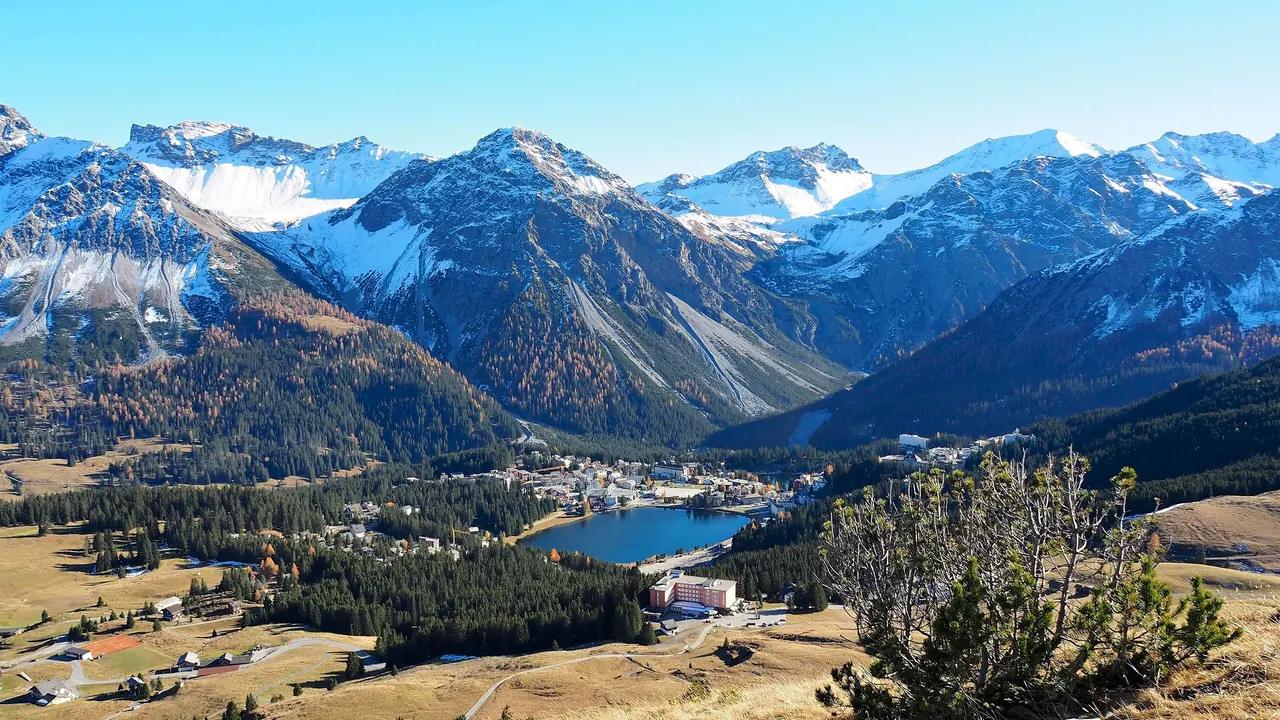
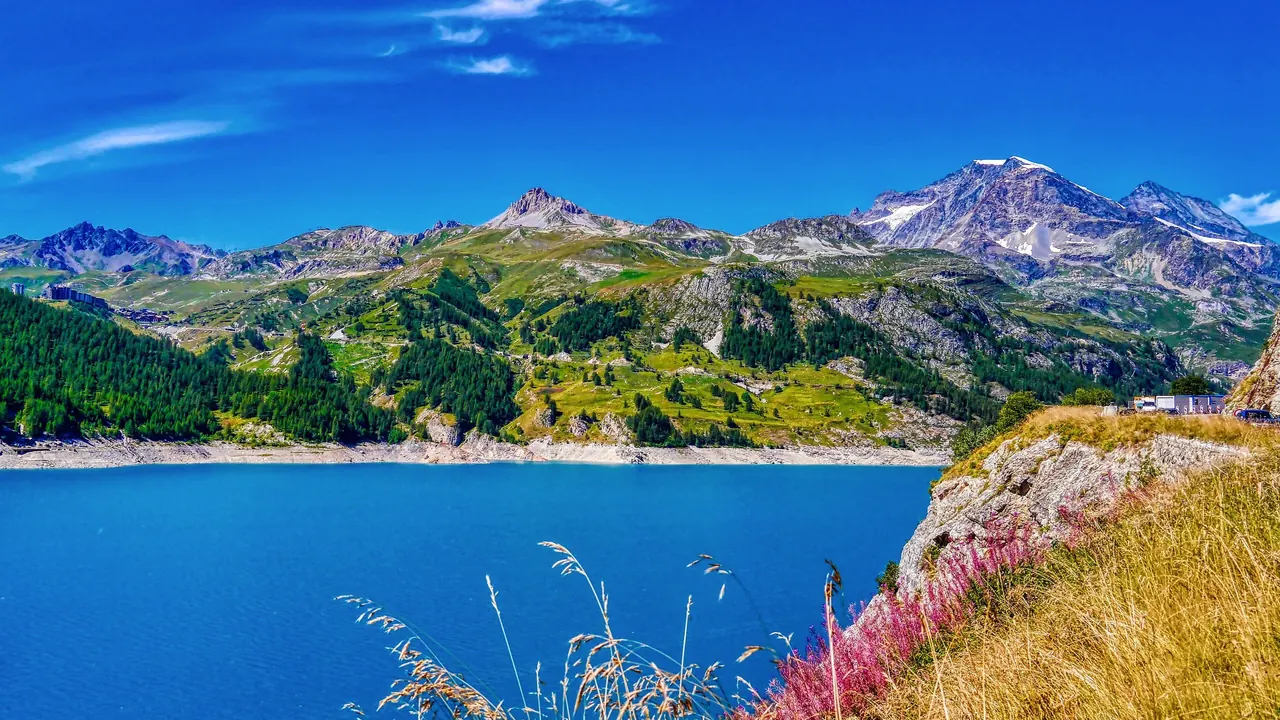
Photos: Arosa by Andres Passwirth, CC BY-SA 4.0, cropped; Tignes by Zairon, CC BY-SA 4.0, cropped.
Arosa or Tignes?
Our verdict in twelve categories, each scored against the same fixed benchmark cities, and the climate month by month, so you can choose for your trip.
Choose Arosa for
- getting around
- live music and the arts
- wellness
Arosa suits travellers who want a mountain stay that is calm as well as active. No car is needed: the scenic railway climbs up from Chur and free buses do the rest. You also get hotel spas facing the peaks, an old chapel on its meadow, summer chamber concerts, and Chur close enough for a change of scene. Families and couples will find it the gentler choice, though they will pay more for it.
Choose Tignes for
- nightlife
- prices
- nature and the outdoors
Tignes is for people who come above all for the terrain. The altitude, the Grande Motte glacier and the link with Val d'Isère give it a longer, higher season and bigger skiing. The Vanoise National Park lies on the doorstep, and après-ski runs loud into the night. Expect functional apartment blocks rather than charm, and a valley that keeps you up in the mountains.
Scoreboard
Twelve categories on one fixed scale from 0 to 100. The shaded stretch is the gap between the two.
Your match
Pick a travel style or drag the sliders, and both match scores follow your weighting.
Wins on getting around and live music and the arts with your weighting.
Wins on nightlife and prices with your weighting.
What matters to you?
Category by category
What the scores mean for a trip.
Beaches & swimming
Arosa's lakes give a swimmer a little more to work with. The Untersee has a lido with a lawn and a jetty, and the Obersee and Schwellisee higher up draw hardy swimmers. On a warm afternoon in July or August the water can reach about 20°C, enough for a proper dip after a hike.
Tignes has one lake, high above the tree line, with a small sandy shore and a supervised area in high summer. Snowmelt keeps it near 16°C, so most swimming there happens in the indoor lagoon pool with slides, which is open in any season.
Food & drink
The two eat in much the same way: Alpine comfort food in hotel dining rooms and slope-side huts, a narrow choice, and many places shut between seasons. The difference is regional. Arosa serves Graubünden dishes such as capuns, barley soup and air-dried meat, and its luxury hotels add a small fine-dining tier.
Tignes is Savoie cheese country, with tartiflette and croziflette made from Beaufort and Reblochon, alongside the pizzerias and crêperies you would expect in a large resort. Its delicatessens sell local charcuterie and Savoie wines, which helps anyone cooking in an apartment.
Culture & sights
Arosa's few sights are old ones. The late medieval Bergkirchli stands alone on a meadow above Innerarosa, and the Schanfigg museum and a handful of grand hotels recall the years when the village treated tuberculosis patients in its thin, dry air.
Tignes has no old buildings worth the name, since the resort was built from scratch after the Chevril dam flooded the original village in 1952. Its heritage is that story, remembered in the giant mural on the dam wall, plus a few small chapels in Les Brévières and Les Boisses. In both places an afternoon covers everything.
Nightlife
Tignes is far livelier after dark. In the ski season, après-ski starts on the mountain terraces and moves down to the bars of Val Claret and Tignes Le Lac. A young crowd of skiers and seasonal workers dances in ski boots until the small clubs close well after midnight.
Arosa's evenings are smarter and quieter, with a few hotel bars and a couple of small clubs, and its liveliest nights come during the January gay ski week. Both resorts go quiet in summer, so the difference really only matters in winter.
Nature & outdoors
Tignes goes higher and bigger. The Grande Motte glacier rises to nearly 3,500m above the lake, so the skiing starts in autumn and lingers into early summer, and the link with Val d'Isère makes one of the largest ski areas in the Alps. In summer the Vanoise National Park, France's oldest, brings ibex along the trails.
Arosa's basin of larches and lakes below the Weisshorn is greener and gentler. Its lifts connect to Lenzerheide in winter, and in summer high routes cross the passes toward Davos. The bear sanctuary and easy lake circuits make it the softer choice for walkers.
Day trips
Arosa is better for outings, mainly because of its railway. The hour-long ride down to Chur over the Schanfigg viaducts is a pleasure in itself and ends in a historic old town with a Romanesque cathedral. From Chur, trains go on to Maienfeld and Liechtenstein, and on a longer day along the Albula line.
From Tignes, the long valley road makes most outings a car journey. Val d'Isère is a short bus ride away. Conflans, Beaufort and, in summer over the Little St Bernard Pass, Aosta all take far more effort.
Good for families
Both suit a family ski trip, and Tignes has the convenience of ski-in, ski-out apartments with beginner areas right beside the villages. Arosa still works better overall. It sits lower, which is easier on small children, and in summer the lakes, farm restaurants, cable car viewpoints and bear sanctuary give families more to do. Free buses and light traffic help too.
In Tignes, the altitude and cold can tire young children, and apart from the snow, the lake and the aquatic centre there is little aimed at them. Its lagoon pool with slides is a better rainy-day fallback than Arosa's indoor pool and ice rink, though.
Getting around
Arosa is easier to reach and to leave. The Rhaetian Railway runs from Chur right into the village, so the whole trip works without a car. Free buses connect the station, the lake and the lifts, although the hillside layout means slopes and stairs when you walk.
Within Tignes, shuttles and lifts link the villages, and many people ski from their door. The difficult part is getting there: the nearest station is at Bourg-Saint-Maurice, about forty minutes below up a winding road, and leaving the valley needs a car or a transfer.
Shopping & style
Neither is a place to shop, and in both the streets are lined with ski hire and outdoor gear shops. Arosa adds a few fashion boutiques for its hotel guests, and Chur, an hour away, has a real range. Tignes is better for edible souvenirs, with Beaufort, cured sausages and mountain honey from its delicatessens.
Affordability
Arosa is the dearer of the two in every season. Its hotels lean upscale, and meals, lift passes and ski rental all carry Swiss mountain prices. Summer is noticeably cheaper than the ski season, and the free village buses and the perks of the summer guest card help a little, but even then a stay costs more than in Tignes.
Tignes is no bargain in winter either. Lessons, equipment hire and long slope-side lunches add up, and the school vacation weeks are the most expensive of the year. The saving comes from how the resort is built: supermarkets in every village make it easy to cook for yourself, so you rely less on restaurants, which charge resort rates whatever the season.
Live music & performing arts
Arosa has a small but real calendar. A long-established comedy festival brings stand-up and cabaret to the village in December, partly outdoors in the snow, and in summer chamber concerts fill its churches, the Bergkirchli included.
Tignes has only bands in the après-ski bars, DJs on the mountain terraces and the occasional free outdoor concert during resort events.
Wellness & relaxation
Arosa is the more restful of the two. Its past as a high-altitude cure resort still shows in its slow pace, and the larger hotels have extensive spas with pools and saunas facing the peaks. Neither village has thermal springs of its own.
Tignes has a hammam and massage at the aquatic centre, plus hotel spas, but in winter the rhythm is early lifts and late bars. For real thermal waters you have to go an hour down the valley to Brides-les-Bains.
When should you go?
Pick your month. The climate figures are measured averages, not a forecast.
Arosa in July
Tignes in July
Daytime high, °C
Rainfall in the month, mm
Where the figures come from
Arosa's temperatures are measured 31 km from the centre, at Samedan.
Arosa has no rain gauge within 25 km of the centre, so its rainfall comes from a gridded climate dataset read at the destination rather than from a gauge further away.
Tignes has no weather station within reach, so its figures come from a gridded climate model rather than a measured record, and read a broad area rather than one spot.
Temperature and rainfall are climate normals, averaged over the years shown. Arosa: 2015-2025 (rainfall 1991-2020) normals, Samedan (31.2 km from centre). Tignes: 2001-2020 normals, NASA POWER reanalysis grid, no weather station within 90 km.
Both are high mountain resorts with a short summer and a long winter, but Tignes sits higher and stays colder. Arosa's warmest months, July and August, reach about 20°C, which is pleasant for hiking and a brief lake swim. Tignes peaks at around 18°C. Its daytime highs stay below freezing from December to February and fall to about -4°C in January, which keeps the snow in good condition. Arosa's winter days hover nearer freezing, which suits walkers and sledgers as much as skiers.
The rain falls differently in the two. Arosa is wettest in summer, peaking at 159mm in August, so showers are part of most July and August hikes. Its driest stretch is late winter. Tignes is drier and steadier all year, with summer months nearer 79mm, and September there is mild and fairly dry. In Arosa the rain only starts to ease from October.
Which traveller are you?
For a food and nightlife trip, Tignes is the livelier choice. Both serve cheese-heavy Alpine food of much the same standard, but after dark the bars and small clubs of Val Claret and Tignes Le Lac keep après-ski going well past midnight, while Arosa goes to bed early.
On a relaxing and wellness trip, Arosa is the better fit. It grew up as a health resort, its larger hotels have extensive spas looking out on the peaks, and outside the busiest ski weeks the village is quiet. Tignes runs to early lifts and late bars.
On a tight budget, Tignes is the easier of two costly resorts. Self-catering apartments make up much of it, early and late season weeks cost noticeably less, and summer brings cheap activities around the lake. Arosa stays very expensive at every time of year.
Before you go
| Measure | Arosa | Tignes |
|---|---|---|
| Official language | French, German, Italian, Romansh | French |
| Currency | Swiss Franc (CHF) | Euro (EUR) |
| Sockets | CJ230 V, 50 Hz | CE230 V, 50 Hz |
| Driving side | Right | Right |
| Time zone | UTC+1, UTC+2 in summer | UTC+1, UTC+2 in summer |
| Emergency number | 112 | 112 |
| Elevation | 1,775 m | 1,440 m |
| Main airport | Zürich Airport (ZRH)114 km from centre226 non-stop destinations | Geneva International Airport (GVA)105 km from centre150 non-stop destinations |
| Public holidays this year | 9 days | 11 days |
By the numbers
| Measure | Arosa | Tignes |
|---|---|---|
| Population | 3,185 | 1,919 |
| People per km² | 21 | 24 |
| Museums within 10 km | 1 | 0 |
| UNESCO World Heritage sites within 50 km | 2 | 0 |
Where else could you go?
Every comparison below shares a destination with this one, so you can follow Arosa or Tignes somewhere new.
- Val d'Isèrevs Tignes
- Lenzerheidevs Arosa
- Davosvs Arosa
- Les Arcsvs Tignes
- La Rosièrevs Tignes
- Klostersvs Arosa