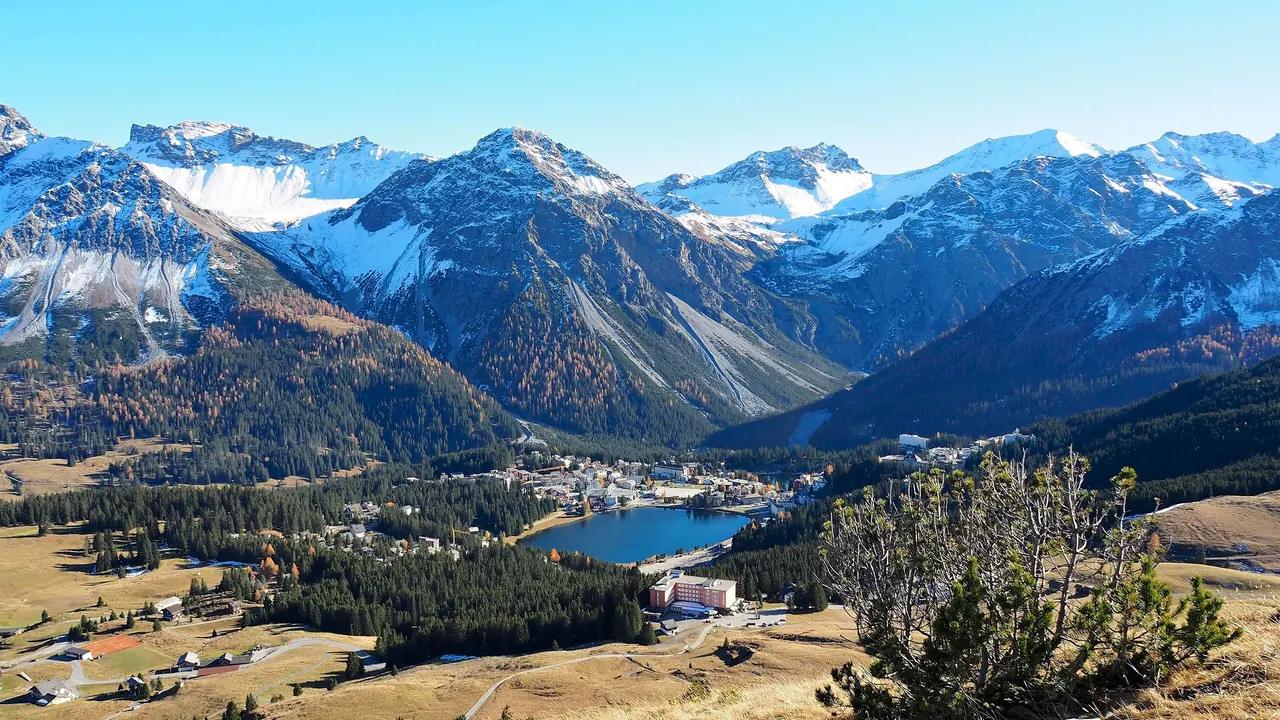
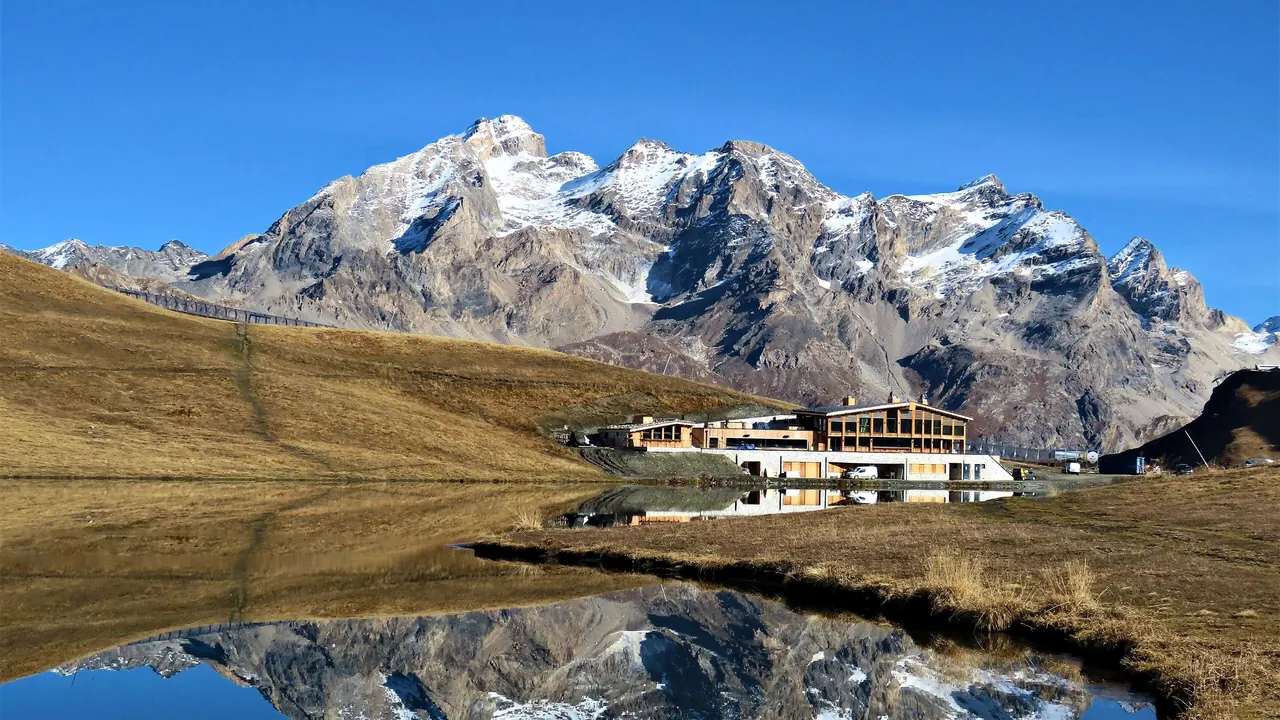
Photos: Arosa by Andres Passwirth, CC BY-SA 4.0, cropped; Val d'Isère by Rémih, CC BY-SA 4.0, cropped.
Arosa or Val d'Isère?
Our verdict in twelve categories, each scored against the same fixed benchmark cities, and the climate month by month, so you can choose for your trip.
Choose Arosa for
- day trips
- live music and the arts
- beaches
Arosa is the gentler, quieter choice. It suits families, couples and anyone who wants mountain air without a party: the train runs right up to the village, the ski area is friendly, the hotel spas are good, and summer brings lakes, easy trails and the bear sanctuary. It also has more to do off the mountain, with Chur's old town an hour down the line and a short calendar of comedy and chamber music.
Choose Val d'Isère for
- nightlife
- food and drink
- shopping
Val d'Isère is for people who come for the skiing first and the evenings second. The terrain shared with Tignes is higher and steeper, with glaciers at the top and serious off-piste, and the après-ski starts on the slopes and ends in basement clubs. The Savoyard food is also better. You pay for that with a long road up from the railway and very little to do away from the snow.
Scoreboard
Twelve categories on one fixed scale from 0 to 100. The shaded stretch is the gap between the two.
Your match
Pick a travel style or drag the sliders, and both match scores follow your weighting.
Wins on day trips and live music and the arts with your weighting.
Wins on nightlife and food and drink with your weighting.
What matters to you?
Category by category
What the scores mean for a trip.
Beaches & swimming
Neither village is a swimming destination, but Arosa makes a summer dip much easier. Its lakes are part of the resort itself: the Untersee lido is a short walk or bus ride from most hotels, and in July and August the water gets a few degrees warmer than anything Val d'Isère offers, reaching around 20°C on a good day.
In Val d'Isère, swimming outdoors means going over the ridge to Lac de Tignes or up to a snowmelt lake that stays near 15°C, and most people try that only once. The indoor pool is the realistic choice there. In Arosa you can spend a whole afternoon on the lakeside lawn after a walk.
Food & drink
Val d'Isère eats better. Its Savoyard repertoire of tartiflette, croziflette and fondue is built around Beaufort cheese, Savoie white wines are poured in the village wine bars, and a few of its evening kitchens are among the most celebrated in the French Alps.
Arosa's best meals are lunches at the mountain huts: capuns, barley soup and Graubünden dried meat with a view down the valley. In the evening the choice narrows to hotel dining rooms and fondue. In both villages most places close between seasons.
Culture & sights
Both villages have about an afternoon's worth of sights, but the history is different. Arosa's story is its past as a health resort: the Schanfigg museum covers the tuberculosis sanatorium era and the grand hotels that remain from it, and the shingled Bergkirchli stands alone on its meadow.
Val d'Isère offers a Baroque altarpiece in Saint-Bernard-de-Menthon, the stone and larch-wood hamlets of Le Fornet and Le Joseray, and the Bellevarde face, where the 1992 Olympic downhill was raced. That last one mainly matters to skiers.
Nightlife
Val d'Isère is far livelier. Après-ski begins mid-afternoon at the party restaurants on the slopes, moves down to packed village bars and ends in basement clubs in the early hours, with a crowd of seasonal workers and groups of British and Scandinavian skiers.
Arosa's evenings are smarter and calmer: slope-side bars, hotel bars and a couple of small clubs at weekends. The exception is the January gay ski week. Outside winter, both villages go quiet.
Nature & outdoors
Both are first-rate mountain bases, but Val d'Isère is on a bigger scale. With Tignes it offers peaks above 3,000m, glacier skiing on the Pissaillas and the Grande Motte, steep runs such as the Face de Bellevarde, and serious off-piste and touring. In summer the Vanoise National Park, with its ibex and chamois, and the climb to the Col de l'Iseran are right on the doorstep.
Arosa's basin of larches and lakes under the Weisshorn is gentler and more varied. The link across to Lenzerheide gives plenty of mixed skiing, along with cross-country trails and winter walking paths. Summer hikes range from easy lake circuits to routes over the passes to Davos.
Day trips
Arosa is easier to get out of. The scenic train down the Schanfigg gorges reaches Chur in an hour, where you find a cathedral, the Bündner art museum and an old centre to walk around. Onward lines run to the Maienfeld vineyards, to Liechtenstein, and on longer days to St. Moritz.
In winter, Val d'Isère's only way out is down the valley to Bourg-Saint-Maurice. Summer adds Bonneval-sur-Arc over the Iseran and Aosta across the Italian border, but you will need a car for both.
Good for families
Arosa suits a wider range of families. Summer is as good as winter there, with lakes, playgrounds, farm-restaurant walks and the bear sanctuary, and it does not depend on everyone in the family wanting to ski.
Val d'Isère is excellent for children who ski, with multilingual ski schools from preschool age, fenced snow gardens and childcare at many chalets. Off the slopes there is little beyond sledging and the ice rink, and the cold at this altitude is hard on toddlers.
Getting around
Getting to Arosa is simpler: the Rhaetian Railway runs right up to the village. Inside it, the free buses help with the steep slopes and stairs between Ausserarosa and Innerarosa.
Val d'Isère is easy once you are there, with shuttles along the valley from La Daille to Le Fornet and lifts starting at several points. Arriving takes an hour's bus or taxi ride up from Bourg-Saint-Maurice, and on winter changeover Saturdays the road can be slow.
Shopping & style
Both main streets mostly sell ski gear. Val d'Isère has slightly more to browse, with boot-fitting specialists and upmarket mountain-wear shops, and its delicatessens sell Beaufort, charcuterie and Savoie wine to take home. Arosa adds Swiss chocolate to its outdoor shops, and Chur's old town is close enough for proper shopping.
Affordability
Both are among the most expensive places in the Alps, and in both the main way to save is a self-catered apartment and a trip outside the ski season. The details differ. Arosa's summer guest card perks and free village buses take a little off the bill. In Val d'Isère, the January weeks and late season are the quieter, cheaper times to ski, which matters because lessons and equipment hire add up there.
Live music & performing arts
Arosa has a small but real calendar of performances. A long-running December comedy festival puts stand-up and cabaret on stages around the village, some of them outdoors in the snow, and summer chamber concerts fill its churches, including the Bergkirchli.
Val d'Isère has nothing like that. Live music there means cover bands and DJs at après-ski and the occasional open-air event.
Wellness & relaxation
Arosa is the more restful place. It was founded on the healing reputation of its dry mountain air, it still keeps early hours, and some of its hotel spas are extensive. Neither village has thermal springs.
In Val d'Isère, an end-of-day sauna or hammam is part of a busy ski routine. Non-residents can use the public spa at the sports centre, but you will only find real calm here in early summer or September.
When should you go?
Pick your month. The climate figures are measured averages, not a forecast.
Arosa in July
Val d'Isère in July
Daytime high, °C
Rainfall in the month, mm
Where the figures come from
Arosa's temperatures are measured 31 km from the centre, at Samedan.
Arosa has no rain gauge within 25 km of the centre, so its rainfall comes from a gridded climate dataset read at the destination rather than from a gauge further away.
Val d'Isère has no weather station within reach, so its figures come from a gridded climate model rather than a measured record, and read a broad area rather than one spot.
Temperature and rainfall are climate normals, averaged over the years shown. Arosa: 2015-2025 (rainfall 1991-2020) normals, Samedan (31.2 km from centre). Val d'Isère: 2001-2020 normals, NASA POWER reanalysis grid, no weather station within 90 km.
Both villages sit at nearly the same altitude, so the pattern is similar: snow from December into spring, and a short green summer in July and August. Val d'Isère is the colder of the two. Its daytime highs stay below freezing from December to February, and glaciers keep its skiing going into early May. Arosa is a few degrees milder in midwinter, which makes village walks and sun terraces more pleasant.
Summer is when they differ most. Arosa reaches about 20°C in July, warm enough for a quick dip in the Untersee, but June to August is also its wettest stretch, with around 150mm a month. Val d'Isère peaks at 18°C with roughly half that rain, so it is the more reliable choice for long hikes and for cycling over the high passes. In both villages, May and October to November fall between seasons, when it is cool and damp and most places are shut.
Which traveller are you?
On a family trip with children, Arosa is the easier choice. You arrive by train and free buses do the rest, and there are sledging runs, lakeside playgrounds and the bear sanctuary. Cable cars carry small legs to the viewpoints, and the indoor pool fills a rainy day.
For a food and nightlife trip, Val d'Isère is clearly better. Après-ski starts with dancing on tables at the slope-side restaurants and carries on into the village bars and late clubs. Dinner can mean Beaufort-rich Savoyard cooking or one of the most celebrated kitchens in the French Alps.
On a relaxing and wellness trip, Arosa fits the mood. The village grew up as a health resort, it keeps early hours, and its larger hotels have extensive spas looking out over the peaks. Val d'Isère's winter weeks are lively, with early lifts and late nights.
Before you go
| Measure | Arosa | Val d'Isère |
|---|---|---|
| Official language | French, German, Italian, Romansh | French |
| Currency | Swiss Franc (CHF) | Euro (EUR) |
| Sockets | CJ230 V, 50 Hz | CE230 V, 50 Hz |
| Driving side | Right | Right |
| Time zone | UTC+1, UTC+2 in summer | UTC+1, UTC+2 in summer |
| Emergency number | 112 | 112 |
| Elevation | 1,775 m | 1,785 m |
| Main airport | Zürich Airport (ZRH)114 km from centre226 non-stop destinations | Geneva International Airport (GVA)111 km from centre150 non-stop destinations |
| Public holidays this year | 9 days | 11 days |
By the numbers
| Measure | Arosa | Val d'Isère |
|---|---|---|
| Population | 3,185 | 1,567 |
| People per km² | 21 | 17 |
| Museums within 10 km | 1 | 0 |
| UNESCO World Heritage sites within 50 km | 2 | 0 |
Where else could you go?
Every comparison below shares a destination with this one, so you can follow Arosa or Val d'Isère somewhere new.
- Tignesvs Val d'Isère
- Lenzerheidevs Arosa
- Davosvs Arosa
- Klostersvs Arosa
- Les Arcsvs Val d'Isère
- Val Cenisvs Val d'Isère