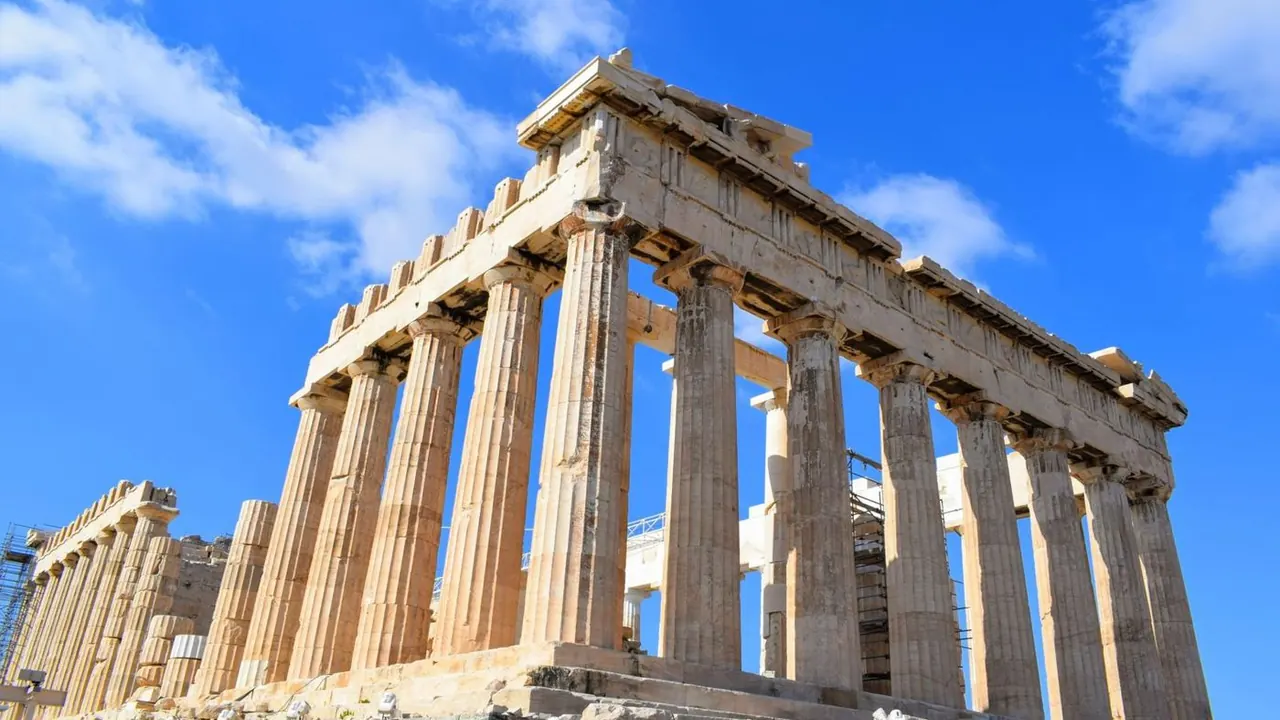
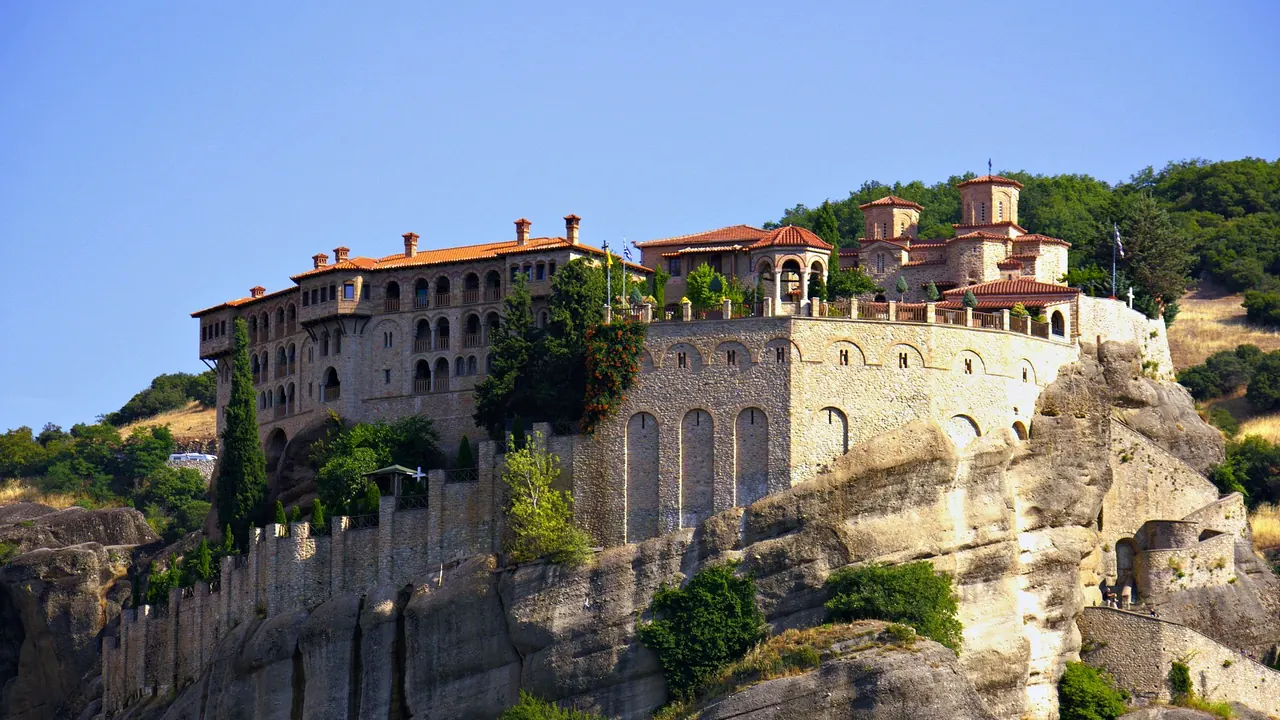
Photos: Athens by Ranjeet Kumar Singh, Pexels License; Kalambaka by José Barbosa, Pexels License.
Athens or Kalambaka?
Our verdict in twelve categories, each scored against the same fixed benchmark cities, and the climate month by month, so you can choose for your trip.
Choose Athens for
- nightlife
- beaches
- live music and the arts
Athens suits a traveller who wants a full city around their sightseeing. The Acropolis and the great museums are the main draw, and late tavernas, rooftop bars, summer performances in ancient theatres and the Riviera beaches fill the rest of the trip. It also works as a base for Delphi, Mycenae and the Saronic islands, so a week here never runs short of things to do.
Choose Kalambaka for
- nature and the outdoors
- prices
Kalambaka is for someone who would rather spend the days walking among the rock pillars of Meteora and visiting monasteries on their summits than in museums and bars. The landscape is the reason to come, along with quiet evenings and lower costs. The town has little else, though, and most people give it two or three nights as an inland stop on a longer tour of Greece.
Scoreboard
Twelve categories on one fixed scale from 0 to 100. The shaded stretch is the gap between the two.
Your match
Pick a travel style or drag the sliders, and both match scores follow your weighting.
Wins on nightlife and beaches with your weighting.
Wins on nature and the outdoors and prices with your weighting.
What matters to you?
Category by category
What the scores mean for a trip.
Beaches & swimming
Athens has a real coastline. The tram and buses reach the Riviera from Faliro down to Vouliagmeni and Varkiza, and the water gets clearer the farther south you go. Aegina and Agistri are close by when you want calmer water. It is still a beach to add to a city stay, not one to plan a trip around.
Kalambaka has no beach at all. The sea is more than two hours' drive away, so swimming means a hotel pool or a cold dip in a Pindos river.
Food & drink
Athens gives you range: meze and grilled octopus in Koukaki or Exarchia, bougatsa at breakfast, the Varvakios market, wines from assyrtiko to xinomavro and a serious fine-dining scene when you want it. You could eat somewhere different every night of a week.
Kalambaka offers one honest style of cooking, the hearty grills, bean soups, pies and tsipouro of central Greece. Menus barely change from one taverna to the next. A table in Kastraki with the rocks turning pink at sunset is the real attraction, and Trikala is the place to go for more variety.
Culture & sights
Both are built around monuments on rock, but on a different scale. Athens has the Acropolis plus the Agora, Kerameikos and Olympian Zeus along one walkable promenade, and museums such as the National Archaeological and the Acropolis Museum that can fill several days by themselves.
Kalambaka has one great sight, the Meteora monasteries. Varlaam, Roussanou and Agios Stefanos hold frescoed churches and icon collections in an unforgettable setting, but with the church of the Dormition in town added, two days covers it. Bring modest dress, including skirts for women.
Nightlife
Few pairs could differ more after dark. In Athens, dinner starts after nine and bars fill at midnight across Psyrri, Gazi and Kolonaki. In summer the clubs move to the coast, and bouzouki clubs still keep people dancing until morning.
Kalambaka closes early. A drink outside a café-bar on the square is the whole evening, and anyone wanting more has to drive half an hour to Trikala's student bar street.
Nature & outdoors
Here Kalambaka comes out ahead. The Meteora pillars, some about 400m high, rise from the back streets, so you can walk from your room up through oak woods to the clifftops. Climbers come for the long bolted routes, and to the west are the fir forests of the Pindos, rafting on the Aspropotamos and the Katara Pass.
Athens has good outdoor options but they take more effort to reach. Lycabettus and Filopappou give city views, Parnitha has proper hiking an hour away, and the Saronic Gulf is good for sailing and paddleboarding. Its bare hills are brown and baking by midsummer.
Day trips
From Athens the classical world is within a day's reach: Sounion at sunset, Delphi, Mycenae and Epidaurus with Nafplio, and boats to car-free Hydra. Few cities have a list like it.
Kalambaka's outings are quieter and more rural. Trikala's Varousi quarter is close, and Metsovo's stone streets and smoked cheeses, Ioannina's lake island and the edge of Zagori are within a drive. You need a car for almost all of them, because buses are sparse.
Good for families
Neither is an easy pick with small children, but Athens has more to fill the days. There are calm Riviera beaches, the zoo, the planetarium, Hellenic Cosmos and the park at the Stavros Niarchos centre, though pushchairs struggle on the broken pavements.
Kalambaka is safe and small, and older children may love the trails or a beginners' climb. Younger ones tend to tire of the monastery steps and the hush inside, so families usually keep it to a night or two.
Getting around
Athens has the metro from the airport and Piraeus, the tram to the coast and plenty of taxis, and its historic core can be walked, despite the hills and cluttered pavements. You only need a car for sites outside the city.
Kalambaka is the opposite case. The town itself takes a quarter of an hour to cross and has a rail link, but the monasteries are several kilometres up a winding road with few buses. Unless you hike up the old paths, plan on a hire car, taxis or a tour.
Shopping & style
For a browse, Athens is well ahead. Chain fashion lines Ermou down from Syntagma, Kolonaki and Voukourestiou carry Greek designers' boutiques, and at weekends the Monastiraki flea market spreads antiques, records and old furniture around Avissynias Square. The best things to take home are local: handmade leather sandals, herbs and honey from the streets around Athinas, and jewellery modelled on ancient designs.
In Kalambaka, shopping means one street of souvenir shops selling painted icons, honey and tsipouro, plus what the monasteries sell themselves. It takes an hour at most.
Affordability
Kalambaka is the cheaper stay. Family guesthouses, generous taverna meals and small monastery fees keep a few nights modest, although car hire, tours and rooms with a view of the rocks add up, as does Orthodox Easter. Athens is sensibly priced for a capital, but central hotels in summer and the ancient-site tickets cost noticeably more.
Live music & performing arts
Summer is when Athens stages performances few cities can match. Opera, ancient drama and concerts fill the Roman Odeon of Herodes Atticus beneath the Acropolis, and tragedy is performed in the theatre at Epidaurus. The rest of the year, the Greek National Opera and the Megaron keep up a solid classical programme, and rebetiko is played late in small tavernas. Most theatre is in Greek, though.
Kalambaka has essentially no performance scene beyond the odd summer festival or a taverna musician on a busy night. The Byzantine chant at a monastery service is worship, not a show.
Wellness & relaxation
Lake Vouliagmeni is the best reason to unwind in Athens. It is a brackish lake on the southern Riviera, fed by warm mineral springs beneath a limestone cliff, and mild enough to bathe in all year. Otherwise rest in Athens means a hammam-style bathhouse in the old centre, a hotel spa or a long coffee in a shaded square, which you will need when the streets are loud and hot.
Kalambaka offers quiet rather than treatments. It has no bathing tradition, only a few hotels with saunas and massage rooms, but the town goes to sleep early and the dawn light on the rocks suits slow mornings. That is restful for a couple of nights, but it is not a reason to come.
When should you go?
Pick your month. The climate figures are measured averages, not a forecast.
Athens in July
Kalambaka in July
Daytime high, °C
Rainfall in the month, mm
Where the figures come from
Kalambaka's temperatures are measured 68 km from the centre, at Larissa Airport.
Kalambaka's station stands 164 m below the city centre, so the centre is likely a little cooler than the figures say.
Kalambaka has no rain gauge within 25 km of the centre, so its rainfall comes from a gridded climate dataset read at the city rather than from a gauge further away.
Temperature and rainfall are climate normals, averaged over the years shown. Athens: 1991-2020 normals, Athens / Athenai / Pláka (2.2 km from centre). Kalambaka: 1991-2020 normals, Larissa Airport (68.1 km from centre).
Both places are at their best in spring and autumn, roughly April to early June and late September to October, when it is warm enough for long walks without the summer glare. In July and August both reach about 34°C, which makes the Acropolis climb and the Meteora footpaths a job for early morning or evening. Only Athens has the sea for a swim. It is pleasant from late May, and in August it peaks at about 26°C, with very little rain and long sunny days all summer.
Winter is where they part. Athens stays fairly mild and gets most of its rain from November to January. Kalambaka, inland against the Pindos, is cooler at around 10°C in January and noticeably wetter, with December the wettest month at about 104mm. That makes it a less comfortable winter stop unless you are heading up to the small ski slopes near Metsovo.
Which traveller are you?
For a beach and sun trip, choose Athens. The Riviera runs south to Vouliagmeni with lidos and rocky coves, and Aegina and Hydra are a ferry ride away. Kalambaka is deep inland, and the nearest swim there is a hotel pool or a cold mountain river.
On a food and nightlife trip, Athens is far ahead. You get late mezedopoleia in Psyrri and Pangrati, Greek wine, rooftop bars facing the Acropolis and clubs in Gazi that run until dawn. In Kalambaka the evening is grilled lamb, tsipouro and a quiet drink in the square.
For an outdoors trip, Kalambaka is the better choice. Old monks' footpaths climb from the edge of town between the Meteora pillars, the conglomerate rock is famous for climbing, and the Pindos forests and the Aspropotamos rafting are close by. In Athens most walking means city hills.
Before you go
| Measure | Athens | Kalambaka |
|---|---|---|
| Official language | Greek | Greek |
| Currency | Euro (EUR) | Euro (EUR) |
| Sockets | CF230 V, 50 Hz | CF230 V, 50 Hz |
| Driving side | Right | Right |
| Time zone | UTC+2, UTC+3 in summer | UTC+2, UTC+3 in summer |
| Emergency number | 112 | 112 |
| Elevation | 74 m | 237 m |
| Main airport | Athens Eleftherios Venizelos International Airport (ATH)20 km from centre173 non-stop destinations | Thessaloniki Macedonia International Airport (SKG)146 km from centre90 non-stop destinations |
| Public holidays this year | 15 days | 15 days |
By the numbers
| Measure | Athens | Kalambaka |
|---|---|---|
| City population | 643,452 | 8,372 |
| People per km² | 16,499 | 4,925 |
| Museums within 10 km | 88 | 0 |
| UNESCO World Heritage sites within 50 km | 2 | 1 |
| Swim season, months above 21 °C | 5 months | - |
Where else could you go?
Every comparison below shares a destination with this one, so you can follow Athens or Kalambaka somewhere new.
- Nafpliovs Athens
- Thessalonikivs Kalambaka
- Ohridvs Kalambaka
- Tiranavs Kalambaka
- Skopjevs Kalambaka
- Nafpliovs Kalambaka