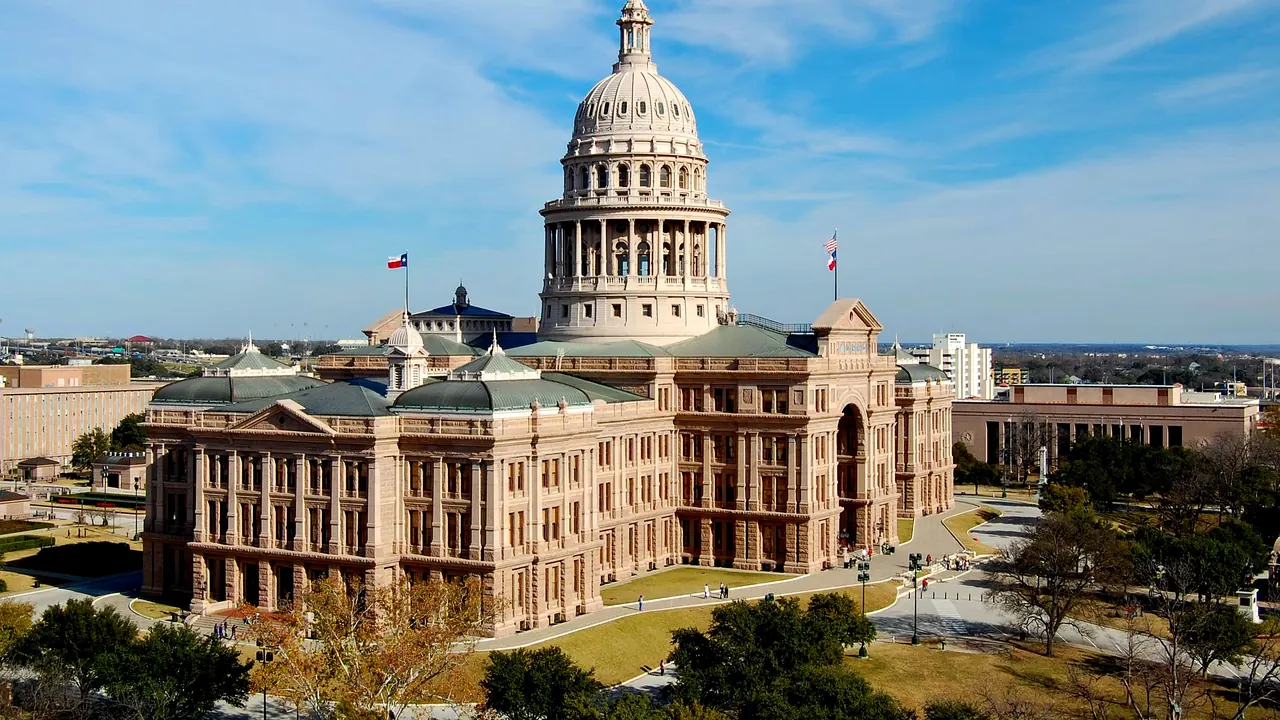
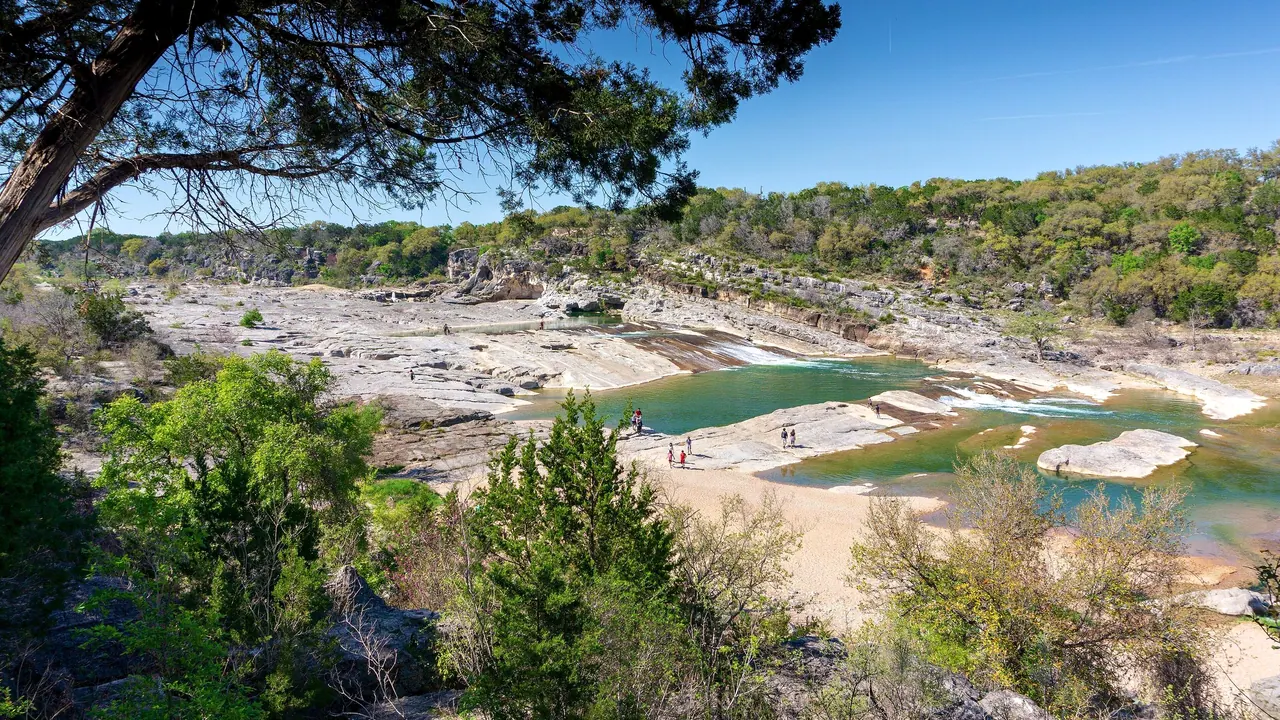
Photos: Austin by LoneStarMike, CC BY 3.0, cropped; Texas Hill Country by Aleksomber, CC BY-SA 4.0, cropped.
Austin or Texas Hill Country?
Our verdict in twelve categories, each scored against the same fixed benchmark cities, and the climate month by month, so you can choose for your trip.
Choose Austin for
- nightlife
- live music and the arts
- food and drink
Austin is the choice for a trip built around evenings. It has live music every night in the clubs on Red River Street and in the honky-tonks, real bar streets on Sixth and Rainey, and breakfast tacos and food trucks by day, with the Capitol and the university museums filling the daytime. It works as a city base, with Barton Springs and the Greenbelt in town and the hills within reach. It is the pricier of the two, though, and harder to get around.
Choose Texas Hill Country for
- families
- beaches
- getting around
Pick the Hill Country for a slower trip by car around the countryside: spring-fed swimming holes, tubing down the rivers at New Braunfels, wine country around Fredericksburg and a porch over the water at night. Families do better here, especially with a base in New Braunfels, and it costs a little less. What you give up is nightlife. The hill towns go quiet early, and Austin's clubs are an hour away on dark roads.
Scoreboard
Twelve categories on one fixed scale from 0 to 100. The shaded stretch is the gap between the two.
Your match
Pick a travel style or drag the sliders, and both match scores follow your weighting.
Too close to call, level with your weighting
Wins on nightlife and live music and the arts with your weighting.
Wins on families and beaches with your weighting.
What matters to you?
Category by category
What the scores mean for a trip.
Beaches & swimming
Neither has a coast, so here the swimming is in cold springs and rivers. In Austin it comes down to Barton Springs and Deep Eddy in town, Lake Travis on the outskirts and the Greenbelt holes after rain. These make good afternoons out from a city base.
The Hill Country has more of it, and more variety: Jacob's Well and Blue Hole near Wimberley, Hamilton Pool and Krause Springs, tubing down the Comal and Guadalupe at New Braunfels, and the Frio at Garner State Park. If a summer trip is built around swimming, the hills give you more days of it, though in dry years some holes close.
Food & drink
Both eat the same Central Texas barbecue, brisket smoked over post oak and served on butcher paper, and Lockhart is within easy reach of either. The difference is range. Austin adds Tex-Mex, food trucks, craft beer and the more ambitious kitchens of East Austin and South Congress.
The Hill Country has its own German strand instead, with bakeries, sausage and schnitzel in Fredericksburg and New Braunfels, and tasting rooms along the road to Johnson City. Small-town menus start to repeat after a few days, so a longer stay leans on trips into Austin.
Culture & sights
Neither is a place to come for the sights, and either can be covered in a couple of days. Austin's sights are institutions: the pink granite Capitol and the museums around the university, among them the Blanton, the Bullock, the LBJ Library and the Harry Ransom Center with its Gutenberg Bible.
The Hill Country's are spread out and best taken slowly by car: Fredericksburg's limestone houses and Vereins Kirche, the National Museum of the Pacific War, the Johnson ranch on the Pedernales, painted courthouses and old dance halls. So it is museums in town against heritage along the road.
Nightlife
Austin is the place to go out. Sixth Street, the bungalow bars of Rainey Street and the dive and mezcal bars of the east side stay busy until 2am, helped by a large student crowd and by festival weeks that take over the whole centre.
In the Hill Country, evenings end early: a saloon, a taproom or a wine bar on Fredericksburg's Main Street, with the summer tubing crowd livening up New Braunfels. For anything more you go back to Austin, with a driver or a room booked.
Nature & outdoors
These two share one landscape, since Austin sits on the eastern edge of the hills, and Enchanted Rock and Pedernales Falls feature on both lists. Austin's advantage is the outdoors in town: the Barton Creek Greenbelt, paddling on Lady Bird Lake and the bat flight from the Congress Avenue Bridge.
Staying in the hills puts you in the middle of it all: cypress-lined rivers, show caves, Lost Maples in autumn colour and bluebonnets along the roadsides in spring, with quiet ranch roads for cycling. In both, the summer heat confines hiking to early mornings.
Day trips
Both reach San Antonio, with its Alamo and missions, in about the same time, and both draw on the same hill towns. From Austin the outings are longer drives into the hills, to Fredericksburg, Gruene or Lockhart for barbecue, plus Waco and its mammoth site to the north.
From a base in the Hill Country they are short hops between towns such as Luckenbach, Comfort, Kerrville and Bandera, with Austin itself as the city day out. The towns look alike, so wherever you stay, a handful of outings is enough.
Good for families
Austin is easy with children but has few big attractions: the train and lawns of Zilker Park, the Thinkery, the IMAX screen at the Bullock and the bats at dusk. The theme parks and waterparks are an hour or so away.
Base yourself in New Braunfels and the Hill Country puts those on the doorstep: the water park on the Comal, tubing, Natural Bridge Caverns and its wildlife ranch. River houses and cabins with pools make good family bases. The part to skip with children is Fredericksburg's wine country.
Getting around
Both need a car, so the real difference is the driving. Austin has a walkable downtown and scooters in the centre, but its swimming spots and many of its best places to eat are spread out. The buses and single rail line are rarely the easy option, and the main highway clogs at peak hours.
The Hill Country has no public transport between towns, yet driving there is easy: two-lane roads, light traffic and towns half an hour to an hour apart, with main streets that are pleasant on foot. The snags are Interstate 35 and wine tastings that call for a designated driver.
Shopping & style
For brand names the Hill Country is the better bet. Two large outlet malls of designer and mainstream labels stand beside the interstate at San Marcos, while Austin keeps its big names in an open-air mall on the northern edge, away from the centre. Austin's strength is browsing South Congress and the east side for vintage clothing, independent boutiques, boots and hats.
In the hills, the browsing is along Fredericksburg's Main Street, with home goods, gourmet food and gifts in old stone buildings, and in the antique shops and local galleries of Gruene, Wimberley and Boerne. Western wear turns up in both places, and serious antique hunters can drive east to the Round Top fairs.
Affordability
Austin costs what a major American city costs. Downtown hotel rooms climb during the music, film and racing weeks, and a hire car and parking come on top. Tacos, food trucks and free sights such as the Capitol and the bat flight help.
The Hill Country is the cheaper of the two, though only moderately. Cottages in Fredericksburg and Wimberley are dear on spring and autumn weekends, but weekdays, motels and river cabins in Kerrville or New Braunfels bring costs down, and state parks cost little.
Live music & performing arts
Austin's music runs every night across many genres. Blues, rock, indie, country and conjunto play in clubs on Red River and Sixth Street, often with no cover, and the Long Center adds the symphony, opera and ballet.
The Hill Country does one tradition well: country music and songwriters in old wooden dance halls such as Gruene Hall, picking circles at Luckenbach and the Kerrville Folk Festival in late spring. It is atmospheric but narrower, and for classical music or theatre you go to Austin or San Antonio.
Wellness & relaxation
In Austin, unwinding is active and urban: a strong yoga and fitness culture, day spas across town and resorts on Lake Austin for a quieter night or two. Away from Sixth Street and the festival weeks, its parks keep the pace easy.
The Hill Country gives you more room to rest, with wide skies, little traffic and wellness retreats around Boerne as well as resorts near Lake Travis. The catch is that treatments mostly mean staying at a resort, because the small towns have few spas of their own, and Fredericksburg and the river towns fill up at weekends. Neither place has a thermal bath.
When should you go?
Pick your month. The climate figures are measured averages, not a forecast.
Austin in July
Texas Hill Country in July
Daytime high, °C
Rainfall in the month, mm
Where the figures come from
Texas Hill Country has no rain gauge within 25 km of the centre, so its rainfall comes from a gridded climate dataset read at the destination rather than from a gauge further away.
Temperature and rainfall are climate normals, averaged over the years shown. Austin: 1991-2020 normals, Camp Mabry/Austin City Asos (3.7 km from centre). Texas Hill Country: 2011-2025 (rainfall 1991-2020) normals, Fredericksburg (5 km from centre).
Spring and autumn suit both. March and April bring warm, comfortable days for walking South Congress or driving between hill towns, and October is much the same. From June to September the heat is fierce. Austin reaches about 36°C in July and August, and its long, very sunny summer days push walking and hiking into the early morning. Roughly May to September is also the swimming season, when the cold springs are at their most welcome.
Around its main towns the Hill Country runs a degree or two cooler than Austin all year and is drier overall. Austin's wettest month is May at 130mm, with October also wet. In the hills the rain is spread more evenly across late spring and early autumn and peaks at 91mm in June. Winters are mild in both. January highs are around 17°C in Austin and a little cooler at 15°C in the hills, which is fine for sightseeing and driving but not for swimming.
Which traveller are you?
For a food and nightlife trip, Austin is the clear pick. The hills serve the same brisket and breakfast tacos, but Austin adds Tex-Mex, food trucks, the bars of Sixth Street, Rainey Street and the east side, and live bands every night. The hill towns are quiet before midnight.
On a family trip with children, the Hill Country suits better. New Braunfels has a huge water park on the Comal River, gentle tubing, caverns and a drive-through wildlife ranch, and San Antonio's theme parks are close. Austin has Zilker Park and the Thinkery, but fewer big draws.
For a relaxing and wellness trip, choose the Hill Country. A mid-week stay in the western hills means quiet roads, river cabins, cottages with hot tubs and wine at sunset, with spa lodges near Wimberley and Fredericksburg. Austin is easy-going too, but its bar streets and festival weeks get loud.
Before you go
| Measure | Austin | Texas Hill Country |
|---|---|---|
| Currency | US Dollar (USD) | US Dollar (USD) |
| Sockets | AB120 V, 60 Hz | AB120 V, 60 Hz |
| Driving side | Right | Right |
| Time zone | UTC-6, UTC-5 in summer | UTC-6, UTC-5 in summer |
| Emergency number | 911 | 911 |
| Elevation | 149 m | - |
| Main airport | Austin Bergstrom International Airport (AUS)13 km from centre90 non-stop destinations | San Antonio International Airport (SAT)48 non-stop destinations |
| Public holidays this year | 13 days | 13 days |
By the numbers
| Measure | Austin | Texas Hill Country |
|---|---|---|
| Population | 961,855 | - |
| People per km² | 1,217 | - |
| Museums within 10 km | 21 | - |
| UNESCO World Heritage sites within 50 km | 0 | - |
Where else could you go?
Every comparison below shares a destination with this one, so you can follow Austin or Texas Hill Country somewhere new.
- San Antoniovs Austin
- Houstonvs Austin
- Dallasvs Austin
- Galvestonvs Austin
- New Orleansvs Austin
- Bransonvs Austin