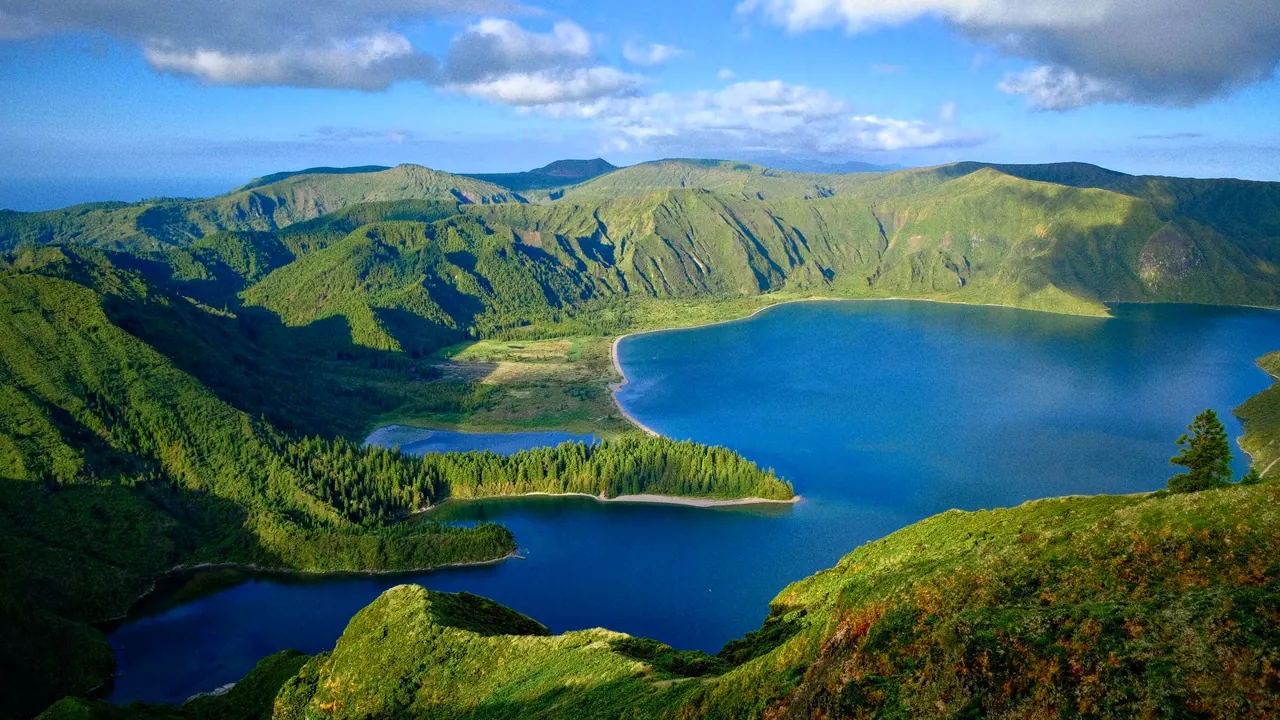
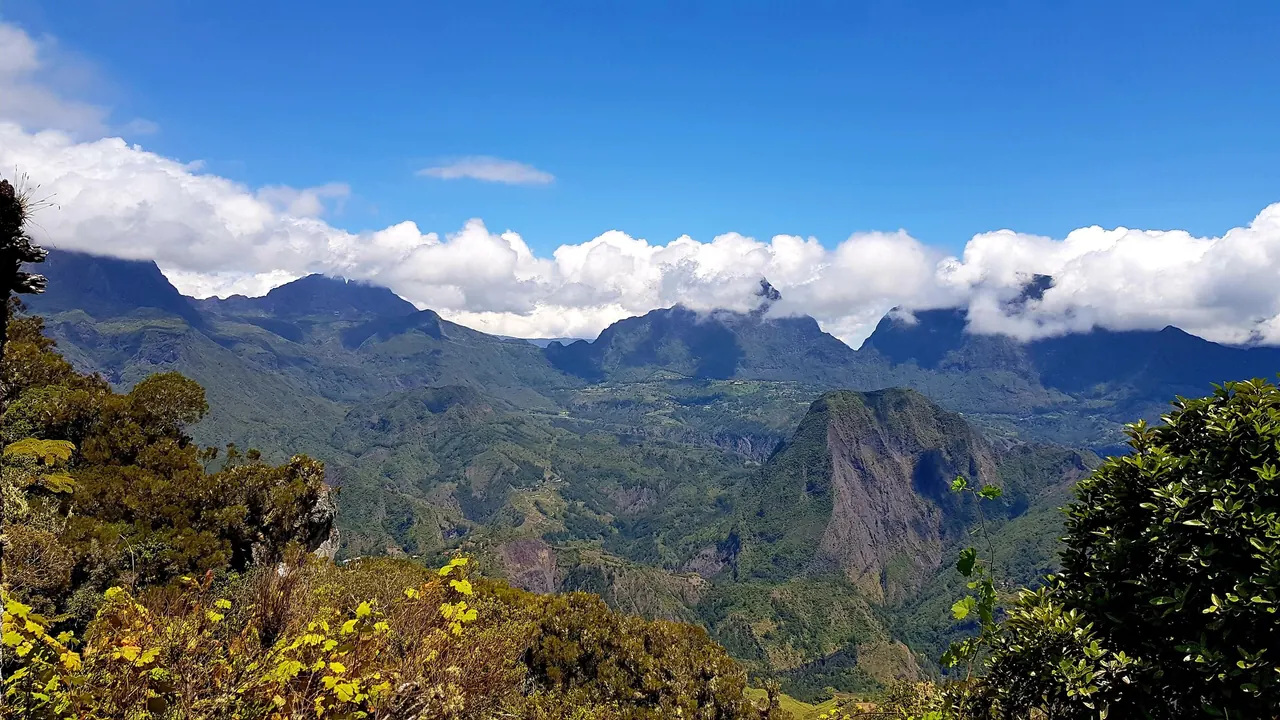
Photos: Azores by Leonardo Barucci, Pexels License; Réunion by Asile4ever, CC BY-SA 4.0, cropped.
Azores or Réunion?
Our verdict in twelve categories, each scored against the same fixed benchmark cities, and the climate month by month, so you can choose for your trip.
Choose Azores for
- wellness
- prices
- culture and sights
The Azores suit travellers who want green volcanic scenery at an unhurried pace: crater lakes, whale boats from Ponta Delgada and Pico, and warm springs to soak in outdoors at Furnas. Angra gives them the stronger historic town, and everyday costs are lower. The price is cool, changeable weather and a sea that is only comfortable for swimming in high summer.
Choose Réunion for
- live music and the arts
- shopping
- nightlife
Réunion is for a warmer and more physical trip. It is one island built around the vast cirques and an active volcano, with serious hiking, a coral lagoon on the west coast that stays swimmable all year, and a Creole culture you can hear in maloya and taste in a carri. It costs more, being priced like France, but families get more to do and evenings around Saint-Gilles have more life.
Scoreboard
Twelve categories on one fixed scale from 0 to 100. The shaded stretch is the gap between the two.
Your match
Pick a travel style or drag the sliders, and both match scores follow your weighting.
Too close to call, level with your weighting
Wins on wellness and prices with your weighting.
Wins on live music and the arts and shopping with your weighting.
What matters to you?
Category by category
What the scores mean for a trip.
Beaches & swimming
Neither is a classic beach island, but Réunion has the edge for swimming. Its reef-protected lagoons on the west coast, between Saint-Gilles and Saint-Leu, are warm all year and clear enough to snorkel over coral. They are also shallow, short and busy at weekends, and the shark risk keeps everyone out of the open ocean.
In the Azores you swim in concrete-edged lava pools at Caloura and Biscoitos or from small black-sand coves on São Miguel, and the sea is comfortable only from about June to early October. Santa Maria's pale sand at Praia Formosa is the exception, but it is a flight away from the main island.
Food & drink
Both islands eat well, in very different ways. Azorean cooking is plain and rooted in dairy farms and the sea: cozido cooked in the hot ground at Furnas, alcatra braised in clay on Terceira, São Jorge cheese, limpets and tuna, washed down with Pico white wine or tea grown on São Miguel.
Réunion's food is spiced Creole, a carri or rougail with rice and lentils, plus samoussas and bonbons piment from its Tamil, Chinese and Malagasy roots. The best of it comes from roadside snack vans, the markets at Saint-Paul and Saint-Pierre and table d'hôte dinners in the cirques, with rum arrangé to finish.
Culture & sights
The Azores have the stronger set of sights, above all Angra do Heroísmo on Terceira, a World Heritage port with a 16th-century street grid, a large cathedral and the Monte Brasil fortress. The painted impérios in Terceira's villages and the stone-walled vineyards of Pico add character, though reaching them means island-hopping by plane.
Réunion's heritage lies in its mixed society rather than its monuments: the Creole villas on Saint-Denis's Rue de Paris, Hell-Bourg's painted cottages, and temples, mosques and chapels side by side. Its best museums, on the volcano, sugar and slavery, fill a few days rather than a trip.
Nightlife
Réunion has the livelier evenings, though only just in absolute terms. Saint-Gilles-les-Bains has sunset beach bars and a handful of clubs that fill on Friday and Saturday nights, and Saint-Pierre has a more local seafront strip.
In the Azores, going out means a few bars near Ponta Delgada's marina, the flag-covered sailors' bars of Horta, or a summer festa on Terceira, when the Sanjoaninas fill Angra's streets.
Nature & outdoors
Both are outstanding, and both are chosen above all for their landscapes, but the experience differs. The Azores spread their scenery over nine islands: the crater lakes of Sete Cidades and Lagoa do Fogo, steaming Furnas, the climb up Pico, Flores's waterfalls and sperm whales offshore all year. The walking is mostly moderate, often in mist.
Réunion packs bigger, harder terrain into one island. The cliff-walled cirques of Cilaos, Salazie and roadless Mafate invite multi-day treks, Piton des Neiges is climbed overnight for sunrise, and Piton de la Fournaise is one of the world's most active volcanoes. Paragliding above Saint-Leu and humpback whales from July to October round it out.
Day trips
Both islands offer smaller town stops between landscape outings, so the difference lies in reach. In the Azores the highlight is the central group, where ferries from Horta cross to Pico's wine cellars and São Jorge's cheese dairies, which gives a real island-hopping day.
Réunion has no neighbour within a boat ride, so its days out stay on the island: Saint-Pierre's market, Hell-Bourg's Creole houses, the vanilla plantations around Saint-Philippe or a rum distillery.
Good for families
Réunion is the easier choice with children. The lagoon at L'Hermitage and La Saline lets small children snorkel among fish in waist-deep water, and the turtles at Kélonia, the Saint-Gilles aquarium, a crocodile park and the Cité du Volcan cover rainy days. French healthcare and supermarkets make the practical side simple, though the hairpin roads into the cirques are hard on young passengers.
The Azores give children memorable outdoor moments, such as whale boats, warm pools at Furnas and lunch lifted out of hot ground. But little is built for them, and the swell and sudden rain need watchful planning.
Getting around
You need a hire car on both, and the challenges differ. On São Miguel the roads are quiet and the main sights are under an hour from Ponta Delgada, but moving between Azorean islands means ferries or flights that Atlantic weather can cancel.
Réunion is a single island with a fast coastal expressway, but rush-hour traffic around Saint-Denis and the west coast is heavy. The mountain roads to Cilaos or the volcano eat up whole mornings, and Mafate can be reached only on foot.
Shopping & style
Réunion offers a little more. Its markets in Saint-Paul, Saint-Pierre and Saint-Denis sell vanilla, spices, rum arrangé and Cilaos embroidery, and there are French chain stores and shopping centres for anything practical.
The Azores are about take-home produce: São Jorge cheese, north-coast tea, Pico wine and scrimshaw on Faial and Pico, with Ponta Delgada's market hall the best single stop.
Affordability
The Azores are the cheaper trip. Village restaurants serve generous plates at modest prices, rural guesthouses undercut city hotels, and the main sights cost nothing, although a hire car, whale trips and inter-island flights add up, especially in July and August.
Réunion is priced like France, with imported goods costing more still, and west-coast beach hotels are expensive in the southern winter. Snack vans, market lunches and mountain gîtes are how to keep costs down there.
Live music & performing arts
Réunion has a living music of its own. Maloya, the drum-and-chant tradition recognised by UNESCO, is played at kabars and on festival stages, and sega fills bars and village fêtes. The Sakifo festival in Saint-Pierre is the year's high point.
Azorean performance follows the parish calendar: filarmónica brass bands at processions, chamarrita folk dances and Angra's autumn jazz festival. On an ordinary evening there is little to hear.
Wellness & relaxation
The Azores are far better for soaking and slowing down. Volcanic heat feeds the big thermal pool in Furnas's Terra Nostra garden, a warm forest waterfall at Caldeira Velha and a hot ocean inlet at Ponta da Ferraria, all outdoors, and the misty pastures and early evenings do the rest.
Réunion's one bathing tradition is the old spa at Cilaos. Beyond that, rest there means resort-hotel spas or a few quiet nights in a gîte in the cirques.
When should you go?
Pick your month. The climate figures are measured averages, not a forecast.
Azores in July
Réunion in July
Daytime high, °C
Rainfall in the month, mm
Where the figures come from
Réunion's temperatures are measured 36 km from the centre, at Saint-Denis / Gillot.
Réunion has no rain gauge within 25 km of the centre, so its rainfall comes from a gridded climate dataset read at the destination rather than from a gauge further away.
Temperature and rainfall are climate normals, averaged over the years shown. Azores: 1991-2020 normals, Ponta Delgada / Nordela Acores (2.3 km from centre). Réunion: 1991-2020 normals, Saint-Denis / Gillot (36.1 km from centre).
The Azores are a summer destination. From June to September the days are mild and the sea warms to about 23°C by August and September. July is the driest month. From October the Atlantic rain returns in earnest, peaking at around 170mm in December, and winter days stay mild but grey, about 17°C. That is fine for walking the streets but no good for swimming.
Réunion runs the other way round, being in the southern hemisphere. January to March are hot, around 30°C on the coast, and very wet, with March the wettest month at about 249mm, cyclones possible and trails closed. The best months are May to November, when it is cooler, drier and good for hiking. Sunshine stays generous all year and the lagoon never drops much below 24°C, so a June to September trip catches both islands at their best, while for October and November Réunion is the clear choice.
Which traveller are you?
On a relaxing and wellness trip, the Azores are the better choice. Spend a few nights in the Furnas valley in May or September, outside the summer rush, and soak outdoors whatever the weather. Réunion's nearest equivalent is a slow week in Cilaos's old spa town.
On a trip on a tight budget, the Azores go further. Travel in spring or early autumn, keep to one island to avoid flights, and rent a self-catering house outside Ponta Delgada. Réunion can be done frugally on its gîte trails, but everything starts higher.
For a beach and sun trip, Réunion is the safer bet. Base yourself between Saint-Gilles and Saint-Leu and come between May and November, when the lagoon is still warm and the rain eases. In the Azores, only Santa Maria in high summer comes close.
Before you go
| Measure | Azores | Réunion |
|---|---|---|
| Official language | Portuguese | French |
| Currency | Euro (EUR) | Euro (EUR) |
| Sockets | CF230 V, 50 Hz | E220 V, 50 Hz |
| Driving side | Right | Right |
| Time zone | UTC-1, UTC in summer | UTC+4 |
| Emergency number | 112 | 112 |
| Main airport | João Paulo II Airport (PDL)25 non-stop destinations | Roland Garros Airport (RUN)14 non-stop destinations |
| Public holidays this year | 15 days | - |
By the numbers
| Measure | Azores | Réunion |
|---|---|---|
| Population | 236,440 | 889,679 |
| People per km² | 102 | 354 |
| Swim season, months above 21 °C | 4 months | 12 months |
Where else could you go?
Every comparison below shares a destination with this one, so you can follow Azores or Réunion somewhere new.
- Madeiravs Azores
- Canary Islandsvs Azores
- Tenerifevs Azores
- Zanzibarvs Réunion
- Madeiravs Réunion
- Hawaiivs Azores