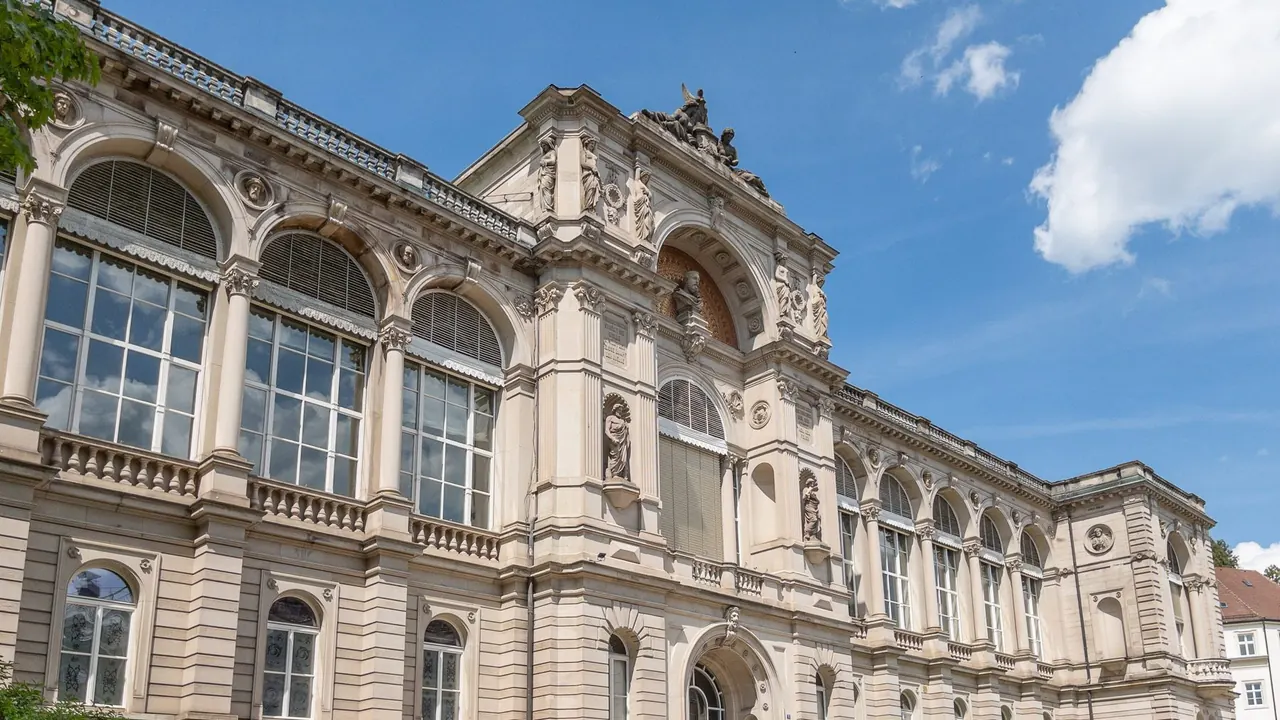
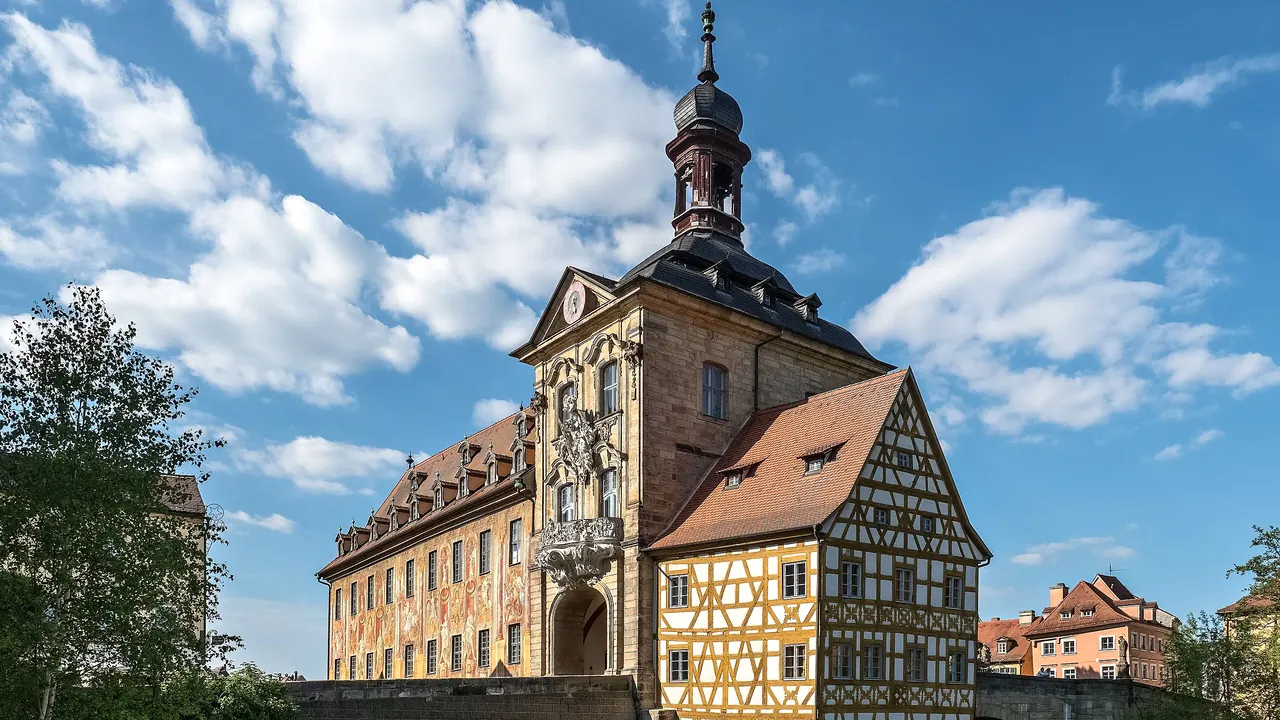
Photos: Baden-Baden by Kent Wang, CC BY-SA 2.0, cropped; Bamberg by Ermell, CC BY-SA 4.0, cropped.
Baden-Baden or Bamberg?
Our verdict in twelve categories, each scored against the same fixed benchmark cities, and the climate month by month, so you can choose for your trip.
Choose Baden-Baden for
- wellness
- nature and the outdoors
- live music and the arts
Baden-Baden suits travellers who want to slow down. The day revolves around the thermal baths of the Friedrichsbad and Caracalla, there are walks along the Lichtentaler Allee, an evening concert at the Festspielhaus, and the Black Forest begins at the edge of town. It costs more and goes to bed early. In return you get a proper rest, forest walks and easy outings to Strasbourg and Alsace.
Choose Bamberg for
- prices
- nightlife
- culture and sights
Bamberg is the better pick if you would rather spend the day walking through a whole historic townscape and the evening in brewery taverns over smoked beer. It is cheaper, easier to manage without a car and livelier after dark. Its spa bathing and its wilder countryside, though, are both a train ride away.
Scoreboard
Twelve categories on one fixed scale from 0 to 100. The shaded stretch is the gap between the two.
Your match
Pick a travel style or drag the sliders, and both match scores follow your weighting.
Too close to call, 1 point apart
Wins on wellness and nature and the outdoors with your weighting.
Wins on prices and nightlife with your weighting.
What matters to you?
Category by category
What the scores mean for a trip.
Beaches & swimming
Neither town has a beach, and neither is worth choosing for swimming. The difference is the kind of water. Baden-Baden's is the warm water of its thermal pools, with gravel pits out on the Rhine plain for a summer swim. Bamberg has a long-established river bathing spot in the Hain park on the Regnitz, a pleasant place to cool off right in town.
Food & drink
Bamberg is the stronger place to eat and drink, as long as you like beer. Its brewery taverns pour smoky Rauchbier from wooden barrels, the hillside beer cellars fill on summer evenings, and plates of Schäufele with dumplings are hearty and local.
Baden-Baden's strength is wine. Riesling and Pinot Noir come from the Rebland villages just outside town, and the cooking has a French accent and plenty of cake. In town the choice is narrower and leans towards hotel dining, so the best tables mean a drive into the Black Forest.
Culture & sights
Bamberg has more to see. Its entire old town escaped wartime damage and is listed by UNESCO. The highlights are the four-towered cathedral with the Bamberg Horseman, the Old Town Hall on its island in the Regnitz, the fishermen's houses of Little Venice and the abbey on Michaelsberg. The museums are small, and the pleasure is the walk itself.
Baden-Baden is a single, very complete period piece: a Belle Époque spa resort of the Kurhaus, the Trinkhalle and hillside villas. Its art is stronger, with the Museum Frieder Burda and the Kunsthalle side by side. Even so, it fills a day or two, while Bamberg's lanes repay a longer stay.
Nightlife
Neither town is a party place, but Bamberg has more going on after dark. Its brewery taverns fill after work, the student bars in the Sand quarter stay busy in term time, and the beer cellars make for long summer evenings.
In Baden-Baden the night out is the Kurhaus casino in smart dress, followed by a hotel or wine bar, and the streets are quiet early. For clubs, people go from Bamberg to Nuremberg, and from Baden-Baden to Karlsruhe or Strasbourg.
Nature & outdoors
Baden-Baden has the bigger landscape on its doorstep. The northern Black Forest begins at the edge of town, the Merkur funicular climbs to views across the Rhine plain to the Vosges, and the High Road follows the ridge to the Mummelsee and the Hornisgrinde moorland above 1,100m, with some skiing in winter.
Bamberg's countryside is gentler: rolling hills, the beech woods of the Steigerwald and cycle paths along the Main. The best of it for hikers and climbers is Franconian Switzerland, with its limestone valleys, caves and rock towers, under an hour to the east.
Day trips
Both towns make excellent bases, and Baden-Baden has the slightly richer list because it reaches across the border. Strasbourg and the Alsace wine villages sit alongside Heidelberg, Freiburg and the UNESCO sites of Speyer and Maulbronn, though several of the best outings are easier by car.
Bamberg's outings are all in Franconia and all reachable by rail. Nuremberg, the Residence at Würzburg, Coburg and Bayreuth are each about an hour away, the basilica of Vierzehnheiligen is closer, and Rothenburg makes a long but rewarding day.
Good for families
Baden-Baden works slightly better with children, mostly because of what lies nearby. Europa-Park is about an hour south, Karlsruhe's zoo is closer, and the funicular and forest trails make good outings. The town itself is made for adults, though, and the Friedrichsbad does not admit young children.
Bamberg is relaxed with children. There are playgrounds in the Hain, boats to hire on the Regnitz, a leisure pool with slides, and beer gardens where children play among the tables. It has no big attraction made for them, however, and the cobbled climbs are hard work with a pushchair.
Getting around
Bamberg is the easier town to manage without a car. The island town, the cathedral hill and Little Venice are minutes apart on foot, the lower town is flat enough for bicycles, and the station connects straight to the rest of Franconia.
Baden-Baden's centre is also easy to walk, but the station is a bus ride away in Oos, some streets climb steeply, and the High Road, the wine villages and Alsace all really need a car.
Shopping & style
Shopping is a side pleasure in both towns, but they suit different shoppers. Baden-Baden is the one for browsing fine things: its two main streets are lined with jewellers, watch shops, fashion boutiques and delicatessens kept for people who come to take the waters, so it rewards someone who likes to window-shop between baths and perhaps buy one good piece. Beyond that, the souvenirs are cuckoo clocks and Rebland wine.
Bamberg has no luxury end at all. Around Grüner Markt you find the familiar high-street names and a few independent bookshops, and the better buys are local: vegetables from the town's market gardens, smoked beer from the brewery shops and old pieces from the antique dealers near the cathedral. It suits anyone after edible souvenirs or antiques, though neither town will fill more than an afternoon.
Affordability
Bamberg is clearly the cheaper of the two. Beer and brewery-tavern meals cost little, hotels are moderately priced for most of the year, and you walk everywhere.
Baden-Baden was built for the wealthy and still prices itself that way. Grand hotels set the tone and every visit to the baths is paid for. Simple guesthouses and wine taverns help, but a stay centred on the spas soon adds up.
Live music & performing arts
Both towns are unusually strong in classical music for their size, and Baden-Baden goes further. The Festspielhaus, one of Germany's largest opera and concert houses, brings leading orchestras and opera productions, and the Kurhaus philharmonic and the small nineteenth-century theatre add to the programme.
Bamberg's pride is its orchestra rather than its venues. The Bamberg Symphony has a real international reputation, and the ETA Hoffmann Theatre and church concerts add to it. The town has no opera company of its own, so opera lovers look to Bayreuth.
Wellness & relaxation
This is where the two towns differ most. Baden-Baden exists for its hot springs. The domed Friedrichsbad takes you through a fixed sequence of rooms in silence, Caracalla has indoor and outdoor pools and a large sauna area, and the grand hotels have spas of their own, all in a town that runs at a slow pace.
Bamberg relaxes you in a different way, with mornings by the river and afternoons in beer gardens, and its only sauna is at the leisure pool. For thermal bathing you take a half-day trip to the brine pools of Bad Staffelstein.
When should you go?
Pick your month. The climate figures are measured averages, not a forecast.
Baden-Baden in July
Bamberg in July
Daytime high, °C
Rainfall in the month, mm
Temperature and rainfall are climate normals, averaged over the years shown. Baden-Baden: 1991-2020 normals, Baden-Baden-Geroldsau (3.9 km from centre). Bamberg: 1991-2020 normals, Bamberg (2.8 km from centre).
Through the year the two towns run at much the same temperatures. Summer days from June to August reach the mid twenties in both, around 25°C in July. December to February are cold in both, and Bamberg is a couple of degrees colder in deep winter, at about 4°C by day. Neither has a sea, so the warm months mean forest walks, beer gardens and outdoor pools. May and September, mild with long days, are the most comfortable months for time on foot in either town.
Rain is where they part. Baden-Baden, on the western edge of the Black Forest, gets about 100mm or more in most months, roughly double Bamberg's rainfall. Even Bamberg's wettest month, July, brings only about 79mm. Baden-Baden has slightly more summer sunshine, and its damp winters matter less when the day is spent in thermal pools. Bamberg's drier weather suits a stay built on walking in any season.
Which traveller are you?
For a relaxing and wellness trip, Baden-Baden is the obvious choice. The town exists for its thermal baths, from the silent, domed Friedrichsbad to the Caracalla pools and saunas, and its quiet evenings suit a stay built around rest. Bamberg has only a leisure-pool sauna.
On a culture and arts trip, Bamberg is better for sightseeing. A whole UNESCO-listed old town, the Imperial Cathedral and the town hall on its island in the river reward days of walking. Baden-Baden replies with the Festspielhaus and stronger art galleries, which may tempt concert-goers.
On a trip on a tight budget, Bamberg goes much further. Beer and tavern meals are cheap, rooms are moderately priced and you can walk everywhere without a car. Baden-Baden's grand hotels and paid entry to every bath make it an expensive place to stay.
Before you go
| Measure | Baden-Baden | Bamberg |
|---|---|---|
| Official language | German | German |
| Currency | Euro (EUR) | Euro (EUR) |
| Sockets | CF230 V, 50 Hz | CF230 V, 50 Hz |
| Driving side | Right | Right |
| Time zone | UTC+1, UTC+2 in summer | UTC+1, UTC+2 in summer |
| Emergency number | 112 | 112 |
| Elevation | 181 m | 262 m |
| Main airport | Karlsruhe Baden-Baden Airport (FKB)12 km from centre44 non-stop destinations | Nuremberg Airport (NUE)46 km from centre56 non-stop destinations |
| Public holidays this year | 12 days | 12 days |
By the numbers
| Measure | Baden-Baden | Bamberg |
|---|---|---|
| City population | 56,952 | 77,218 |
| People per km² | 406 | 1,414 |
| Museums within 10 km | 11 | 11 |
| UNESCO World Heritage sites within 50 km | 3 | 1 |
Where else could you go?
Every comparison below shares a destination with this one, so you can follow Baden-Baden or Bamberg somewhere new.
- Strasbourgvs Baden-Baden
- Nurembergvs Bamberg
- Stuttgartvs Baden-Baden
- Rothenburg ob der Taubervs Bamberg
- Heidelbergvs Baden-Baden
- Freiburgvs Baden-Baden