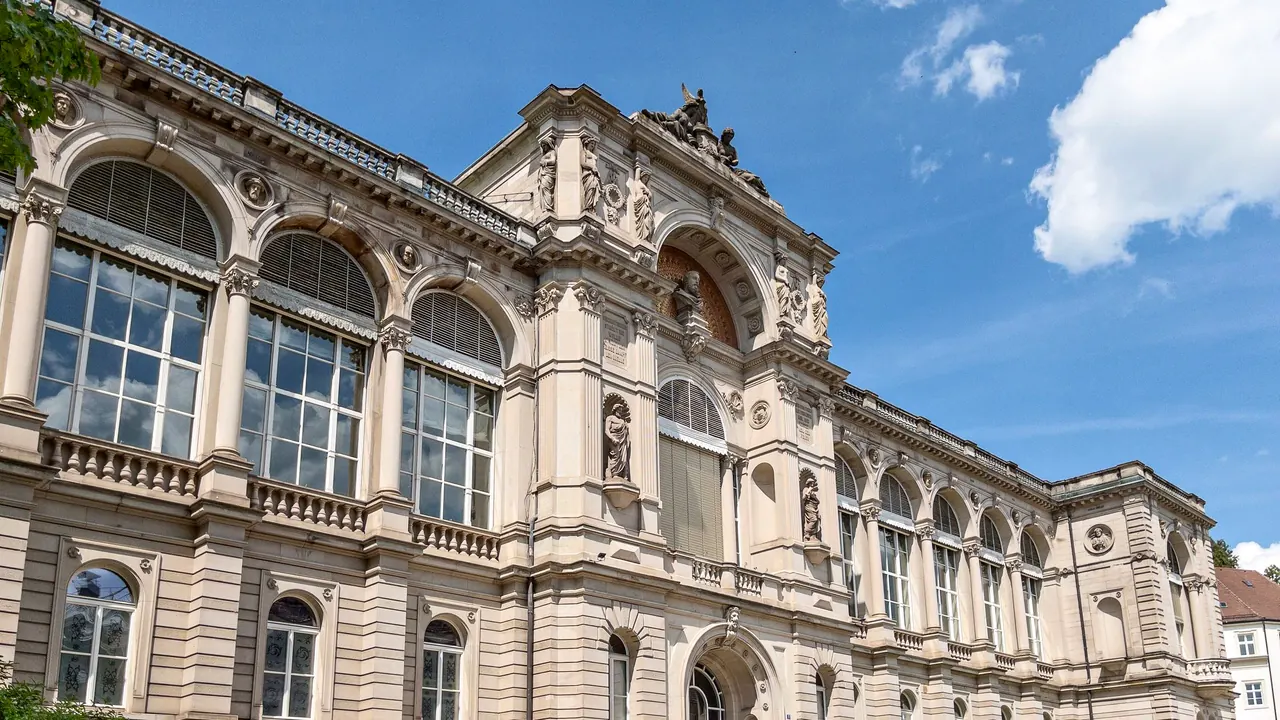
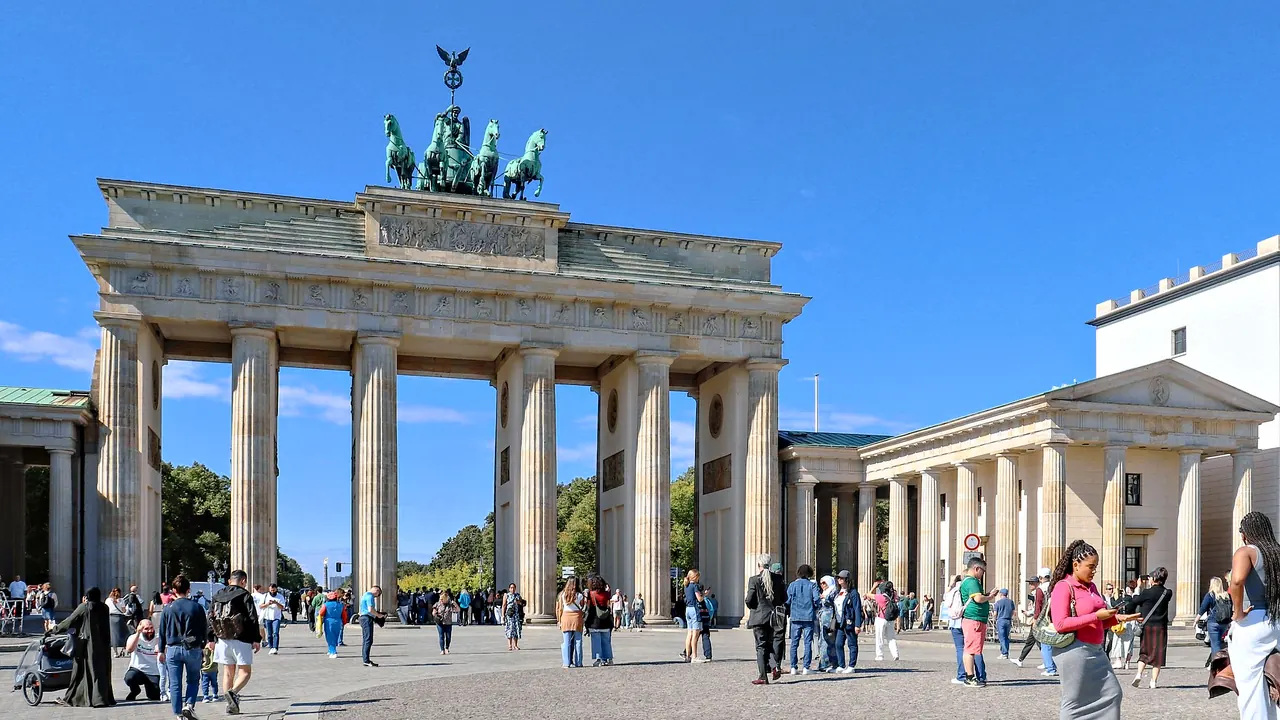
Photos: Baden-Baden by Kent Wang, CC BY-SA 2.0, cropped; Berlin by Claudia Solano, Pexels License.
Baden-Baden or Berlin?
Our verdict in twelve categories, each scored against the same fixed benchmark cities, and the climate month by month, so you can choose for your trip.
Choose Baden-Baden for
- wellness
- nature and the outdoors
- day trips
Baden-Baden is for a slow, restorative vacation. Its whole reason for being is the hot springs, and a stay here moves between the Friedrichsbad, the Caracalla pools, the Lichtentaler Allee and an evening at the Festspielhaus or the casino. The Black Forest starts at the edge of town, and Strasbourg, Alsace, Heidelberg and Freiburg are all within easy reach. It suits couples and older travellers who want calm, good wine and fresh air more than a crowded programme.
Choose Berlin for
- nightlife
- culture and sights
- live music and the arts
Berlin is the better pick for anyone who wants a big city with plenty going on day and night. Museum Island, the places where the Wall and the twentieth century happened, three opera houses and the Philharmonic would fill a week, and the clubs and bars are known worldwide. It feeds you more cheaply and more widely, works better with children, and is easier to get around without a car.
Scoreboard
Twelve categories on one fixed scale from 0 to 100. The shaded stretch is the gap between the two.
Your match
Pick a travel style or drag the sliders, and both match scores follow your weighting.
Wins on wellness and nature and the outdoors with your weighting.
Wins on nightlife and culture and sights with your weighting.
What matters to you?
Category by category
What the scores mean for a trip.
Beaches & swimming
Neither city is anywhere near the sea, but Berlin at least gives you a proper summer swim. Strandbad Wannsee has a long sandy shore and wicker beach chairs, and the Müggelsee and forest lakes such as Schlachtensee are a short S-Bahn ride away, warm enough in July and August.
Baden-Baden's outdoor swimming is limited to gravel-pit lakes on the Rhine plain and the town's pools. Here the water you come for is the warm water inside the bathhouses.
Food & drink
Berlin is the better city for eating out because of its range. Turkish bakeries in Kreuzberg and Neukölln, good Vietnamese, Levantine and Korean cooking, Markthalle Neun's street-food evenings and a serious fine-dining tier mean you can eat well and casually every night of a long stay.
Baden-Baden has less choice but a stronger sense of place. Flammkuchen, venison, Black Forest ham and cherry gateau carry a French accent from across the Rhine, and the Riesling and Pinot Noir taverns of the Rebland villages are its best evenings out. In the centre you mostly find hotel dining and cafés, and keen eaters drive out to the celebrated restaurants of the northern Black Forest.
Culture & sights
Berlin has far more to see. Museum Island alone, with Nefertiti and the Pergamon collections, could fill several days, and then come the Gemäldegalerie, Charlottenburg Palace and the sites of the city's twentieth-century history, from the Reichstag dome to the Wall Memorial on Bernauer Strasse.
Baden-Baden's appeal is the town itself, an intact Belle Époque spa resort with the Kurhaus, the Trinkhalle and hillside villas. The Museum Frieder Burda, the Kunsthalle and the Brahms house add real quality, but it is a day or two of sightseeing against Berlin's week or more.
Nightlife
This is where the two differ most. Berlin's techno clubs in old power stations and factories have no fixed closing time, and on top of that there are smoky Kneipen in Neukölln, cocktail bars in Mitte and canal-side drinking in Friedrichshain and Kreuzberg.
A night out in Baden-Baden means a jacket for the gilded casino rooms, then a glass in a hotel or wine bar among an older crowd. Anyone wanting to dance has to go to Karlsruhe or Strasbourg.
Nature & outdoors
Baden-Baden has the better outdoors, because it sits on real upland. The Merkur funicular and the Battert cliffs lead straight into the fir forest. Further in, the Black Forest High Road passes the Mummelsee and rises above 1,100m on the Hornisgrinde, with waterfalls, mountain biking and some winter skiing.
Berlin's green space is generous but flat: the Tiergarten, the runways of Tempelhof, the Grunewald and Havel lakes, and the Wall Trail by bike. Brandenburg's lakes are good for canoeing, but there is nothing to climb.
Day trips
Baden-Baden's position near the French border gives it the richer choice. Strasbourg and the Alsace wine route, Heidelberg, Freiburg, the UNESCO cathedral at Speyer and Maulbronn monastery are all around an hour away, which means two countries and several very different regions, though a car helps.
Berlin has one outstanding outing in Potsdam's Sanssouci palaces, only half an hour out, plus Wittenberg, Leipzig, the Spreewald and Sachsenhausen by train. Dresden makes a long day, and after that the options thin out.
Good for families
Berlin is the easier city with children. Two large zoos, the dinosaur skeleton at the Natural History Museum, the Museum of Technology's trains and planes, playgrounds everywhere and flat streets for prams keep a family busy without a car.
Baden-Baden is safe and calm, and the funicular and forest trails go down well, but the Friedrichsbad turns away young children and the mood is adult. Families usually spend their days at Europa-Park, about an hour south.
Getting around
Berlin's U-Bahn, S-Bahn, trams and buses run on one ticket, the trains run all night at weekends, and the flat streets suit cycling. The catch is size: Mitte, Kreuzberg and Charlottenburg are separate centres you ride between.
Baden-Baden is the opposite. The baths, Kurhaus and museums are a short, sometimes steep walk apart, but the station is a bus ride out and the wine villages, the High Road and Alsace really need a car.
Shopping & style
Berlin gives a shopper much more to do. You get the brands on the Kurfürstendamm, the KaDeWe food hall, young designers around Hackescher Markt and vintage and record shops in Kreuzberg, with the Sunday flea markets at Mauerpark and Boxhagener Platz as the highlight.
Baden-Baden is smaller but more polished. Sophienstraße and Lange Straße are lined with jewellers, watchmakers and delicatessens for a wealthy spa crowd, and that is about the extent of it.
Affordability
Berlin is the cheaper stay. Hotels cost less than in most big capitals, and döner stands, Vietnamese canteens and corner bars make cheap meals easy. The costs that add up there are museum tickets and fine dining.
Baden-Baden was built for the wealthy and still prices itself that way. Grand hotels set the tone and every visit to the baths is paid for separately. Guesthouses, bakeries and wine taverns are fair value, but a stay built around the spas soon gets expensive.
Live music & performing arts
Both are serious about classical music, but Berlin works on a different scale: three opera houses, the Berlin Philharmonic in Scharoun's Philharmonie, the Konzerthaus, Brecht's Berliner Ensemble, the Friedrichstadt-Palast revue and a deep jazz and rock circuit, so there is something on every night.
Baden-Baden is remarkable for a small town. The Festspielhaus brings leading international orchestras and opera productions, and the Kurhaus and the little nineteenth-century theatre continue a tradition left by Brahms and Clara Schumann. Beyond classical music, though, there is little.
Wellness & relaxation
Baden-Baden is one of Europe's classic places to take the waters. The springs the Romans used still fill the Friedrichsbad, with its silent, unclothed sequence of hot rooms and pools under a dome, and the Caracalla's indoor and outdoor pools next door.
Berlin has no springs of its own. It offers German sauna culture instead, with large clothes-free complexes and the columned halls of Stadtbad Neukölln, while lazy Sundays in café gardens supply the rest.
When should you go?
Pick your month. The climate figures are measured averages, not a forecast.
Baden-Baden in July
Berlin in July
Daytime high, °C
Rainfall in the month, mm
Temperature and rainfall are climate normals, averaged over the years shown. Baden-Baden: 1991-2020 normals, Baden-Baden-Geroldsau (3.9 km from centre). Berlin: 1991-2020 normals, Berlin / Alexanderplatz (0.9 km from centre).
The two follow almost the same temperature curve. Summer days reach about 25°C in both in July and August, May and September are mild and good for walking, and from November to February both are cold and grey, with Berlin a touch colder at about 4°C in midwinter. Sunshine is also close, at its longest from May to August and thin in December in both places.
Rain is the real difference. Baden-Baden, on the wet western slope of the Black Forest, gets around 100mm or more nearly every month, so showers are likely whenever you go. Berlin is far drier, often under 50mm a month, and is wettest in July. For forest walks in Baden-Baden, late spring and early autumn are the best balance of warmth and light. Berlin's lake swimming only really works in high summer. The baths of Baden-Baden make its cold, wet winter months easier to enjoy than Berlin's.
Which traveller are you?
For a relaxing and wellness trip, Baden-Baden wins easily. Its Roman springs feed the silent, domed Friedrichsbad and the Caracalla pools and saunas, and the whole town keeps a slow pace. Berlin's sauna complexes are good, but nobody goes to Berlin for the water.
For a food and nightlife trip, Berlin is the obvious choice. Turkish grill houses in Kreuzberg, Vietnamese canteens and market-hall evenings come before techno clubs that run from Saturday into Monday. Baden-Baden offers wine taverns, hotel bars and a dressed-up casino, and the streets are quiet by late evening.
On an outdoors trip, Baden-Baden has the stronger landscape. The Merkur funicular, the Battert cliffs and trails into the fir forest start at the edge of town, and the High Road leads up to the Hornisgrinde moorland. Berlin's lakes and woods are pleasant, but the land is flat.
Before you go
| Measure | Baden-Baden | Berlin |
|---|---|---|
| Official language | German | German |
| Currency | Euro (EUR) | Euro (EUR) |
| Sockets | CF230 V, 50 Hz | CF230 V, 50 Hz |
| Driving side | Right | Right |
| Time zone | UTC+1, UTC+2 in summer | UTC+1, UTC+2 in summer |
| Emergency number | 112 | 112 |
| Elevation | 181 m | 34 m |
| Main airport | Karlsruhe Baden-Baden Airport (FKB)12 km from centre44 non-stop destinations | Berlin Brandenburg Airport (BER)19 km from centre160 non-stop destinations |
| Public holidays this year | 12 days | 10 days |
By the numbers
| Measure | Baden-Baden | Berlin |
|---|---|---|
| Population | 56,952 | 3,700,577 |
| People per km² | 406 | 4,153 |
| Museums within 10 km | 11 | 157 |
| UNESCO World Heritage sites within 50 km | 3 | 4 |
Where else could you go?
Every comparison below shares a destination with this one, so you can follow Baden-Baden or Berlin somewhere new.
- Strasbourgvs Baden-Baden
- Stuttgartvs Baden-Baden
- Heidelbergvs Baden-Baden
- Freiburgvs Baden-Baden
- Colmarvs Baden-Baden
- Baselvs Baden-Baden