
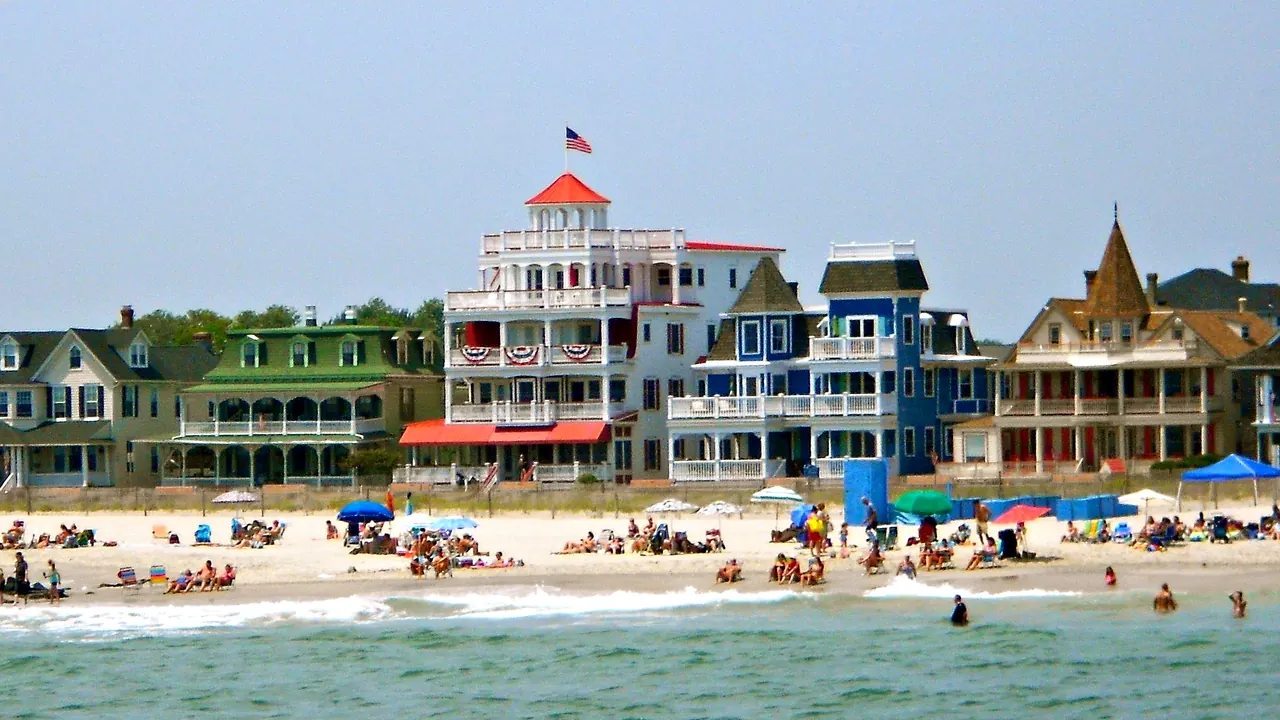
Photos: Baltimore by Styves Exantus, Pexels License; Cape May by Smallbones, CC0.
Baltimore or Cape May?
Our verdict in twelve categories, each scored against the same fixed benchmark cities, and the climate month by month, so you can choose for your trip.
Choose Baltimore for
- day trips
- nightlife
- culture and sights
Baltimore is the choice for a city trip with substance. Its free art museums, Fort McHenry and the old streets of Fells Point and Mount Vernon fill two or three busy days, the crab houses and bar districts take care of the evenings, and Washington and Philadelphia are both an easy train ride away. It suits travellers who want sights, food and excursions in all seasons, and it is the more affordable of the two places to stay.
Choose Cape May for
- beaches
- wellness
- nature and the outdoors
Cape May suits a slower summer week by the sea. It has a long lifeguarded beach, a whole town of Victorian guesthouses with porches to sit on, safe streets for children on bikes, and dolphins and migrating birds just offshore. Come for sand, quiet evenings and fresh scallops rather than museums or nightlife, and expect to pay well for the privilege in high season.
Scoreboard
Twelve categories on one fixed scale from 0 to 100. The shaded stretch is the gap between the two.
Your match
Pick a travel style or drag the sliders, and both match scores follow your weighting.
Wins on day trips and nightlife with your weighting.
Wins on beaches and wellness with your weighting.
What matters to you?
Category by category
What the scores mean for a trip.
Beaches & swimming
Cape May's beach is the whole point of a summer stay. A continuous strip of lifeguarded sand runs along the promenade with gentle surf, Cape May Point is quieter, and at Sunset Beach on the bay side people hunt for the quartz pebbles called Cape May diamonds.
Baltimore offers nothing comparable. Its waterfront is a working harbour, and the nearest sand is Sandy Point State Park facing the Bay Bridge, where the brackish water brings sea nettles in high summer and swimming can close after storms. The Atlantic surf that Cape May sits on is about three hours from Baltimore.
Food & drink
Both places revolve around seafood, but Baltimore gives you more to work through. Steamed blue crabs with Old Bay, eaten with mallets off brown paper, set the tone, and the historic Lexington Market, the red-sauce kitchens of Little Italy and the chef-led rooms of Hampden and Harbor East add range across several neighbourhoods.
Cape May's strength is its fishing fleet, so scallops, flounder and local oysters turn up everywhere from dockside shacks to Victorian dining rooms, and porch breakfasts are a pleasure. Beyond that it is mostly fudge, taffy and ice cream, with queues in summer and closed kitchens in winter.
Culture & sights
Baltimore has a real museum city to offer. The Baltimore Museum of Art's Cone Collection of Matisse and the Walters' run from Egyptian antiquities to Fabergé are both free, and Fort McHenry, the B&O roundhouse and the ships in the Inner Harbor add American history on top.
In Cape May the sight is the town itself, a National Historic Landmark district of gingerbread cottages and painted-lady guesthouses best seen on a walking or trolley tour. The Emlen Physick Estate and a climb up the lighthouse round it off, and a day or two covers it.
Nightlife
Neither town is a clubbing destination, but Baltimore at least gives you a proper bar crawl. Fells Point's taverns in centuries-old buildings fill up with students at weekends, Federal Hill's rooftops get loud after Orioles and Ravens games, and Station North has dive bars with an artier crowd.
In Cape May, evenings are a cover band in a hotel bar off the pedestrian mall and bed before midnight. Anyone wanting more drives up to the Wildwoods boardwalk.
Nature & outdoors
Cape May has the edge for wildlife. It sits on a migration funnel where hawks, songbirds and monarch butterflies pour through Cape May Point and Higbee Beach in autumn, and dolphin-watching boats rarely come back without a sighting. The marsh boardwalks and lanes are completely flat.
Baltimore's outdoors is more varied but less remarkable. There are the wooded river gorges of Patapsco Valley, the trout streams of Gunpowder Falls, sailing on the sheltered Chesapeake out of Annapolis, and real hills on the Appalachian Trail about an hour and a half west.
Day trips
Baltimore's position between two major cities is a big advantage. Washington's Smithsonian museums and Philadelphia's Independence Hall are each about an hour by train, and with a car you can add Annapolis, the Gettysburg battlefield, Harpers Ferry and the Eastern Shore villages.
Cape May sits at the end of the road, so its outings are more limited. The best is the ferry across Delaware Bay to colonial Lewes. Besides that there are the Wildwoods, Atlantic City and the county wineries, while Philadelphia is a tiring long day by car.
Good for families
Cape May is slightly better for young children, mainly because the whole town is gentle. Lifeguarded beaches, slow safe streets, surrey rides on the promenade, crabbing on the bay and a free county zoo make an easy week, though some historic-district B&Bs turn away small children.
Baltimore's family strength is concentrated at the Inner Harbor, where the National Aquarium, the Maryland Science Center and Port Discovery sit within a short walk of each other. They make a superb day or two, but beyond the harbour the city is uneven and you'll be using taxis.
Getting around
Both have a walkable core and patchy links beyond it, but the details differ. In Baltimore you walk the waterfront promenade between Fells Point, Federal Hill and Little Italy or hop on a water taxi to Fort McHenry. The fast trains to Washington and Philadelphia are excellent, though Hampden and the zoo need a taxi.
Cape May is flat, compact and best seen by bicycle, with a summer trolley for the rest. Getting there is the hard part, though, as there's no passenger rail. Most people drive in or come over on the Delaware ferry, then struggle to park.
Shopping & style
Neither place is worth visiting for its shops, and neither has department stores or luxury labels. What differs is the flavour. Baltimore's Avenue in Hampden leans towards vintage, kitsch and local art, while Fells Point adds records and antiques. Cape May's three-block Washington Street Mall is gentler, with boutiques, bookshops, kitchenware and fudge, which suits a rainy afternoon.
Affordability
Baltimore is the cheaper base by some way. Hotels cost noticeably less than in nearby Washington, many visitors to the capital stay here for that reason, and the two main art museums are free. Restaurant tips and taxi fares still add up.
Cape May in summer is a splurge. You'll find premium B&B rates with minimum stays, big-city dinner prices, a beach tag and paid parking. Shoulder-season visits or a rental house for a group soften the cost, and many budget beachgoers stay in the Wildwoods and come down for the day.
Live music & performing arts
Baltimore has a year-round arts calendar. The Baltimore Symphony plays at the Meyerhoff, the Peabody Institute puts on frequent concerts in Mount Vernon (many of them free), and the Hippodrome brings in touring Broadway shows. For live music there are small indie and punk clubs around Station North.
Cape May's offering is smaller and more seasonal. A professional theatre company plays in a converted church, and a long-running chamber music festival fills churches in late spring and early summer. Out of season there is little more than weekend shows.
Wellness & relaxation
Cape May is far easier to unwind in, especially in spring and autumn. You can spend slow days in rocking chairs on Victorian porches, take afternoon tea in guesthouse parlours, cycle under shady trees and watch sunsets over the bay, with a few guesthouse spas besides. Summer weekends are busier, though.
Baltimore has gritty city energy. Rest there means a hotel spa, a morning on the harbour promenade or an hour in Druid Hill Park, and locals who want real calm head for the Eastern Shore.
When should you go?
Pick your month. The climate figures are measured averages, not a forecast.
Baltimore in July
Cape May in July
Daytime high, °C
Rainfall in the month, mm
Where the figures come from
Cape May has no rain gauge within 25 km of the centre, so its rainfall comes from a gridded climate dataset read at the city rather than from a gauge further away.
Temperature and rainfall are climate normals, averaged over the years shown. Baltimore: 1991-2020 (sunshine 1971-2000) normals, Baltimore (0.4 km from centre). Cape May: 2006-2020 (rainfall 1991-2020) normals, Wildwood / Sally Marshall Crossing (8.4 km from centre).
Summer belongs to Cape May. From late June to mid-September the Atlantic is warm enough for swimming, reaching about 24°C in August, and sea breezes keep the town a touch cooler than Baltimore, which climbs to 31°C in July and August with heavy humidity that makes long days on foot hard work. Baltimore's bay water is warm too, but it isn't a place to swim.
For walking the city, Baltimore is best in May and from mid-September through October, when daytime highs sit in the low to mid twenties and the long summer sunshine of nearly 290 hours in July has eased. In both places rain is spread fairly evenly through the year, with no real dry season, and winters are cold at about 6°C. That is fine for Baltimore's museums, but Cape May goes quiet and many of its kitchens close. Spring and autumn suit Cape May's birdwatchers and anyone after calm porch days.
Which traveller are you?
For a beach and sun trip, Cape May is the clear pick. Its lifeguarded Atlantic sand runs right along the town, with gentle surf and warm water in August, while Baltimore's nearest beach is a brackish bay strip forty minutes away by car.
On a culture and arts trip, Baltimore offers much more. You get free museums with Matisse and Fabergé, Fort McHenry, a full symphony season and Peabody concerts. Cape May's Victorian streets and its lighthouse are lovely, but they fill a day or two at most.
For a food and nightlife trip, Baltimore wins easily. Crab feasts, Lexington Market and Little Italy cover the eating, then Fells Point and Federal Hill keep the bars busy until last call. Cape May eats well for its size but is mostly asleep by midnight.
Before you go
| Measure | Baltimore | Cape May |
|---|---|---|
| Currency | US Dollar (USD) | US Dollar (USD) |
| Sockets | AB120 V, 60 Hz | AB120 V, 60 Hz |
| Driving side | Right | Right |
| Time zone | UTC-5, UTC-4 in summer | UTC-5, UTC-4 in summer |
| Emergency number | 911 | 911 |
| Elevation | 10 m | 3 m |
| Main airport | Baltimore/Washington International Thurgood Marshall Airport (BWI)13 km from centre89 non-stop destinations | Atlantic City International Airport (ACY)65 km from centre11 non-stop destinations |
| Public holidays this year | 12 days | 13 days |
By the numbers
| Measure | Baltimore | Cape May |
|---|---|---|
| City population | 585,708 | 2,768 |
| People per km² | 2,457 | 390 |
| Museums within 10 km | 27 | 4 |
| UNESCO World Heritage sites within 50 km | 0 | 0 |
| Swim season, months above 21 °C | 3 months | 3 months |
Where else could you go?
Every comparison below shares a destination with this one, so you can follow Baltimore or Cape May somewhere new.
- Rehoboth Beachvs Cape May
- Bethany Beachvs Cape May
- Washington DCvs Baltimore
- Ocean City, Marylandvs Cape May
- Atlantic Cityvs Cape May
- Philadelphiavs Cape May