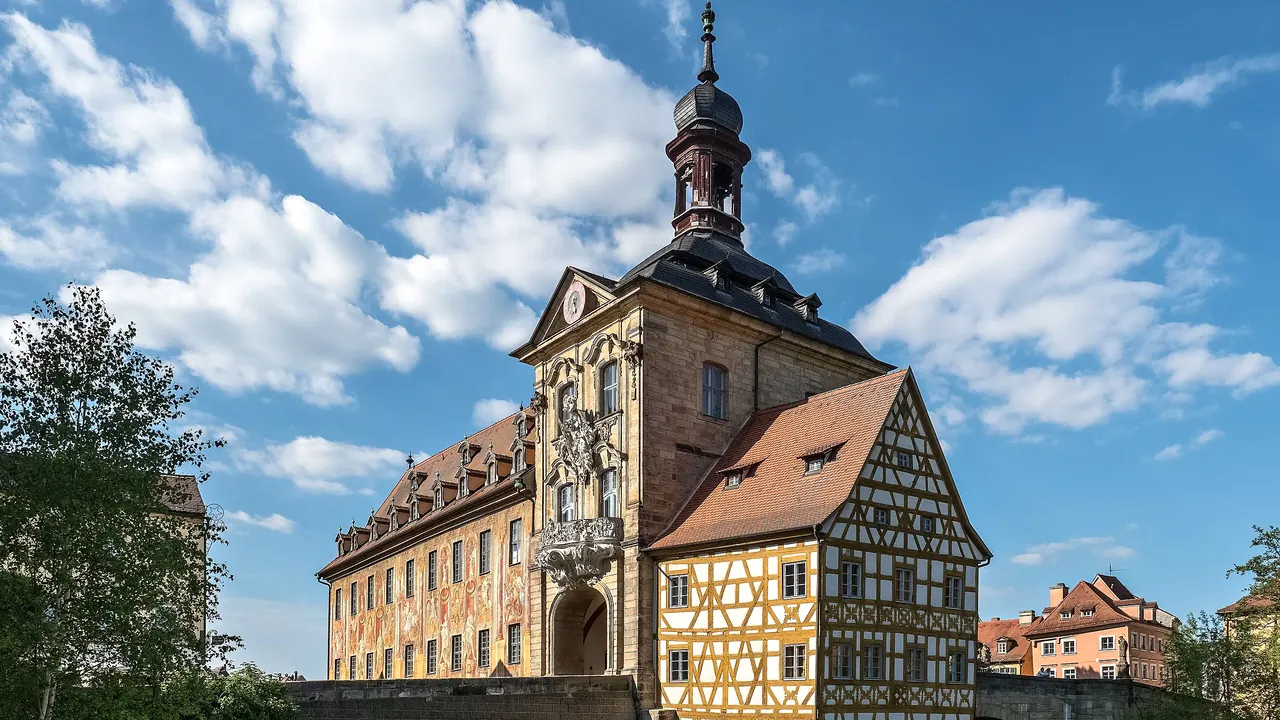

Photos: Bamberg by Ermell, CC BY-SA 4.0, cropped; Berlin by Claudia Solano, Pexels License.
Bamberg or Berlin?
Our verdict in twelve categories, each scored against the same fixed benchmark cities, and the climate month by month, so you can choose for your trip.
Choose Bamberg for
- prices
- day trips
- nature and the outdoors
Bamberg suits travellers who want to wander a small, intact old town on foot, drink smoked beer in centuries-old brewery taverns and hillside beer cellars, and use a calm base for rail trips around Franconia. It is the slower, somewhat cheaper choice. It works best for a few unhurried days, or as a stop on a wider tour taking in Nuremberg, Würzburg and Bayreuth.
Choose Berlin for
- nightlife
- live music and the arts
- shopping
Choose Berlin if you want depth and range. It has world-class museums, twentieth-century history at the places where it happened, three opera houses, the Philharmonic and a club scene people cross Europe for. It is also much better with children and for shopping. In exchange you give up Bamberg's compact townscape for a big city of separate centres linked by trains.
Scoreboard
Twelve categories on one fixed scale from 0 to 100. The shaded stretch is the gap between the two.
Your match
Pick a travel style or drag the sliders, and both match scores follow your weighting.
Wins on prices and day trips with your weighting.
Wins on nightlife and live music and the arts with your weighting.
What matters to you?
Category by category
What the scores mean for a trip.
Beaches & swimming
Bamberg has a river bathing spot in the Hain park, gravel-pit lakes on the edge of town and public pools. They are fine for cooling off on a hot afternoon, but not for a day at the beach.
Neither city has a coast, but Berlin is far better for a swim. Strandbad Wannsee has a long sandy shore and wicker beach chairs, and the Müggelsee and forest lakes such as Schlachtensee are a short S-Bahn ride away and warm enough for swimming in high summer.
Food & drink
Bamberg gives you depth in one thing: beer. Smoky Rauchbier is poured from wooden barrels in old brewery taverns and drunk under chestnut trees in the hillside Bierkeller, with Schäufele and dumplings to go with it. Beyond the Franconian classics, though, there is little choice.
Berlin edges ahead on range. Its Turkish grill houses in Kreuzberg and Neukölln, Vietnamese and Korean kitchens, market-hall street food and a serious fine-dining tier mean you can eat something different every night, even though its own cuisine is no richer than Bamberg's.
Culture & sights
Bamberg's appeal is the townscape as a whole. The UNESCO-listed old town came through the war almost untouched, from the four-towered cathedral on its hill to the frescoed Old Town Hall on its island in the Regnitz. You enjoy it by walking, not by visiting museums.
Berlin goes much deeper. Museum Island, Nefertiti and the Gemäldegalerie's old masters would justify a trip on their own. Add the Reichstag, the Wall Memorial on Bernauer Strasse and the Holocaust memorial, and you get modern history no pretty old town can offer, even if the cityscape itself is patchy.
Nightlife
In Bamberg an evening means beer: brewery taverns after work, student bars in the Sand quarter during term, and long summer nights in the beer cellars. Most of the town is quiet well before the small hours.
Berlin is in another league. Its techno clubs in old power stations and warehouses have no fixed closing time, and the Kneipen and cocktail bars of Friedrichshain, Kreuzberg and Neukölln mean there is always somewhere open.
Nature & outdoors
The two are broadly level, but the landscapes are different. From Bamberg, Franconian Switzerland's limestone valleys, rock towers, caves and castle-topped crags are under an hour away, and footpaths link village breweries through rolling, wooded hills.
Berlin is flat and watery instead. You get forest walks in the Grunewald, sailing on the Havel, paddling on the Müggelsee, cycling the Wall Trail and the vast open runways of Tempelhof. It suits people who like lakes better than hills.
Day trips
Bamberg is the better base. Nuremberg, Würzburg's Residence, Coburg and Bayreuth all lie within about an hour by train, and the baroque basilica of Vierzehnheiligen is even closer, so you could spend a week on day trips without repeating yourself.
From Berlin, Potsdam's palaces and gardens are outstanding, and Wittenberg and Leipzig are easy to reach. Dresden already makes a long day, however, and after that the choice soon runs out.
Good for families
Bamberg is safe and relaxed, with playgrounds and rowing boats in the Hain park and beer gardens where children play among the tables. But it is mostly churches and steep cobbles, which children tire of quickly.
Berlin is much stronger here. It has two large zoos, a dinosaur skeleton, a technology museum full of trains and planes, children's museums, and playgrounds on almost every corner, and prams roll easily along the flat streets.
Getting around
Bamberg is a walking town. The island, the cathedral hill and Little Venice are minutes apart, though the climbs up the cobbles are steep, and the station is a fair walk from the centre.
Berlin is easier overall, despite its size. One ticket covers the U-Bahn, S-Bahn, trams and buses, trains run all night at weekends, and the flat streets make cycling natural. The difference is that you ride between districts, where in Bamberg you would stroll.
Shopping & style
In Bamberg, shopping fills an hour between sights. There are chain stores on Lange Strasse, a few bookshops and antique dealers, and smoked beer or market-garden produce to take home.
Berlin is a real shopping destination for independent tastes. It has concept stores around Hackescher Markt, vintage and record shops in Kreuzberg, KaDeWe's food hall, and Sunday flea markets at Mauerpark and Boxhagener Platz for East German curios and vinyl.
Affordability
Bamberg is a little easier on the wallet. Tavern meals and local beer cost less than in a big city, and walking means you hardly spend anything on transport, although old-town rooms get dearer at weekends and during the Christmas market season.
Berlin has cheap food of its own and hotels that are reasonable for a capital. A culture-heavy itinerary, trade fairs and summer weekends push the total up.
Live music & performing arts
Bamberg has one real asset: the Bamberg Symphony, an orchestra of international standing, plus the ETA Hoffmann Theatre and church concerts. It has no opera company of its own.
Berlin has far more on stage. There are three opera houses, the Berlin Philharmonic in Scharoun's Philharmonie, the Berliner Ensemble and Schaubühne for theatre, and jazz cellars and experimental venues, so there is something on every night.
Wellness & relaxation
Bamberg relaxes you mainly through its pace: quiet riverside mornings, shaded beer-garden afternoons, and calm evenings once the day visitors leave. For real thermal bathing, the brine pools of Bad Staffelstein are about half an hour away by train.
Berlin offers more within the city itself. Large sauna complexes keep up the German clothes-free tradition, and the columned halls of the Stadtbad Neukölln are a memorable place to swim and sweat.
When should you go?
Pick your month. The climate figures are measured averages, not a forecast.
Bamberg in July
Berlin in July
Daytime high, °C
Rainfall in the month, mm
Temperature and rainfall are climate normals, averaged over the years shown. Bamberg: 1991-2020 normals, Bamberg (2.8 km from centre). Berlin: 1991-2020 normals, Berlin / Alexanderplatz (0.9 km from centre).
The two climates are almost identical. Both are cold and dark from November to February, with daytime highs around 4°C in midwinter and short, grey days. Both warm steadily through spring to summer highs of about 25°C in July and August, with Bamberg a degree warmer at its peak. Summer is also the wettest stretch in both, and July brings the most rain, close to 80mm.
For walking the streets, May, June and September are the best months in either city: mild, with long sunny days and no real heat. Bamberg's beer cellars and riverside park are at their best from May to September. Berlin's lake swimming needs the warmth of July and August. In neither city does summer get too hot for sightseeing, and in both, winter is a time for indoor sights.
Which traveller are you?
For a food and nightlife trip, Bamberg does one thing very well: an evening of smoked beer that is over before midnight. Berlin is the clear winner, with enough variety at the table and late into the night to make every evening different.
On a family trip with children, Bamberg works for a slow few days with small children, but its sights are made for adults. Berlin is the stronger choice. There is enough there for children to fill a week, whatever the weather.
On a tight budget, Bamberg is the safer bet, because the town is small and walkable and an ordinary day costs less. Berlin can be done cheaply too, but with so many museums, shows and late nights, it is harder to keep spending down.
Before you go
| Measure | Bamberg | Berlin |
|---|---|---|
| Official language | German | German |
| Currency | Euro (EUR) | Euro (EUR) |
| Sockets | CF230 V, 50 Hz | CF230 V, 50 Hz |
| Driving side | Right | Right |
| Time zone | UTC+1, UTC+2 in summer | UTC+1, UTC+2 in summer |
| Emergency number | 112 | 112 |
| Elevation | 262 m | 34 m |
| Main airport | Nuremberg Airport (NUE)46 km from centre56 non-stop destinations | Berlin Brandenburg Airport (BER)19 km from centre161 non-stop destinations |
| Public holidays this year | 12 days | 10 days |
By the numbers
| Measure | Bamberg | Berlin |
|---|---|---|
| City population | 77,218 | 3,700,577 |
| People per km² | 1,414 | 4,153 |
| Museums within 10 km | 11 | 157 |
| UNESCO World Heritage sites within 50 km | 1 | 4 |
Where else could you go?
Every comparison below shares a destination with this one, so you can follow Bamberg or Berlin somewhere new.
- Nurembergvs Bamberg
- Rothenburg ob der Taubervs Bamberg
- Karlovy Varyvs Bamberg
- Leipzigvs Berlin
- Frankfurtvs Bamberg
- Dresdenvs Berlin