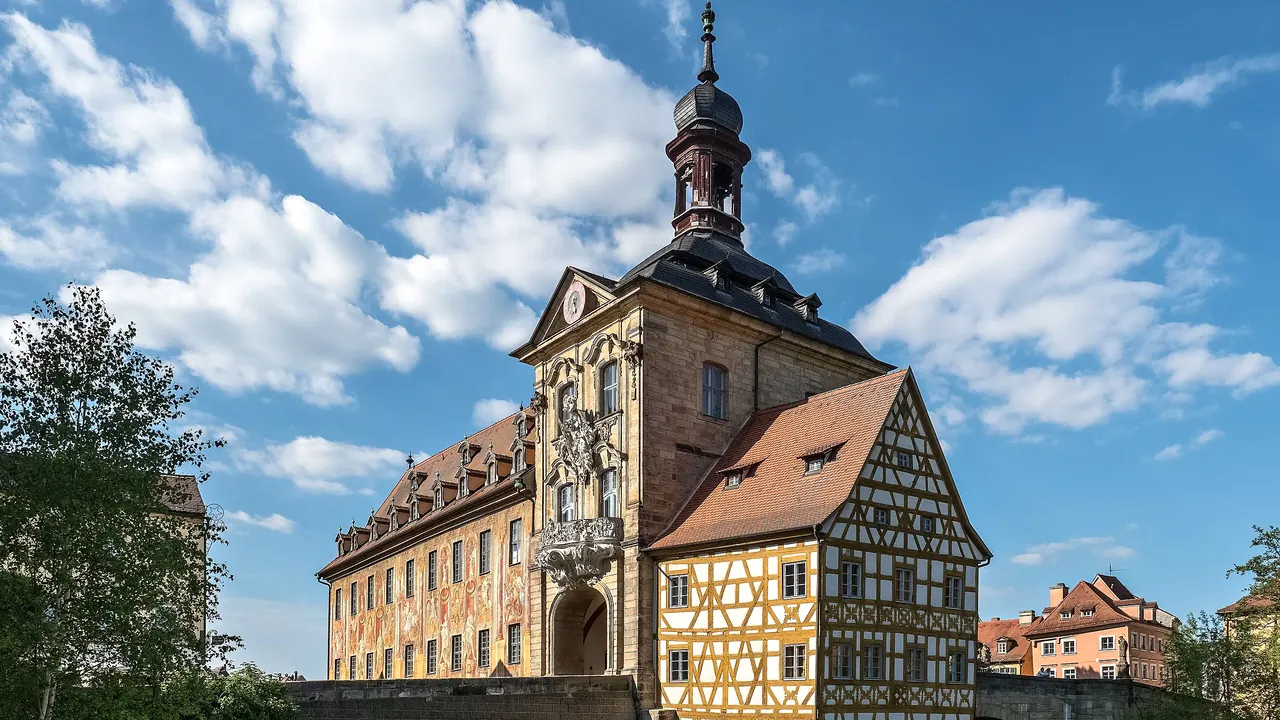
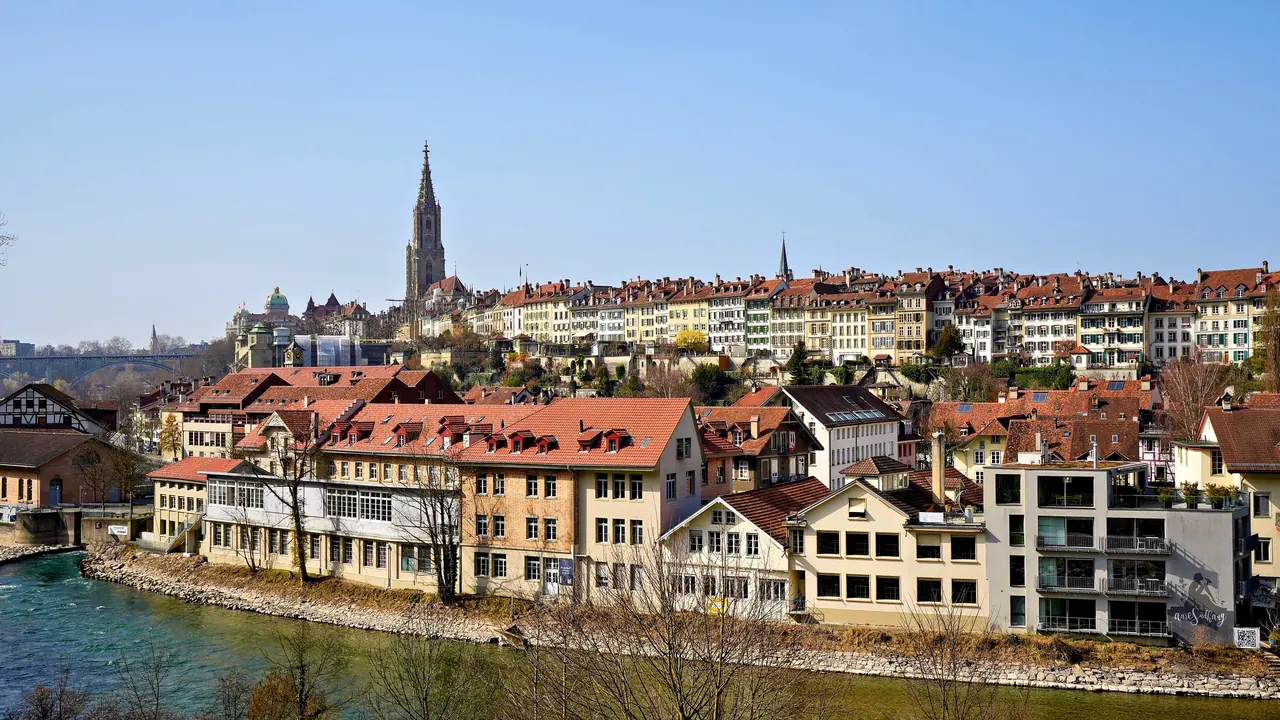
Photos: Bamberg by Ermell, CC BY-SA 4.0, cropped; Bern by Beat Bieri, Pexels License.
Bamberg or Bern?
Our verdict in twelve categories, each scored against the same fixed benchmark cities, and the climate month by month, so you can choose for your trip.
Choose Bamberg for
- prices
- food and drink
- culture and sights
Bamberg suits a slower, cheaper trip built around walking and beer. Its intact old town on the Regnitz, the brewery taverns pouring smoked Rauchbier and the hillside beer cellars give each day an easy rhythm. A stay costs far less than anything in Switzerland, and the Franconian towns of Nuremberg and Würzburg are close by train.
Choose Bern for
- beaches
- nature and the outdoors
- families
Pick Bern if the landscape matters as much as the town. The Alps are about an hour away and Lake Thun is nearer still, and the Swiss rail network puts Lucerne, Basel and Zurich within easy reach, which makes it a strong base for a varied week. It is also easier with children and simpler to get around. The catch is cost: Bern is one of the dearest places in Europe, so the budget needs to stretch.
Scoreboard
Twelve categories on one fixed scale from 0 to 100. The shaded stretch is the gap between the two.
Your match
Pick a travel style or drag the sliders, and both match scores follow your weighting.
Wins on prices and food and drink with your weighting.
Wins on beaches and nature and the outdoors with your weighting.
What matters to you?
Category by category
What the scores mean for a trip.
Beaches & swimming
Neither city is on the coast, but Bern is much better for swimming. In summer, locals walk upstream from the Marzili baths and let the cold, fast Aare carry them back past the Federal Palace. Riverside lidos have lawns and pools, and Lake Thun, twenty minutes away, has calmer water under the Alps. The river itself is for confident swimmers only.
Bamberg has a bathing spot on the Regnitz in the Hain park and gravel-pit lakes on the edge of town. That is enough to cool off on a hot afternoon, but not something to plan a day around.
Food & drink
Bamberg eats and drinks better, and beer is the reason. It has a very dense cluster of small breweries, Rauchbier poured from wooden barrels and summer Bierkeller under chestnut trees, all of which give eating out a character of its own. Schäufele and dumplings come with it.
Bern is hearty in a similar way, with the Berner Platte, rösti and fondue served in guildhall rooms and arcade cellars, and its chocolate is a real draw. It has a little more international range, but nothing as distinctive as Bamberg's brewing, and meals cost a good deal more.
Culture & sights
Both are UNESCO-listed old towns that came through the twentieth century intact, and they are close in what they offer. Bamberg is a townscape to wander. It has seven hills crowned by churches and monasteries, the four-towered cathedral with the Bamberg Horseman, the Old Town Hall on its island and Little Venice along the bank, but its museums are small.
Bern pairs its arcaded streets and the Zytglogge with real collections: the Zentrum Paul Klee, Switzerland's oldest art museum and the Einstein Museum. That gives you more to do indoors on a wet day.
Nightlife
Neither city suits a clubbing trip, and their evenings are similar in scale. In Bamberg the night is about beer: brewery taverns after work, the student bars of the Sand quarter in term time and the hillside cellars in summer. For a big night out, you take the train to Nuremberg.
Bern has a little more edge. There are the vaulted cellar bars under the arcades and the bars along Aarbergergasse, the Reitschule hosts late, rough-edged parties, and in warm weather people gather at the riverside terraces.
Nature & outdoors
Bern wins this clearly. The Eiger, Mönch and Jungfrau line its skyline and are about an hour away by train, with high-mountain hiking, cable cars and winter skiing. Lake Thun, the Gurten funicular and the wooded Aare paths are closer still.
Bamberg's surroundings are gentle. The limestone valleys and rock towers of Franconian Switzerland are less than an hour east, with the Steigerwald beech woods to the west and cycle paths along the Main and Regnitz. It is good walking country, often from one village brewery to the next, but there are no mountains.
Day trips
Both are well-placed rail hubs, but Bern reaches further and more easily. Lucerne, Basel and Zurich are each about an hour away, Lake Geneva's Lavaux terraces a little further, and Fribourg, Gruyères, Murten and Thun are close by. The scenery on the way is part of the outing.
Bamberg offers a fine Franconian circuit: Nuremberg in under an hour, Würzburg's Residence, Coburg, Bayreuth and the basilica of Vierzehnheiligen, with Rothenburg for a long day. It is rich in historic towns but has less variety of landscape.
Good for families
Bern is the easier choice with children. The bear park below the old town, the Dählhölzli zoo along the Aare, the dioramas at the Natural History Museum and the playground on the Gurten fill several days. The mountains are close when you want more.
Bamberg is safe and relaxed, with playgrounds in the Hain park, boat hire on the Regnitz and beer gardens where children play among the tables. Beyond that the sights are churches and townscape, and the cobbles up the cathedral hill are hard going with a pushchair.
Getting around
Step off the train and the difference shows at once. Bamberg's station is a fair walk from the old town, while Bern's opens straight onto the top of its arcaded centre. Once you reach Bamberg's island town, the cathedral hill and Little Venice are minutes apart on foot. Bicycles suit the flat lower town and buses fan out from a central hub, but the steep, uneven cobbles up to the cathedral and Michaelsberg have to be climbed on foot.
Bern is the smoother of the two. You can walk its centre end to end in about twenty minutes under the arcades. Trams and buses run on a single fare system, and short funiculars and a public lift save you the climb between the old town and the riverside quarter below.
Shopping & style
The best things to take home from Bamberg are mostly edible or old. There is produce from the town's own market gardens, bottled Rauchbier from the brewery shops and the antique dealers near the cathedral. The pedestrian streets around Grüner Markt and Lange Strasse are mostly chain stores and a few bookshops, enough for an hour between sights.
Bern gives you more to browse. Spitalgasse, Marktgasse and Kramgasse run in one long arcaded line with watch and chocolate shops. The cellar shops reached by steep steps on Gerechtigkeitsgasse sell antiques, design and crafts, and in late November the Zibelemärit sells woven onion braids. Neither city offers luxury or much fashion.
Affordability
This is where the two differ most. Bamberg has ordinary Western European prices, kept low by Franconian habits: cheap local beer, inexpensive meals in brewery taverns and moderately priced hotels. Weekends and the Christmas market season are the dearer times.
Bern is very expensive across the board, from plain guesthouses to a beer on a terrace. The tram and bus pass that hotels usually give guests, free pleasures like the bear park and the river paths, and supermarket lunches all help, but the same stay costs far more than in Bamberg.
Live music & performing arts
The two are evenly matched overall, but in different ways: Bamberg has the more celebrated orchestra, while Bern has the wider range. The Bamberg Symphony has a real international reputation and plays its home season in the concert hall on the Regnitz. The ETA Hoffmann Theatre stages drama, and organ and choral concerts fill the cathedral. Bamberg has no opera company of its own, but the Bayreuth Festival is an hour away.
Bern has its own opera and ballet at the Stadttheater, and the Bern Symphony Orchestra plays in the Casino above the Aare. The Dampfzentrale adds contemporary dance and new music, and the Reitschule puts on alternative concerts. A spring jazz festival and the Gurtenfestival in July bring in jazz, rock and pop.
Wellness & relaxation
Both are restful by temperament rather than through any bathing tradition. Bamberg's calm comes from mornings by the river and long afternoons in beer gardens once the day visitors have left. For thermal bathing, the warm brine pools of Bad Staffelstein are about half an hour away by train.
Bern's quiet arcades and still Sundays slow you down the same way, and it has more spa options in the city itself: a large thermal complex on the western edge, a hammam-style spa and hotel spas. For serious spa time, the mountain spa hotels of the Bernese Oberland are close.
When should you go?
Pick your month. The climate figures are measured averages, not a forecast.
Bamberg in July
Bern in July
Daytime high, °C
Rainfall in the month, mm
Where the figures come from
Bern has no rain gauge within 25 km of the centre, so its rainfall comes from a gridded climate dataset read at the city rather than from a gauge further away.
Bern's sunshine is measured 41 km from the centre, at Payerne.
Temperature and rainfall are climate normals, averaged over the years shown. Bamberg: 1991-2020 normals, Bamberg (2.8 km from centre). Bern: 2010-2020 (sunshine 1961-1990, rainfall 1991-2020) normals, Bern / Bern - Belp Airport (5.5 km from centre).
The two follow almost the same temperature curve. Both reach about 26°C in July and fall to 4-5°C in midwinter, so the comfortable months for walking the streets run from May to September in either city, and winter is cold and dark in both. Swimming is a summer-only pleasure. Bern's Aare and Lake Thun are good from June to early September, and Bamberg's river bathing spot and lakes are best in the warmest weeks.
Rain is the real difference. Bern is much wetter all year, and early summer is its wettest stretch, with about 118mm in May. Bamberg's wettest month is July at 79mm, and its spring is notably dry. Sunshine is broadly similar: Bamberg is a little brighter in April and May, while Bern catches up in July and September. Bern's covered arcades soften a wet day, which matters given how often it rains there.
Which traveller are you?
On a trip on a tight budget, Bamberg is the clear choice. Cheap local beer, filling tavern meals and moderately priced guesthouses keep costs down, and since everything is within walking distance, transport costs little. Bern charges far more for every room, meal and drink.
For an outdoors trip, Bern has the Alps within an hour by train: high-mountain hiking and cable cars in the Jungfrau region, skiing in winter, and Lake Thun and the Aare paths close by. Bamberg's limestone valleys and beech woods suit gentler walking and cycling.
On a food and nightlife trip, Bamberg makes more of the evening. Its small breweries, smoked Rauchbier and summer beer cellars make eating and drinking the point of the visit. Bern's cellar bars and the Reitschule are livelier at weekends, but every dinner costs considerably more.
Before you go
| Measure | Bamberg | Bern |
|---|---|---|
| Official language | German | French, German, Italian, Romansh |
| Currency | Euro (EUR) | Swiss Franc (CHF) |
| Sockets | CF230 V, 50 Hz | CJ230 V, 50 Hz |
| Driving side | Right | Right |
| Time zone | UTC+1, UTC+2 in summer | UTC+1, UTC+2 in summer |
| Emergency number | 112 | 112 |
| Elevation | 262 m | 542 m |
| Main airport | Nuremberg Airport (NUE)46 km from centre56 non-stop destinations | Zürich Airport (ZRH)101 km from centre226 non-stop destinations |
| Public holidays this year | 12 days | 10 days |
By the numbers
| Measure | Bamberg | Bern |
|---|---|---|
| City population | 77,218 | 136,988 |
| People per km² | 1,414 | 2,655 |
| Museums within 10 km | 11 | 30 |
| UNESCO World Heritage sites within 50 km | 1 | 2 |
Where else could you go?
Every comparison below shares a destination with this one, so you can follow Bamberg or Bern somewhere new.
- Interlakenvs Bern
- Nurembergvs Bamberg
- Lucernevs Bern
- Baselvs Bern
- Rothenburg ob der Taubervs Bamberg
- Lausannevs Bern