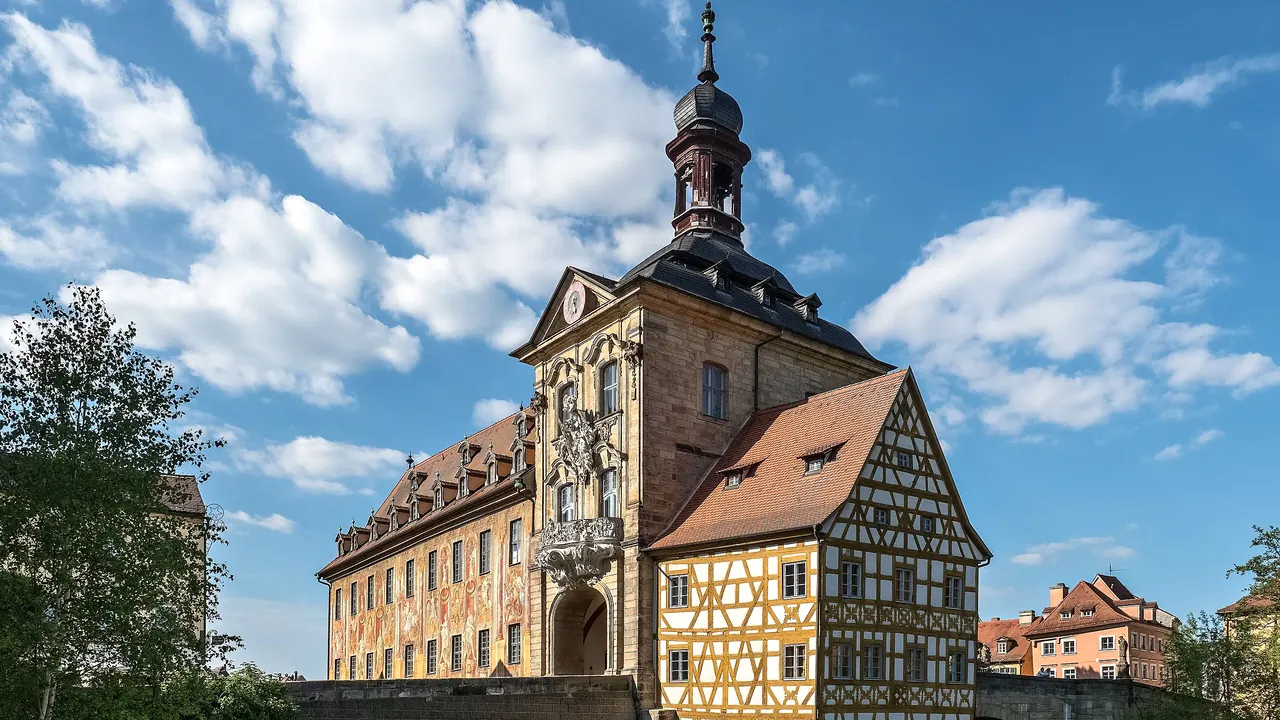
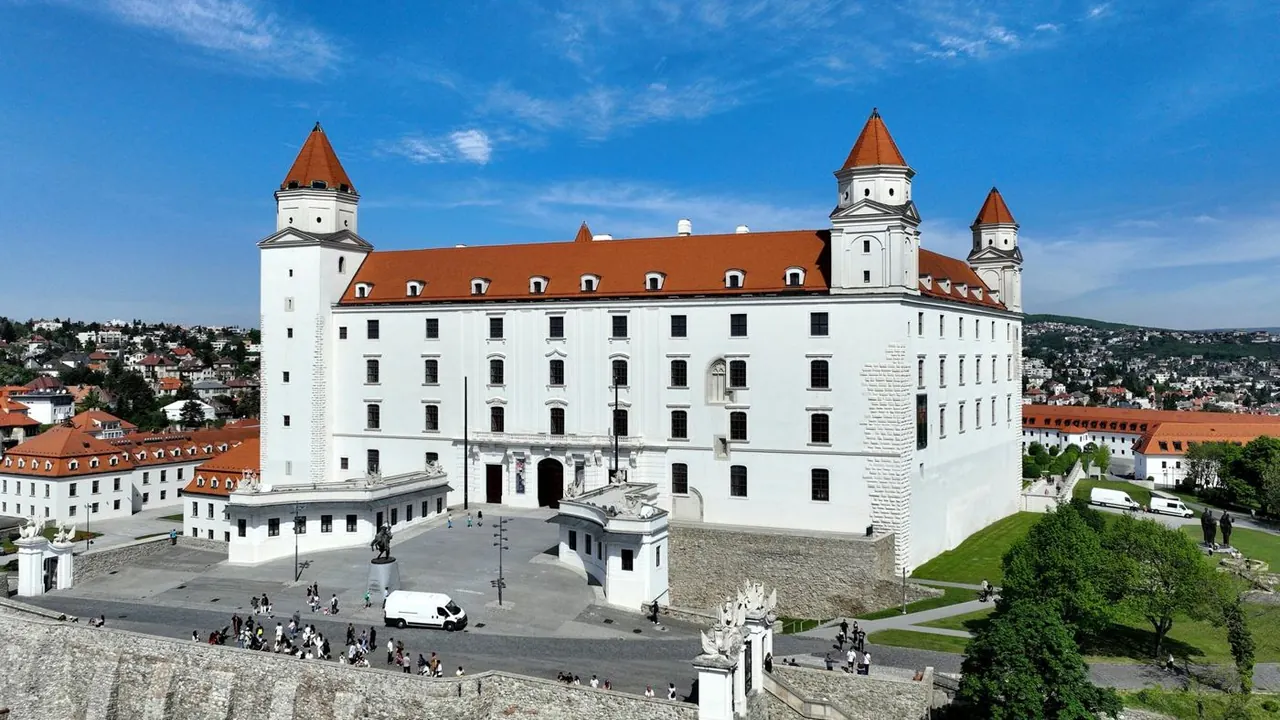
Photos: Bamberg by Ermell, CC BY-SA 4.0, cropped; Bratislava by C.Stadler/Bwag, CC BY-SA 4.0, cropped.
Bamberg or Bratislava?
Our verdict in twelve categories, each scored against the same fixed benchmark cities, and the climate month by month, so you can choose for your trip.
Choose Bamberg for
- culture and sights
- food and drink
- wellness
Bamberg suits travellers who want an old town to wander and a table to linger at. Its intact medieval and baroque centre on seven hills is the richer of the two places to explore on foot, and its brewery taverns and hillside beer cellars give it the more distinctive food and drink. The pace is slow, the evenings end early, and Nuremberg and Würzburg are easy trains away.
Choose Bratislava for
- nightlife
- prices
- day trips
Choose Bratislava for a livelier and cheaper few days, with Vienna close enough for a day out. It has more going on after dark, especially at weekends, an opera house with its own company, and Small Carpathian wine at the edge of town. Its sights take a day or two, so it works best as a base for crossing borders rather than as a place to study in depth.
Scoreboard
Twelve categories on one fixed scale from 0 to 100. The shaded stretch is the gap between the two.
Your match
Pick a travel style or drag the sliders, and both match scores follow your weighting.
Too close to call, 2 points apart
Wins on culture and sights and food and drink with your weighting.
Wins on nightlife and prices with your weighting.
What matters to you?
Category by category
What the scores mean for a trip.
Beaches & swimming
Neither city is a place for a beach, and both cope with summer heat in a similar, modest way. The difference is in the kind of water.
Bamberg offers river bathing in the Hain park and gravel-pit lakes on the edge of town, while Bratislava has a proper sandy shore at Zlate piesky, reachable by tram, and the larger Senec lakes half an hour out. Bratislava's lakes feel more like a lido day; Bamberg's river spot is the more charming quick dip.
Food & drink
Bamberg is the clear winner for food and drink, almost entirely because of beer. Rauchbier poured from wooden barrels in centuries-old brewery taverns, Schäufele with dumplings, and summer evenings in the hillside Bierkeller give it an identity that a beer lover will travel for.
Bratislava's Slovak cooking, bryndzove halusky, roast duck with lokse and the poppy-seed rolls, is hearty and enjoyable but less distinctive, and the central squares lean towards tourist menus. Its real strength is wine: Veltliner and Frankovka from the Small Carpathians, rarely found outside Slovakia.
Culture & sights
Bamberg offers far more to see. Its old town is one of the largest intact historic centres in Germany, and the cathedral hill, the island Old Town Hall, Little Venice and Michaelsberg Abbey make a townscape you can walk for days without exhausting.
Bratislava's Old Town is compact and pretty, with the coronation cathedral, the Primate's Palace and the Blue Church close together, plus the castle and the Most SNP bridge for the twentieth century. It is covered in a day or two, so it rewards a short stop rather than slow exploration.
Nightlife
Bratislava has the livelier evenings. On Friday and Saturday nights its Old Town pubs, wine bars and cocktail bars stay loud and full until late, helped by students and weekend groups from abroad, though weeknights go quiet.
Bamberg's evenings belong to the brewery taverns, the summer beer cellars and the student bars of the Sand quarter, and most of the town is asleep well before the small hours. For a club night, Bamberg sends you to Nuremberg, while Bratislava at least has a few of its own.
Nature & outdoors
The two are evenly matched for the outdoors, both offering gentle hills and woodland rather than mountains. Bamberg's attraction is Franconian Switzerland under an hour east, with limestone valleys, rock towers and caves, plus cycle paths along the Main and hikes from one village brewery to the next.
Bratislava's wild country starts closer to the centre: forest trails climb from Koliba to Kamzik, the Danube floodplain forests line the river, and the whitewater course at Cunovo adds rafting that Bamberg cannot match.
Day trips
Both are excellent bases, but Bratislava edges ahead thanks to Vienna, a world capital about an hour away by train or boat. Add the Small Carpathian wine villages, Carnuntum, Lake Neusiedl and Lednice-Valtice, and three countries lie within easy reach.
Bamberg's list stays within Franconia but is impressively dense: Nuremberg, Würzburg's Residence, Coburg and Bayreuth all sit about an hour away by rail, with Vierzehnheiligen and Banz Abbey closer still.
Good for families
For children, the two are much alike: safe, small and easy, but with little made for young visitors. Bamberg leans on the Hain park playgrounds, rowing boats on the Regnitz and beer gardens where children play between the tables, though its cobbled climbs are hard with a pushchair. Bratislava has a little more variety, with the zoo, the Kamzik chairlift and the Senec water park.
Getting around
Both centres are best on foot, and neither needs a car. Bamberg is the more compact, with the island town, cathedral hill and Little Venice minutes apart, and bicycles handle the flat lower town; only the steep cobbles up the hills slow you down.
Bratislava spreads further, so its trams, trolleybuses and buses do more of the work, reaching Kamzik, the zoo and Devin. Without a metro, longer crossings of the river feel slower than the map suggests.
Shopping & style
Shopping is a sideline in both cities, filling an hour rather than a day. What to bring home differs: smoked beer from Bamberg's brewery shops and produce from its market gardens, against Small Carpathian wine and folk crafts such as Modra majolica and lace in Bratislava. Bratislava's riverside malls offer more chain stores, and Vienna is close for serious fashion.
Affordability
Bratislava is the cheaper of the two. Pub lunch menus, local beer and wine, public transport and museum entry all cost little, and prices only climb on the main squares and in the glass-fronted riverside complexes.
Bamberg is fair value for Germany, with cheap beer and brewery-tavern meals, but its hotel rooms in the old town tighten and rise at weekends and through the Christmas market season, and overall it stays at ordinary Western European levels.
Live music & performing arts
The two are close, but their strengths differ. Bamberg is an orchestra town, home to the internationally known Bamberg Symphony, with drama at the ETA Hoffmann Theatre and choral music in the cathedral, but no opera company of its own.
Bratislava is the place for opera and ballet, staged by the Slovak National Theatre on Hviezdoslav Square, with the Slovak Philharmonic in the Reduta across the way and tickets easy to find from autumn to spring.
Wellness & relaxation
Bamberg is the more restful stay. The town empties of day visitors in the evening, the riverside and beer gardens set an unhurried rhythm, and the brine pools of Bad Staffelstein are an easy half-day.
Bratislava is calm for a capital, but wellness in town means hotel spas and café afternoons. Its real baths, the Senec water park and the historic cures of Piestany, need a day set aside.
When should you go?
Pick your month. The climate figures are measured averages, not a forecast.
Bamberg in July
Bratislava in July
Daytime high, °C
Rainfall in the month, mm
Where the figures come from
Bratislava has no rain gauge within 25 km of the centre, so its rainfall comes from a gridded climate dataset read at the city rather than from a gauge further away.
Bratislava's sunshine is measured 56 km from the centre, at Wien / Hohe Warte.
Temperature and rainfall are climate normals, averaged over the years shown. Bamberg: 1991-2020 normals, Bamberg (2.8 km from centre). Bratislava: 1991-2020 normals, Bratislava Ivanka (8.6 km from centre).
Bamberg is coldest in December and January, with daytime highs around 4°C, and November is already chilly. The days are short and dull from November to January. Spring warms up through April, and from May to September afternoons are comfortable for walking the hills and sitting out in the beer cellars, peaking at 26°C in July. Summer is also when most rain falls, with July the wettest month, and the rain eases a little from August onwards.
Bratislava follows almost the same calendar. It is just as cold in midwinter but a degree or two warmer from spring to autumn, reaching 27°C in July and August, which is warm enough for an afternoon at the Zlate piesky lake. It is clearly the brighter of the two, with about 270 hours of sunshine in July against 230 in Bamberg, and it stays sunnier into October. Its rain lasts longer, though, and September is as wet as August. For walking either town in comfort, late spring and early autumn are the best times, with mild afternoons and none of the July warmth. Bamberg's slightly cooler summer also makes the steep cobbled climb to the cathedral less tiring.
Which traveller are you?
On a culture and arts trip, Bamberg is the stronger pick. Its whole old town is UNESCO-listed and survived the war almost untouched, from the four-towered cathedral to the island town hall, and the Bamberg Symphony adds concerts of real standing.
For a trip on a tight budget, Bratislava stretches money further. Weekday lunch menus in ordinary pubs, cheap beer and wine, low-cost trams and museum entry keep daily spending down, and Vienna is reachable for a day without paying Viennese hotel prices.
On a relaxing and wellness trip, Bamberg is the calmer choice. Mornings by the Regnitz and long afternoons under chestnut trees set the pace, and the warm brine pools of Bad Staffelstein are only half an hour away by train.
Before you go
| Measure | Bamberg | Bratislava |
|---|---|---|
| Official language | German | Slovak |
| Currency | Euro (EUR) | Euro (EUR) |
| Sockets | CF230 V, 50 Hz | CE230 V, 50 Hz |
| Driving side | Right | Right |
| Time zone | UTC+1, UTC+2 in summer | UTC+1, UTC+2 in summer |
| Emergency number | 112 | 112 |
| Elevation | 262 m | 152 m |
| Main airport | Nuremberg Airport (NUE)46 km from centre56 non-stop destinations | M. R. Štefánik Airport (BTS)8 km from centre68 non-stop destinations |
| Public holidays this year | 12 days | 15 days |
By the numbers
| Measure | Bamberg | Bratislava |
|---|---|---|
| City population | 77,218 | 480,902 |
| People per km² | 1,414 | 1,308 |
| Museums within 10 km | 11 | 22 |
| UNESCO World Heritage sites within 50 km | 1 | 2 |
Where else could you go?
Every comparison below shares a destination with this one, so you can follow Bamberg or Bratislava somewhere new.
- Nurembergvs Bamberg
- Viennavs Bratislava
- Rothenburg ob der Taubervs Bamberg
- Brnovs Bratislava
- Karlovy Varyvs Bamberg
- Frankfurtvs Bamberg