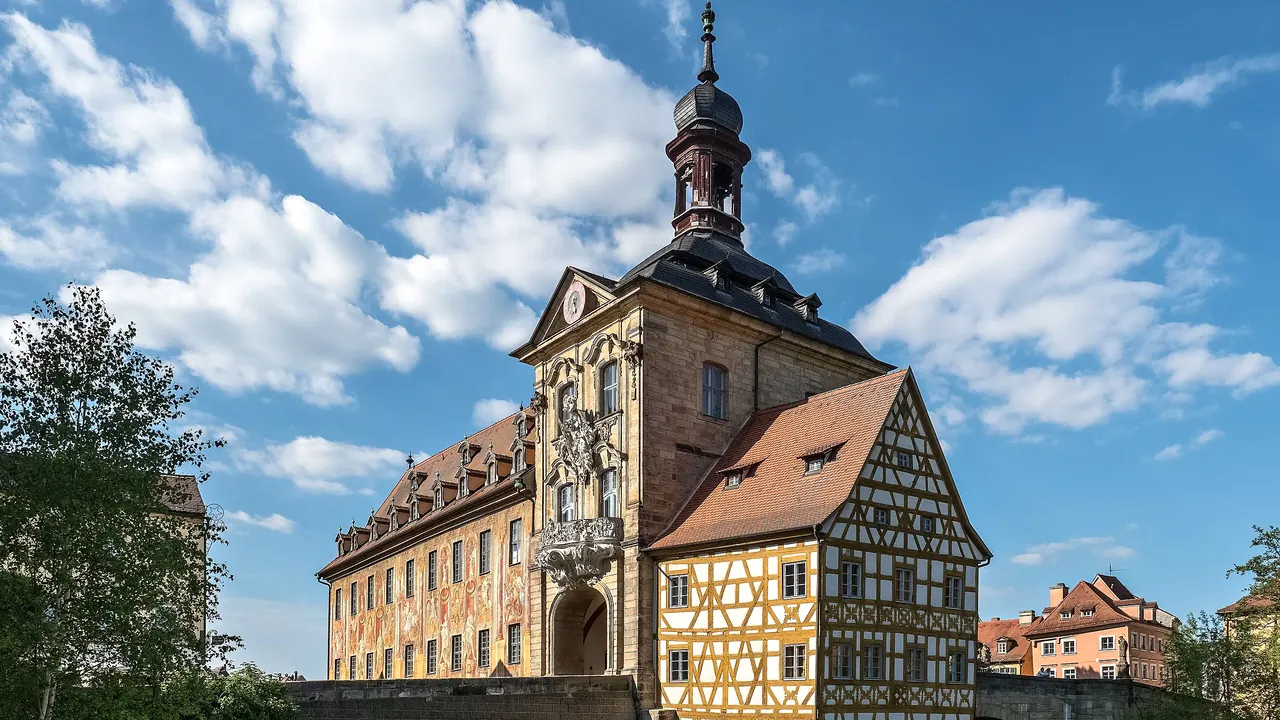
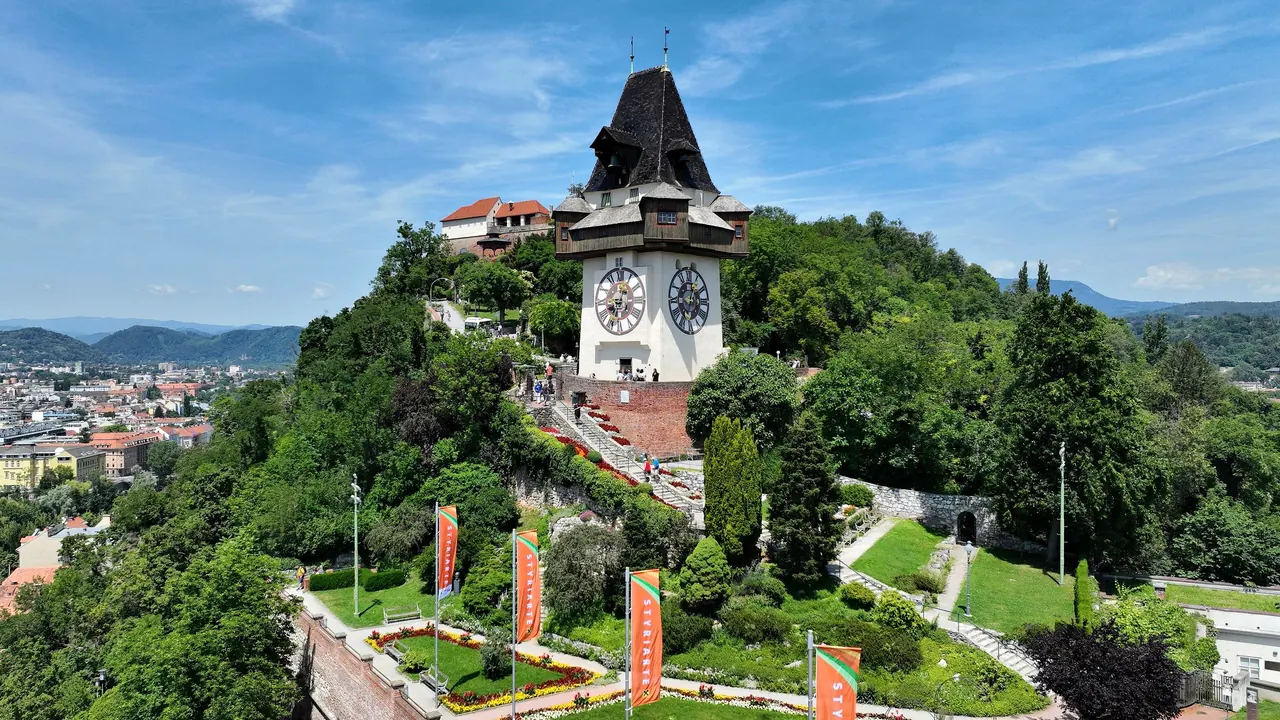
Photos: Bamberg by Ermell, CC BY-SA 4.0, cropped; Graz by C.Stadler/Bwag, CC BY-SA 4.0, cropped.
Bamberg or Graz?
Our verdict in twelve categories, each scored against the same fixed benchmark cities, and the climate month by month, so you can choose for your trip.
Choose Bamberg for
- prices
- day trips
- culture and sights
Bamberg suits travellers who want to spend their days walking an unbroken old town and their evenings in brewery taverns and hillside beer cellars. It costs a little less, and its place on the main Franconian rail line puts Nuremberg, Würzburg and Bayreuth within easy reach, so a stay there can be the base for a car-free tour of the region.
Choose Graz for
- families
- nature and the outdoors
- shopping
Graz is the better pick for a more rounded city stay. It has an opera house, a jazz scene and livelier student bars, and real hills close by, with the Schöckl and alpine hiking country within reach. Families do especially well there, thanks to the slide inside the Schlossberg, the fairytale train and a children's museum.
Scoreboard
Twelve categories on one fixed scale from 0 to 100. The shaded stretch is the gap between the two.
Your match
Pick a travel style or drag the sliders, and both match scores follow your weighting.
Wins on prices and day trips with your weighting.
Wins on families and nature and the outdoors with your weighting.
What matters to you?
Category by category
What the scores mean for a trip.
Beaches & swimming
Neither city is a place for beach time, and both cool off in fresh water. Bamberg's swimming is right in town, at the old river bathing spot in the Hain park on the Regnitz, with gravel-pit lakes on the outskirts. The Mur in Graz is not for swimming, so people head south to the grassy banks and jetties of Schwarzlsee, which warms to about 23°C in high summer.
Food & drink
The two are equally rewarding at the table, and both are proudly regional, but they revolve around different drinks. Bamberg is a beer town. Smoky Rauchbier is poured from wooden barrels, Schäufele and dumplings come out of old brewery taverns, and summer evenings move up to the Bierkeller under the chestnut trees.
Graz is built on Styria's larder and wine. Pumpkin seed oil goes on nearly everything, the morning farmers' markets at Kaiser-Josef-Platz and Lendplatz are worth a visit, and there is crisp Sauvignon Blanc from the southern hills. Neither city offers much beyond its own cuisine.
Culture & sights
Both have outstanding historic centres, but you experience them differently. Bamberg is about the townscape as a whole: a UNESCO-listed old town spread over seven hills, the four-towered cathedral with the Bamberg Horseman, and the Old Town Hall standing on its island in the Regnitz. You enjoy it by wandering, because the museums are small.
Graz gives you more to go inside. The Landeszeughaus armoury still holds thousands of suits of armour, and Schloss Eggenberg has state rooms and a peacock park. The blue Kunsthaus and the Murinsel add a modern contrast that Bamberg does not have.
Nightlife
Graz has more to offer after dark, though neither is a clubbing city. In the old-town lanes of the Bermuda Triangle, bars spill outside on summer nights, Lend has artier places, and a few clubs stay open late at weekends.
Bamberg's evenings are slower and centred on beer: brewery taverns after work, student bars in the Sand quarter, and long summer nights in the beer cellars. Most of the town is quiet well before the small hours, and anyone wanting more takes the train to Nuremberg.
Nature & outdoors
Graz has the more varied outdoors on its doorstep. The Schöckl has a cable car, trails and paragliders, the Grazer Bergland is a short bus ride out, and the limestone walls of the Gesäuse and the Hochschwab offer real alpine hiking.
Bamberg's countryside is gentler. The limestone valleys and rock towers of Franconian Switzerland begin less than an hour east, and there are the beech woods of the Steigerwald and cycle paths along the Main. You will find rolling hills and walks from one village brewery to the next, but no mountains or big views.
Day trips
Bamberg is the stronger base for outings, because the train does the work. Nuremberg's castle, Würzburg's Residence, Coburg's fortress and Bayreuth's opera houses are each about an hour away, with Vierzehnheiligen even closer.
From Graz, the best trips go into the countryside rather than to other cities: the South Styrian Wine Road, Riegersburg on its volcanic crag, the Lipizzaners at Piber and Admont's great library. Most are much easier by car, though Maribor across the Slovenian border is about an hour by train.
Good for families
Graz is clearly better with children. They can ride the glass lift up the Schlossberg and come down by the long slide inside the hill, take the Märchenbahn through the rock and visit FRida & freD, the children's museum in the Augarten. Trams take buggies easily.
Bamberg is safe and relaxed but offers less for children: playgrounds and boat hire along the Hain, a leisure pool with slides for wet days, and beer gardens where children play among the tables. The steep cobbles up to the cathedral are hard work with a pushchair.
Getting around
Both centres are easily walked, but Graz is a little easier. Its old town is flat and largely pedestrianised, trams run through the middle on one simple ticket, and a lift and a funicular take the effort out of the Schlossberg.
Bamberg is all on foot, with short but steep cobbled climbs to the cathedral and Michaelsberg, and its station is a fair walk from the old town. In return its rail links reach the rest of the region, whereas outside Graz the buses are sparse.
Shopping & style
Graz gives shoppers more to do. Kastner & Öhler, the city's grand department store, has a rooftop terrace, Herrengasse and Sporgasse are lined with traditional shops in old buildings, and Lend adds design studios and vintage stores. Pumpkin seed oil, Schilcher rosé and regional chocolate make good things to take home.
In Bamberg, shopping fills an hour at most. Beyond the chain stores and a few bookshops, the finds are bottled smoked beer, market-garden produce and the antique dealers near the cathedral.
Affordability
Bamberg is easier on the wallet. Local beer is cheap, a brewery-tavern dinner costs less than in a big city, and rooms are moderately priced apart from weekends and the Christmas market season.
Graz is fair rather than cheap. Student lunch menus and bakeries help, but sit-down dinners and wine are priced like anywhere in Austria. Combined tickets for the Joanneum museums soften the cost of sightseeing.
Live music & performing arts
Graz has much the broader stage. It has Austria's second-largest opera house with a full season of opera, ballet and operetta, the Styriarte early-music festival, steirischer herbst's avant-garde programme in autumn, and a jazz scene fed by the music university.
Bamberg's strength is narrower but real. The Bamberg Symphony is an orchestra of international standing, and there are organ and choral concerts in the cathedral and plays at the ETA Hoffmann Theatre. For opera you go an hour away to Bayreuth.
Wellness & relaxation
The two are much alike here. Neither has a bathing tradition of its own, so the spa trip happens outside town. From Bamberg, the brine pools of Bad Staffelstein are a simple half hour by train. From Graz, a whole string of thermal villages lies about an hour east, including Hundertwasser's grass-roofed Bad Blumau and Loipersdorf, so there is more choice but a longer trip. In town, Bamberg relaxes in its riverside mornings and beer gardens, while Graz has coffee houses and the shaded paths of the Schlossberg.
When should you go?
Pick your month. The climate figures are measured averages, not a forecast.
Bamberg in July
Graz in July
Daytime high, °C
Rainfall in the month, mm
Temperature and rainfall are climate normals, averaged over the years shown. Bamberg: 1991-2020 normals, Bamberg (2.8 km from centre). Graz: 1991-2020 normals, Graz Airport (7.9 km from centre).
Both cities are cold in winter and warm in summer, but the weather differs in other ways. In Bamberg, May to September is the time for walking and beer gardens, with highs in the low to mid twenties. The rain is spread fairly evenly through the year and peaks at only about 79mm in July. Winters are grey: from November to January the sun barely shows, and the cobbles are cold underfoot.
Graz is a touch warmer, reaching 27°C in July, and sunnier in every month. In January it gets nearly twice Bamberg's sunshine, which makes it the better choice for a crisp winter break. The catch is a much wetter summer, with about 125mm of rain in each month from June to August, though July and August are also when the bathing lakes south of the city are at their warmest. Late April, May, September and an October still near 16°C are the most comfortable months for walking there.
Which traveller are you?
On a family trip with children, Graz is the easier choice. The castle hill alone can fill a happy day, the trams spare tired legs, and the countryside around it keeps a longer stay interesting. Bamberg suits families only at a slow pace.
For an outdoors trip, Graz has the edge. Mountain walking starts close to town, and serious alpine country is within a couple of hours. Bamberg is better for cyclists and gentle walkers who prefer woodland and river paths to summits.
On a tight budget, your money goes further in Bamberg. Eating and drinking in the brewery taverns costs less than in Graz, you can walk everywhere in the old town, and the regional trains let you see Franconia without hiring a car.
Before you go
| Measure | Bamberg | Graz |
|---|---|---|
| Official language | German | German, Austrian Sign Language |
| Currency | Euro (EUR) | Euro (EUR) |
| Sockets | CF230 V, 50 Hz | CF230 V, 50 Hz |
| Driving side | Right | Right |
| Time zone | UTC+1, UTC+2 in summer | UTC+1, UTC+2 in summer |
| Emergency number | 112 | 112 |
| Elevation | 262 m | 353 m |
| Main airport | Nuremberg Airport (NUE)46 km from centre56 non-stop destinations | Graz Airport (GRZ)9 km from centre26 non-stop destinations |
| Public holidays this year | 12 days | 16 days |
By the numbers
| Measure | Bamberg | Graz |
|---|---|---|
| City population | 77,218 | 306,971 |
| People per km² | 1,414 | 2,406 |
| Museums within 10 km | 11 | 29 |
| UNESCO World Heritage sites within 50 km | 1 | 1 |
Where else could you go?
Every comparison below shares a destination with this one, so you can follow Bamberg or Graz somewhere new.
- Nurembergvs Bamberg
- Rothenburg ob der Taubervs Bamberg
- Bledvs Graz
- Ljubljanavs Graz
- Viennavs Graz
- Hallstattvs Graz