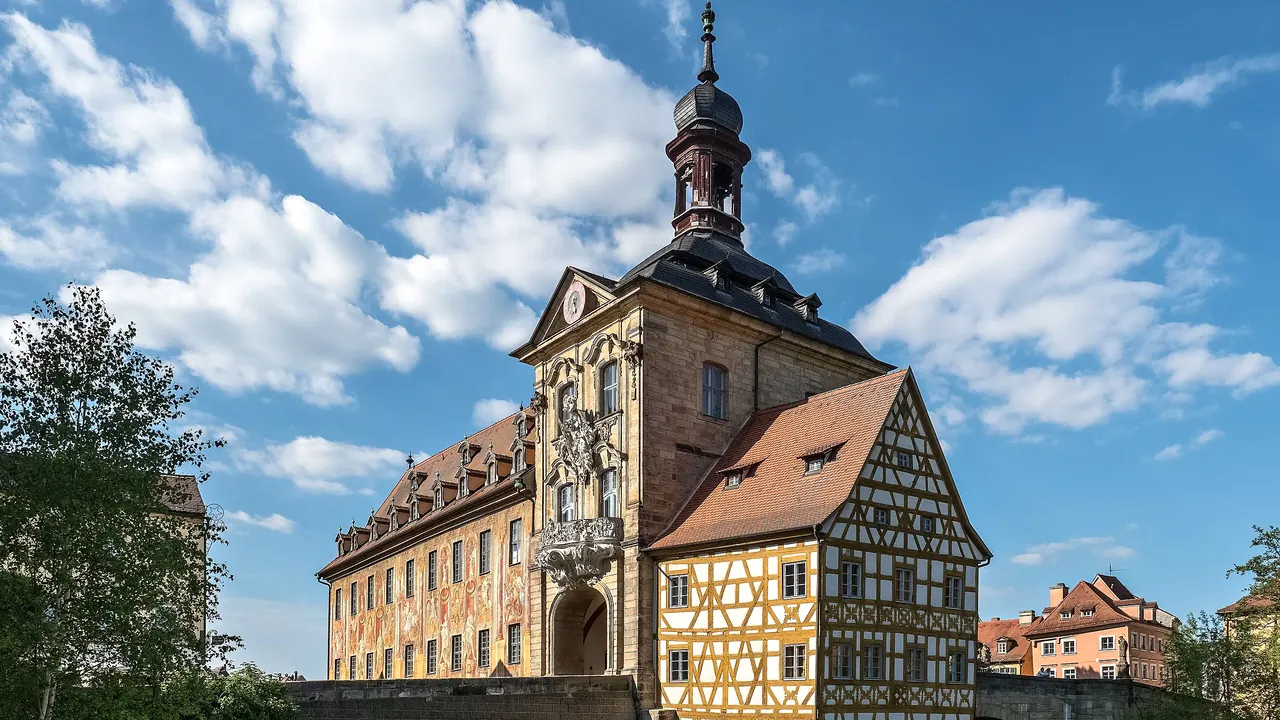
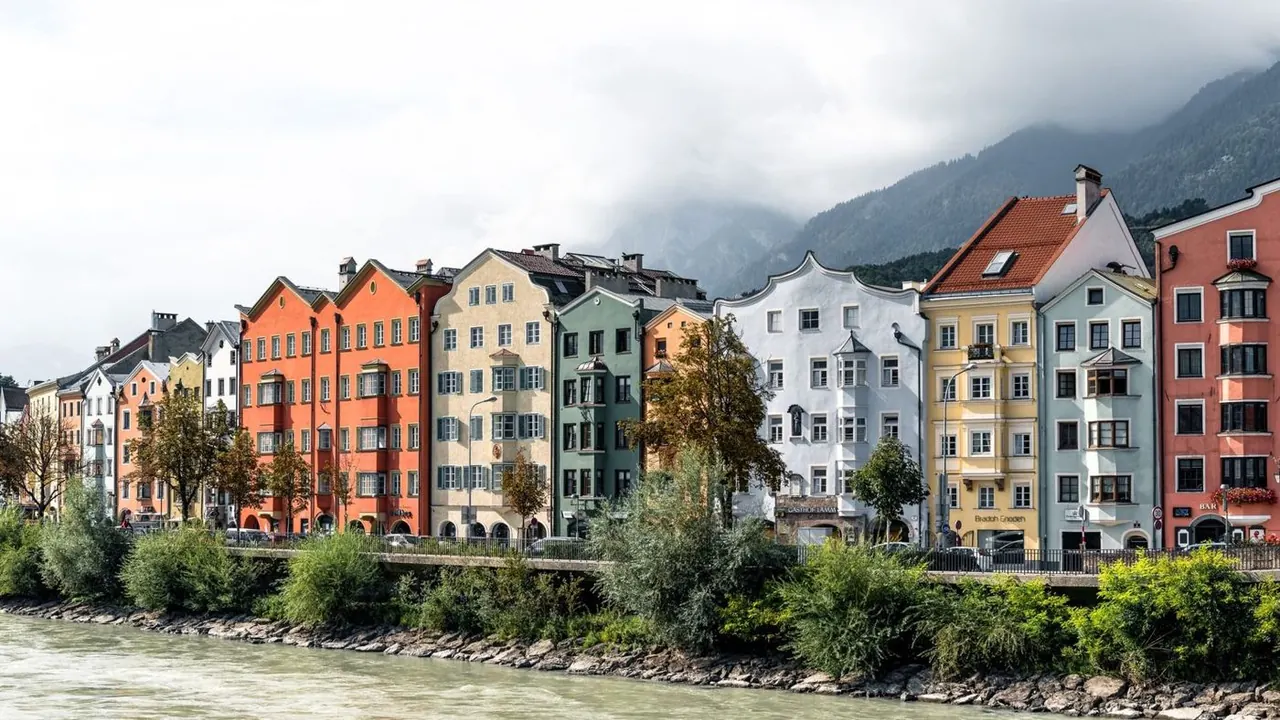
Photos: Bamberg by Ermell, CC BY-SA 4.0, cropped; Innsbruck by Wolfgang Weiser, Pexels License.
Bamberg or Innsbruck?
Our verdict in twelve categories, each scored against the same fixed benchmark cities, and the climate month by month, so you can choose for your trip.
Choose Bamberg for
- food and drink
- prices
- culture and sights
Bamberg suits travellers who want to wander one of Germany's great intact old towns at an easy pace, with a brewery tavern or a hillside beer garden waiting at the end of each walk. The cathedral hill, the island Town Hall and Little Venice reward slow sightseeing, the food is cheaper and more distinctive, and Nuremberg, Würzburg and Bayreuth are all close by train. Pick it for a culture-and-beer trip where the outdoors means gentle countryside.
Choose Innsbruck for
- nature and the outdoors
- families
- beaches
Anyone who wants mountains should go to Innsbruck. A funicular from the edge of the old town leads up to high Alpine ridges, so hiking, skiing and lake swimming fit around a compact Habsburg centre. It is better for families and for active trips, but expect to pay more, especially for lifts and in ski season.
Scoreboard
Twelve categories on one fixed scale from 0 to 100. The shaded stretch is the gap between the two.
Your match
Pick a travel style or drag the sliders, and both match scores follow your weighting.
Wins on food and drink and prices with your weighting.
Wins on nature and the outdoors and families with your weighting.
What matters to you?
Category by category
What the scores mean for a trip.
Beaches & swimming
Neither city has a sea, but Innsbruck makes the better summer swim. The Lanser See and Natterer See on the plateaus above town warm up to a pleasant temperature in high summer, with mountains all around, and the clear Achensee is beautiful to look at even if it is cold to swim in.
In Bamberg, cooling off means the river bathing spot in the Hain park, the gravel-pit lakes on the edge of town or a public pool. That is fine for a hot afternoon, but it is not a day out in itself.
Food & drink
Bamberg has the more memorable food, and nearly all of it comes back to beer. Smoky Rauchbier poured from wooden barrels in centuries-old brewery taverns, long summer evenings in the Bierkeller under chestnut trees, and the market gardeners' stalls on Grüner Markt give eating there a strong local identity.
Innsbruck's Tyrolean cooking, such as Gröstl, Kaspressknödel and Kaiserschmarrn, is at its best in a mountain hut after a hike, and the coffee houses do good strudel. In town, though, there is no market culture, and the inns around the Golden Roof cater largely to tour groups. Neither city offers much international range.
Culture & sights
Bamberg comes out ahead because the whole town is the sight. Its UNESCO-listed old centre survived the war almost untouched and spreads over seven hills, from the four-towered cathedral with the Bamberg Horseman to the frescoed Town Hall standing in the Regnitz. Its museums are small, and the reward is walking rather than looking at collections.
Innsbruck's historic core is smaller, but it has stronger single sights. Emperor Maximilian's tomb in the Hofkirche, ringed by bronze figures, and the Renaissance cabinet of curiosities at Ambras Castle beat anything Bamberg has indoors. Two or three days see both cities well.
Nightlife
Neither city is built for big nights, but Innsbruck stays up a little later. The bars and small clubs in the brick arches under the railway viaduct keep going late at weekends, and in winter many visitors head to après-ski in the resorts instead.
Bamberg's evenings are about beer rather than dancing. The brewery taverns fill up after work, the Sand quarter's student bars stay busy in term time, and the hillside beer cellars are the place to spend a summer evening. The town is quiet early, and the big nights out are in Nuremberg.
Nature & outdoors
Here the two cities could hardly be further apart. In Innsbruck, the funicular and the Nordkette cable cars lift you from the old town to a ridge at about 2,300m. The Karwendel lies behind it, and across the valley are the Patscherkofel, the Stubai Glacier and a year of skiing, hut-to-hut hiking, paragliding and rafting.
Bamberg's countryside is gentle by comparison. There are limestone valleys and rock towers in Franconian Switzerland, beech forest in the Steigerwald, and cycle paths along the Main past orchard villages, with walks that link one village brewery to the next.
Day trips
Both cities make excellent bases, but they reach different worlds. From Bamberg, the trips are short rail hops around Franconia: Nuremberg's castle, Würzburg's Residence, Coburg, Bayreuth and the baroque basilica of Vierzehnheiligen, most of them within about an hour.
From Innsbruck, you can cover three countries but travel further. Hall in Tirol is minutes away, while Munich and Salzburg take nearly two hours, as do Bolzano and Merano over the Brenner Pass. Neuschwanstein is easiest by car.
Good for families
Innsbruck is the easier choice with children because the outdoors does the work. The Alpenzoo with its ibex, bears and lynx sits just up the funicular. In summer there are mountain adventure trails, playgrounds by the huts and warm plateau lakes, and in winter there are ski schools on gentle slopes.
Bamberg is safe and relaxed, with playgrounds and rowing boats in the Hain, a leisure pool with slides and beer gardens where children play among the tables. Beyond that, little is aimed at young visitors, and the cobbles up the cathedral hill are hard work with a pushchair.
Getting around
Both are walkable cities where a car is unnecessary, and Innsbruck has a slight edge. Its centre is flat, its main station is central, and trams run out to Igls and the Stubai valley. Above all, the mountain funicular starts at the edge of the old town.
Bamberg's sights are also minutes apart, but reaching the cathedral and Michaelsberg means short, steep climbs over uneven cobbles, and the station is a fair walk from the old town. Buses and bicycles cover the flat lower town.
Shopping & style
Neither city is a shopping destination, and what you take home differs in kind. In Bamberg the best finds are things to eat and drink: produce from the town's market gardens and bottled smoked beer from the brewery shops. There are also antique dealers around the cathedral quarter.
Innsbruck leans towards Alpine crafts and gear. The old town arcades sell loden jackets, dirndls, woodcarvings and crystal, and the specialist outdoor and ski shops are excellent if you are kitting out for the mountains.
Affordability
Bamberg is clearly the cheaper stay. The local beer and the tavern meals cost less than in a big German city, hotels are moderately priced for most of the year, and you walk everywhere.
Innsbruck adds an Alpine resort premium. Hotels are dearest in ski season, the inns are filling but not cheap, and cable car tickets soon add up. The guest and city cards help, and spring and autumn are noticeably cheaper.
Live music & performing arts
The two programmes are of similar size but differ in kind. Bamberg's strength is orchestral: the Bamberg Symphony has a real international reputation and plays in its concert hall on the Regnitz, and there are organ and choral concerts in the cathedral. It has no opera company, though Bayreuth's festival is an hour away.
Innsbruck has more on stage, with opera, operetta and dance at the Tiroler Landestheater. Its summer Festival of Early Music, held partly in the Spanish Hall at Ambras Castle, is the city's musical highlight.
Wellness & relaxation
Neither city has baths of its own, so the difference is in how you unwind. Bamberg's calm comes from its slow pace, with mornings by the river and long afternoons in shaded beer gardens. The warm brine pools of Bad Staffelstein are half an hour away by train.
Innsbruck offers the Alpine version: mountain air, hotel spas with valley views up in Igls, and the large thermal complexes of the Ötztal and Zillertal about an hour away.
When should you go?
Pick your month. The climate figures are measured averages, not a forecast.
Bamberg in July
Innsbruck in July
Daytime high, °C
Rainfall in the month, mm
Temperature and rainfall are climate normals, averaged over the years shown. Bamberg: 1991-2020 normals, Bamberg (2.8 km from centre). Innsbruck: 1991-2020 normals, Innsbruck-Flughafen (3.3 km from centre).
Temperatures in the two cities run almost in step. Winter days are cold, around 4°C, and summer peaks near 26°C in July. May to September is the comfortable time for walking the streets, and only July and August are warm enough to swim in a river, lake or outdoor pool. Where they differ is rain. Bamberg is fairly dry all year, and even its wettest month, July, sees only about 79mm. Innsbruck's summers are much wetter, with rain building to around 144mm in August, so a summer mountain trip there needs some slack for wet days.
Through the cold half of the year the balance tips the other way. From November to February Innsbruck gets roughly twice Bamberg's sunshine, which makes its clear winter days good for skiing and for city walks. Bamberg's winters are grey and short on daylight. Spring and early autumn suit both cities, and they are drier in Innsbruck than its high summer.
Which traveller are you?
On a trip on a tight budget, Bamberg is the better choice. Its prices are ordinary for Western Europe and kept down by Franconian habits, so rooms and meals cost less. Innsbruck charges an Alpine premium, and an active stay there costs more again.
For an outdoors trip, Bamberg's gentle Franconian countryside cannot compete with Innsbruck, where high Alpine terrain starts at the edge of the old town. There, hiking, climbing and skiing fit into an ordinary day instead of needing a separate excursion.
On a family trip with children, Bamberg offers a safe town and a slow pace but little else aimed at the young. Innsbruck has more for children because the mountains act as their playground, summer and winter, and they are only minutes from the centre.
Before you go
| Measure | Bamberg | Innsbruck |
|---|---|---|
| Official language | German | German, Austrian Sign Language |
| Currency | Euro (EUR) | Euro (EUR) |
| Sockets | CF230 V, 50 Hz | CF230 V, 50 Hz |
| Driving side | Right | Right |
| Time zone | UTC+1, UTC+2 in summer | UTC+1, UTC+2 in summer |
| Emergency number | 112 | 112 |
| Elevation | 262 m | 574 m |
| Main airport | Nuremberg Airport (NUE)46 km from centre56 non-stop destinations | Innsbruck Airport (INN)4 km from centre40 non-stop destinations |
| Public holidays this year | 12 days | 16 days |
By the numbers
| Measure | Bamberg | Innsbruck |
|---|---|---|
| City population | 77,218 | 132,499 |
| People per km² | 1,414 | 1,263 |
| Museums within 10 km | 11 | 28 |
| UNESCO World Heritage sites within 50 km | 1 | 1 |
Where else could you go?
Every comparison below shares a destination with this one, so you can follow Bamberg or Innsbruck somewhere new.
- Nurembergvs Bamberg
- Rothenburg ob der Taubervs Bamberg
- Munichvs Innsbruck
- Cortina d'Ampezzovs Innsbruck
- Salzburgvs Innsbruck
- Karlovy Varyvs Bamberg