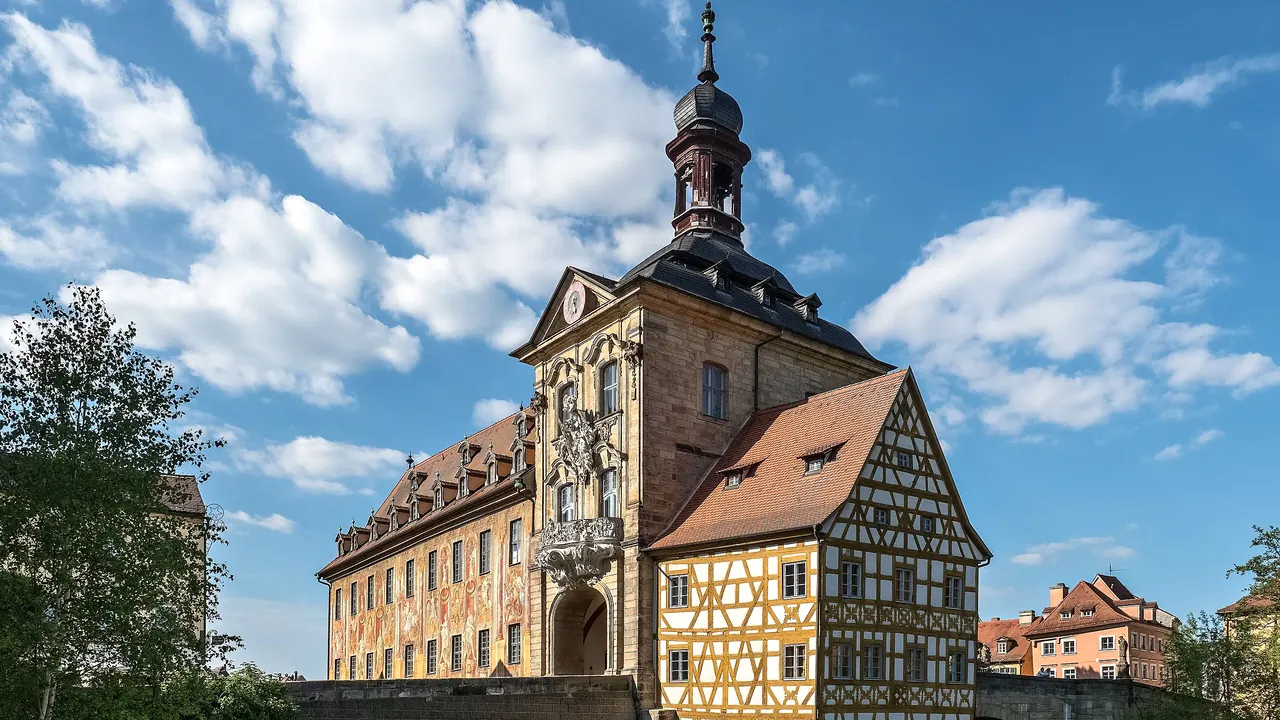
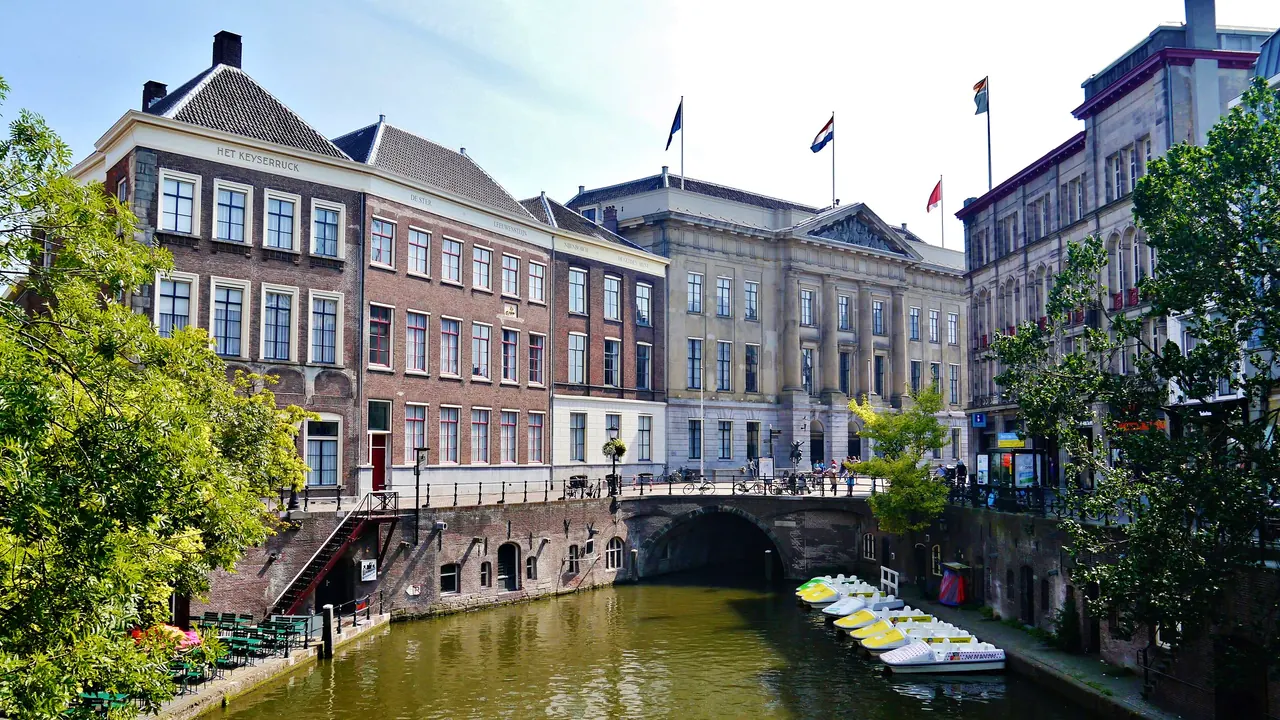
Photos: Bamberg by Ermell, CC BY-SA 4.0, cropped; Utrecht by Zairon, CC BY-SA 4.0, cropped.
Bamberg or Utrecht?
Our verdict in twelve categories, each scored against the same fixed benchmark cities, and the climate month by month, so you can choose for your trip.
Choose Bamberg for
- prices
- food and drink
- culture and sights
Bamberg suits travellers who want to stay in one place and soak it up. Its old town survived the war almost whole, its seven hills and island town hall reward slow walking, and its brewery taverns and hillside beer cellars give it a food and drink identity Utrecht cannot match. It is also the cheaper stay, and walkers will find rock valleys and beech forest close by.
Choose Utrecht for
- families
- shopping
- day trips
Pick Utrecht if the city is a base rather than the whole trip. Amsterdam, Rotterdam, The Hague and Delft are all short train rides from the station on the edge of the old town. Back in the city there is more to do in the evenings, on stage and in the shops, and it is the easier place to bring children. The trade-off is the price of a room.
Scoreboard
Twelve categories on one fixed scale from 0 to 100. The shaded stretch is the gap between the two.
Your match
Pick a travel style or drag the sliders, and both match scores follow your weighting.
Wins on prices and food and drink with your weighting.
Wins on families and shopping with your weighting.
What matters to you?
Category by category
What the scores mean for a trip.
Beaches & swimming
Neither city is a beach destination, and in both the summer swim is a local lake. Bamberg has the river bathing spot in the Hain park on the Regnitz and gravel-pit lakes on the edge of town, with the sea a full day away. Utrecht has recreation lakes such as the Maarsseveense Plassen, and it also has the North Sea at Zandvoort or Scheveningen about an hour or more away by train, though the water there stays cool.
Food & drink
Bamberg is the one to choose for food and drink, as long as beer and hearty cooking are what you are after. Smoky Rauchbier poured from wooden barrels, Schäufele with dumplings and long evenings at the hillside Bierkeller give it a character Utrecht simply does not have.
Utrecht offers range instead. Its Indonesian and Surinamese kitchens and bistros around the Twijnstraat and Lombok are varied and casual, and eating on the cellar wharves of the Oudegracht is the memorable part. The setting matters more than the cooking there.
Culture & sights
Both have medieval centres that escaped heavy damage, but Bamberg's is the richer townscape. It is UNESCO-listed as a whole, with the four-towered Imperial Cathedral and the Bamberg Horseman, the Old Town Hall on its island in the Regnitz, and Michaelsberg Abbey above Little Venice.
Utrecht is a smaller set of highlights with stronger collections. You can climb the Dom Tower, see the cloister standing apart from it, and visit the Centraal Museum's De Stijl rooms and the Rietveld Schröder House. Bamberg is for wandering, Utrecht for a few targeted visits.
Nightlife
Utrecht has the livelier evenings. Its large student population fills the bars around the Neude, the Janskerkhof and the Oudegracht on weeknights too, and it has a handful of clubs. Bamberg's nights are slower and built around beer: brewery taverns after work, student bars in the Sand quarter during term, and quiet streets well before the small hours. Each city sends its serious party-goers to a bigger neighbour, Amsterdam or Nuremberg.
Nature & outdoors
Bamberg has the more varied countryside on its doorstep. Franconian Switzerland, with limestone valleys, rock towers, caves and castle-topped crags, starts less than an hour east, and the Steigerwald beech forests lie to the west. Walkers can link one village brewery to the next.
Utrecht's surroundings are flatter and best seen by bike, along the Vecht past windmills and country estates and into the polders. The heath and wooded ridges of the Utrechtse Heuvelrug are its closest thing to walking country, and the Loosdrecht lakes add sailing.
Day trips
Both make good bases, but Utrecht's position at the hub of the Dutch rail network is hard to beat. Amsterdam is under half an hour away, and Rotterdam, The Hague, Delft, Leiden and Gouda are all simple rides, so you can cover much of the country without moving hotel.
Bamberg's outings take a little longer and are more regional. Nuremberg, the Würzburg Residence, Coburg and Bayreuth are each around an hour, and the baroque basilica of Vierzehnheiligen is closer still.
Good for families
Utrecht is much the better city for children. The national Railway Museum and the Miffy museum are aimed squarely at them, and the castle at De Haar makes a fairy-tale outing. The only real hazard is the constant stream of bikes.
Bamberg is safe and relaxed, with playgrounds and boat hire in the Hain park and beer gardens where children play among the tables. Beyond those it has little made for young visitors, and pushing a buggy up the cathedral hill is hard work.
Getting around
Both centres are walkable and neither needs a car, but Utrecht is the smoother of the two. Its main station sits right at the edge of the old town, the streets are flat, and trams, buses and trains share one tap-in card. Bamberg is compact too, but the station is a fair walk out, and the short climbs to the cathedral and Michaelsberg are steep and cobbled.
Shopping & style
Utrecht is the better place to shop. Independent fashion, design and homeware shops line the Oudegracht wharves, the Elisabethstraat and the Twijnstraat, Hoog Catharijne covers the chains, and the flower and textile markets add colour.
Bamberg has mostly chain stores on Grüner Markt and Lange Strasse. Its best buys are edible: market-garden produce and bottled smoked beer, plus the antique dealers near the cathedral.
Affordability
Bamberg is clearly the cheaper stay. Beer and tavern meals cost less than in a big city, and rooms are moderately priced except at weekends and during the Christmas market season.
In Utrecht the bed is the problem. Central hotels are few and priced like those in any large Western European city, and dinners with drinks add up. Cheap student cafés and the compact centre help, but they do not close the gap.
Live music & performing arts
Utrecht has the broader stage life. TivoliVredenburg stacks classical, pop, jazz and experimental music under one roof, and the Festival Oude Muziek draws early-music lovers from across Europe. Theatre, however, is mostly in Dutch.
Bamberg's strength is narrower but real: the Bamberg Symphony is an orchestra of international standing, and the cathedral hosts organ and choral concerts. The Bayreuth Festival is within an hour for opera.
Wellness & relaxation
Neither city has a bathing tradition of its own, so in both the calm comes mostly from the pace. What differs is the spa trip: from Bamberg it is a half-hour train ride to the warm brine pools of Bad Staffelstein, while from Utrecht you take a short drive or bus to the large Dutch sauna complexes in the green belt. For quiet moments, Bamberg has its shaded beer gardens and Utrecht has the Pandhof cloister garden and its canal wharves in the evening.
When should you go?
Pick your month. The climate figures are measured averages, not a forecast.
Bamberg in July
Utrecht in July
Daytime high, °C
Rainfall in the month, mm
Temperature and rainfall are climate normals, averaged over the years shown. Bamberg: 1991-2020 normals, Bamberg (2.8 km from centre). Utrecht: 1991-2020 normals, De Bilt (4.3 km from centre).
Both cities are best from May to September, but they feel different. Bamberg has the warmer summer, reaching about 26°C in July, and it is noticeably drier through most of the year, though July brings summer downpours. Its winters are colder, with daytime highs of around 4°C from December to January, so the cobbled climbs to the cathedral are pleasanter in spring and early autumn. Bamberg also gets slightly more sun in high summer.
Utrecht is milder at both ends of the year and never really hot, peaking in the low twenties. It is wetter, and the rain stays heavy from July right through winter at around 80mm a month, so autumn there is greyer and damper than in Franconia. The North Sea within reach of Utrecht warms to about 19°C only in August, which makes a beach day a warm-spell treat rather than a plan.
Which traveller are you?
For a trip on a tight budget, Bamberg is the safer choice. Its sights are mostly the streets themselves, so a full day of walking costs little and evenings stay cheap. Utrecht can be done cheaply by day, but its rooms eat the savings.
On a family trip with young children, Bamberg suits a slow few days by the river, but Utrecht is the stronger pick. It has attractions built for small visitors and level streets, and Dutch habits take children everywhere, so the days plan themselves.
On a shopping trip, Bamberg's shops fill a spare hour, and its best buys are things to eat and drink. Utrecht is worth whole afternoons of browsing, especially for people who would rather find something unusual in a small shop than chase big brands.
Before you go
| Measure | Bamberg | Utrecht |
|---|---|---|
| Official language | German | Dutch |
| Currency | Euro (EUR) | Euro (EUR) |
| Sockets | CF230 V, 50 Hz | CF230 V, 50 Hz |
| Driving side | Right | Right |
| Time zone | UTC+1, UTC+2 in summer | UTC+1, UTC+2 in summer |
| Emergency number | 112 | 112 |
| Elevation | 262 m | 5 m |
| Main airport | Nuremberg Airport (NUE)46 km from centre56 non-stop destinations | Amsterdam Airport Schiphol (AMS)34 km from centre287 non-stop destinations |
| Public holidays this year | 12 days | 11 days |
By the numbers
| Measure | Bamberg | Utrecht |
|---|---|---|
| City population | 77,218 | 359,370 |
| People per km² | 1,414 | 3,619 |
| Museums within 10 km | 11 | 28 |
| UNESCO World Heritage sites within 50 km | 1 | 5 |
| Swim season, months above 21 °C | - | None |
Where else could you go?
Every comparison below shares a destination with this one, so you can follow Bamberg or Utrecht somewhere new.
- Amsterdamvs Utrecht
- Haarlemvs Utrecht
- Rotterdamvs Utrecht
- Nurembergvs Bamberg
- The Haguevs Utrecht
- Rothenburg ob der Taubervs Bamberg