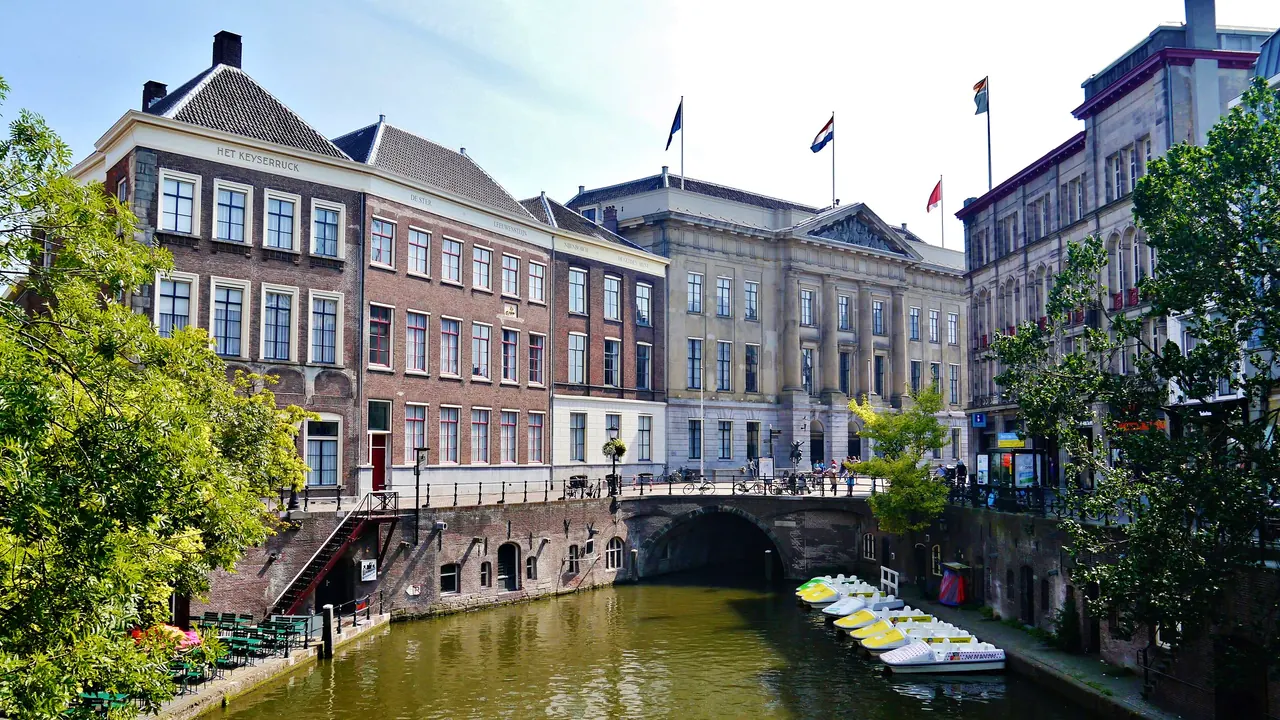
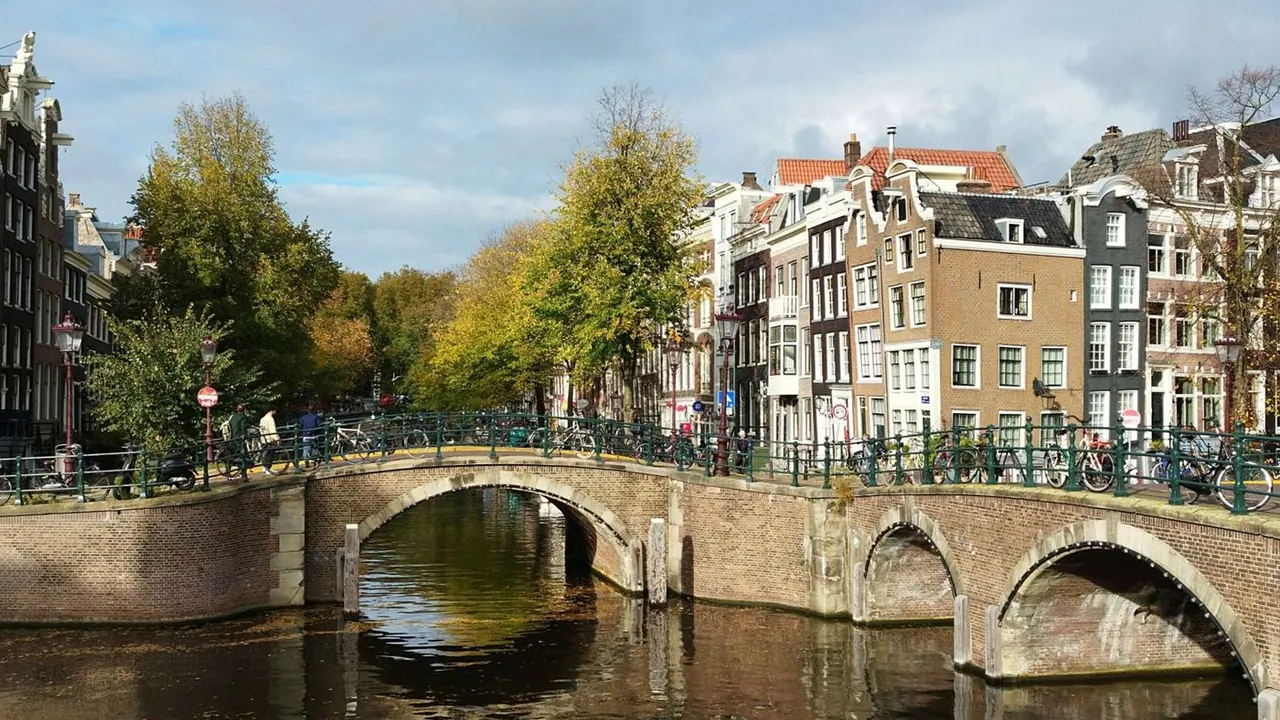
Photos: Utrecht by Zairon, CC BY-SA 4.0, cropped; Amsterdam by Hans, Pexels License.
Utrecht or Amsterdam?
Our verdict in twelve categories, each scored against the same fixed benchmark cities, and the climate month by month, so you can choose for your trip.
Choose Utrecht for
- prices
- nature and the outdoors
Utrecht is better for a calmer, slightly cheaper stay with a medieval core that has more of a local feel than a tourist one. The Dom Tower, the two-level Oudegracht wharves and the Rietveld Schröder House fill two or three easy days. Its real advantage is position. From the hub of the rail network you can reach Rotterdam, The Hague, Gouda and Arnhem quickly, and Amsterdam itself is under half an hour away, so it makes a sensible base for touring the country without changing hotels.
Choose Amsterdam for
- nightlife
- culture and sights
- live music and the arts
Amsterdam suits travellers who want a great deal packed into a few days: world-class art at the Rijksmuseum and Van Gogh Museum, the Anne Frank House, the Concertgebouw, serious clubbing and the best eating and shopping in the country. It is the stronger choice for a first visit to the Netherlands, for anyone who wants late nights, and for families who want the big-name museums and Artis. The trade-offs are crowds in the centre and some of the costliest beds in Europe.
Scoreboard
Twelve categories on one fixed scale from 0 to 100. The shaded stretch is the gap between the two.
Your match
Pick a travel style or drag the sliders, and both match scores follow your weighting.
Wins on prices and nature and the outdoors with your weighting.
Wins on nightlife and culture and sights with your weighting.
What matters to you?
Category by category
What the scores mean for a trip.
Beaches & swimming
Neither city is a place for a beach vacation, but Amsterdam is closer to the coast. The dune-backed sand at Zandvoort and Bloemendaal is about half an hour away by train. From Utrecht the North Sea at Zandvoort or Scheveningen takes an hour or more, so a beach afternoon becomes most of a day.
Swimming in town works much the same way in both cities: Amsterdam has the man-made IJburg beaches and the Sloterplas, while Utrecht has the Maarsseveense Plassen and the Loosdrecht lakes. All of these are for cooling off on a hot day, not a reason to come.
Food & drink
Amsterdam gives you more to eat and drink. The trading-history dishes are the reason to look: Indonesian rijsttafel, Surinamese roti, raw herring from the stalls. Its drinking culture of jenever tasting rooms and the early-evening borrel has more depth than Utrecht's. The places to look are De Pijp, the Jordaan and Oost, not the streets around Damrak.
In Utrecht the setting matters more than the cooking. Eating on a wharf terrace by the Oudegracht at water level is a real pleasure, and the student crowd keeps casual kitchens going around the Twijnstraat and Lombok. Fine dining is thin, though, and few people come here for the food.
Culture & sights
Amsterdam is in a different league for museums. Rembrandt's Night Watch, the largest Van Gogh collection anywhere and the Anne Frank House are all within a short walk, and the whole UNESCO canal ring of merchant houses surrounds them. Allow three or four days to do it properly.
Utrecht's appeal is more intimate. You can climb the Dom Tower, look across to the cathedral choir standing apart since the 1674 storm, and walk the split-level Oudegracht, which has no equal elsewhere in the country. Its museums are modest, but the Rietveld Schröder House and the De Stijl holdings give design lovers something Amsterdam does not.
Nightlife
Amsterdam has a far bigger night scene. Clubs with all-night licences fill converted industrial buildings across the IJ in Noord, and the Amsterdam Dance Event takes over the city each October. For a quieter drink, canal-side terraces in the Jordaan and De Pijp are better than the crowded Leidseplein.
Utrecht's evenings are mostly student-driven, in bars around the Neude and the Janskerkhof and on terraces by the canal. They are lively on weeknights too, but clubs are few, and people after a proper night out usually head to Amsterdam.
Nature & outdoors
Both sit in flat, green country best seen by bike, so the difference is in the kind of landscape. From Amsterdam a ferry over the IJ leads to the meadows and wooden villages of Waterland, and the coastal dunes of Zuid-Kennemerland have bison and sea air.
Utrecht offers woodland instead. The Utrechtse Heuvelrug has low wooded ridges, heath and sandy trails good for mountain biking, the Vecht is lined with country estates, and the Loosdrecht lakes are for sailing.
Day trips
Both are excellent bases, and what differs is which direction is easiest. Amsterdam is better placed for the north and the old Zuiderzee: Haarlem is a quarter of an hour away, and Zaanse Schans, Volendam, Marken and the spring Keukenhof fields are all close.
Utrecht sits at the middle of the rail network, which puts Rotterdam and The Hague nearer and opens up the east and south. From there you can reach Kasteel de Haar, the Kröller-Müller Museum, the open-air museum near Arnhem and Den Bosch, with Amsterdam itself as an easy day out.
Good for families
Amsterdam has a little more for children. Artis, one of the oldest zoos in Europe, and the hands-on NEMO science museum are the big draws, with canal boats and pancake houses around them. The cost is the unfenced canal edges and the steep stairs of the old houses, so small children need watching.
Utrecht is calmer and smaller. The national Railway Museum, set in an old station, and the Miffy museum for toddlers are both excellent, and Kasteel de Haar makes a good fairy-tale outing. For a zoo you need to take a train.
Getting around
Both are easy, but in different ways. Amsterdam has a full network of trams, a north-south metro and free ferries to Noord, plus a direct train to Schiphol. You will use them, because the city spreads further than Utrecht does.
In Utrecht, Centraal station opens straight onto the old town, and the Dom, the canals and even the Railway Museum are a short walk away, so many visitors barely use local transport. In both cities the bikes are the main hazard on foot, and a car is a burden.
Shopping & style
Amsterdam has the wider range. The Nine Streets are packed with boutiques and vintage shops, PC Hooftstraat carries the luxury labels, and De Bijenkorf anchors Dam Square. The Noordermarkt, Waterlooplein and the floating Bloemenmarkt add markets Utrecht cannot match.
Utrecht's independent shops along the Oudegracht wharves and the Twijnstraat are good for an afternoon of browsing, and Hoog Catharijne handles the chains. With almost no luxury brands, serious fashion shoppers take the train to Amsterdam.
Affordability
Neither is cheap, but Utrecht is gentler on the wallet. Amsterdam's canal-ring hotels are among the dearest in Europe and carry a hefty tourist tax, which is why sleeping in Haarlem or in Utrecht itself is a common way round them. Utrecht's central rooms are scarce and dearer at weekends and in festival weeks, but they start from a lower point.
In Amsterdam the daily savings come from the street: herring and fries from the stalls, the Albert Cuyp market, and trams that are reasonably priced, though over a few days you will use them often. In Utrecht you can mostly do without local transport, a rental bike covers the outer districts, and the Vredenburg market has cheese and herring for a picnic. A sit-down dinner with drinks costs normal Dutch prices in both.
Live music & performing arts
Amsterdam offers far more on stage. The Concertgebouw and its orchestra are among the best in the world, the Dutch National Opera and Ballet perform on the Amstel, the Bimhuis covers jazz, and Paradiso and the Melkweg host touring bands. The Holland Festival adds international work each June.
Utrecht does well for its size. TivoliVredenburg mixes classical, pop and jazz under one roof, and the Festival Oude Muziek draws early-music lovers from across Europe. There is no opera house, and in both cities most theatre is in Dutch.
Wellness & relaxation
Neither has a bathing tradition, and in both the serious relaxing happens in large, Dutch-style sauna complexes on the city edge. Amsterdam has more hotel spas to fall back on. Its central streets stay crowded, though, so calm means an early canal walk or the Vondelpark.
Utrecht's centre quietens once the day-trippers leave. Evenings on the canal wharves and the cloister garden of the Pandhof beside the Dom make it the more restful place to stay, even though its hotel spas are few.
When should you go?
Pick your month. The climate figures are measured averages, not a forecast.
Utrecht in July
Amsterdam in July
Daytime high, °C
Rainfall in the month, mm
Where the figures come from
Amsterdam has no rain gauge within 25 km of the centre, so its rainfall comes from a gridded climate dataset read at the city rather than from a gauge further away.
Amsterdam's sunshine is measured 35 km from the centre, at De Bilt.
Temperature and rainfall are climate normals, averaged over the years shown. Utrecht: 1991-2020 normals, De Bilt (4.3 km from centre). Amsterdam: 1991-2020 normals, Amsterdam Airport Schiphol (12 km from centre).
The two cities share almost the same climate, so choosing between them makes little difference to the weather. Both are at their best from late May to early September, when afternoons reach about 22°C in Amsterdam and 23°C in Utrecht and May and June bring the longest sunny spells. Neither ever gets too hot for walking. The North Sea warms to around 19°C at best in August, which is bracing rather than inviting, so beach days on the coast are for walking more than swimming. April is the driest month in both and is pleasant for cycling and sightseeing.
Autumn is where they part a little. Amsterdam gets its heaviest rain in October, about 102mm, while Utrecht's wet months are more even and October brings around 81mm. From November to February both are cold, grey and short on daylight, which is fine for museums and brown cafés but poor for cycling out into the countryside.
Which traveller are you?
For a culture and arts trip, Amsterdam is the clear pick. The Rijksmuseum and Van Gogh Museum share the Museumplein, the Anne Frank House stands on the UNESCO canal ring, and the Concertgebouw and the opera on the Amstel fill the evenings.
On a food and nightlife trip, Amsterdam again pulls ahead. Rijsttafel, Surinamese roti and jenever in centuries-old tasting rooms lead on to all-night clubs in Noord. Utrecht's student bars are cheerful, but visitors wanting a bigger night take the train.
For a trip on a tight budget, Utrecht is the easier choice, though neither is cheap. A bed still costs a lot, but museum fees are modest, student lunch cafés keep meals simple, and Amsterdam is close enough for a day visit.
Before you go
| Measure | Utrecht | Amsterdam |
|---|---|---|
| Official language | Dutch | Dutch |
| Currency | Euro (EUR) | Euro (EUR) |
| Sockets | CF230 V, 50 Hz | CF230 V, 50 Hz |
| Driving side | Right | Right |
| Time zone | UTC+1, UTC+2 in summer | UTC+1, UTC+2 in summer |
| Emergency number | 112 | 112 |
| Elevation | 5 m | -2 m |
| Main airport | Amsterdam Airport Schiphol (AMS)34 km from centre287 non-stop destinations | Amsterdam Airport Schiphol (AMS)12 km from centre287 non-stop destinations |
| Public holidays this year | 11 days | 11 days |
By the numbers
| Measure | Utrecht | Amsterdam |
|---|---|---|
| City population | 359,370 | 921,468 |
| People per km² | 3,619 | 4,208 |
| Museums within 10 km | 28 | 101 |
| UNESCO World Heritage sites within 50 km | 5 | 5 |
| Swim season, months above 21 °C | None | None |
Where else could you go?
Every comparison below shares a destination with this one, so you can follow Utrecht or Amsterdam somewhere new.
- Haarlemvs Amsterdam
- Haarlemvs Utrecht
- Rotterdamvs Utrecht
- The Haguevs Amsterdam
- The Haguevs Utrecht
- Rotterdamvs Amsterdam