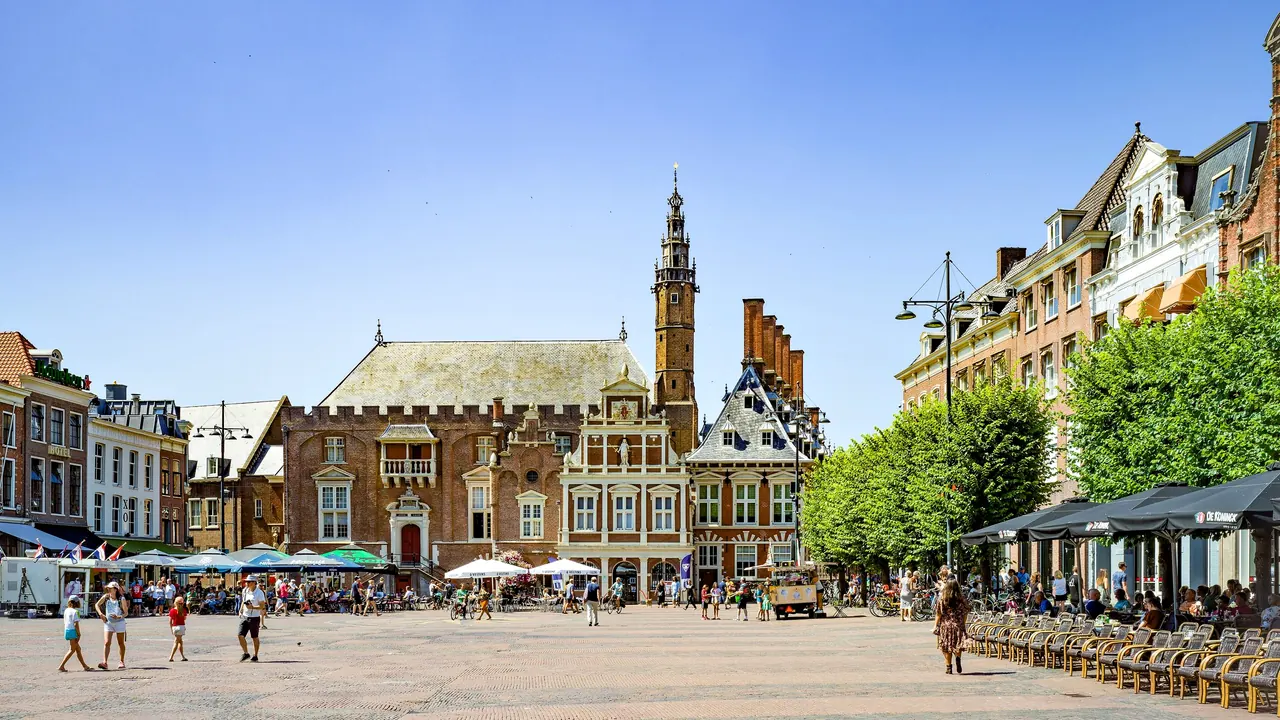
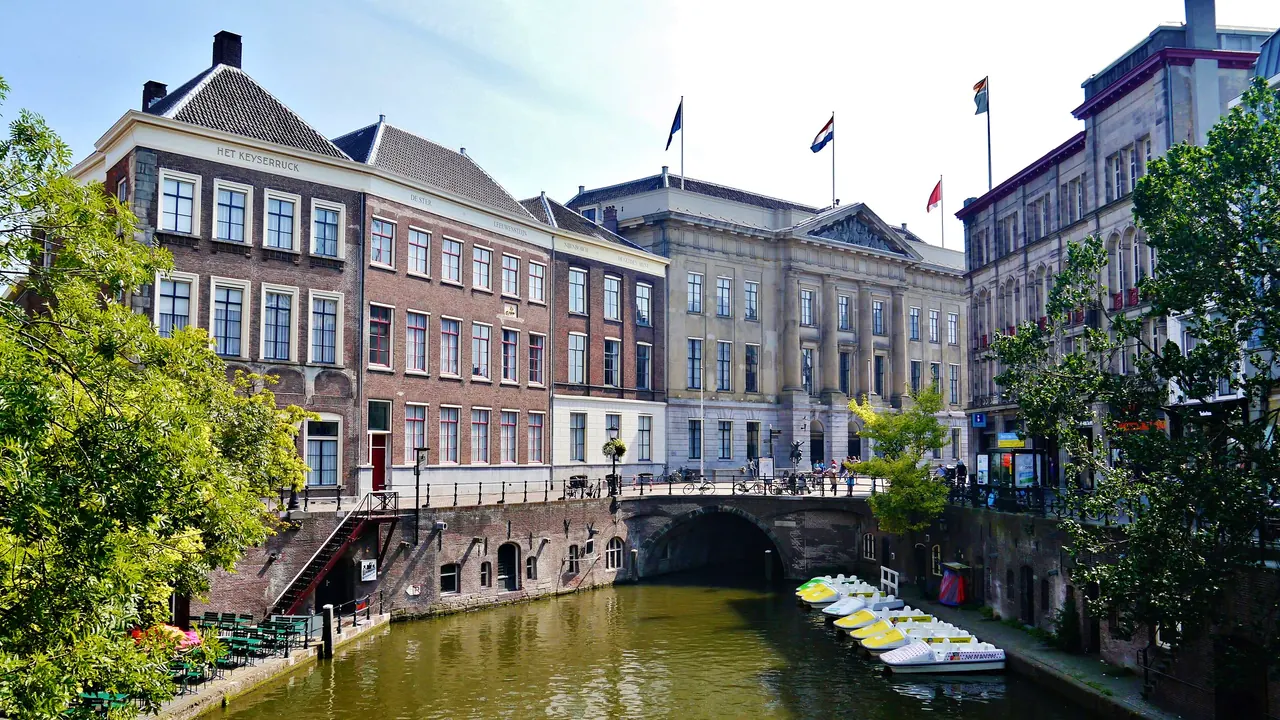
Photos: Haarlem by Moroder, CC BY-SA 4.0, cropped; Utrecht by Zairon, CC BY-SA 4.0, cropped.
Haarlem or Utrecht?
Our verdict in twelve categories, each scored against the same fixed benchmark cities, and the climate month by month, so you can choose for your trip.
Choose Haarlem for
- beaches
- nature and the outdoors
- food and drink
Haarlem suits travellers who want the coast and the dunes close to a small, handsome Golden Age town. The national park starts at the edge of town, Zandvoort's sand is a short train ride away and the bulb fields lie to the south. That makes it the place for a spring or summer stay that mixes gabled streets, cycling and walks by the sea, with Amsterdam close enough for a day there before you come back to quieter streets.
Choose Utrecht for
- nightlife
- live music and the arts
- families
Choose Utrecht for livelier evenings and for a trip with children. A large student population keeps the canal-side terraces full even on weeknights, TivoliVredenburg and the early-music festival give it the fuller concert calendar, and the Railway Museum and the Miffy museum make it the easier family base. It also sits in the middle of the rail network, so the east of the country is as easy to reach as the west.
Scoreboard
Twelve categories on one fixed scale from 0 to 100. The shaded stretch is the gap between the two.
Your match
Pick a travel style or drag the sliders, and both match scores follow your weighting.
Too close to call, 1 point apart
Wins on beaches and nature and the outdoors with your weighting.
Wins on nightlife and live music and the arts with your weighting.
What matters to you?
Category by category
What the scores mean for a trip.
Beaches & swimming
Haarlem has the sea on its doorstep. Zandvoort's long sandy beach is about ten minutes away by train, and the dune-backed strand at Bloemendaal aan Zee is a bike ride away, so a beach afternoon fits easily into any warm day. The North Sea stays cool and the swimming season is short, but a walk along the shore or an afternoon at the beach pavilions is a real pleasure.
From Utrecht the same coast is an hour or more away, so going there takes a whole outing. For a swim, people in Utrecht go to the recreation lakes on the edge of the city, such as the Maarsseveense Plassen. They are fine for cooling off but not worth travelling for.
Food & drink
Neither city is a food destination, and the meals are much alike. What differs is the setting and the range. Haarlem leans on its long brewing history, with craft beer taps, brown cafés around the Grote Markt and a Saturday market selling herring and freshly fried kibbeling.
Utrecht's students bring more variety to everyday eating, with Indonesian and Surinamese kitchens and casual bistros around the Twijnstraat and Lombok. Its cellar terraces on the Oudegracht wharves let you eat right at the water's edge, below street level.
Culture & sights
Both reward two or three unhurried days of sightseeing, but they have a different character. Haarlem is a Golden Age town, with the portraits of Frans Hals, the 18th-century oval room at Teylers Museum, the huge church of St Bavo and the hofjes tucked behind plain doors.
Utrecht feels more medieval. Its centre is built around the Dom Tower, which you can climb, and the two-level Oudegracht canal. Its museums lean towards design, with the De Stijl collection at the Centraal Museum and the Rietveld Schröder House, a UNESCO-listed masterpiece of modern architecture.
Nightlife
Utrecht is the livelier of the two after dark. Thanks to its large student population, the bars around the Neude, the Janskerkhof and the canal wharves fill on weeknights as well as weekends. There are also a few clubs and late venues, some of them run by student and cultural groups.
Haarlem's evenings are gentler. They centre on brown cafés and terraces around the Grote Markt and the Botermarkt, which are busy on summer weekends and wind down well before dawn. From either city a real club night means the train to Amsterdam, which is a little closer from Haarlem.
Nature & outdoors
Haarlem has the better countryside, and it starts at the edge of town. The dunes, pine woods and small lakes of Zuid-Kennemerland, grazed by Highland cattle and wild ponies, lead out to long beach walks. In spring the bulb fields towards Leiden add colour.
Utrecht's landscape is quieter farmland and river scenery, best seen by bike along the Vecht past country estates and windmills. The wooded ridges and heath of the Utrechtse Heuvelrug and the sailing lakes at Loosdrecht add variety, but they take a little more travel to reach.
Day trips
Both are excellent bases, and the difference is in which direction each one faces. Haarlem looks towards Amsterdam, a quarter of an hour away, and towards Leiden and the coast. The Keukenhof, Alkmaar and Zaanse Schans are also easy outings.
Utrecht sits in the middle of the rail network, so it opens up the east and south of the country as well. From there you can reach Kasteel de Haar, the Kröller-Müller Museum, the open-air museum near Arnhem and the old centre of Den Bosch, while Amsterdam, Rotterdam and The Hague are all short rides away.
Good for families
Utrecht has more that is made with children in mind. The Railway Museum, in an old station, is among the best children's museums in the country, Miffy has her own museum for toddlers, and Kasteel de Haar makes a ready-made fairy-tale outing.
Haarlem is just as relaxed about children, and its mostly car-free centre and the dunes give them room to run. Apart from the fossils at Teylers Museum, though, little in town is aimed at them, so families often take the train to the zoo and science museum in Amsterdam.
Getting around
Haarlem is easy to get about on foot or by bike. Its flat historic centre takes about twenty minutes to cross on foot from the station at its northern edge, and separate bike paths run straight into the dunes and down to the beach. Beyond the centre you rely on trains and regional buses, which serve the coast and the bulb fields well but are fewer than in a larger city.
Utrecht is easier still. Utrecht Centraal, the country's busiest station, sits right beside the old town, so the Dom, the canals and even the Railway Museum are a short walk from the platform. Trams and buses on the same tap-in card reach the outer districts and the Uithof campus, and the huge underground cycle park at the station puts you on a bike as soon as you arrive. You do not need a car in either city.
Shopping & style
In both cities shopping makes a pleasant afternoon rather than a reason to visit, and in both the best of it is in independent shops along small streets. Haarlem's boutiques, design shops and delicatessens are close together on Gierstraat, Kleine Houtstraat and Schagchelstraat, south and west of the Grote Markt.
Utrecht has a large covered mall at Hoog Catharijne for the chains, and its markets offer more variety, with a flower market on the Janskerkhof and a textile market by the canal. Neither city has a luxury shopping street, so for serious fashion shopping you go to Amsterdam.
Affordability
In either city, a bed is what costs the most, because both historic centres have few hotels for the demand. In Haarlem, rooms tend to be small for the money and fill early in tulip season and summer, because many visitors to the region use the town as a calm base. Regular train outings and museum tickets add to the bill.
Utrecht's rooms cost what they would in any large Western European city, and weekends and festival weeks cost more. Its students give a careful traveller a little more room to save, with cheap lunch cafés, snack bars and simple pubs around the university quarter, and museum entry is modest. In both towns a rental bike keeps the cost of getting around close to nothing.
Live music & performing arts
Utrecht has the richer music life. TivoliVredenburg stacks several halls in one building and can have the Radio Philharmonic, pop, jazz and experimental acts on the same evening. The Festival Oude Muziek is one of Europe's leading early-music festivals.
Haarlem offers less, but it has a speciality of its own. There are classical concerts at the 19th-century Philharmonie and, above all, recitals on St Bavo's great organ, home to an international organ festival with a history of generations. Neither city has an opera house, and theatre in both is mostly in Dutch.
Wellness & relaxation
Neither city has a bathing tradition, and in both the large Dutch sauna complexes are out in the surrounding region rather than in town. The calm comes instead from the pace of each place.
In Haarlem that means the quiet almshouse courtyards after dark and a bike ride through the dunes. In Utrecht it means slow evenings on the canal wharves and the cloister garden of the Pandhof beside the Dom.
When should you go?
Pick your month. The climate figures are measured averages, not a forecast.
Haarlem in July
Utrecht in July
Daytime high, °C
Rainfall in the month, mm
Where the figures come from
Haarlem has no rain gauge within 25 km of the centre, so its rainfall comes from a gridded climate dataset read at the city rather than from a gauge further away.
Haarlem's sunshine is measured 49 km from the centre, at De Bilt.
Temperature and rainfall are climate normals, averaged over the years shown. Haarlem: 1991-2020 normals, Amsterdam Airport Schiphol (12.7 km from centre). Utrecht: 1991-2020 normals, De Bilt (4.3 km from centre).
The two cities have almost the same weather, so the timing depends on what you plan to do. May to September is the comfortable stretch for walking and cycling. July and August bring highs of about 22°C to 23°C, and May to July have the longest sunny days. Winter is grey and cold, with highs in single figures, though in both towns the centre is small enough to walk between cafés and museums.
The differences are small. Haarlem is about a degree cooler in summer and clearly wetter in autumn: October brings about 109mm of rain there, against about 81mm in Utrecht. Only Haarlem is close enough to the sea to make use of it, and the North Sea reaches only about 19°C in August, enough for a quick dip on a warm day but not for long swims. April is the driest month in both and a good time for cycling the countryside.
Which traveller are you?
For an outdoors trip, Haarlem is the better base. The dunes, woods and grazing ponies of Zuid-Kennemerland begin at the edge of town, bike paths lead straight to the beach, and in spring you can cycle among the bulb fields towards Leiden.
On a family trip with young children, Utrecht makes the easier stay. Its museums for children are a short walk from the station, so a wet day is covered without a train ride. Haarlem suits families who would rather spend their days on the beach and in the dunes.
For a food and nightlife trip, Utrecht comes out ahead. Meals are much alike in both cities, but Utrecht's students fill the bars around the Neude and along the Oudegracht every night of the week. Haarlem's terraces are more subdued.
Before you go
| Measure | Haarlem | Utrecht |
|---|---|---|
| Official language | Dutch | Dutch |
| Currency | Euro (EUR) | Euro (EUR) |
| Sockets | CF230 V, 50 Hz | CF230 V, 50 Hz |
| Driving side | Right | Right |
| Time zone | UTC+1, UTC+2 in summer | UTC+1, UTC+2 in summer |
| Emergency number | 112 | 112 |
| Elevation | 2 m | 5 m |
| Main airport | Amsterdam Airport Schiphol (AMS)12 km from centre287 non-stop destinations | Amsterdam Airport Schiphol (AMS)34 km from centre287 non-stop destinations |
| Public holidays this year | 11 days | 11 days |
By the numbers
| Measure | Haarlem | Utrecht |
|---|---|---|
| City population | 162,543 | 359,370 |
| People per km² | 5,064 | 3,619 |
| Museums within 10 km | 28 | 28 |
| UNESCO World Heritage sites within 50 km | 5 | 5 |
| Swim season, months above 21 °C | None | None |
Where else could you go?
Every comparison below shares a destination with this one, so you can follow Haarlem or Utrecht somewhere new.
- Amsterdamvs Haarlem
- Amsterdamvs Utrecht
- The Haguevs Haarlem
- Rotterdamvs Utrecht
- Rotterdamvs Haarlem
- The Haguevs Utrecht