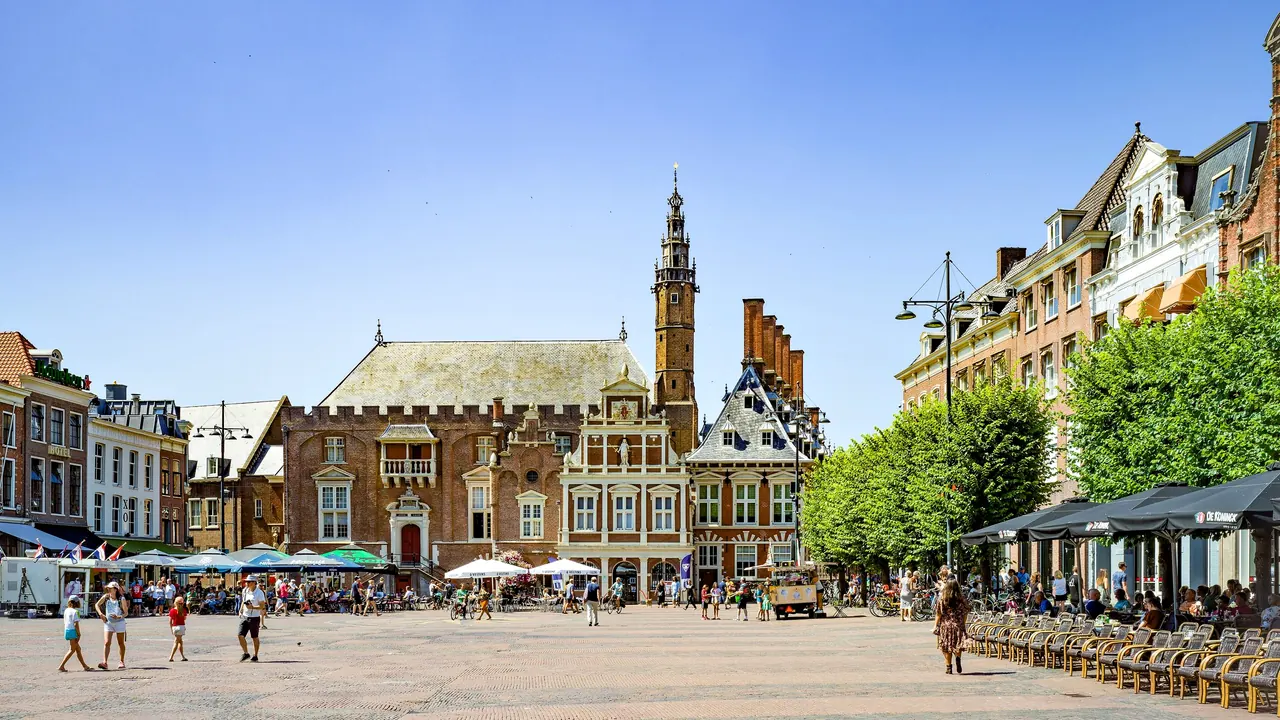
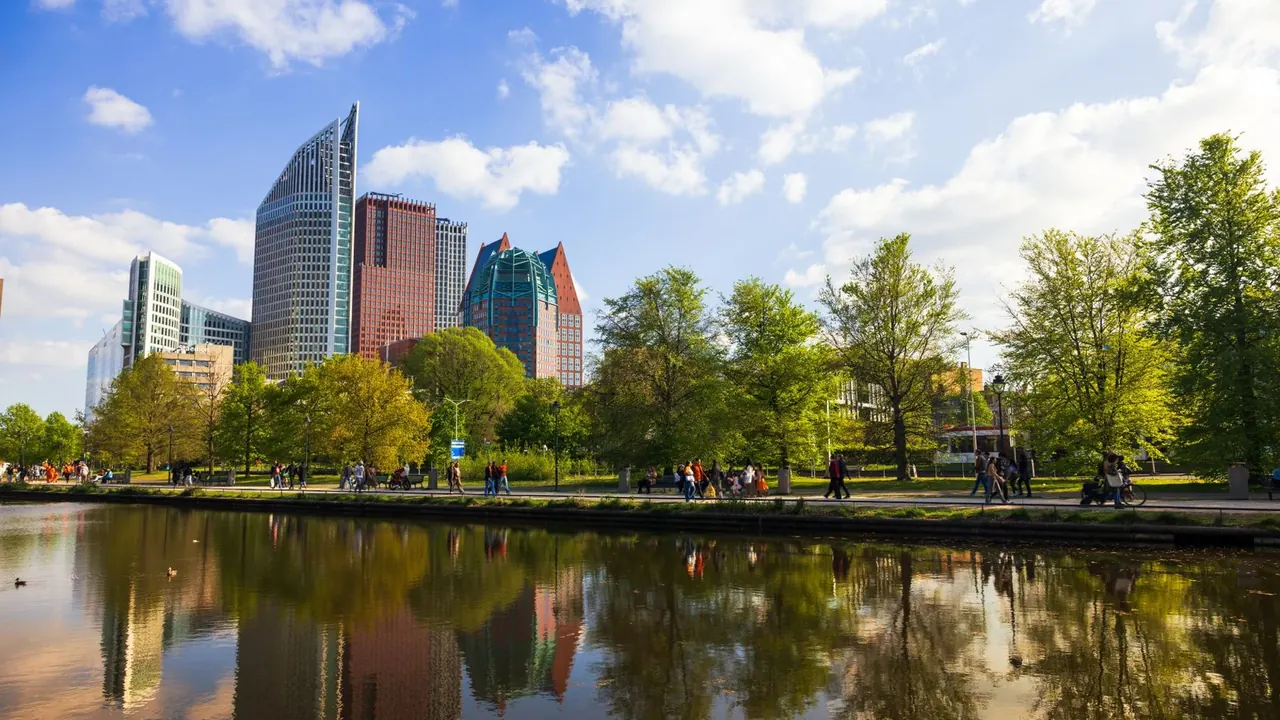
Photos: Haarlem by Moroder, CC BY-SA 4.0, cropped; The Hague by Bráulio jardim, Pexels License.
Haarlem or The Hague?
Our verdict in twelve categories, each scored against the same fixed benchmark cities, and the climate month by month, so you can choose for your trip.
Choose Haarlem for
- nature and the outdoors
- shopping
Haarlem suits travellers who want a small, intact Golden Age town to wander and a base for seeing the rest of Holland. Its centre of canals, hofjes and the great church of St Bavo can be crossed on foot, the dunes of Zuid-Kennemerland start at the edge of town, and Amsterdam is close enough for an evening and then back to quiet streets. Pick it if you want cycling, browsing independent shops and a slower pace.
Choose The Hague for
- families
- live music and the arts
- beaches
The Hague is the better choice for families and for anyone who wants more to see in town. It has the Mauritshuis and the Binnenhof, Nederlands Dans Theater on stage, Madurodam and a sea aquarium for children, and a beach that a tram reaches from the centre. It is more spread out and more formal than Haarlem, but it gives a longer stay more variety.
Scoreboard
Twelve categories on one fixed scale from 0 to 100. The shaded stretch is the gap between the two.
Your match
Pick a travel style or drag the sliders, and both match scores follow your weighting.
Wins on nature and the outdoors and shopping with your weighting.
Wins on families and live music and the arts with your weighting.
What matters to you?
Category by category
What the scores mean for a trip.
Beaches & swimming
Both look out on the same cold, grey North Sea, so neither will do for a swimming vacation. The Hague comes out a little ahead because the beach is part of the city. Scheveningen's wide sand, pier and promenade are a short tram ride from the centre, and Kijkduin offers a calmer alternative.
From Haarlem you take the train to Zandvoort or cycle through the dunes to Bloemendaal aan Zee. It is an easy outing, and the dune-backed strand there feels wilder than Scheveningen, but it is a trip out of town rather than a walk from your hotel.
Food & drink
Neither city is a serious food destination, and what sets them apart is the kind of food. Haarlem's best eating is Dutch and local: cheese, herring and kibbeling at the Saturday market on the Grote Markt, and a long brewing history that shows in its craft beer taps.
The Hague has something Haarlem lacks: Indonesian cooking of rare quality, from a full rijsttafel to simple plates of rendang, the legacy of families from the former Dutch East Indies. Add the Chinatown noodle shops and the fish stalls at Scheveningen harbour, and it has more variety.
Culture & sights
The Hague has more to see. The Mauritshuis, with the Girl with a Pearl Earring and View of Delft, sits beside the medieval Binnenhof, and the Peace Palace, Panorama Mesdag, the Mondrian collection and Escher's palace fill a third day.
Haarlem's appeal is the town itself: an unbroken old centre of gabled houses, almshouse courtyards and the Grote Kerk, along with the Frans Hals Museum and the wonderfully old-fashioned oval room at Teylers. It is more intimate and more picturesque, but you see it in less time.
Nightlife
Both are early, sociable towns where the evening happens on café terraces, and serious clubbers in either one take the train. The Hague has a little more range: the after-work crowd on the Plein, the busier weekend bars of its own Grote Markt, and in summer the beach pavilions at Scheveningen, where drinks at sunset often turn into dancing. Haarlem's brown cafés around the Grote Markt and Botermarkt are cosier and quieter, with Amsterdam a quarter of an hour away for a bigger night.
Nature & outdoors
Haarlem sits closer to open country. Zuid-Kennemerland's dunes, woods and lakes begin at the edge of town, grazed by Highland cattle and ponies, with fallow deer in the water-supply dunes to the south. In spring the bulb fields towards Leiden are an easy ride away.
The Hague has its own dunes at Meijendel and the Westduinpark, and the old Haagse Bos forest almost reaches the centre. The coast is its main outdoor asset, good for beach walks and for kitesurfing. Both are completely flat and windy, so the difference is how quickly you are out among the dunes.
Day trips
These are two of the best bases in the country, and the difference is which way they face. Haarlem looks north and east: Amsterdam is next door, with Alkmaar's cheese market and Zaanse Schans within easy reach.
The Hague looks south. Delft and Leiden are a few minutes away, Rotterdam and Gouda are under half an hour, and Kinderdijk is an easy outing. Choose the one nearer the places you most want to see.
Good for families
The Hague is much better set up for children. Madurodam is a ready-made family day, and Scheveningen adds a beach, a pier and a large sea aquarium, with Museon, the Louwman car museum and Duinrell's rides and water park nearby. Trams carry pushchairs easily.
Haarlem is relaxed and largely car-free, and children love the fossils at Teylers and the playgrounds in the dune park. But there is no zoo, aquarium or theme park in town, so families end up travelling to Amsterdam for those.
Getting around
Both are easy without a car, but they work differently. Haarlem is a walking and cycling town: the station sits at the edge of a centre you can cross in twenty minutes, and bike paths run straight into the dunes and to the coast.
The Hague's historic core is just as compact, but the city spreads out to Scheveningen, Madurodam and the Peace Palace, so you will use its tram network and its two main stations more often.
Shopping & style
Haarlem keeps its shopping in one compact quarter. Gierstraat, Kleine Houtstraat, Schagchelstraat and the other lanes south and west of the Grote Markt are lined with independent fashion boutiques, design shops, bookshops and delicatessens, all a few minutes' walk from each other.
The Hague's shopping is spread across the city and has an older, more refined character. Antique dealers and galleries line Denneweg and Noordeinde, the glass-roofed Passage makes a covered stroll, and the main pedestrian streets have a large department store among the chains. Its standout is the Haagse Markt, one of Europe's biggest open-air markets, whose fabrics and spices go well beyond anything on Haarlem's square.
Affordability
In Haarlem the problem is hotels. Many visitors choose the town as a calmer base near Amsterdam, so the few hotels fill early in tulip season and summer, and the rooms are small for what they cost. Market stalls and bakeries keep lunch cheap, but train fares for regular day trips add up.
The Hague gives you more room to save. Its central hotels empty of government and business travellers at weekends, and Indonesian and Surinamese eateries serve filling plates for far less than a sit-down Dutch dinner. Only Scheveningen's seafront hotels charge extra in summer. Either way, you pay full Northern European prices for rooms and meals, so neither city suits a tight budget.
Live music & performing arts
The Hague is the stronger stage city, mainly thanks to Nederlands Dans Theater, a world-class company that is well worth booking. The Residentie Orkest and the Royal Conservatory's concerts add depth, and dance, unlike Dutch-language drama, needs no translation.
Haarlem's speciality is the organ. Regular concerts on St Bavo's great Müller instrument and a long-running international organ festival give it something The Hague does not have, alongside chamber music at the Philharmonie.
Wellness & relaxation
Neither has thermal springs. Both rely on the Dutch sauna and on a calm pace. The Hague has large day-long sauna complexes in the city and on its outskirts (expect nudity to be the norm), and its quiet embassy streets make for restful evenings.
In Haarlem the restful part is the town itself: silent hofjes after dark, long terrace afternoons and a bike ride into the dunes. The bigger spa complexes are a trip out into the region.
When should you go?
Pick your month. The climate figures are measured averages, not a forecast.
Haarlem in July
The Hague in July
Daytime high, °C
Rainfall in the month, mm
Where the figures come from
Haarlem has no rain gauge within 25 km of the centre, so its rainfall comes from a gridded climate dataset read at the city rather than from a gauge further away.
Haarlem's sunshine is measured 49 km from the centre, at De Bilt.
The Hague has no rain gauge within 25 km of the centre, so its rainfall comes from a gridded climate dataset read at the city rather than from a gauge further away.
The Hague's sunshine is measured 60 km from the centre, at De Bilt.
Temperature and rainfall are climate normals, averaged over the years shown. Haarlem: 1991-2020 normals, Amsterdam Airport Schiphol (12.7 km from centre). The Hague: 1991-2020 normals, Valkenburg (13.6 km from centre).
Haarlem and The Hague are a short train ride apart on the same coast, and their climates are almost the same. Summer is the season for both. From June to August daytime highs reach about 22°C at best, the long sunny days run from May into July, and the North Sea is at its least cold in August at around 19°C. That is warm enough for a beach afternoon and a brisk dip, but not for a long swim. Spring is the driest part of the year, and April and May are good months for walking and cycling, with the bulb fields in flower near both cities.
Rain builds through late summer and autumn and peaks in October, with over 100mm in each city. From November to February the days are short and grey, with highs of only about 7°C. That is fine for museums and cafés but chilly for long walks or the seafront. Haarlem is a degree warmer at the height of summer, which is too small a difference to choose on.
Which traveller are you?
On a family trip with children, The Hague is the clear pick. Madurodam's miniature Netherlands, the sea aquarium and pier at Scheveningen, Museon and the nearby Duinrell park give a week of outings, while Haarlem has nothing comparable built for children in town.
For an outdoors trip, Haarlem has the edge. Zuid-Kennemerland National Park starts at the western edge of town, with dune paths, wild ponies and deer, and in spring you can cycle out to the bulb fields towards Leiden.
On a culture and arts trip, The Hague offers more. The Mauritshuis holds Vermeer and Rembrandt, the Kunstmuseum has its Mondrians, and Nederlands Dans Theater performs at home. Haarlem's Frans Hals and Teylers museums are fine, but two days covers them.
Before you go
| Measure | Haarlem | The Hague |
|---|---|---|
| Official language | Dutch | Dutch |
| Currency | Euro (EUR) | Euro (EUR) |
| Sockets | CF230 V, 50 Hz | CF230 V, 50 Hz |
| Driving side | Right | Right |
| Time zone | UTC+1, UTC+2 in summer | UTC+1, UTC+2 in summer |
| Emergency number | 112 | 112 |
| Elevation | 2 m | 1 m |
| Main airport | Amsterdam Airport Schiphol (AMS)12 km from centre287 non-stop destinations | Rotterdam The Hague Airport (RTM)16 km from centre53 non-stop destinations |
| Public holidays this year | 11 days | 11 days |
By the numbers
| Measure | Haarlem | The Hague |
|---|---|---|
| City population | 162,543 | 548,320 |
| People per km² | 5,064 | 5,589 |
| Museums within 10 km | 28 | 54 |
| UNESCO World Heritage sites within 50 km | 5 | 4 |
| Swim season, months above 21 °C | None | None |
Where else could you go?
Every comparison below shares a destination with this one, so you can follow Haarlem or The Hague somewhere new.
- Amsterdamvs Haarlem
- Rotterdamvs The Hague
- Utrechtvs Haarlem
- Amsterdamvs The Hague
- Rotterdamvs Haarlem
- Utrechtvs The Hague