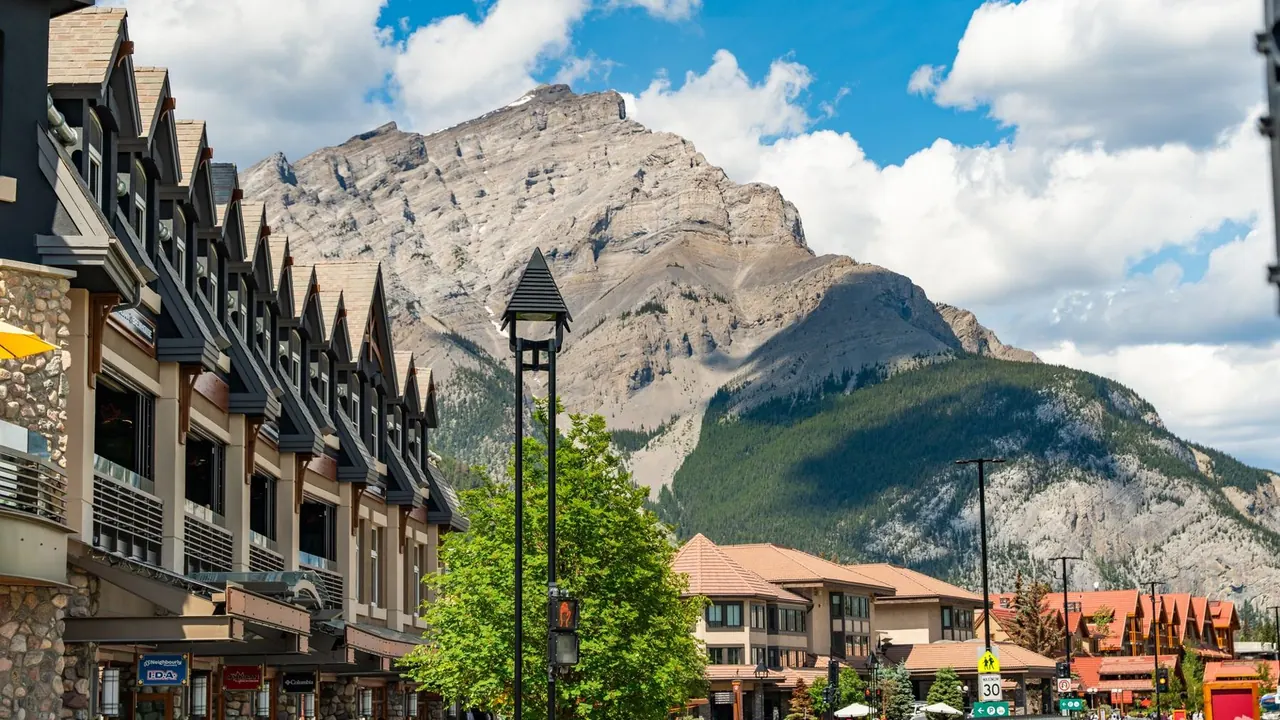
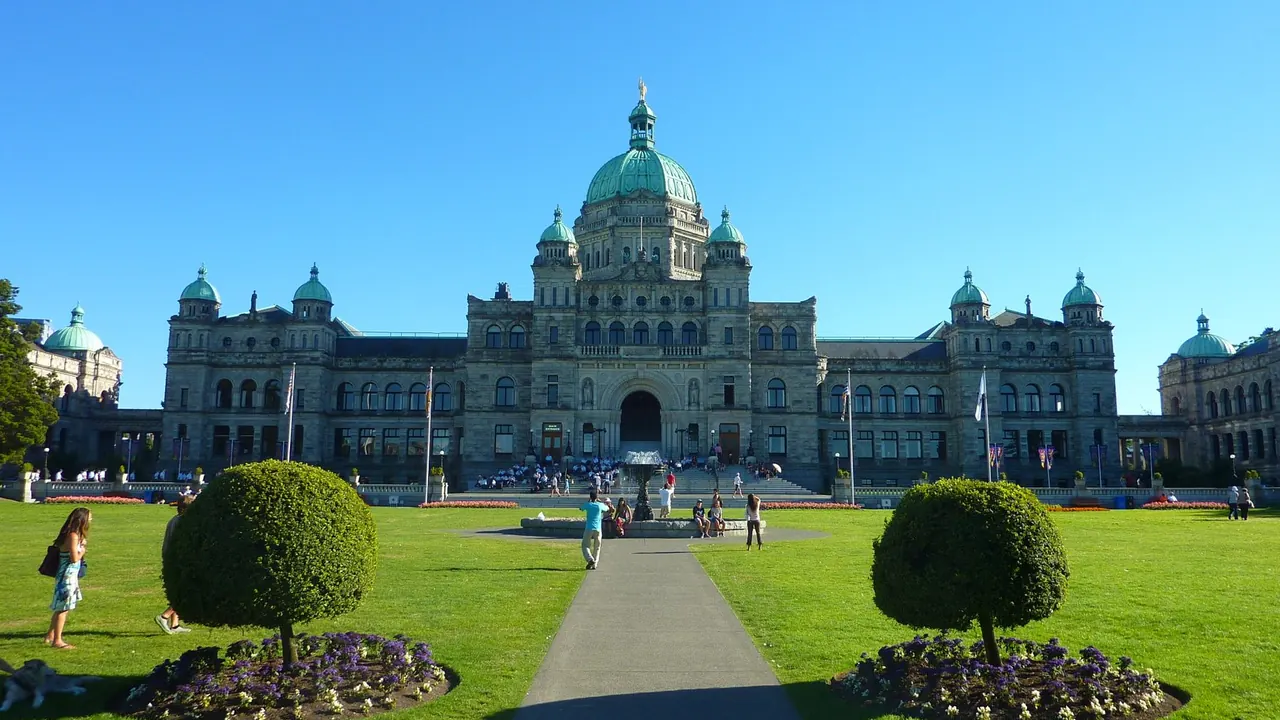
Photos: Banff by bryan pascual, Pexels License; Victoria by Guilice, CC BY-SA 3.0, cropped.
Banff or Victoria?
Our verdict in twelve categories, each scored against the same fixed benchmark cities, and the climate month by month, so you can choose for your trip.
Choose Banff for
- nature and the outdoors
- wellness
Banff is for travellers whose vacation is the landscape itself. The town sits inside a national park, with glacier lakes, wildlife on the roadsides, the Icefields Parkway and three ski areas within reach, and the hot springs to finish the day. Go there to hike, paddle, ski or simply stare at mountains, and accept that the town, its restaurants and its sights are a pleasant base rather than the point.
Choose Victoria for
- day trips
- culture and sights
- food and drink
Victoria rewards a slower, more rounded trip. Its graceful Inner Harbour, a good provincial museum, Pacific seafood, independent shops, a steady theatre and concert calendar and easy outings to Butchart Gardens and the Cowichan Valley give more to do away from the trail. Its outdoors are coastal and gentle rather than alpine, and it is somewhat kinder on the budget, which makes it the better pick for couples, city-break travellers and anyone who wants variety over drama.
Scoreboard
Twelve categories on one fixed scale from 0 to 100. The shaded stretch is the gap between the two.
Your match
Pick a travel style or drag the sliders, and both match scores follow your weighting.
Wins on nature and the outdoors and wellness with your weighting.
Wins on day trips and culture and sights with your weighting.
What matters to you?
Category by category
What the scores mean for a trip.
Beaches & swimming
Neither is a beach destination, but Victoria gives a little more to do by the water. Banff's swimming comes down to Johnson Lake on a hot August afternoon, since the glacier-fed lakes are for paddling and photographs.
Victoria has sandy, sheltered spots at Willows Beach and Gonzales Bay for paddling at the edge, even though the strait is too cold for a real swim. In summer, Thetis Lake, Elk/Beaver Lake and the Sooke Potholes give proper warm-weather swims within easy reach of downtown.
Food & drink
Victoria is the better place to eat. Its cooking draws on the sea and nearby farms: wild salmon, Dungeness crab, oysters and spot prawns, with cheese and wine from the Saanich Peninsula and the Cowichan Valley, plus serious brunch, a long-established craft beer culture and afternoon tea at the Empress.
Banff feeds hungry hikers and skiers well enough with Alberta beef, bison, elk and fondue, and the grand hotels aim higher. Beyond the meat and the pub plates the choice narrows quickly, so meals there are fuel more than an event.
Culture & sights
Victoria has the stronger set of sights. The Inner Harbour, framed by the domed Parliament Buildings and the Empress, is a fine sight in itself, and the Royal BC Museum, the totem poles of Thunderbird Park, Craigdarroch Castle and the Emily Carr House fill two or three days.
Banff's sights are fewer and all tell the story of the park: the Cave and Basin, where Canada's national parks began, the Banff Springs Hotel, the Whyte Museum and the Buffalo Nations Luxton Museum. They make a good rainy day rather than the backbone of a trip.
Nightlife
Both towns are equally modest after dark, but the mood differs. Banff is louder and younger, driven by seasonal workers and the ski crowd, with après-ski and a couple of dance bars on Banff Avenue running late in season.
Victoria is more grown-up: British-style pubs, brewery taprooms and a few good cocktail bars in old brick buildings around Wharf Street and Lower Johnson, with a small student club scene at weekends. Expect a quiet pint by the harbour and an early night rather than a party.
Nature & outdoors
This is Banff's great strength and where it leaves Victoria behind. The Rockies start at the end of the street, with elk on the lawns, bears and bighorn sheep along the roads, the turquoise water of Lake Louise and Moraine Lake, hundreds of kilometres of trails and three ski areas in winter.
Victoria's outdoors are coastal and gentle in kind: the Dallas Road clifftop path, orca and humpback watching from the harbour, easy sea kayaking among the Gulf Islands and old-growth cedar in Goldstream. It is lovely and usable all year, but there are no high mountains within easy reach.
Day trips
From Banff, most outings lead deeper into the mountains, so a day spent somewhere other than the park comes down to a short list. Canmore, a relaxed former mining town, is about twenty minutes down the valley. Calgary, an hour and a half east, gives a big-city day of museums and the Heritage Park historic village, and Field and Golden across the Continental Divide make modest stops.
Victoria offers far more choice, with gardens, farms, islands and small towns. Butchart Gardens and seaside Sidney are a short drive up the Saanich Peninsula, and about an hour north over the Malahat the Cowichan Valley has wineries, Duncan's totem poles and Chemainus's murals. Salt Spring Island, with its market and artists' studios, is a ferry ride from Swartz Bay. Vancouver is a quick floatplane hop or a long day by car ferry, so the island trips take longer than the map suggests.
Good for families
Both are safe, easy places for children, and they entertain them in different ways. In Banff the outdoors does the work: wildlife spotting, the Sulphur Mountain gondola, Johnston Canyon's boardwalk and, in winter, ski schools and skating on frozen lakes.
Victoria offers more under a roof and on foot, with the petting farm in Beacon Hill Park, the Royal BC Museum's replica old town, the small aquarium in Sidney and seaplanes over the harbour. Neither has a zoo, and both need a plan for bad weather.
Getting around
The two are much alike: compact, walkable centres and car-free days that work well. Banff's flat town is crossed on foot in about twenty minutes, and Roam Transit buses and Parks Canada shuttles reach the gondola, hot springs and busiest lakes, but the Icefields Parkway and quieter trailheads really need a car or a tour.
Victoria adds little harbour ferries and some of Canada's best cycling, with protected lanes and long car-free trails. Its buses are slow beyond the city, so Sooke and the Cowichan Valley are also easier by car.
Shopping & style
Victoria is the more rewarding place to browse. Lower Johnson Street's heritage storefronts hold local labels and design shops, Market Square and Chinatown add small curio and tea shops, and specialist galleries sell Northwest Coast First Nations prints, carvings and jewellery, alongside good second-hand bookshops.
Banff's shopping is mostly outdoor outfitters and souvenirs on Banff Avenue, useful if you arrive without boots. Its few galleries of Indigenous art and mountain painting are the best finds.
Affordability
Both are dear, but Banff stretches a budget harder. Rooms are limited by building rules inside the park, restaurants charge resort prices, and the park pass, gondola, lift passes and tours add up, which is why many budget travellers sleep in Canmore or at a campground.
Victoria is expensive in summer too, yet its compact centre saves on transport, the parks and waterfront are free, and pub meals, food trucks and Chinatown help. Winter visits from November to March bring much lower room rates.
Live music & performing arts
Banff's stage life rests on one resident institution, while Victoria spreads its programme across a circuit of historic downtown theatres, so Victoria offers more chance of a good evening on any given night. In Banff the Banff Centre for Arts and Creativity on Tunnel Mountain puts on concerts and dance, mostly in summer, and the Banff Mountain Film and Book Festival comes each autumn. Otherwise it is bands in pubs.
In Victoria, the Royal Theatre and the McPherson Playhouse host the symphony, Pacific Opera Victoria and ballet, and the Belfry, in a converted church, stages contemporary Canadian theatre. Summer adds the jazz and Fringe festivals and the free symphony concert on a barge in the Inner Harbour.
Wellness & relaxation
Banff has a slight edge because it has real hot water. The Banff Upper Hot Springs, a 1930s bathhouse with an open-air mineral pool above the valley, is at its best after skiing in falling snow, and the grand mountain hotels have large spas with mineral pools.
Victoria relaxes you through its pace instead: gardens, seafront walks, long afternoon teas and quiet days in Oak Bay, in a climate mild enough for any season. It has no thermal springs, so treatments mean hotel and day spas.
When should you go?
Pick your month. The climate figures are measured averages, not a forecast.
Banff in July
Victoria in July
Daytime high, °C
Rainfall in the month, mm
Where the figures come from
Victoria's sunshine is measured 87 km from the centre, at Vancouver International Airport.
Temperature and rainfall are climate normals, averaged over the years shown. Banff: 1991-2020 normals, Banff (2 km from centre). Victoria: 1991-2020 normals, Victoria Gonzales CS (3.6 km from centre).
Banff has two clear seasons. Summer runs from June to September, with July afternoons around 23°C, warm enough for long hikes and paddling, though June is the wettest month and the lakes stay cold all through. From November to March daytime highs sit near or below freezing, down to -4°C in December. That is what the ski areas and frozen lakes need, but walking around town means warm layers. April, May and October are cool and changeable in between.
Victoria is never properly cold or properly hot. Winter highs stay around 8°C and summer highs only reach the low twenties, so walking around the city is comfortable in any month. The real difference is rain and light. The wet season runs from October to January, peaking at 116mm in November, with short, grey days, while July and August are almost dry and the sunniest of the year. The sea gets no warmer than about 12°C, so even in high summer the shore is for walking rather than swimming. For a dry, sunny summer stay, choose Victoria. For snow, only Banff will do.
Which traveller are you?
On an outdoors trip, Banff is the clear choice. Trails from lakeshore strolls to high alpine passes, wildlife along the roads, Moraine Lake, Johnston Canyon and the glaciers of the Icefields Parkway outclass Victoria's gentler coastal walks, kayaking and whale watching.
For a culture and arts trip, Victoria gives far more to fill the days. The Parliament Buildings and Empress on the Inner Harbour, the Royal BC Museum, Emily Carr's legacy and an evening at the symphony or the Belfry go well beyond Banff's handful of small museums.
For skiers and snowboarders, only Banff is in the running. Sunshine Village, Lake Louise and Mt Norquay sit within easy reach of town, with après-ski on Banff Avenue and the hot springs afterwards, while Victoria's mild, rainy winters have no slopes at all.
Before you go
| Measure | Banff | Victoria |
|---|---|---|
| Official language | French, English | French, English |
| Currency | Canadian Dollar (CAD) | Canadian Dollar (CAD) |
| Sockets | AB120 V, 60 Hz | AB120 V, 60 Hz |
| Driving side | Right | Right |
| Time zone | UTC-7, UTC-6 in summer | UTC-8, UTC-7 in summer |
| Emergency number | 911 | 911 |
| Elevation | 1,400 m | 23 m |
| Main airport | Calgary International Airport (YYC)109 km from centre103 non-stop destinations | Victoria International Airport (YYJ)25 km from centre16 non-stop destinations |
| Public holidays this year | 13 days | 11 days |
By the numbers
| Measure | Banff | Victoria |
|---|---|---|
| City population | 8,305 | 91,867 |
| People per km² | 1,730 | 4,711 |
| Museums within 10 km | 4 | 6 |
| UNESCO World Heritage sites within 50 km | 0 | 0 |
| Swim season, months above 21 °C | - | None |
Where else could you go?
Every comparison below shares a destination with this one, so you can follow Banff or Victoria somewhere new.