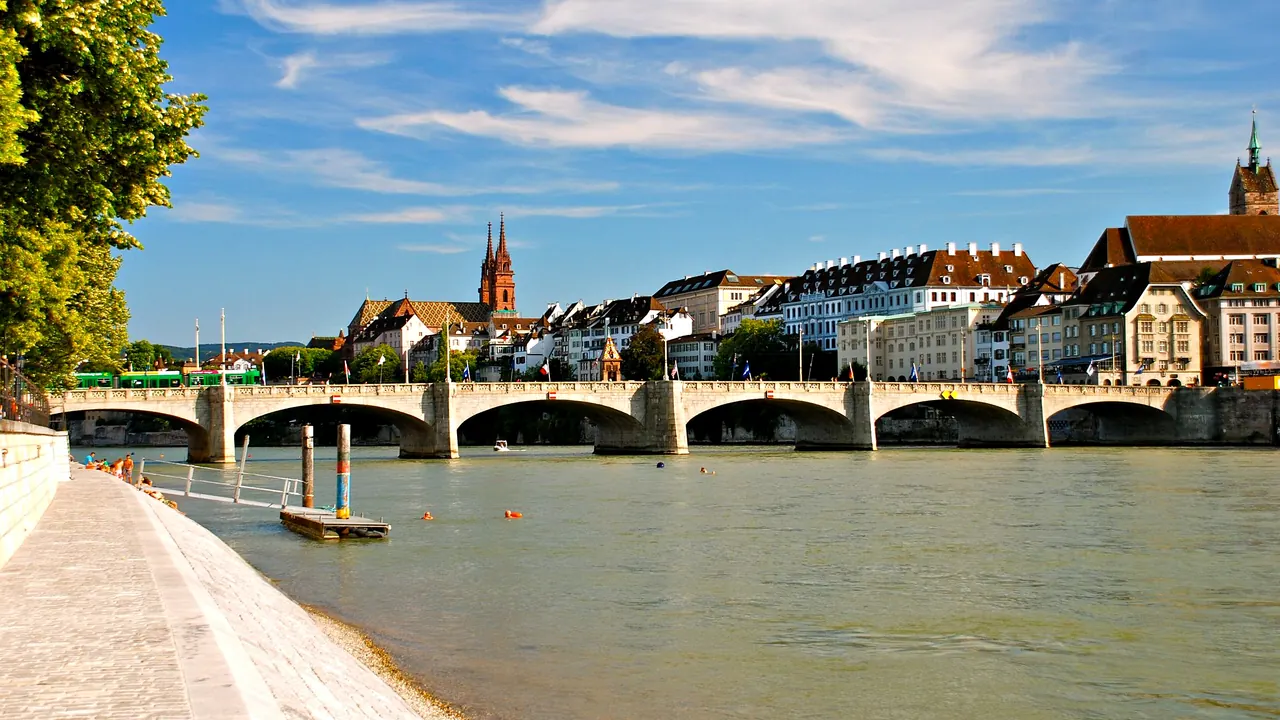
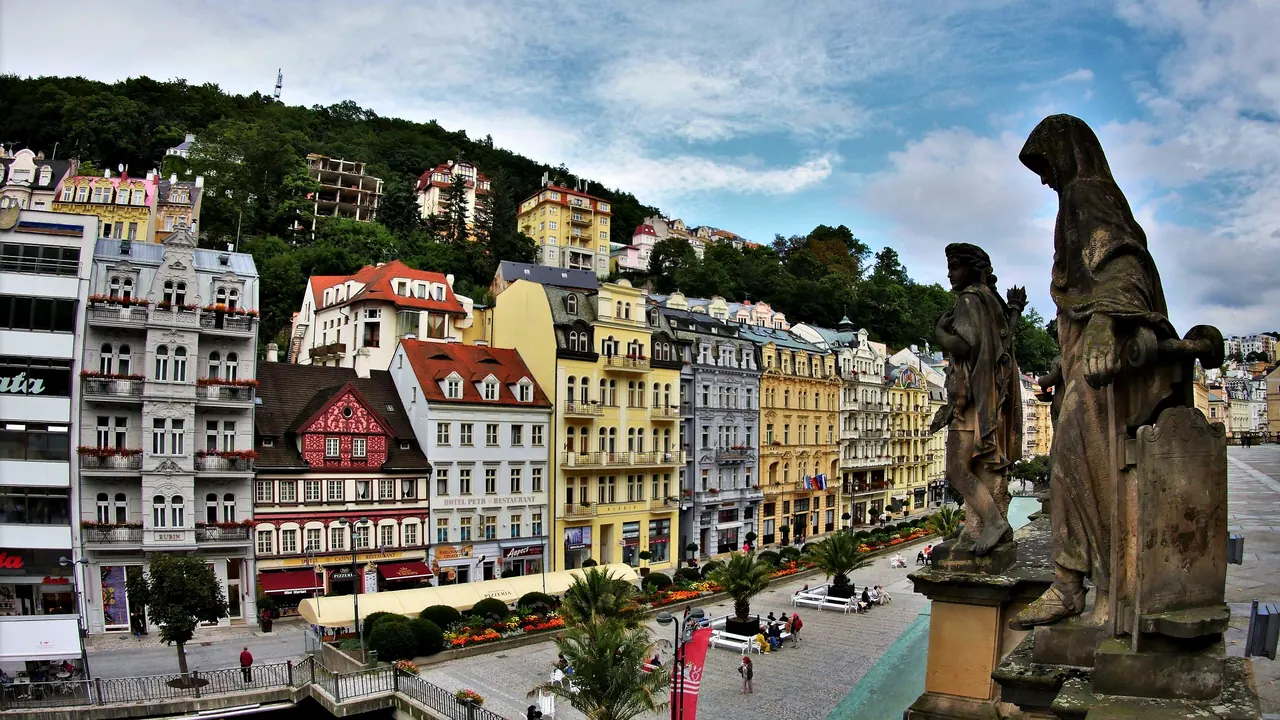
Photos: Basel by Lucazzitto, CC BY-SA 3.0, cropped; Karlovy Vary by Rolf Dietrich Brecher from Germany, CC BY-SA 2.0, cropped.
Basel or Karlovy Vary?
Our verdict in twelve categories, each scored against the same fixed benchmark cities, and the climate month by month, so you can choose for your trip.
Choose Basel for
- live music and the arts
- families
- beaches
Basel is the better choice for a traveller who wants a lot packed into a few days. It has museums of real weight, from the Holbein rooms of the Kunstmuseum to the Fondation Beyeler, a serious opera and concert calendar, and fast trains that put Alsace, the Black Forest, Lucerne and Bern within about an hour. It suits people who will pay Swiss prices for that range and ease, and families who want a first-class zoo and trams that take prams.
Choose Karlovy Vary for
- prices
- wellness
Anyone who wants to slow down will be happier in Karlovy Vary. The whole town is built around the spa: drinking cures at the colonnade springs, carbonated baths, and forest paths laid out for convalescents, all in a Belle Époque valley you can see in full in a day or two. It costs far less than Basel and its evenings end early, so it is for rest rather than a crowded itinerary.
Scoreboard
Twelve categories on one fixed scale from 0 to 100. The shaded stretch is the gap between the two.
Your match
Pick a travel style or drag the sliders, and both match scores follow your weighting.
Wins on live music and the arts and families with your weighting.
Wins on prices and wellness with your weighting.
What matters to you?
Category by category
What the scores mean for a trip.
Beaches & swimming
Neither city has sand, but Basel at least has a summer swim worth planning around. You float down the Rhine from the Kleinbasel bank past the old town, with the water often above 20°C in August. It is for confident swimmers only.
Karlovy Vary's options are a drive away or indoors: Lake Medard, a flooded mine near Sokolov, a few hill reservoirs, and the warm outdoor pools fed by the springs. They are fine on a hot day, but nobody chooses the town for swimming.
Food & drink
Basel eats better and more widely. It borrows from Alsace and Baden as much as from Swiss-German cooking, has a small fine-dining tier, and offers the Markthalle and the Marktplatz market for casual meals.
Karlovy Vary stays within hearty Czech cooking: roast pork, dumplings and svíčková with good beer, plus warm spa wafers and Becherovka, the herbal liqueur invented in the town. It has no real market and few ambitious kitchens, though its cafés serving cake suit a spa day well.
Culture & sights
Basel offers the deeper cultural trip. Its museums carry international weight, from the Kunstmuseum's Old Masters to the Fondation Beyeler and the Museum Tinguely. The Münster, the painted Rathaus and the climb up Spalenberg to the Spalentor give you a medieval core to explore over three or four days.
Karlovy Vary is one complete townscape rather than a list of collections. The pastel spa quarter is listed by UNESCO, with its colonnades and the Vřídlo geyser. Its museums are small and cover glass, Becherovka and local history, so a day or two is enough.
Nightlife
Neither town is made for late nights, but Basel gives you somewhere to go after dinner. On a summer evening the Kleinbasel riverbank becomes one long open-air bar, and for the rest of the year the bars around the Kaserne and a few weekend clubs can keep you out past midnight, at Swiss prices. A typical evening in Karlovy Vary is a stroll along the promenade and a nightcap in the hotel bar, and the town is quiet by eleven.
Each has one week when the rules change. Basel's is the bigger: in late winter Fasnacht starts before dawn and fills the old town for three days with masked fife-and-drum groups and glowing lanterns. Karlovy Vary's film festival in early summer brings crowds and outdoor parties to the valley for a week, and then the spa calm returns.
Nature & outdoors
Both are good bases for walkers rather than climbers, but the landscape works differently. Basel's strength is reach. The Jura, the Black Forest summits above 1,400m and the Vosges are all within about an hour, and flat cycle paths along the Rhine run into Germany and France.
Karlovy Vary has forest on its doorstep instead. Old spa paths climb straight from the colonnades to the Diana tower, the moors of the Slavkov Forest lie further out, and in winter there is downhill and cross-country skiing around Klínovec in the Ore Mountains.
Day trips
Basel opens on to three countries. Colmar and the Alsace wine villages, Freiburg and the Black Forest, and Lucerne, Bern and Zurich are each about an hour away by fast train, with Strasbourg and the Rhine Falls a little further. A week would not use them all up.
Karlovy Vary has a good but more regional circuit: the castle town of Loket twenty minutes away, the sister spa towns of Mariánské Lázně and Františkovy Lázně, and the St Maurus reliquary at Bečov. Plzeň and Cheb are within reach, but Prague means a long day, with two hours on the coach each way.
Good for families
Basel is the easier family trip. The Zolli, one of Europe's finest zoos, is a short walk from the station. The natural history and toy museums cover a wet morning, the ferries pulled across by the current delight small children, and Europa-Park is about an hour away.
Karlovy Vary has a short list: the geyser, sipping spring water from spouted cups, the funicular to the Diana lookout with its animal enclosure, and the outdoor thermal pool. The town is built for adults taking cures, and its steep valley sides are hard work with a pushchair.
Getting around
Basel is simpler. It has a walkable old town, green trams to every district and across the borders, free local transport for hotel guests, and a main station with direct trains into three countries.
Karlovy Vary is walkable along its narrow promenade strip, but the steep valley sides mean taking buses and the funicular up to hotels and viewpoints. Slow regional trains also make a car useful for reaching the forests and villages.
Shopping & style
Neither is a shopping destination, and the real difference is what you bring home. On Basel's Freie Strasse and Gerbergasse that means Swiss watches, chocolate and Läckerli, with small design shops in Spalenberg and a pretty Christmas market by the Münster. Along Karlovy Vary's Stará louka, look instead for Moser crystal from its own showroom, local porcelain, Bohemian garnets and spa cups, beside fur and fashion boutiques for wealthy spa guests.
Affordability
This is where Karlovy Vary pulls far ahead. Basel charges Swiss prices for everything from rooms to museum tickets, and trade fairs such as Art Basel make beds scarce. Free transport for hotel guests and cheaper meals across the German and French borders only soften the bill.
Karlovy Vary is moderately priced. The grand hotels and colonnade restaurants charge for the setting, but the Czech pubs one street back keep meals cheap. Rooms are best value outside summer and the festival week.
Live music & performing arts
Basel has a proper performance calendar. Theater Basel is known for bold opera, ballet and drama, the Sinfonieorchester plays at the Stadtcasino, there are early-music concerts, and the jazz school feeds small clubs, though July and August are quiet.
Karlovy Vary offers a pleasant evening rather than a season. Its symphony orchestra, which grew out of the old spa orchestras, plays light classical programmes, sometimes outdoors on the colonnades, and the Fellner and Helmer theatre hosts touring operetta and drama.
Wellness & relaxation
Basel is restful rather than restorative. It has quiet Sundays and a riverside made for doing nothing, but for proper bathing you go out of town to the saline baths at Rheinfelden or the spa towns of southern Baden.
Karlovy Vary exists for wellness. Thirteen springs feed the colonnades, and guests sip the drinking cure from spouted porcelain cups. Spa hotels offer carbonated baths, peat wraps and medical stays, and several have warm spring-water pools. Public bathhouses are few, so booking a spa stay is the way to get the full experience.
When should you go?
Pick your month. The climate figures are measured averages, not a forecast.
Basel in July
Karlovy Vary in July
Daytime high, °C
Rainfall in the month, mm
Where the figures come from
Karlovy Vary's station stands 156 m above the city centre, so the centre is likely a little warmer than the figures say.
Karlovy Vary has no rain gauge within 25 km of the centre, so its rainfall comes from a gridded climate dataset read at the city rather than from a gauge further away.
Karlovy Vary's sunshine is measured 37 km from the centre, at Cheb.
Temperature and rainfall are climate normals, averaged over the years shown. Basel: 1991-2020 (sunshine 1961-1990) normals, Basel / Binningen (1.9 km from centre). Karlovy Vary: 1999-2020 (sunshine 1981-2010, rainfall 1991-2020) normals, Karlovy Vary (4.6 km from centre).
Basel has the warmer summer. From June to early September highs are in the low to mid twenties, reaching 26°C in July, and that is when the Rhine is warm enough to float down. The catch is that this is also its wettest stretch, with showery months from May to August. Spring and early autumn are the most comfortable times for walking the old town and taking day trips. Winters are grey and chilly but seldom harsh.
Karlovy Vary is a few degrees cooler all year. At the height of summer it reaches about 22°C, which is pleasant for forest paths and the colonnades but never really hot. Its spring is drier and May is notably sunny, while July brings its heaviest rain at about 95mm. Winter is harder than in Basel, with January highs around 1°C against 5°C, so the cold months suit a spa stay of warm pools and indoor treatments better than long walks.
Which traveller are you?
For a relaxing and wellness trip, Karlovy Vary is the clear pick. The town exists for its thirteen springs, its spa hotels and medical stays, and its slow days of colonnade walks and coffee. Basel has a calm pace, but its thermal baths lie outside the city.
On a culture and arts trip, Basel wins comfortably. The Kunstmuseum, Fondation Beyeler and Vitra campus go well beyond Karlovy Vary's small specialist museums. Theater Basel and the Stadtcasino also give you evenings of opera and orchestral music the spa town cannot match.
On a tight budget, Karlovy Vary goes much further. Pubs one street back from the colonnades serve Czech food and beer at local prices, and the buses and funicular cost little. Basel charges full Swiss prices for rooms, meals and museums, softened only by free transport for hotel guests.
Before you go
| Measure | Basel | Karlovy Vary |
|---|---|---|
| Official language | French, German, Italian, Romansh | Czech |
| Currency | Swiss Franc (CHF) | Czech Koruna (CZK) |
| Sockets | CJ230 V, 50 Hz | CE230 V, 50 Hz |
| Driving side | Right | Right |
| Time zone | UTC+1, UTC+2 in summer | UTC+1, UTC+2 in summer |
| Emergency number | 112 | 112 |
| Elevation | 247 m | 447 m |
| Main airport | EuroAirport Basel–Mulhouse–Freiburg (BSL)7 km from centre112 non-stop destinations | Václav Havel Airport Prague (PRG)100 km from centre178 non-stop destinations |
| Public holidays this year | 10 days | 13 days |
By the numbers
| Measure | Basel | Karlovy Vary |
|---|---|---|
| City population | 176,329 | 49,073 |
| People per km² | 7,378 | 830 |
| Museums within 10 km | 61 | 2 |
| UNESCO World Heritage sites within 50 km | 2 | 3 |
Where else could you go?
Every comparison below shares a destination with this one, so you can follow Basel or Karlovy Vary somewhere new.