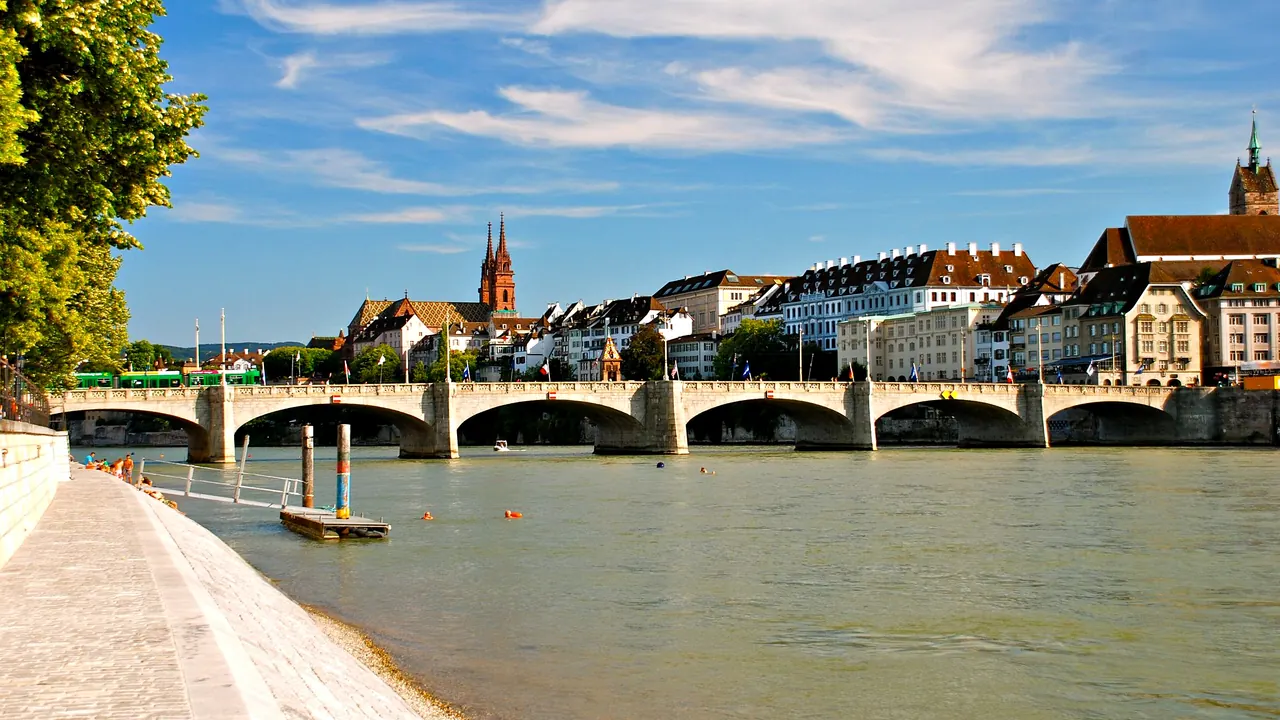
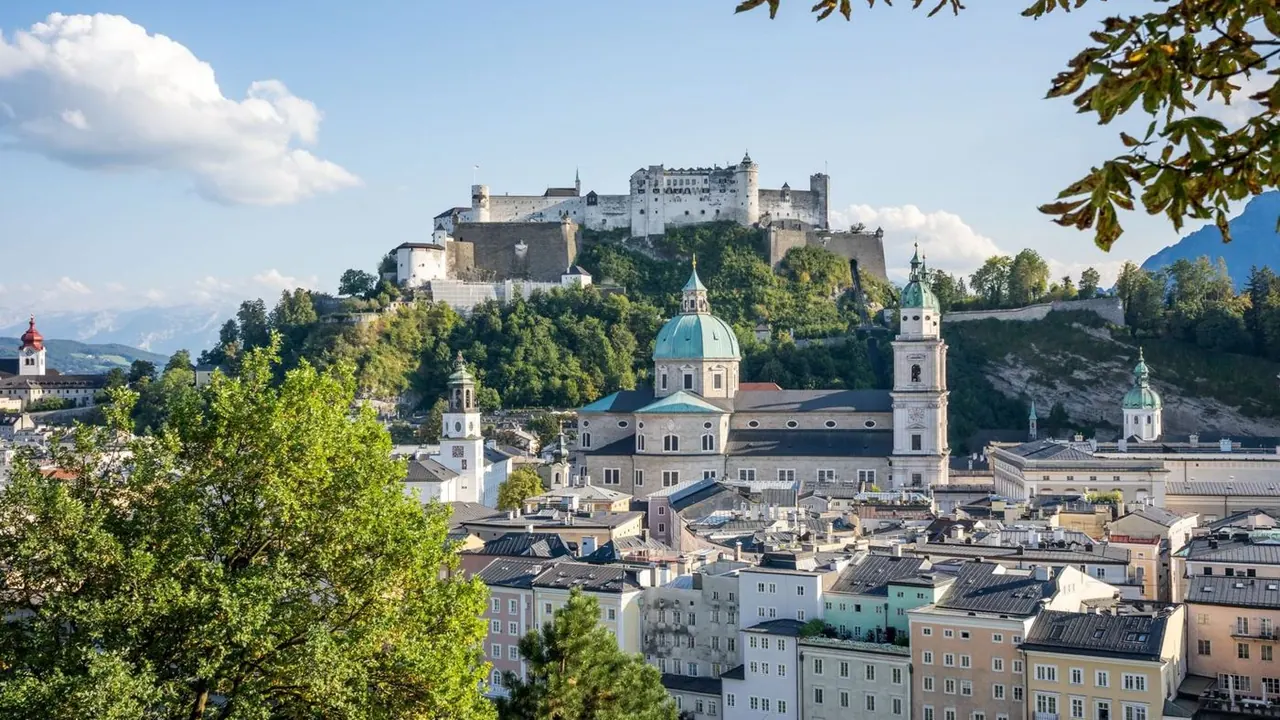
Photos: Basel by Lucazzitto, CC BY-SA 3.0, cropped; Salzburg by Leonhard Niederwimmer, Pexels License.
Basel or Salzburg?
Our verdict in twelve categories, each scored against the same fixed benchmark cities, and the climate month by month, so you can choose for your trip.
Choose Basel for
- getting around
- nightlife
- day trips
Basel suits a traveller who wants a well-run base for exploring three countries. The trams and trains make it effortless to get around, the museums are far stronger than a city this size would suggest, and summer evenings on the Kleinbasel riverbank give it a livelier after-dark life than Salzburg. It is the better pick if you plan to spend half your days in Alsace, the Black Forest or other Swiss cities, and can live with very Swiss bills.
Choose Salzburg for
- nature and the outdoors
- prices
- live music and the arts
Salzburg is the choice for music lovers and anyone who wants mountains on the doorstep. Its Baroque old town sits under a clifftop fortress, opera and concerts run through the year, and the Alps, the Salzkammergut lakes and Berchtesgaden are all close by. It is expensive too, but less so than Basel. Evenings end early, and the lake villages are easier to reach with a car.
Scoreboard
Twelve categories on one fixed scale from 0 to 100. The shaded stretch is the gap between the two.
Your match
Pick a travel style or drag the sliders, and both match scores follow your weighting.
Wins on getting around and nightlife with your weighting.
Wins on nature and the outdoors and prices with your weighting.
What matters to you?
Category by category
What the scores mean for a trip.
Beaches & swimming
Neither city has a beach, so the choice comes down to river or lake. In Basel the swimming is in the middle of town: you walk up the Kleinbasel bank and let the Rhine's current carry you back past the old town. It is a strong current, so this is for confident swimmers.
Salzburg's own river is too cold and fast for swimming. Instead, people drive half an hour or more to the clear Salzkammergut lakes and swim from lawns, jetties and small pebble shores. That makes the lakes the gentler option for weaker swimmers, but Basel's swim is the one you can do in the middle of a day of sightseeing.
Food & drink
Neither city is worth travelling to for the food alone, but the two eat very differently. Basel borrows from its neighbours, with Alsatian tarte flambée, Baden wines and a small but very good fine-dining tier. It is also easy to cross the border for a cheaper meal in an Alsace wine village.
Salzburg's strengths are the old Viennese-style coffee houses, Austrian dishes like the Salzburger Nockerl, and the monastery brewery in Mülln, where you drink in a chestnut-shaded garden and can bring your own food. Avoid the tourist menus in its old town.
Culture & sights
The two are about equal, but their appeal is different. Basel is a city of museums: the Kunstmuseum's Holbeins, the Fondation Beyeler in its park in Riehen, the Museum Tinguely and the Vitra campus just over the German border. Modern buildings by Herzog & de Meuron stand alongside the red sandstone Münster.
In Salzburg the city itself is the main sight. Its UNESCO-listed Baroque centre takes in the cathedral, the Residenz, the Mozart houses and Mirabell, all under the Hohensalzburg fortress, and you can cover it in fewer days.
Nightlife
Basel offers more after dark, though neither city is a party destination. In summer people drink on the Kleinbasel riverside steps until late, the bars cluster around the Kaserne, and a few clubs in old harbour buildings play electronic music at weekends. Fasnacht, when drums and lantern processions run through the night for three days, has no equivalent in Salzburg.
In Salzburg a night out usually means a concert and a litre mug in a beer hall, and the old town is quiet by midnight. For clubbing, people take the train to Munich.
Nature & outdoors
Salzburg wins easily for scenery. Wooded ridges rise inside the city, the Untersberg cable car takes you to limestone walks at about 1,800m, and Königssee and the Salzkammergut lakes add sailing and paddling. Bigger ski areas are about an hour away.
Basel's countryside is gentler and still pleasant. The Jura, the Black Forest and the Vosges all have good marked trails, and the flat Rhine paths make easy cycling into France and Germany. The real Alps are a couple of hours away.
Day trips
Both cities make excellent bases, and Basel has a slight edge because it borders three countries and the trains are so fast. Colmar and the Alsace wine villages, Freiburg, Strasbourg, Lucerne and Bern are all simple rail trips, with Roman Augusta Raurica almost on the doorstep.
Salzburg's trips are more about landscape and salt. There is Hallstatt, the show mines at Hallein and Berchtesgaden, St Wolfgang on its lake and the fortress at Werfen, with Munich for a city day. Several of the lake villages are much easier to reach by car.
Good for families
Both are small, safe and easy with children, with a good zoo in each, but the outings differ. Basel has the Zolli near the station, the little ferries pulled across the Rhine by the current, and Europa-Park about an hour away for a big theme-park day.
Salzburg has more hands-on fun. Children get sprayed by the trick fountains at Hellbrunn, and at the salt mines they ride miners' slides and take boats across underground lakes. Its cobbles and steep lanes are harder going with a pushchair.
Getting around
Basel is noticeably easier. Its green trams cover the whole city and some cross into France and Germany. Hotel guests travel free, and the main station has direct trains to all three countries, so you never need a car.
Salzburg's centre is a pleasure to walk, and trolleybuses reach Hellbrunn and the Untersberg cable car. There is no tram, though, and the regional buses to the lakes are slow, which is why many visitors hire a car.
Shopping & style
Neither city is a shopping destination, and they are close enough that the real difference is in what you come home with. Basel's buys are Swiss: watches, jewellery and chocolate along Freie Strasse and Gerbergasse, with small design and interior shops in the Spalenberg lanes and around St Johann. Beyond that the high street is ordinary and costly, which is why so many locals do their everyday shopping over the border in Germany.
Salzburg has the more distinctive speciality in Tracht. Workshops around the old town make dirndls, loden jackets and leather goods to measure, and Basel has nothing like it. Getreidegasse, with its wrought-iron guild signs, is a pleasure to walk. Much of the old town, though, sells Mozartkugeln and souvenirs, and there is little luxury shopping. Both cities come into their own in Advent. Basel's market is a pretty one spread around the Münster and Barfüsserplatz, while Salzburg's on Domplatz, below the fortress, is the more famous of the two.
Affordability
Both cities are expensive, but Basel is the harder on the wallet. Hotels, meals, drinks and museum entry all cost Swiss prices, and rooms become scarce during the big trade fairs. Free transport for hotel guests and cheaper meals across the border in France and Germany help a little.
Salzburg is costly mainly in the old town and during the festival and Advent seasons. Inns in the outer districts, a combined city card and a room across the river bring the cost down more than anything Basel offers.
Live music & performing arts
Salzburg is the stronger choice for music. Its summer festival brings opera, concerts and theatre by leading performers to the Felsenreitschule and the Festspielhaus, and Mozart Week and the Easter Festival add more seasons. The Mozarteum, the Landestheater and the Marionette Theatre perform through the rest of the year.
Basel is good for its size. Theater Basel is known for bold opera and ballet, and the Stadtcasino and the city's early-music tradition fill the concert calendar. Its season fades in July and August, which is exactly when Salzburg is at its busiest.
Wellness & relaxation
Both cities are calm places with good spas just outside rather than in town. In Basel the slow pace comes from quiet Sundays and the riverbank. For bathing, the saline baths at Rheinfelden are close, and the German spa towns of Baden are within reach.
Salzburg has a public bath with saunas in the city park, the brine spa of Bad Reichenhall across the border, and the radon springs and Belle Époque hotels of the Gastein valley further south.
When should you go?
Pick your month. The climate figures are measured averages, not a forecast.
Basel in July
Salzburg in July
Daytime high, °C
Rainfall in the month, mm
Temperature and rainfall are climate normals, averaged over the years shown. Basel: 1991-2020 (sunshine 1961-1990) normals, Basel / Binningen (1.9 km from centre). Salzburg: 1991-2020 normals, Salzburg (3.4 km from centre).
Both cities are at their best from late May to September, when highs reach about 26°C in Basel and 25°C in Salzburg. That is warm enough for floating down the Rhine or swimming in the lakes from June to early September. The big difference is rain. Salzburg's summers are its wettest months, with around 168mm in June, while Basel gets roughly half that, about 83mm. Basel also gets noticeably more sunshine from June to August, so a week of sightseeing there is less likely to be interrupted by downpours.
Spring and autumn suit walking in both cities, and September and early October are mild and drier than high summer. Winter is cold in both. Salzburg is the colder of the two, at around 3°C in January, often with snow reaching the town. That suits Advent markets and nearby skiing more than long days on foot. Basel's grey, low-sun winter is best spent indoors in its museums, or out on the streets for Fasnacht in late winter.
Which traveller are you?
On an outdoors trip, Salzburg is the clear choice. You can walk its wooded ridges from the old town, and the Untersberg cable car, the Salzkammergut lakes, Berchtesgaden National Park and the ski areas are all within easy reach. Basel's Jura and Black Forest are gentler country for walking.
For a culture and arts trip built around music, Salzburg is the place. Its summer festival, Mozart Week, the Easter Festival and a year-round programme at the Mozarteum and Landestheater give it the edge. Basel answers with outstanding art museums and the bold productions of Theater Basel.
For a short city break, Basel is the easier of the two. Free transport for hotel guests, trams on both banks and a compact old town let you see a lot in little time. Its riverside bars and kiosks also keep evenings going later than Salzburg's.
Before you go
| Measure | Basel | Salzburg |
|---|---|---|
| Official language | French, German, Italian, Romansh | German, Austrian Sign Language |
| Currency | Swiss Franc (CHF) | Euro (EUR) |
| Sockets | CJ230 V, 50 Hz | CF230 V, 50 Hz |
| Driving side | Right | Right |
| Time zone | UTC+1, UTC+2 in summer | UTC+1, UTC+2 in summer |
| Emergency number | 112 | 112 |
| Elevation | 247 m | 424 m |
| Main airport | EuroAirport Basel–Mulhouse–Freiburg (BSL)7 km from centre112 non-stop destinations | Salzburg Airport (SZG)3 km from centre64 non-stop destinations |
| Public holidays this year | 10 days | 16 days |
By the numbers
| Measure | Basel | Salzburg |
|---|---|---|
| City population | 176,329 | 155,021 |
| People per km² | 7,378 | 2,360 |
| Museums within 10 km | 61 | 38 |
| UNESCO World Heritage sites within 50 km | 2 | 3 |
Where else could you go?
Every comparison below shares a destination with this one, so you can follow Basel or Salzburg somewhere new.