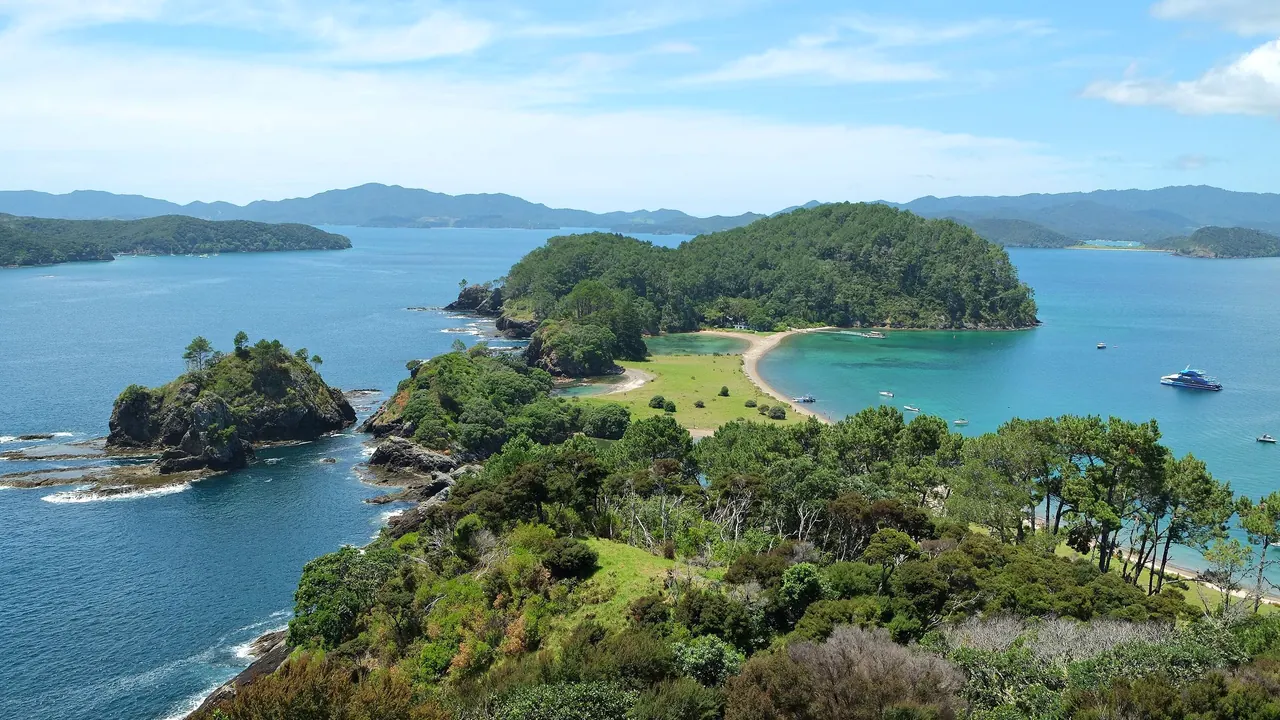
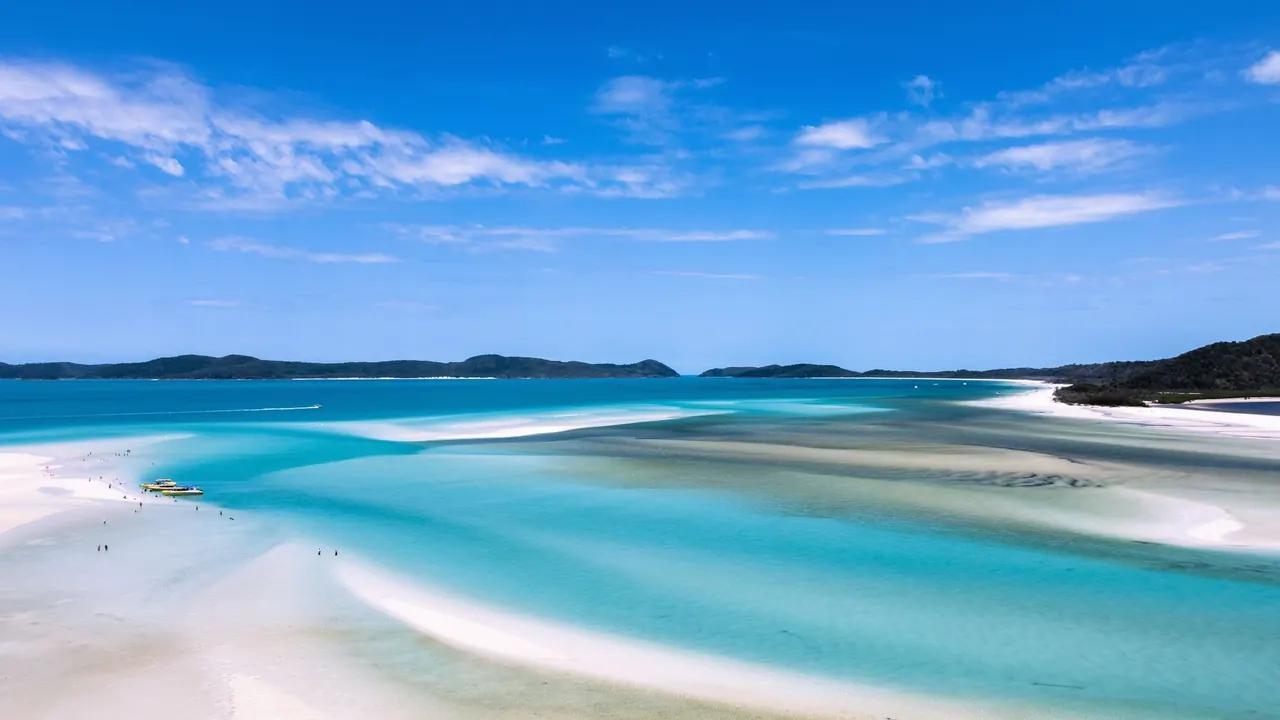
Photos: Bay of Islands by Pseudopanax at English Wikipedia, CC BY 4.0, cropped; Whitsundays by Lukas Kloeppel, Pexels License.
Bay of Islands or Whitsundays?
Our verdict in twelve categories, each scored against the same fixed benchmark cities, and the climate month by month, so you can choose for your trip.
Choose Bay of Islands for
- culture and sights
- day trips
- live music and the arts
The Bay of Islands suits a traveller who wants a calmer, more varied trip in a temperate place. A morning might be a swim in a sheltered cove and a dolphin cruise, and the afternoon the Treaty Grounds at Waitangi or the old mission buildings at Kerikeri. It is where New Zealand's history began, and it adds orchards, small towns and drives to the Hokianga, so it rewards a road trip more than a fixed base.
Choose Whitsundays for
- nightlife
- beaches
- nature and the outdoors
Choose the Whitsundays for the sea itself. Whitehaven's silica sand, water that is warm all year and islands set inside the Great Barrier Reef make it the stronger pick for beach days, sailing and snorkelling, and Airlie Beach gives younger travellers livelier evenings. What it gives up is almost everything on land. There is little history, few outings beyond boat trips, and most of the best places are reached by a booked boat.
Scoreboard
Twelve categories on one fixed scale from 0 to 100. The shaded stretch is the gap between the two.
Your match
Pick a travel style or drag the sliders, and both match scores follow your weighting.
Too close to call, 1 point apart
Wins on culture and sights and day trips with your weighting.
Wins on nightlife and beaches with your weighting.
What matters to you?
Category by category
What the scores mean for a trip.
Beaches & swimming
Both have calm water and island coves reached by boat, but the Whitsundays have the finer beaches and the warmer sea. The long white arc of Whitehaven and the swirling channels of Hill Inlet outshine anything around the Bay of Islands, and the water never turns cool.
The Bay of Islands offers something simpler: shallow, sheltered bays on Urupukapuka, a town beach in Paihia and the coves at Matauri Bay, with no stingers or crocodiles to think about, only a sea that is pleasant for just a few months. In the Whitsundays the mainland shore is muddy, so a beach day means taking a boat, and for half the year it means a stinger suit as well.
Food & drink
Neither is a place to travel to for the food, but the Bay of Islands eats a little better. Kerikeri's orchards, Sunday farmers' market and small vineyards, along with local oysters and green-lipped mussels, give its table a sense of place. The Whitsundays mostly lack that, with Airlie's casual bistros and resort dining on the islands. Their best plates are local prawns and reef fish, and in either place a long stay soon becomes repetitive.
Culture & sights
Here the gap is wide. The Bay of Islands has the Waitangi Treaty Grounds, where the treaty of 1840 was signed, with its carved meeting house and great war canoe. It also has Christ Church in Russell and the stone and wooden mission buildings at Kerikeri, a compact set of sites that fills two worthwhile days.
The Whitsundays have little beyond the Ngaro rock art sites on the islands and small heritage displays in Proserpine and Bowen. Anyone who wants some history alongside the sea should choose the New Zealand bay.
Nightlife
Neither stays up late, but at least people go out in the Whitsundays. Airlie Beach's short main street fills with backpackers once the sailing trips return, with big pub bars, open decks and a couple of late venues, loud and young for a few nights. The Bay of Islands offers a waterfront pub in Paihia or a sunset drink at Russell's historic hotel bar, followed by an early night before the boats go out.
Nature & outdoors
Both are built around sheltered island water, but the Whitsundays are the grander setting. Their islands, most of them national park, lie inside the Great Barrier Reef, so sailing and snorkelling come with coral. There are seaplane flights over Heart Reef, humpbacks in winter and the rainforest of Conway National Park behind Airlie.
The Bay of Islands is gentler and temperate. It has about 144 islands, dolphins all year, the Hole in the Rock off Cape Brett, headlands of pōhutukawa and easy walks to Haruru Falls or into the kauri of Puketi Forest. Divers can reach the Poor Knights to the south, but nothing here matches the scale of the reef.
Day trips
Outings from the Bay of Islands are drives, while from the Whitsundays they are mostly boat trips, and that gives the bay more places to go and see. The old timber villages of the Hokianga, Mangonui on Doubtless Bay and Whangārei's town basin and art museum each make a day out by car, and a coach runs up to Cape Reinga and Ninety Mile Beach.
Once Whitehaven and the reef are done, the Whitsundays offer a ferry to Hamilton's marina village or to Daydream Island, or Bowen's beaches and mango farms about an hour to the north, and little beyond that.
Good for families
Both suit families about equally, in different ways. The Bay of Islands offers a classic New Zealand camping summer: cabins, rock pools, shallow island beaches, dolphin cruises and the cultural show at Waitangi. Rainy days, though, are hard to fill.
The Whitsundays rely on the resort islands, with koalas, kids' clubs and golf buggies on Hamilton, the coral lagoon on Daydream and the netted lagoon in Airlie. Stingers, crocodiles and long boat rides to Whitehaven make the Whitsundays easier with older children than with toddlers.
Getting around
The Whitsundays are a little easier to reach and to move around. Hamilton Island has flights from the big cities, ferries link Airlie with the resort islands and on Hamilton a buggy does the rest, although Whitehaven and the reef depend on booked boats.
In the Bay of Islands, Paihia is walkable and a short ferry crosses to Russell. Kerikeri, the northern beaches and the west coast all need a car, though, and the drive up from Auckland takes about three and a half hours.
Shopping & style
Shopping is a minor pleasure in both, and slightly more rewarding in the Bay of Islands. Kerikeri's galleries, potters and woodturners and Paihia's Māori carving and pounamu give a visitor something worth taking home. The Whitsundays run to swimwear, surf gear and souvenirs in Airlie and around the Hamilton marina, plus a weekend craft market on the foreshore.
Affordability
Both are costly, but the Bay of Islands is a little easier on a budget. Camping grounds with cabins, hostels and the Paihia to Russell ferry help, and the walks and beaches cost little. Even so, summer rooms fill early and boat trips add up.
The Whitsundays charge Australian restaurant prices and add an island premium. Sailing, reef days and scenic flights, the very reasons for coming, are the expensive part. Airlie's hostels and campgrounds keep a budget stay possible, but the luxury resorts on Hayman and Hamilton set the tone.
Live music & performing arts
The Māori cultural show at the Waitangi Treaty Grounds, with haka and waiata in the carved meeting house, is the one performance in either place worth planning a day around, and it gives the Bay of Islands the edge. Kerikeri's small arts centre and the long-standing jazz and blues festival add a little more. In the Whitsundays, live music means cover bands and acoustic sets in Airlie's pubs, plus a yearly festival on the foreshore, and there is no theatre at all.
Wellness & relaxation
Both restore mainly through their slow pace rather than through treatments, so the difference is in kind. The Bay of Islands has a proper soak in the Ngāwhā hot springs, geothermal mineral pools inland from Kerikeri, along with a few lodge spas and retreats in the hills.
The Whitsundays have no springs, but the spas at the Hamilton and Hayman resorts are more polished, and there are quiet days on a yacht anchored in a still bay. To get the benefit, stay on an island rather than in noisy Airlie.
When should you go?
Pick your month. The climate figures are measured averages, not a forecast.
Bay of Islands in July
Whitsundays in July
Daytime high, °C
Rainfall in the month, mm
Where the figures come from
Bay of Islands's temperatures are measured 78 km from the centre, at Kaitaia.
Bay of Islands has no rain gauge within 25 km of the centre, so its rainfall comes from a gridded climate dataset read at the destination rather than from a gauge further away.
Whitsundays's temperatures are measured 29 km from the centre, at Proserpine.
Whitsundays has no rain gauge within 25 km of the centre, so its rainfall comes from a gridded climate dataset read at the destination rather than from a gauge further away.
Temperature and rainfall are climate normals, averaged over the years shown. Bay of Islands: 1991-2020 normals, Kaitaia (77.6 km from centre). Whitsundays: 1991-2020 normals, Proserpine (28.6 km from centre).
The two are at their best at opposite ends of the year. The Bay of Islands is a summer destination. From December to March the days are warm rather than hot, peaking at about 25°C in February. The sea is at its warmest, around 21°C, in February and March, and January is the sunniest month. Winter is mild enough for walking but wet and grey, with July the rainiest month at about 180mm. From June to November the sea is too cool for most swimmers.
The Whitsundays run the other way. January to March are hot, humid and very wet, with February bringing about 414mm of rain, and this is also the stinger and cyclone season. From May the rain largely stops. Through the winter the days stay warm in the mid twenties and the sea never drops below 22°C. The dry spell lasts into October. That dry winter is the time to go, and it falls just when the Bay of Islands is at its dampest.
Which traveller are you?
On a beach and sun trip, the Whitsundays win clearly. Whitehaven and the island coves have finer sand and much warmer water, and the dry winter months are reliably settled. The Bay of Islands has calm, safe coves, but its swimming season is shorter and cooler.
For a culture and arts trip, the Bay of Islands is the only real choice of the two. Waitangi, Russell's old church and the Kerikeri Mission Station tell the founding story of New Zealand, while the Whitsundays offer little beyond the rock art along one island trail.
On an outdoors trip, both destinations are about the water, but the Whitsundays go further. They have a sailing ground of national park islands, fringing reefs, the outer Great Barrier Reef and whales in winter. The Bay of Islands offers kayaking, resident dolphins and walks in kauri forest instead.
Before you go
| Measure | Bay of Islands | Whitsundays |
|---|---|---|
| Official language | English, New Zealand Sign Language, Māori | English |
| Currency | New Zealand Dollar (NZD) | Australian Dollar (AUD) |
| Sockets | I230 V, 50 Hz | I230 V, 50 Hz |
| Driving side | Left | Left |
| Time zone | UTC+12, UTC+13 in summer | UTC+10 |
| Emergency number | 111 | 000 |
| Main airport | Kerikeri Airport (KKE)1 non-stop destination | Proserpine Whitsunday Coast Airport (PPP)4 non-stop destinations |
| Public holidays this year | 12 days | 11 days |
By the numbers
| Measure | Bay of Islands | Whitsundays |
|---|---|---|
| Population | - | 2,269 |
| People per km² | - | 8 |
| Swim season, months above 21 °C | 1 month | 12 months |
Where else could you go?
Every comparison below shares a destination with this one, so you can follow Bay of Islands or Whitsundays somewhere new.
- North Islandvs Bay of Islands
- Cairnsvs Whitsundays
- K'garivs Whitsundays
- Sunshine Coastvs Whitsundays
- South Islandvs Bay of Islands
- Uluruvs Whitsundays