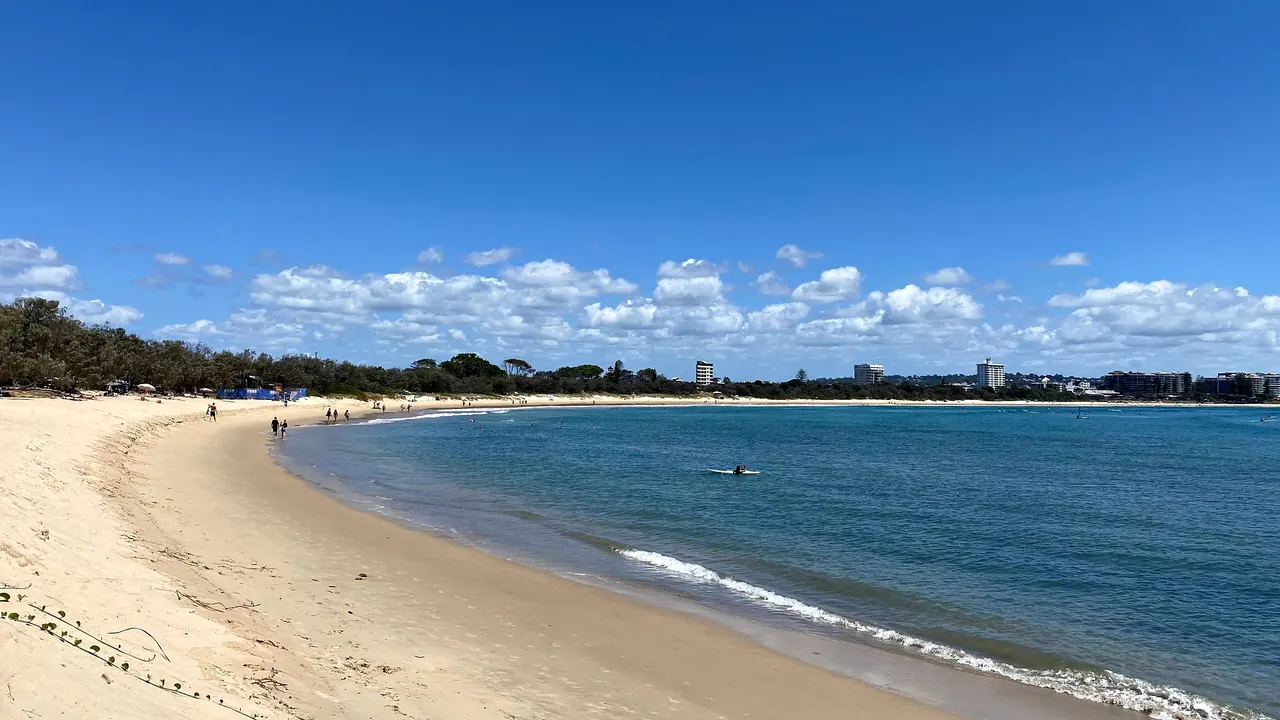
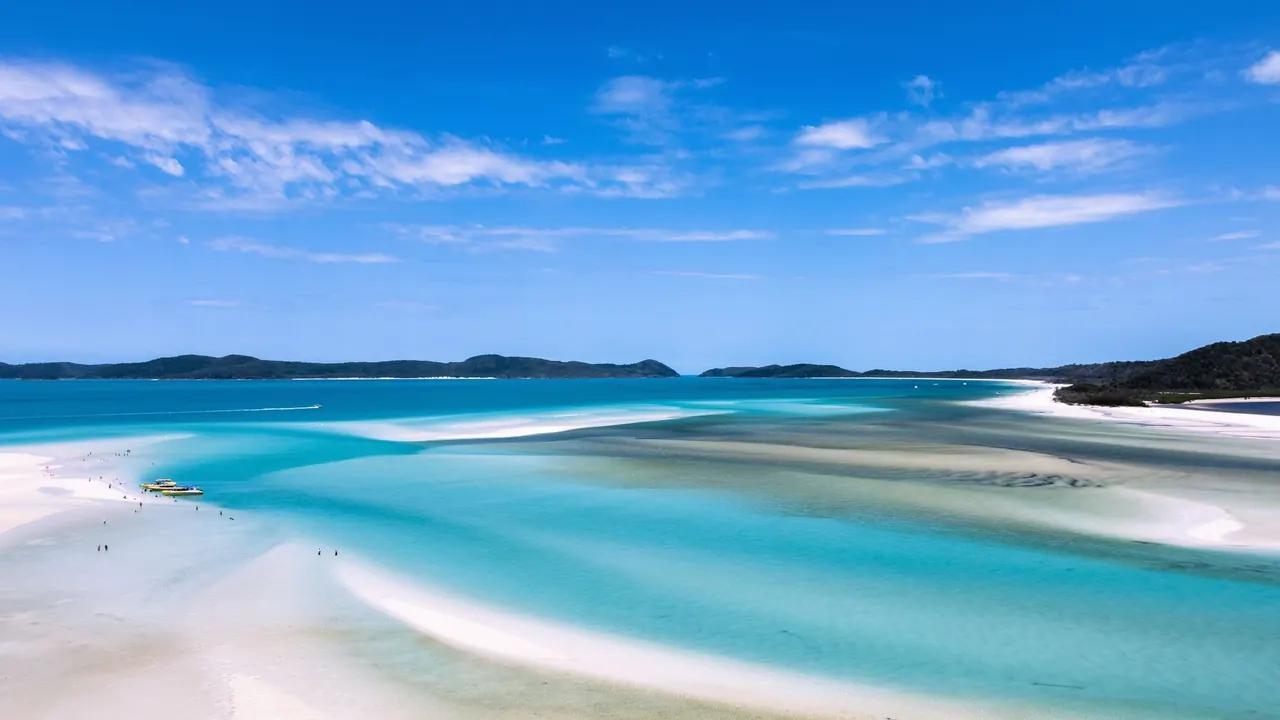
Photos: Sunshine Coast by -wuppertaler, CC BY 4.0, cropped; Whitsundays by Lukas Kloeppel, Pexels License.
Sunshine Coast or Whitsundays?
Our verdict in twelve categories, each scored against the same fixed benchmark cities, and the climate month by month, so you can choose for your trip.
Choose Sunshine Coast for
- shopping
- food and drink
- day trips
The Sunshine Coast suits a family vacation, or an easy-going trip where you drive between surf beaches, hinterland villages and a good dinner. Patrolled beaches you can walk to from your apartment, Australia Zoo, farm-gate produce, the Eumundi Markets and Brisbane within a day's reach give it far more variety on land. You can also swim all year without a stinger suit.
Choose Whitsundays for
- nightlife
- nature and the outdoors
- wellness
Choose the Whitsundays if the sea itself is the reason for the trip. That means sailing among national park islands inside the Great Barrier Reef, snorkelling fringing reefs and stepping onto Whitehaven's white silica sand. You give up variety ashore, the food is plainer and most days run to boat timetables. Still, nothing on the Sunshine Coast matches the island scenery, and Airlie Beach has livelier evenings for a younger crowd.
Scoreboard
Twelve categories on one fixed scale from 0 to 100. The shaded stretch is the gap between the two.
Your match
Pick a travel style or drag the sliders, and both match scores follow your weighting.
Wins on shopping and food and drink with your weighting.
Wins on nightlife and nature and the outdoors with your weighting.
What matters to you?
Category by category
What the scores mean for a trip.
Beaches & swimming
Both coasts are built around beaches, but very different ones. On the Sunshine Coast you walk out onto about 60km of mainland sand, mostly patrolled surf beaches. Noosa Main Beach and the Caloundra bays are calm, while Coolum and Peregian are wilder.
In the Whitsundays the best beaches, Whitehaven and the coves of the national park islands, are reached by boat or from a resort island. The mainland shore at Airlie is shallow and muddy, which is why the town has a swimming lagoon. The sea is a few degrees warmer, but from about November to May stingers mean wearing a full-body suit, which the Sunshine Coast does not ask of you.
Food & drink
The Sunshine Coast eats better and has more range. Noosa's Hastings Street and riverside have the most polished dinners, and Mooloolaba does seafood by the harbour. In the hinterland you can seek out macadamias, cheese, strawberries and small breweries and wineries.
In the Whitsundays, meals mostly fill the gaps between boat days. Airlie has casual cafés, pubs and bistros, and Hamilton and Hayman have resort dining. Local prawns, reef fish and fruit from around Bowen are the highlights. A week there soon repeats itself, while the Sunshine Coast gives you several towns to rotate through.
Culture & sights
Neither is a place for sights, but the Sunshine Coast has a little more to fill a wet afternoon. It has regional galleries in Caloundra, Noosa, Montville and Maleny, the Caloundra lighthouses, the Glass House Mountains as a landscape sacred to its first peoples, and Brisbane's museums within a day trip. The Whitsundays' heritage comes down to Ngaro rock art along the Ngaro Sea Trail and small displays in Proserpine and Bowen, and beyond that it is all sea and islands.
Nightlife
For going out, Airlie Beach has the edge. Its short main street is a backpacker strip of big pub bars, open-air decks and a couple of late venues that fill up when the sailing trips come back. It is loud, young and small, and the islands themselves go quiet early.
On the Sunshine Coast, evenings are more spread out and calmer. You get sunset drinks at a surf club, a beer at a brewery and long dinners. Mooloolaba and Maroochydore have a few late bars and clubs, and Noosa's wine bars are mostly quiet by midnight. For a serious night out, people drive to Brisbane.
Nature & outdoors
The Whitsundays win outdoors because they have something the Sunshine Coast lacks: 74 islands, most of them national park, in sheltered water inside the Great Barrier Reef. Sailing trips, snorkelling the fringing reefs, kayaking between islands and diving the outer reef fill the days, and the Ngaro Track and Hill Inlet lookout give good walking.
The Sunshine Coast is greener and more varied on land. There is the Noosa headland track with its koalas, climbs in the Glass House Mountains, waterfall walks on the Blackall Range and kayaking in the tea-coloured Noosa Everglades. Humpback whales pass close to shore in winter on both coasts.
Day trips
The Sunshine Coast has more places to drive to. Brisbane, with its museums and South Bank, is an hour or so south. The hinterland circuit of Montville, Maleny and the Eumundi market makes an easy outing, and Rainbow Beach or a guided crossing to K'gari fills a longer day.
From the Whitsundays, almost every outing is a boat trip to a reef or beach rather than to another place. Hamilton Island's marina village, Daydream Island and the mango-growing town of Bowen are the alternatives, and little else is within reach.
Good for families
The Sunshine Coast is the easier family trip. Australia Zoo, the Mooloolaba aquarium and a small theme park fill the days away from the sea. The sheltered, patrolled beaches at Noosa and Caloundra are close to self-catering apartments, and many beaches have shaded playgrounds and barbecues behind them.
The Whitsundays work best from a resort island, with Hamilton's kids' clubs, koalas and golf buggies or Daydream's coral lagoon. But stinger suits in the warmer months, crocodiles in the mainland creeks and hours on a boat to reach Whitehaven make it better for older children than for toddlers.
Getting around
Neither is effortless, and each asks for something different. On the Sunshine Coast you hire a car. Caloundra to Noosa is about an hour's drive and the hinterland less than half an hour, but buses are slow, and summer traffic and parking around Noosa and Mooloolaba can be a trial.
In the Whitsundays a car only helps on the mainland. Airlie is easy to walk, ferries run to Hamilton and Daydream, and Hamilton has its own airport and buggies. Whitehaven and the reef, though, mean booked boat trips, so your days follow departure times and the weather.
Shopping & style
Shopping is a small part of either trip, but the Sunshine Coast at least gives you something to browse. The Eumundi Markets, held since the late 1970s, have hundreds of stalls selling crafts, ceramics and produce, Hastings Street has resort-wear and homewares boutiques, and Maroochydore has a large shopping centre. The Whitsundays have little beyond swimwear, surf gear and souvenirs in Airlie and at the Hamilton marina, plus a weekend craft market on the Airlie foreshore.
Affordability
Both are expensive, as Australian coasts tend to be, but the money goes in different places. On the Sunshine Coast the main costs are car hire, eating out and a Noosa base in peak season. The beaches, national park walks and hinterland lookouts are free, and apartments in Caloundra or Maroochydore keep the bill down.
In the Whitsundays you can find a cheap bed in an Airlie hostel or campground. But the things you come for, sailing trips, reef days and scenic flights, cost extra every time, and the island resorts and their meals carry a premium.
Live music & performing arts
The Sunshine Coast offers more. Caloundra's regional theatre hosts touring shows and comedy, and there are pub bands at weekends, the Woodford Folk Festival over Christmas and New Year, Noosa's arts and jazz festivals in the cooler months, and Brisbane in reach for opera and orchestras. The Whitsundays have cover bands and acoustic sets in Airlie's pubs and resort bars, an annual music festival on the foreshore and occasional events on Hamilton Island, but no theatre or concert hall.
Wellness & relaxation
Neither has a bathing tradition, and both rely on spas and a slow pace, but the setting differs. The Sunshine Coast has Noosa's day spas and yoga classes by the river, then rainforest retreats and guesthouses around Maleny and Montville for a few days of doing very little.
In the Whitsundays the restful part is being on an island. The resorts on Hamilton and Hayman have serious spas, or you can spend a few days on a yacht anchored in a still bay. Stay on an island rather than in Airlie, whose backpacker noise makes it the least restful base.
When should you go?
Pick your month. The climate figures are measured averages, not a forecast.
Sunshine Coast in July
Whitsundays in July
Daytime high, °C
Rainfall in the month, mm
Where the figures come from
Sunshine Coast's sunshine is measured 83 km from the centre, at Brisbane Airport.
Whitsundays's temperatures are measured 29 km from the centre, at Proserpine.
Whitsundays has no rain gauge within 25 km of the centre, so its rainfall comes from a gridded climate dataset read at the destination rather than from a gauge further away.
Temperature and rainfall are climate normals, averaged over the years shown. Sunshine Coast: 1991-2020 normals, Sunshine Coast Airport (5.6 km from centre). Whitsundays: 1991-2020 normals, Proserpine (28.6 km from centre).
Around the main resort towns, the Sunshine Coast is milder, but its rain lasts longer. The wet months run from December to June and peak in February at about 210mm. August to November is the best stretch: drier, with long hours of sunshine and warm beach days, though the sea is at its coolest early in that stretch. Summer stays a few degrees cooler than the Whitsundays, so walking around town is comfortable all year, and winter days are mild rather than cool.
The Whitsundays, further north, run hotter, with highs around 32°C from November to February. Around Airlie the wet season is far heavier, reaching about 414mm in February, and cyclones are also a risk then. June to October is the dry season and the time to go. Days of about 25°C from June to August are the most comfortable for beach days and walking, with humpback whales close to shore from July. September and October stay dry but warm up towards 30°C. Stinger suits are needed in the sea from roughly November to May.
Which traveller are you?
On a family trip with young children, the Sunshine Coast is the safer choice. Sheltered, patrolled beaches sit close to self-catering apartments, and Australia Zoo and the aquarium add variety. There are no stinger suits or long boat days, which toddlers find hard.
For an outdoors trip, the Whitsundays lead clearly. You can sail among national park islands inside the Great Barrier Reef, snorkel fringing reefs and dive the outer reef. The Sunshine Coast's hinterland walks and Noosa headland are lovely but cannot match that.
On a culture and arts trip, neither is ideal, but the Sunshine Coast serves you better. Its hinterland galleries, Caloundra's theatre, Noosa's festivals and Brisbane's museums within a day trip offer far more than the Whitsundays' few Ngaro sites.
Before you go
| Measure | Sunshine Coast | Whitsundays |
|---|---|---|
| Official language | English | English |
| Currency | Australian Dollar (AUD) | Australian Dollar (AUD) |
| Sockets | I230 V, 50 Hz | I230 V, 50 Hz |
| Driving side | Left | Left |
| Time zone | UTC+10 | UTC+10 |
| Emergency number | 000 | 000 |
| Main airport | Sunshine Coast Airport (MCY)8 non-stop destinations | Proserpine Whitsunday Coast Airport (PPP)4 non-stop destinations |
| Public holidays this year | 11 days | 11 days |
By the numbers
| Measure | Sunshine Coast | Whitsundays |
|---|---|---|
| Population | 284,131 | 2,269 |
| People per km² | 614 | 8 |
| Swim season, months above 21 °C | 10 months | 12 months |
Where else could you go?
Every comparison below shares a destination with this one, so you can follow Sunshine Coast or Whitsundays somewhere new.
- K'garivs Sunshine Coast
- Cairnsvs Whitsundays
- K'garivs Whitsundays
- Blue Mountainsvs Sunshine Coast
- Uluruvs Whitsundays
- Balivs Whitsundays