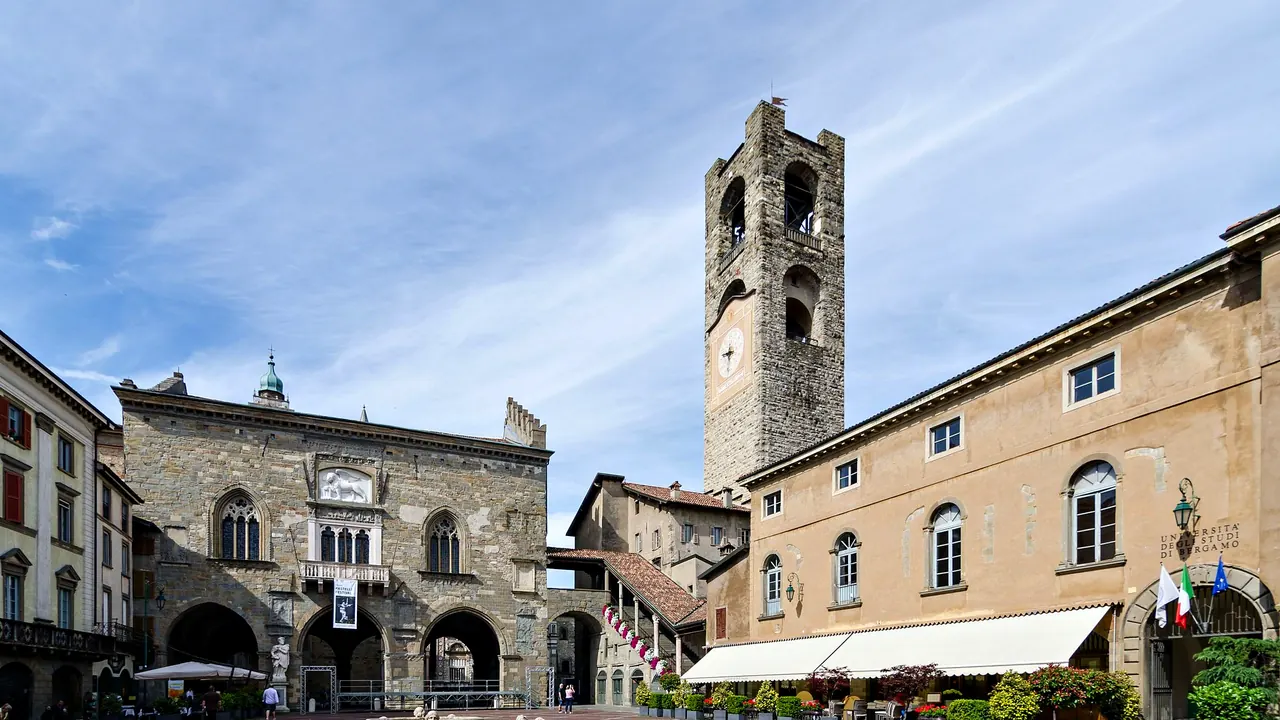
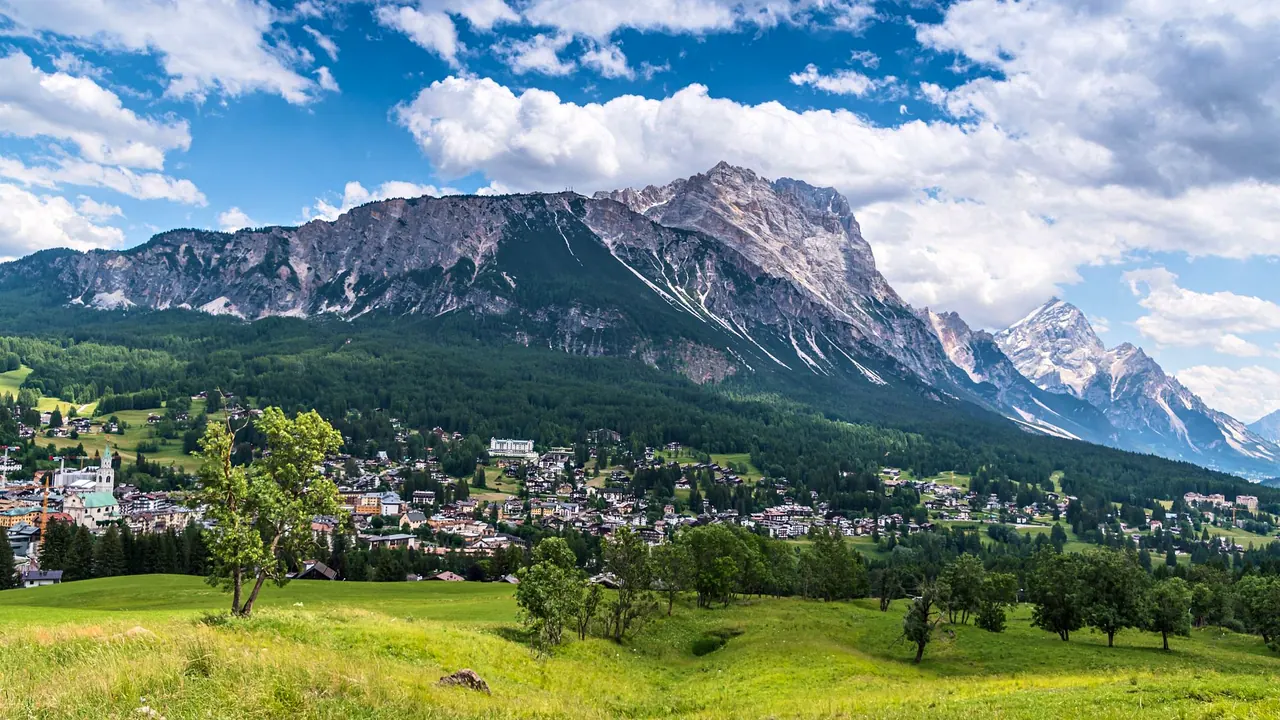
Photos: Bergamo by Steffen Schmitz, CC BY-SA 4.0, cropped; Cortina d'Ampezzo by Andreas Neubauer, Pexels License.
Bergamo or Cortina d'Ampezzo?
Our verdict in twelve categories, each scored against the same fixed benchmark cities, and the climate month by month, so you can choose for your trip.
Choose Bergamo for
- culture and sights
- day trips
- prices
Bergamo suits a traveller who wants a walled hilltop old town, a serious art gallery and a base with good trains to Milan, the lakes and Verona. It costs less, is easier without a car, and is the better pick for a short stay built around sights, Lombard food and opera. The Orobie Alps are a bonus there rather than the point.
Choose Cortina d'Ampezzo for
- nature and the outdoors
Choose Cortina when the mountains are the whole trip. The ring of Dolomite peaks, the lifts straight from town, Dolomiti Superski and the Alta Via 1 give skiers, hikers and climbers a setting that Bergamo's valleys cannot match. In return you accept resort prices, quiet evenings, few sights and a coach or car journey to get there.
Scoreboard
Twelve categories on one fixed scale from 0 to 100. The shaded stretch is the gap between the two.
Your match
Pick a travel style or drag the sliders, and both match scores follow your weighting.
Wins on culture and sights and day trips with your weighting.
Wins on nature and the outdoors with your weighting.
What matters to you?
Category by category
What the scores mean for a trip.
Beaches & swimming
Neither is a beach destination, but Bergamo does have proper lake swimming within reach. There are lidos around Sarnico and Lovere on Lake Iseo, and the Lecco arm of Lake Como is close too. By July the water is warm, and you swim from pebble, grass or concrete rather than sand. Cortina's lakes, Ghedina and Pianozes, are fed by snowmelt and better for walking round than swimming in, so in practice a swim means a hotel pool.
Food & drink
Both cities cook Alpine mountain food, and their signature pastas are cousins: Bergamo's casoncelli with butter, sage and pancetta, and Cortina's beetroot casunziei with poppy seeds. Bergamo has more to offer. Its valleys produce Taleggio, Branzi and Strachitunt, the Città Alta has trattorias and pastry shops, the lower town has everyday aperitivo bars, and you drink Valcalepio and Franciacorta.
In Cortina the best meals are often on rifugio terraces among the peaks, with stube dining rooms and a few ambitious kitchens down in the valley. There is less choice there, and almost nothing is cheap.
Culture & sights
The gap here is wide. Bergamo's Città Alta is an almost complete walled hilltop town, with Piazza Vecchia, Santa Maria Maggiore and the marble front of the Cappella Colleoni. Below it, the Accademia Carrara holds Raphael, Bellini and Mantegna.
Cortina's centre is pleasant, with the basilica's tall bell tower, painted houses and the ice stadium from the 1956 Olympics, and its small museums fill a wet afternoon. Its most striking history, the First World War tunnels on Lagazuoi and the Cinque Torri, lies up in the mountains and takes a day to reach.
Nightlife
Neither town is made for late nights, but in an ordinary week Bergamo has more going on. Expect a long aperitivo, then wine bars and student pubs around Via XX Settembre and Borgo Santa Caterina, and drinks on the walls in summer. Milan is close for anything bigger.
Cortina's evenings mean après-ski and a stroll along the Corso Italia, followed by long dinners. Smart bars and a club or two stay open late only in the peak winter weeks, and in summer the town goes quiet early.
Nature & outdoors
Cortina is the stronger choice and one of the finest mountain bases anywhere. The Tofane, Cristallo and Cinque Torri ring the valley, lifts run straight up from town, and the Tre Cime and Lago di Misurina are under an hour away. Winter brings Dolomiti Superski, and summer brings the Alta Via 1 and historic via ferrata routes.
Bergamo's outdoors are good but gentler and more spread out. There are wooded paths from the upper town to San Vigilio, hut-to-hut hiking in the Orobie valleys, and sailing and cycling on Iseo and Como. Its ski areas are small, and the mountains are easier with a car.
Day trips
Bergamo is much the better base. Milan is under an hour by train, Lake Iseo and Lake Como are closer still, and Crespi d'Adda, Brescia, Cremona and Verona all make practical days out.
From Cortina, most excursions head into the mountains. The towns within reach are charming rather than essential: San Candido, Brunico with its Messner museum, and Bolzano, with the Iceman, about two hours away. Venice is a long day by coach.
Good for families
For children the two are close, but in very different ways. Bergamo offers easy outings: funicular rides, a walk on the walls with a gelato, and Leolandia and the Le Cornelle wildlife park close by. The cobbled upper town is hard work with a buggy.
Cortina works for families who ski or hike. It has ski schools, beginner slopes at Socrepes, skating at the Olympic stadium and gentle trails to huts. There is no theme park or zoo, though, rainy days drag, and costs climb quickly.
Getting around
Bergamo is the easier place to be without a car. Funiculars link the lower town, the Città Alta and San Vigilio, the airport is a short bus ride away, and direct trains run to Milan, Brescia and Lecco.
Cortina's small centre is easy to walk and ski buses serve the slopes, but there has been no railway since 1964. Getting there means a coach from Venice or a long drive. Buses to the passes and the Tre Cime are limited, so many visitors hire a car.
Shopping & style
The two are broadly level but suit different shoppers. Bergamo's arcaded Via XX Settembre and Sentierone have mid-range Italian chains, and the main lane of the upper town is the place for cheese, salumi and wine to take home. Milan is close for serious fashion.
Cortina puts luxury fashion, jewellers, furriers and upmarket ski wear along the single strip of the Corso Italia. The Cooperativa, founded in 1893, anchors it, and there are shops for local wood carving and filigree.
Affordability
Bergamo is moderately priced for northern Italy. Fair lower-town hotels and inexpensive buses and funiculars make it a sensible base, and only the Città Alta and summer weekends push costs up.
Cortina is among the most expensive places to stay in Italy. It charges luxury-resort rates in the winter peak and in August, and lift passes and equipment hire come on top. Meals at the rifugi and the quieter weeks of June and late September soften the bill only a little.
Live music & performing arts
Bergamo has a real stage life for its size, built around Donizetti. The Teatro Donizetti runs a season of opera, concerts and theatre plus an autumn festival of the composer's works, the Teatro Sociale stages smaller productions in the upper town, and Bergamo Jazz comes each spring.
Cortina has no theatre season and no regular venue. Its live music comes from summer chamber and classical festivals in churches and mountain settings, plus a few concerts around Christmas and New Year.
Wellness & relaxation
Bergamo has a slight edge because real spa towns are close by: the Belle Époque thermal baths of San Pellegrino Terme up Val Brembana, and the sulphur springs at Trescore Balneario, in use since Roman times. Early mornings in the quiet Città Alta add a slower pace.
Cortina has no springs, so relaxing there means Alpine hotel spas with saunas, hay baths and pools after a day outdoors, or an afternoon on a hut terrace in June or September. In the peak weeks, traffic and crowds make it far less restful.
When should you go?
Pick your month. The climate figures are measured averages, not a forecast.
Bergamo in July
Cortina d'Ampezzo in July
Daytime high, °C
Rainfall in the month, mm
Where the figures come from
Bergamo has no rain gauge within 25 km of the centre, so its rainfall comes from a gridded climate dataset read at the city rather than from a gauge further away.
Bergamo's sunshine is measured 64 km from the centre, at Lugano.
Temperature and rainfall are climate normals, averaged over the years shown. Bergamo: 1991-2020 normals, Bergamo / Orio Al Serio (3.9 km from centre). Cortina d'Ampezzo: 1991-2020 normals, Dobbiaco (22.5 km from centre).
Bergamo is a warm-season city at the edge of the plain. July and August are the sunniest months and reach about 29°C. That is fine for a day at the lake but heavy for climbing to the upper town at midday, so late spring and early September are better for walking. Rain is heaviest from September to November, at around 125mm a month. Winters are cool but fairly dry and mild enough for a trip built around galleries and trattorias.
Cortina has two seasons. Summer highs only reach about 22°C, which is ideal for hiking from June to September. July is the wettest month, with 130mm, so expect showers on the peaks. From December to February daytime highs stay around freezing, and that is the ski season. April, May, October and November fall between the two and suit neither well.
Which traveller are you?
For a culture and arts trip, Bergamo is the clear choice. The walled Città Alta, the Accademia Carrara and the Teatro Donizetti's opera fill several days, and the Brera in Milan is under an hour away. Cortina's sights fill one rainy afternoon.
On an outdoors trip, Cortina is the place. Lifts climb from town into the Dolomites, and the valley has some of the Alps' oldest via ferrata routes, the Alta Via 1 and Dolomiti Superski in winter. Bergamo's Orobie valleys are good, but gentler, and much easier with a car.
On a tight budget, Bergamo is far easier. Lower-town hotels are fairly priced, buses and the funicular cost little, and trains make day trips cheap. Cortina is among Italy's most expensive resorts, and budget travellers often stay in other valleys and drive in.
Before you go
| Measure | Bergamo | Cortina d'Ampezzo |
|---|---|---|
| Official language | Italian | Italian |
| Currency | Euro (EUR) | Euro (EUR) |
| Sockets | CFL230 V, 50 Hz | CFL230 V, 50 Hz |
| Driving side | Right | Right |
| Time zone | UTC+1, UTC+2 in summer | UTC+1, UTC+2 in summer |
| Emergency number | 112 | 112 |
| Elevation | 249 m | 1,224 m |
| Main airport | Il Caravaggio International Airport (BGY)4 km from centre146 non-stop destinations | Venice Marco Polo Airport (VCE)116 km from centre103 non-stop destinations |
| Public holidays this year | 13 days | 13 days |
By the numbers
| Measure | Bergamo | Cortina d'Ampezzo |
|---|---|---|
| City population | 119,534 | 5,546 |
| People per km² | 2,973 | 22 |
| Museums within 10 km | 21 | 3 |
| UNESCO World Heritage sites within 50 km | 6 | 1 |
Where else could you go?
Every comparison below shares a destination with this one, so you can follow Bergamo or Cortina d'Ampezzo somewhere new.
- Milanvs Bergamo
- Comovs Bergamo
- Luganovs Bergamo
- Innsbruckvs Cortina d'Ampezzo
- Veronavs Bergamo
- Venicevs Cortina d'Ampezzo