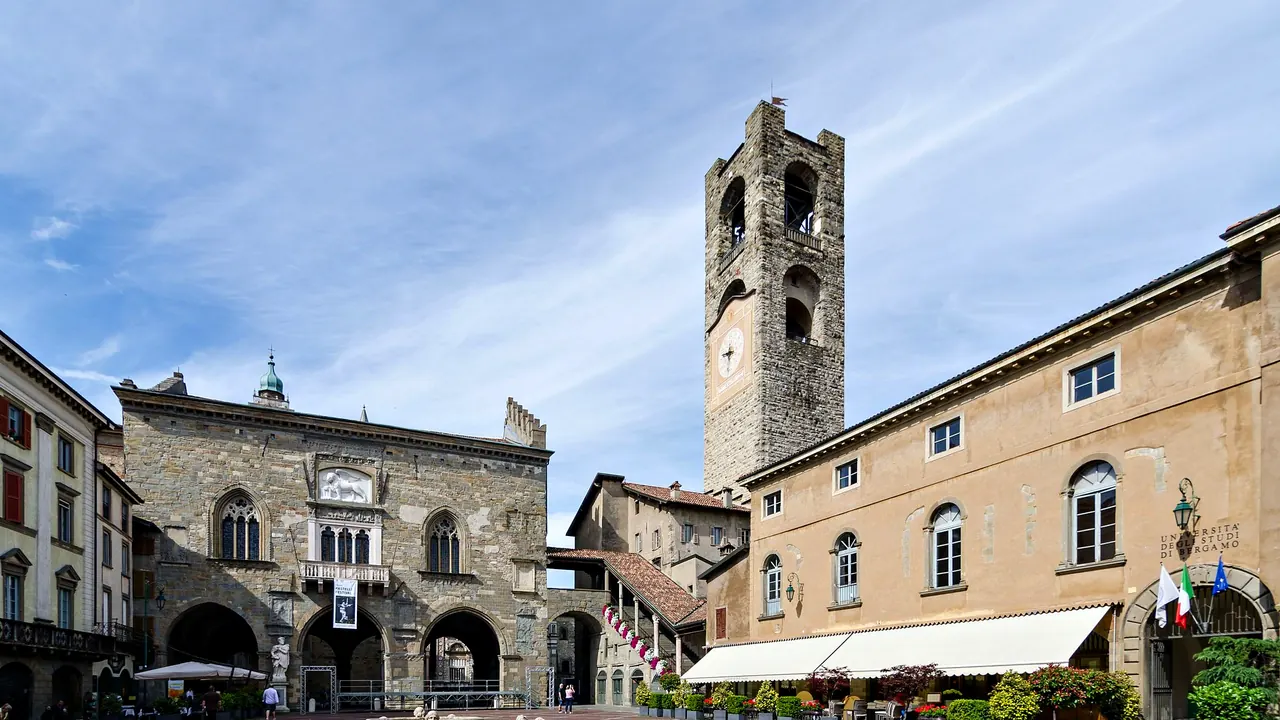
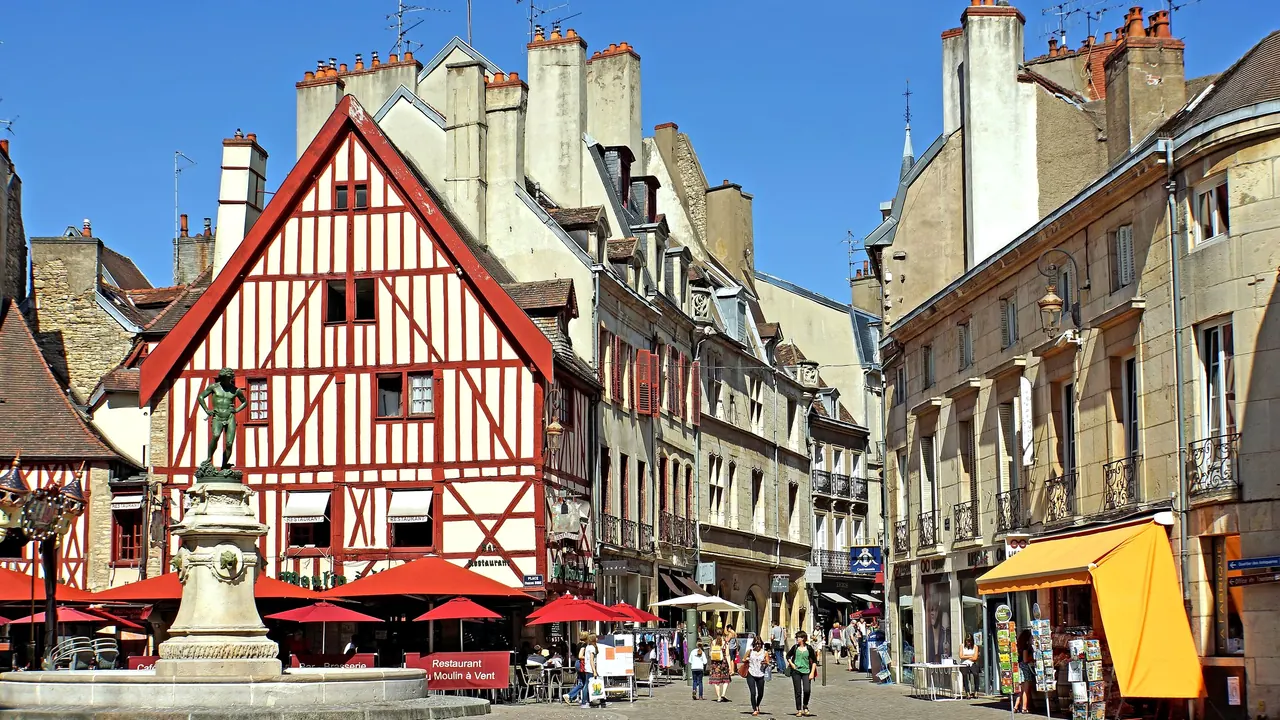
Photos: Bergamo by Steffen Schmitz, CC BY-SA 4.0, cropped; Dijon by Dennis G. Jarvis, CC BY-SA 2.0, cropped.
Bergamo or Dijon?
Our verdict in twelve categories, each scored against the same fixed benchmark cities, and the climate month by month, so you can choose for your trip.
Choose Bergamo for
- wellness
- beaches
- nature and the outdoors
Bergamo suits travellers who want a walled hilltop town as a base, with mountains and lakes close by. The Orobie valleys, Lake Iseo and Lake Como, spa towns such as San Pellegrino and a run of train day trips to Milan, Brescia and Verona give a stay here more range. It is also the easier of the two with children.
Choose Dijon for
- food and drink
- getting around
Choose Dijon if the trip is really about eating and drinking. Burgundian cooking, the market hall of Les Halles and the Côte de Nuits starting at the edge of town make it the stronger table. Its compact, pedestrian centre around the ducal palace is easy to take in over a few unhurried days, and Beaune is a short train ride south.
Scoreboard
Twelve categories on one fixed scale from 0 to 100. The shaded stretch is the gap between the two.
Your match
Pick a travel style or drag the sliders, and both match scores follow your weighting.
Wins on wellness and beaches with your weighting.
Wins on food and drink and getting around with your weighting.
What matters to you?
Category by category
What the scores mean for a trip.
Beaches & swimming
Neither city is a swimming destination, but Bergamo has the better fallback. The lidos on Lake Iseo around Sarnico and Lovere and the Lecco arm of Lake Como are a short trip away, and the water is near 23°C by July. The shores are pebble, grass or concrete rather than sand.
Dijon has only Lac Kir, a reservoir on the edge of town with a small supervised lawn-and-sand area. It is fine for a hot afternoon and not much more.
Food & drink
Both serve hearty regional cooking with little beyond it, but Dijon is the richer table. Boeuf bourguignon, jambon persillé, mustard and cassis, the iron hall of Les Halles and Côte de Nuits wines by the glass make eating the point of a stay.
Bergamo's mountain cooking is honest and satisfying. There is casoncelli, polenta with game, and some of Italy's great cheeses, such as Taleggio and Strachitunt, with Franciacorta made just over the border. It is a good food town rather than a reason to travel.
Culture & sights
The two are closely matched, and both have UNESCO-listed heritage, but they reward different kinds of sightseeing. In Bergamo the setting is the draw: an almost complete walled town on a hill, with the Cappella Colleoni and Santa Maria Maggiore around Piazza Vecchia. Below it, the Accademia Carrara holds Raphael and Bellini.
Dijon is flat and built around one grand ensemble, the ducal palace, where the Musée des Beaux-Arts holds the Valois tombs. Around it are half-timbered streets, the gargoyles of Notre-Dame and Sluter's Well of Moses. Bergamo fills a day or two, while Dijon rewards two or three.
Nightlife
Evenings go much the same way in both cities: aperitivo or wine, a late dinner and home around midnight, with few clubs. In Bergamo people drink in Borgo Santa Caterina, or on summer nights in the squares and along the walls of the Città Alta, and Milan is close for a bigger night. In Dijon students keep the small bars of Rue Berbisey busy, but the town goes quiet outside term.
Nature & outdoors
Bergamo has real mountains close by. Woodland paths climb from the upper town to San Vigilio, and the Orobie Alps up Val Brembana and Val Seriana have rifugi and high lakes. Two large lakes offer sailing and lakeside walks, and there are small ski areas in winter.
Dijon's countryside is gentler. There are limestone combes west of town for walking and climbing, the flat towpath of the Burgundy Canal and the vineyard cycle route to Beaune. Its wildest landscape, the Morvan, is about an hour and a half away.
Day trips
Both are excellent bases, but Bergamo offers more variety. Milan's Duomo and Last Supper are under an hour by train, and Lake Como, Lake Iseo and Monte Isola are closer still. Brescia, Cremona and Verona add three very different cities.
Most of Dijon's outings share one theme, and a fine one: the Route des Grands Crus to Beaune, Fontenay Abbey and the medieval towns of the Auxois. Many of the wine villages need a car, a bike or a tour, whereas Bergamo's main trips run by train.
Good for families
Bergamo gives children more to do. The funiculars up to the Città Alta and San Vigilio are a treat in themselves. Leolandia and the Le Cornelle wildlife park are both close, though the cobbled upper town is hard work with a buggy.
Dijon is just as calm and safe, and its flat pedestrian centre is easier with a pushchair. Beyond the planetarium at the Jardin de l'Arquebuse and paddling at Lac Kir, though, its wine and art itineraries are made for adults.
Getting around
Both are easy without a car in town, and both need one for the countryside. Bergamo works on two levels. Funiculars link the flat lower town to the hilltop, the airport is a short bus ride away and trains run directly to Milan and Lecco.
Dijon is flat and compact, so the station, market and palace are a few minutes' walk apart. Trams reach the outskirts, and the TGV gets to Paris in well under two hours.
Shopping & style
Neither is a fashion destination, and in both the best things to buy are things to eat and drink. Bergamo's main upper-town lane is lined with cheese shops, salumi and Valcalepio wine, and Milan is close for serious fashion. Dijon sells mustard, pain d'épices, cassis and Burgundy from its cellars, and the lanes off Rue de la Liberté add antiques and small independent shops.
Affordability
Costs are much the same in both, comfortably mid-range. In Bergamo the saving comes from staying in a lower-town hotel, because rooms inside the Città Alta cost more and summer weekends fill up. In Dijon the bistro set lunches and wine by the glass are fairly priced, but tastings, wine tours and good bottles stretch the budget.
Live music & performing arts
Both have a proper season for cities of their size, but their strengths differ. Bergamo's stage life centres on opera and its native composer Donizetti, with an autumn festival of his works at the Teatro Donizetti. Bergamo Jazz runs each spring, and La Scala is within reach for an evening.
Dijon's programme is broader, with opera, concerts and dance at the Grand Théâtre and the Auditorium, known for its acoustics, plus a national drama centre. It thins out in summer.
Wellness & relaxation
Bergamo is clearly the better choice for spa time. The grand thermal spa at San Pellegrino Terme is about forty minutes up the valley, and Trescore Balneario has sulphur springs used since Roman times.
Dijon has no baths of its own, only a few hotel spas, some offering grape-based treatments. Its calm comes from long lunches and quiet afternoons in the vineyards rather than from the water.
When should you go?
Pick your month. The climate figures are measured averages, not a forecast.
Bergamo in July
Dijon in July
Daytime high, °C
Rainfall in the month, mm
Where the figures come from
Bergamo has no rain gauge within 25 km of the centre, so its rainfall comes from a gridded climate dataset read at the city rather than from a gauge further away.
Bergamo's sunshine is measured 64 km from the centre, at Lugano.
Temperature and rainfall are climate normals, averaged over the years shown. Bergamo: 1991-2020 normals, Bergamo / Orio Al Serio (3.9 km from centre). Dijon: 1991-2020 normals, Dijon (7 km from centre).
Bergamo has the hotter summer, with highs of 29°C in July and August. That is warm enough for lake swimming at Iseo and Como, but sticky for climbing to the upper town at midday. Dijon peaks nearer 27°C, which is comfortable for walking and cycling in the vineyards. Late spring and early autumn are the best months for walking in both cities, but Bergamo is much the wetter. May brings heavy rain, and September to November is wetter still, with about 129mm in October. Dijon stays near 77mm even in its wettest months.
Winters are cold in both, with highs in single figures. Bergamo keeps more sunshine through the dark months, while December in Dijon is grey, with about half Bergamo's sunshine. Dijon is at its best from May to September. Bergamo is best in April and early June for sightseeing, and June to August for the lakes.
Which traveller are you?
For a relaxing and wellness trip, Bergamo is the better fit. A thermal bathing day slots easily between the sightseeing, and the upper town is calm early and late. In Dijon, rest means long lunches rather than treatments.
On an outdoors trip, Bergamo wins clearly. Walkers can set off on foot from town and be in woodland within the hour, and serious mountain days, sailing or winter skiing are within reach. Dijon's rolling country suits easier rides and walks.
For a food and nightlife trip, Dijon has the edge. Evenings are equally low-key in both, so the table decides, and while Bergamo eats well, Dijon's cooking and local wine are the reason to travel.
Before you go
| Measure | Bergamo | Dijon |
|---|---|---|
| Official language | Italian | French |
| Currency | Euro (EUR) | Euro (EUR) |
| Sockets | CFL230 V, 50 Hz | CE230 V, 50 Hz |
| Driving side | Right | Right |
| Time zone | UTC+1, UTC+2 in summer | UTC+1, UTC+2 in summer |
| Emergency number | 112 | 112 |
| Elevation | 249 m | 220 m |
| Main airport | Il Caravaggio International Airport (BGY)4 km from centre146 non-stop destinations | Lyon Saint-Exupéry Airport (LYS)178 km from centre141 non-stop destinations |
| Public holidays this year | 13 days | 11 days |
By the numbers
| Measure | Bergamo | Dijon |
|---|---|---|
| City population | 119,534 | 161,830 |
| People per km² | 2,973 | 3,890 |
| Museums within 10 km | 21 | 8 |
| UNESCO World Heritage sites within 50 km | 6 | 1 |
Where else could you go?
Every comparison below shares a destination with this one, so you can follow Bergamo or Dijon somewhere new.