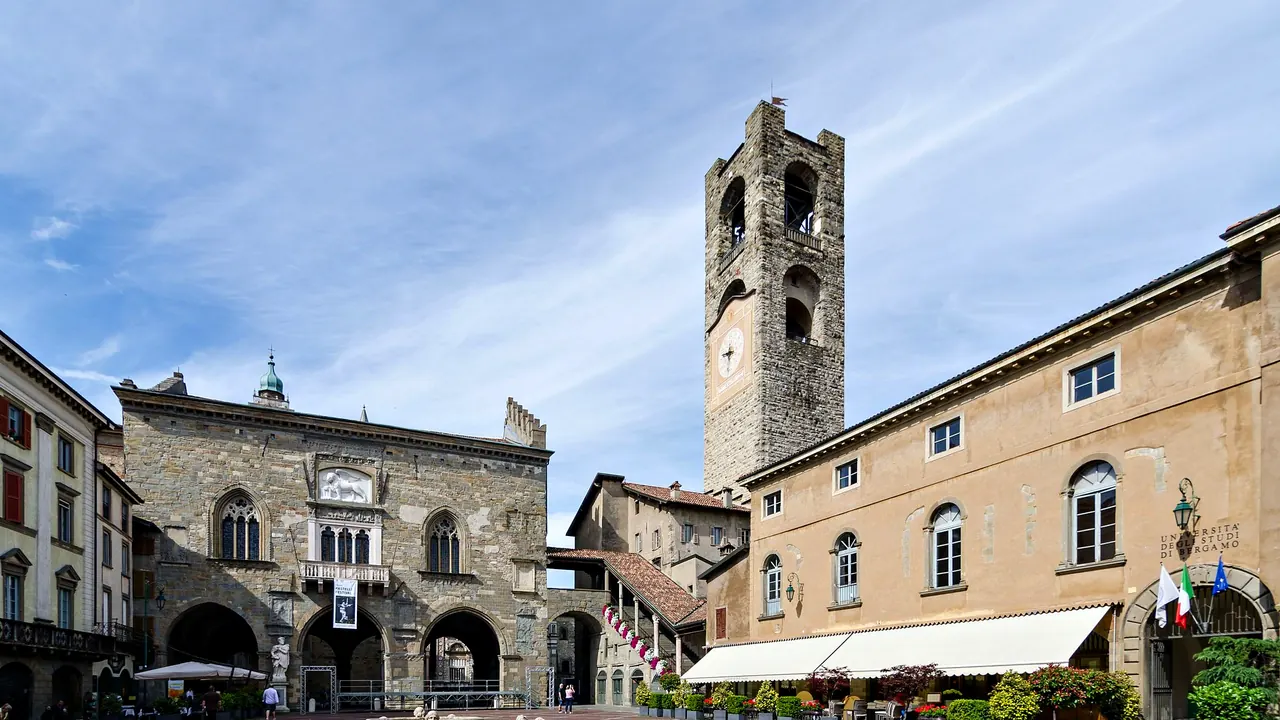
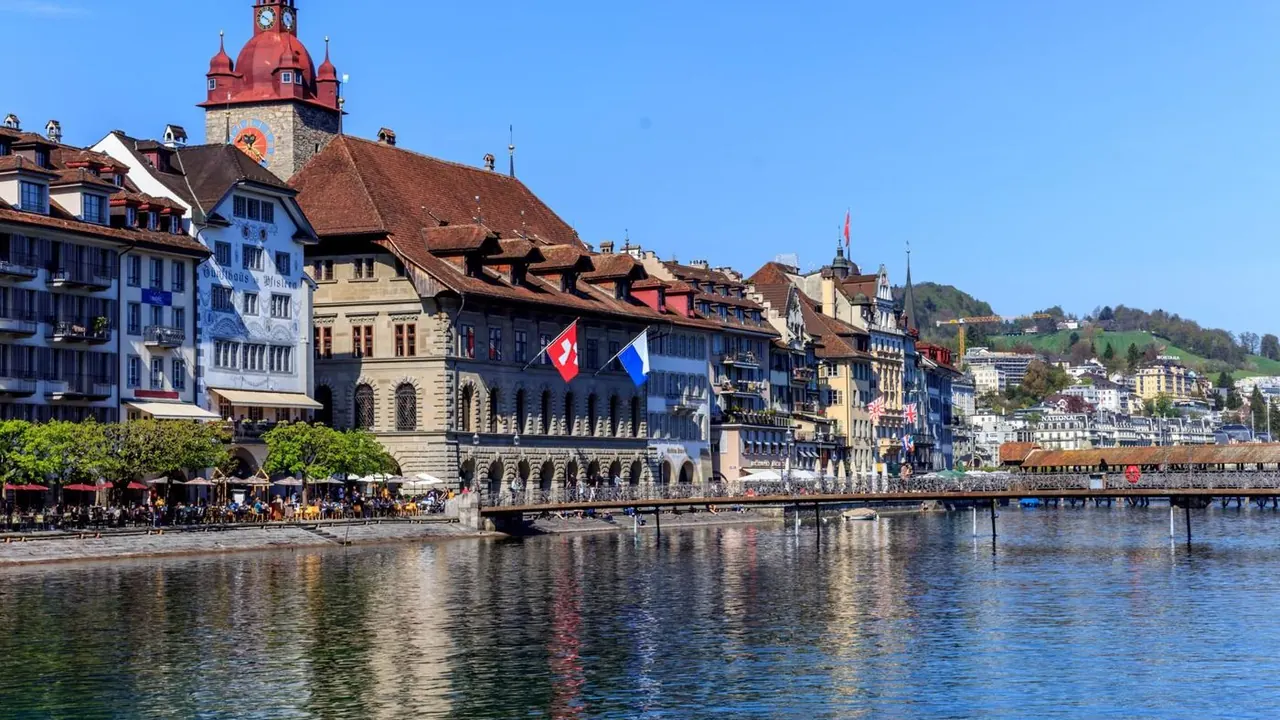
Photos: Bergamo by Steffen Schmitz, CC BY-SA 4.0, cropped; Lucerne by ILOVESwitzerland, Pexels License.
Bergamo or Lucerne?
Our verdict in twelve categories, each scored against the same fixed benchmark cities, and the climate month by month, so you can choose for your trip.
Choose Bergamo for
- prices
- food and drink
- culture and sights
Bergamo suits a traveller who wants to eat well, see a good deal and keep costs sensible. The walled Città Alta and the Accademia Carrara give it more substance than Lucerne's short list of sights. The Lombard kitchen is far richer, and Milan, the lakes, Verona and Cremona all make easy outings by train.
Choose Lucerne for
- live music and the arts
- nature and the outdoors
- getting around
Choose Lucerne when the landscape is the point. Pilatus, Rigi and Titlis rise almost from the lakeshore, and steamers, cogwheel railways and cable cars link them so smoothly that no car is needed. It is the easier place with children and the stronger one for classical music, but you pay a steep price for all of it.
Scoreboard
Twelve categories on one fixed scale from 0 to 100. The shaded stretch is the gap between the two.
Your match
Pick a travel style or drag the sliders, and both match scores follow your weighting.
Too close to call, 1 point apart
Wins on prices and food and drink with your weighting.
Wins on live music and the arts and nature and the outdoors with your weighting.
What matters to you?
Category by category
What the scores mean for a trip.
Beaches & swimming
Neither city has a beach, and in both you swim in a lake from pebble, grass or lawn rather than sand. The difference is distance. In Lucerne you can walk from the Old Town to the Lido, the wooden lake baths or Ufschötti. From Bergamo, a swim means a trip out to Lake Iseo or the Lecco arm of Lake Como.
The Italian lakes are a little warmer in July, and Bergamo's hotter summer makes a swim more welcome. Lucerne's water is cooler, but with mountains behind it and boats out to the village bathing spots, a swim fits easily into a sightseeing day.
Food & drink
Bergamo eats much better. Its cooking draws on the mountain valleys: casoncelli with butter and sage, polenta with braised meats and game, and cheeses such as Taleggio, Branzi and Strachitunt, with Valcalepio and Franciacorta to drink. The trattorias and cheese counters of the Città Alta are worth an unhurried afternoon.
Lucerne serves sound Swiss comfort food in its old guild houses: Chügelipastete, fondue, rösti and lake perch. The choice is narrow, though. Many places near the Chapel Bridge cater to tour groups, and prices are high for what reaches the plate.
Culture & sights
You can see either city in a day or two, but Bergamo has more weight. The Città Alta is a nearly complete hilltop town inside UNESCO-listed Venetian walls, with Santa Maria Maggiore and the Cappella Colleoni grouped around Piazza Vecchia. Below the hill, the Accademia Carrara holds Raphael, Bellini and Mantegna.
Lucerne has fewer sights, but they are famous: the Chapel Bridge and Water Tower, the towers of the Musegg Wall, the Lion Monument and the Rosengart Collection's Picasso and Klee. It is a lovely Old Town rather than a deep one.
Nightlife
Both cities are quiet after dark. From Bergamo, a big night out means going to Milan, and Lucerne has little to offer beyond a few weekend nights. What differs is the setting. Bergamo's evenings are Italian: a long aperitivo on Via XX Settembre or in Borgo Santa Caterina, then summer drinks in the squares and along the walls of the upper town.
In Lucerne, evenings mean a glass by the river or the lake, with a small club scene near the station. The one great exception is Fasnacht, when the whole town stays out in costume until dawn.
Nature & outdoors
Lucerne is the stronger choice by a wide margin. Pilatus, Rigi, the Stanserhorn and the glacier on Titlis are all reached by cogwheel railway, cable car or paddle steamer, so one day can combine boat, train and ridge walk without a car. Low cloud can hide it all for days, though.
Bergamo has real outdoors of its own. The Colli di Bergamo climb straight from the upper town, Val Brembana and Val Seriana lead into the Orobie Alps with their rifugi and high lakes, and Lake Iseo is good for cycling and sailing. The higher ground, however, is far easier to reach with a car.
Day trips
Bergamo has the richer choice of outings. Milan's Duomo, Last Supper and Brera are under an hour away, and Lake Iseo with car-free Monte Isola and Lake Como are closer still. Brescia, Cremona, Verona and Mantua add a run of historic Italian towns.
Lucerne is well placed too. Zurich, Bern and Basel are each under an hour by train, and the lake boat runs to the Rütli meadow and the William Tell country around Altdorf. Its excursions lean towards scenery, while Bergamo's lean towards art and old cities.
Good for families
Lucerne is the easier choice with children. The Swiss Museum of Transport fills a whole day, and the Glacier Garden's mirror maze and the wildlife park at Goldau add more. The steamers, cogwheel trains and the summer toboggan run on Pilatus feel like outings in themselves. The cost adds up, though, and there is no zoo or aquarium for a wet day.
In Bergamo, children enjoy the funiculars and a gelato on the walls, but the cobbled upper town is hard going with a buggy. Its two main attractions for children, Leolandia and Le Cornelle, lie outside the city.
Getting around
Lucerne is simpler to get around. The station, the boat piers and the Old Town sit together on the lakefront, and the sights are a flat walk along the Reuss. One integrated ticket system takes you onto steamers, cogwheel trains and cable cars, so you never need a car.
Bergamo works well in town. Funiculars link the lower town to the Città Alta and on to San Vigilio, the airport is a short bus ride away, and trains run direct to Milan. What holds it back is the steep climb between the two towns on foot, and the car you need for the upper valleys and the lake shores.
Shopping & style
Neither city is a shopping destination, and their strengths are different. Bergamo's best buys are things to eat: Taleggio, salumi and Valcalepio from the delicatessens of the upper town. There is chain fashion along the Sentierone, and Milan is close for anything serious.
Lucerne's trade is Swiss watches, sold by the big houses on Schwanenplatz, along with army knives, chocolate and cuckoo clocks. Beyond these, both are thin on fashion and design.
Affordability
Bergamo is far kinder to your budget. Lower-town hotels and trattorias are fairly priced, and buses and funiculars cost little, which makes it a sensible base for Lombardy. Only rooms inside the Città Alta push the cost up.
Lucerne is very expensive in every way: hotels, simple meals and above all the mountain railways and cable cars that are the reason to go. Swiss travel passes and lakeside picnics soften the cost, but it cannot be done on a budget.
Live music & performing arts
Lucerne has the stronger stage. The Lucerne Festival brings the world's leading orchestras to Jean Nouvel's lakefront concert hall. The hall also has a year-round programme with the Lucerne Symphony Orchestra, and the city theatre adds opera, drama and dance.
Bergamo's stage life centres on opera. Donizetti was born here, and the Teatro Donizetti's autumn festival of his works draws devoted listeners, while Bergamo Jazz fills a week in spring. The rest of the year the programme is a provincial one, with La Scala an evening's trip away in Milan.
Wellness & relaxation
Bergamo has a slight edge if you want to soak. San Pellegrino Terme, a Belle Époque spa about forty minutes up Val Brembana, and the sulphur springs at Trescore Balneario, used since Roman times, give it real thermal waters close by.
Lucerne has no bathing tradition of its own, though the Botta-designed mineral bath on the Rigi offers a soak with a mountain view. Its calm comes from the lake instead: slow promenades, steamer afternoons and the old wooden baths in summer. The Old Town is crowded at midday when the tour groups arrive.
When should you go?
Pick your month. The climate figures are measured averages, not a forecast.
Bergamo in July
Lucerne in July
Daytime high, °C
Rainfall in the month, mm
Where the figures come from
Bergamo has no rain gauge within 25 km of the centre, so its rainfall comes from a gridded climate dataset read at the city rather than from a gauge further away.
Bergamo's sunshine is measured 64 km from the centre, at Lugano.
Lucerne has no rain gauge within 25 km of the centre, so its rainfall comes from a gridded climate dataset read at the city rather than from a gauge further away.
Lucerne's sunshine is measured 42 km from the centre, at Zurich Town / Ville..
Temperature and rainfall are climate normals, averaged over the years shown. Bergamo: 1991-2020 normals, Bergamo / Orio Al Serio (3.9 km from centre). Lucerne: 2005-2025 (sunshine 1991-2020, rainfall 1991-2020) normals, Emmen (4.2 km from centre).
Bergamo is the warmer of the two. Summer days reach about 29°C, which is warm enough for a lake swim at Iseo but sticky for climbing to the upper town at midday. May, June and early September are the most comfortable months for walking. Its wettest stretch comes in autumn, from September to November, and its winters are cool but noticeably sunnier than Lucerne's.
Lucerne peaks at about 24°C in July and August, which is pleasant for hiking and a short swim. Summer is also its wettest season, though, at around 140mm a month. From November to January it is cold and grey, with as little as 43 hours of sunshine in December, and that matters in a city whose main draw is the mountain view. Late spring and the start of autumn give the best balance in both.
Which traveller are you?
On a trip on a tight budget, Bergamo goes much further. The Venetian walls and Piazza Vecchia cost nothing to walk, and a lower-town room puts Milan and Brescia within an easy train ride. In Lucerne, the mountain railways that justify the trip drain the budget fastest.
For an outdoors trip, Lucerne wins. Bergamo's Orobie valleys make good walking country, but you need a car to reach most of them. From Lucerne, a steamer and a cogwheel train take you to ridge walks on Rigi or Pilatus, and Titlis keeps its snow all year.
On a food and nightlife trip, Bergamo has the better table. Casoncelli, polenta and valley cheeses such as Taleggio easily beat Lucerne's fondue and rösti. A long aperitivo in Borgo Santa Caterina starts the evening well, though neither city stays up much past midnight.
Before you go
| Measure | Bergamo | Lucerne |
|---|---|---|
| Official language | Italian | French, German, Italian, Romansh |
| Currency | Euro (EUR) | Swiss Franc (CHF) |
| Sockets | CFL230 V, 50 Hz | CJ230 V, 50 Hz |
| Driving side | Right | Right |
| Time zone | UTC+1, UTC+2 in summer | UTC+1, UTC+2 in summer |
| Emergency number | 112 | 112 |
| Elevation | 249 m | 436 m |
| Main airport | Il Caravaggio International Airport (BGY)4 km from centre146 non-stop destinations | Zürich Airport (ZRH)49 km from centre226 non-stop destinations |
| Public holidays this year | 13 days | 12 days |
By the numbers
| Measure | Bergamo | Lucerne |
|---|---|---|
| City population | 119,534 | 86,234 |
| People per km² | 2,973 | 2,963 |
| Museums within 10 km | 21 | 14 |
| UNESCO World Heritage sites within 50 km | 6 | 1 |
Where else could you go?
Every comparison below shares a destination with this one, so you can follow Bergamo or Lucerne somewhere new.