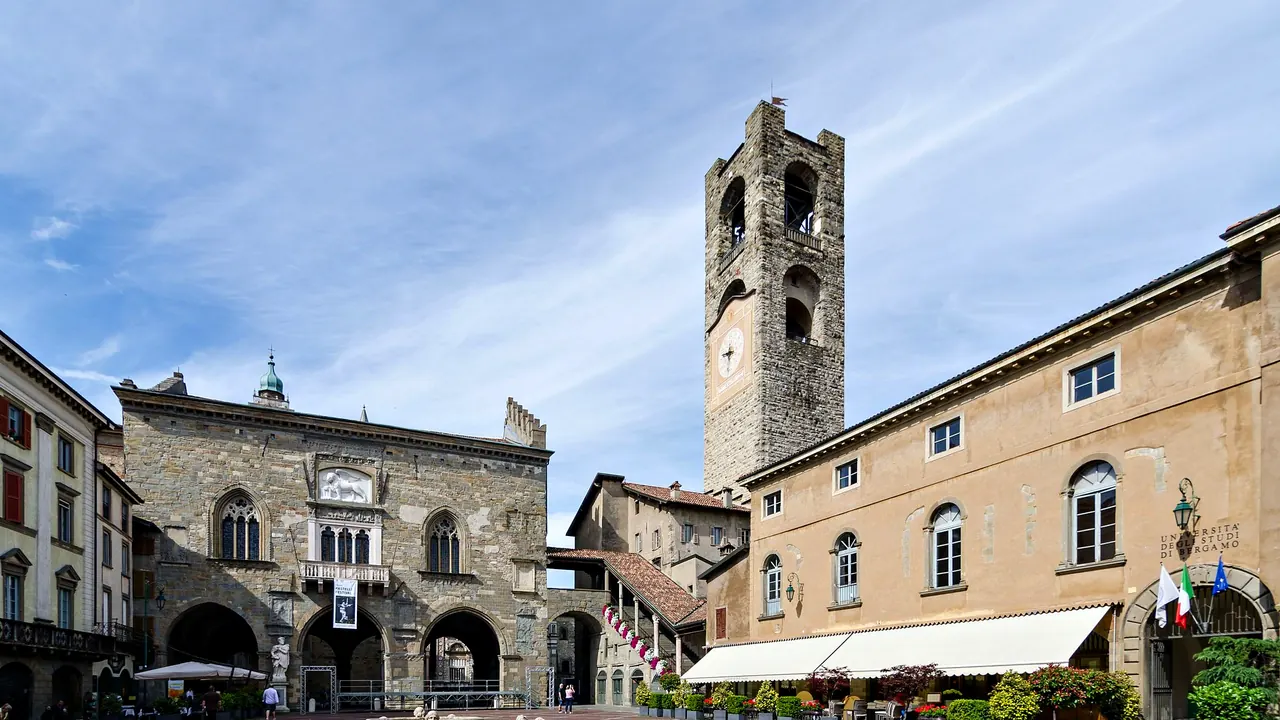
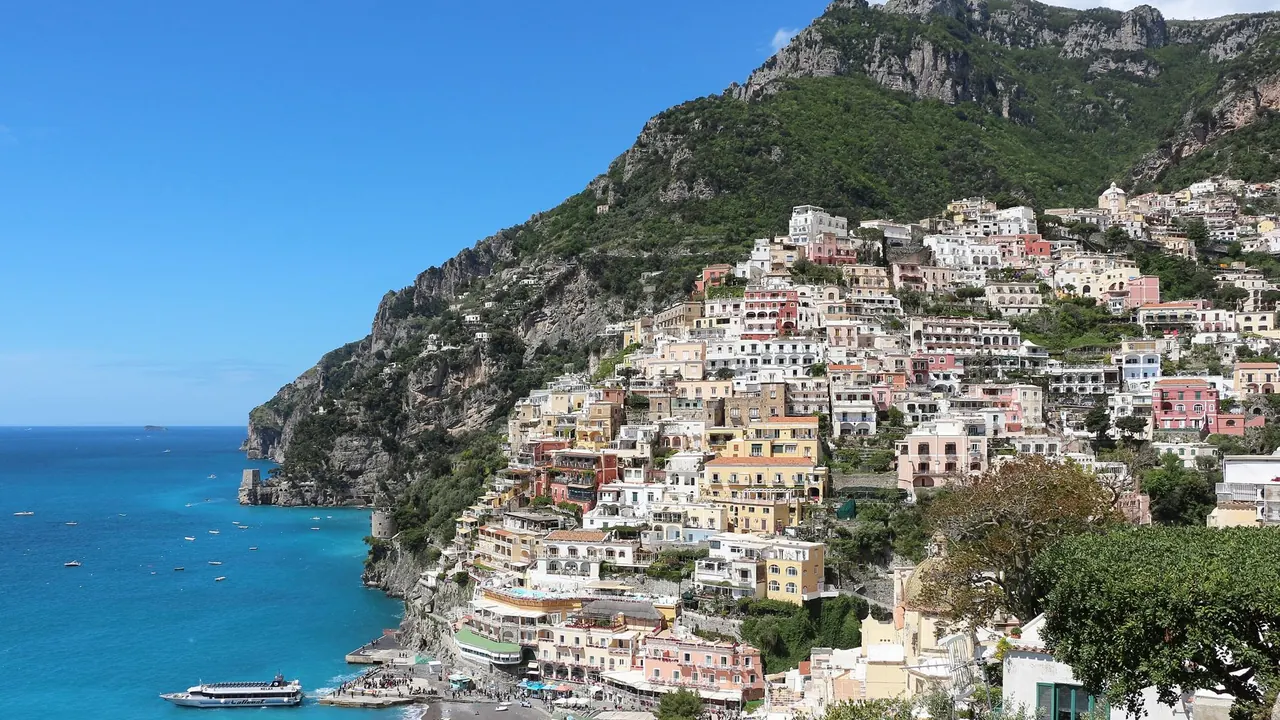
Photos: Bergamo by Steffen Schmitz, CC BY-SA 4.0, cropped; Positano by Bernard Gagnon, CC BY 4.0, cropped.
Bergamo or Positano?
Our verdict in twelve categories, each scored against the same fixed benchmark cities, and the climate month by month, so you can choose for your trip.
Choose Bergamo for
- culture and sights
- prices
- getting around
Bergamo suits a traveller who wants a walled hilltop town, a serious art gallery and a base with good rail links to Milan, the lakes and Verona. It costs less, is easier to get around and is much kinder to families. Its Lombard cooking of casoncelli, polenta and valley cheeses also gives you more to explore at the table.
Choose Positano for
- beaches
- nature and the outdoors
- shopping
Choose Positano for the sea and the cliffs. This is a vacation of swimming off Spiaggia Grande, boat trips to Capri and walking the Path of the Gods above town. It works best for couples and adults who don't mind stairs or a large bill. There are few sights and little to do in the evenings, so the town rewards slowing down more than sightseeing.
Scoreboard
Twelve categories on one fixed scale from 0 to 100. The shaded stretch is the gap between the two.
Your match
Pick a travel style or drag the sliders, and both match scores follow your weighting.
Wins on culture and sights and prices with your weighting.
Wins on beaches and nature and the outdoors with your weighting.
What matters to you?
Category by category
What the scores mean for a trip.
Beaches & swimming
Positano is a real seaside resort and Bergamo is not. In Bergamo, swimming means a day out to Lake Iseo or the Lecco arm of Lake Como. You lie on grass, pebbles or concrete platforms, and the water reaches about 23°C by July.
In Positano the sea is at the door. Spiaggia Grande and Fornillo lie beneath the town, Arienzo and Laurito are down long stairways, and boats run to coves further along. The shore is coarse grey sand and pebble that drops away steeply, and in high summer it fills up early. Still, the clear water is in another league from a lake lido.
Food & drink
Bergamo has the wider and deeper food scene. Its mountain cooking includes casoncelli with butter and sage, polenta with braised meats and game, and cheeses such as Taleggio and Strachitunt. The lower town adds everyday trattorias and aperitivo bars, and the province has a fine-dining tier.
In Positano, eating is mostly about the setting: clams, grilled fish and lemon desserts on a terrace above the sea. The menus repeat one another, there is little market or street food, and many kitchens close for the winter.
Culture & sights
The gap here is wide. Bergamo's Città Alta is an almost complete walled town inside UNESCO-listed Venetian fortifications, with Piazza Vecchia, Santa Maria Maggiore and the marble front of the Cappella Colleoni. Below the hill, the Accademia Carrara has paintings by Raphael, Bellini and Mantegna.
In Positano, the main sight is the town itself, stacked up its ravine. The majolica dome of Santa Maria Assunta and the painted Roman villa beneath it fill a couple of hours, and for serious sightseeing you have to go to Naples or along the coast.
Nightlife
Neither town is the place for a big night, but Bergamo has more going on, and all year round. It has long aperitivo hours, wine bars and pubs around Via XX Settembre and Borgo Santa Caterina, students keeping a few bars busy, and Milan close by for clubs. In Positano, the evening is a drink with a view and a long dinner, with one cave club on Spiaggia Grande, and even that fades once the season ends.
Nature & outdoors
Both have mountains on the doorstep, but Positano's are more spectacular. The Lattari range drops straight into the sea, the Path of the Gods runs high above the lemon terraces to Nocelle, and kayaks follow the cliffs to grottoes and the Li Galli islets.
Bergamo has more space and variety inland. The Colli di Bergamo park climbs from the walls to San Vigilio, the deep Orobie valleys have rifugi and high lakes, the foothills are good for cycling, and there are small ski areas in winter. For most of this you will want a car.
Day trips
Both are excellent bases, so the real question is which region you want to see. From Bergamo, trains run in any season to Milan, Brescia and Verona, and Lake Como, Lake Iseo and Crespi d'Adda are all close.
From Positano, ferries link Amalfi, Ravello and Capri, and Pompeii, Herculaneum and Paestum are further off. These trips are about boats and ancient ruins rather than cities and lakes, and outside the ferry season they become slow bus journeys.
Good for families
Bergamo is much the easier choice with children. The funiculars, the walls and the city playgrounds keep younger children happy, and Leolandia and the Le Cornelle wildlife park are short drives away. The cobbled upper town is hard going with a buggy, though.
Positano is built of stairs, so pushchairs are useless, and apart from the sea there is nothing aimed at children. Older children who like swimming and boats will enjoy it, but it is no place for toddlers.
Getting around
Bergamo is easy to get around. Two funiculars link the lower town, the Città Alta and San Vigilio, buses run to the station and the airport, and direct trains go to Milan, Brescia and Lecco.
In Positano you get around on foot and by boat. Almost every walk means hundreds of steps, coast buses crawl in summer traffic, parking is scarce, and the ferries mostly run only in season.
Shopping & style
Neither town is a shopping destination in its own right, so the difference lies in what you buy. Bergamo's shopping is practical and edible. The arcaded streets of the lower town carry Italian chains and mid-range clothes, while the lane through the Città Alta is where to stock up on Taleggio, salumi and bottles of Valcalepio. Luxury labels and design shops are largely missing, but Milan's are an easy train ride away.
Positano sells one style, and wandering down towards the sea through its boutiques is part of the pleasure. The shops specialise in white linen and bright resort prints, sandals are made to measure on the spot, and painted ceramics and lemon goods fill the remaining windows. It is the place to dress for a summer by the sea, but anyone hoping for high-street variety, markets or department stores will look in vain.
Affordability
Bergamo is comfortable rather than cheap, but next to Positano it is a bargain. Lower-town hotels and trattorias are fairly priced and the funiculars and buses cost little, which is why so many travellers use it as a base.
Positano is one of the most expensive places to stay in Italy, and you pay for the sea view in rooms, loungers and terrace tables alike. Staying in Praiano or Sorrento, or visiting in May or October, softens the cost.
Live music & performing arts
Bergamo has a real stage life for a provincial city, built around Donizetti. The Teatro Donizetti has a season of opera and concerts and an autumn festival of his works, the Teatro Sociale in the upper town stages smaller productions, Bergamo Jazz runs each spring, and La Scala is within reach.
Positano itself has only occasional summer concerts in churches and squares. The coast's highlight is Ravello's summer music festival, an evening trip away, and for opera you go to Naples.
Wellness & relaxation
Bergamo has the edge because of its spa towns. San Pellegrino Terme up Val Brembana and the sulphur springs of Trescore Balneario offer proper thermal bathing, and the Città Alta is quiet early in the morning and in the evening.
Positano has no bathing tradition, so relaxation comes from hotel spas, cliff-side pools and long afternoons on a terrace. That works well in May, June or late September, but the crowds of July and August and the endless stairs make high summer less restful.
When should you go?
Pick your month. The climate figures are measured averages, not a forecast.
Bergamo in July
Positano in July
Daytime high, °C
Rainfall in the month, mm
Where the figures come from
Bergamo has no rain gauge within 25 km of the centre, so its rainfall comes from a gridded climate dataset read at the city rather than from a gauge further away.
Bergamo's sunshine is measured 64 km from the centre, at Lugano.
Positano's temperatures are measured 25 km from the centre, at Capri.
Positano has no rain gauge within 25 km of the centre, so its rainfall comes from a gridded climate dataset read at the city rather than from a gauge further away.
Positano's sunshine is measured 59 km from the centre, at Grazzanise.
Temperature and rainfall are climate normals, averaged over the years shown. Bergamo: 1991-2020 normals, Bergamo / Orio Al Serio (3.9 km from centre). Positano: 2005-2025 (sunshine 1991-2020, rainfall 1991-2020) normals, Capri (25.3 km from centre).
Bergamo has proper seasons. July and August reach about 29°C, warm enough for a day at the lake but hot work on the climb to the Città Alta at midday, while winter highs stay in single figures and call for a coat. Rain falls all year but is heaviest from September to November, peaking at around 129mm in October, and May is often wet too. Late spring and early September are the most comfortable times for walking the walls and the hills.
Positano is drier and sunnier in summer. August has barely 19mm of rain and the sea is at about 26°C, and swimming is good from June to early October. The rain comes back in October and November, though November is still mild at around 18°C, and even midwinter stays well above Bergamo's cold. Both towns suit walkers in spring and late September, but only Positano has a real beach season.
Which traveller are you?
For a beach and sun trip, Positano is the clear choice. It has clear deep-blue water off Spiaggia Grande and Fornillo, coves you reach by boat and dry, sunny summers. In Bergamo, swimming means a drive to the lidos of Lake Iseo.
On a culture and arts trip, Bergamo wins easily. The walled Città Alta, the Cappella Colleoni, the Accademia Carrara and opera at the Teatro Donizetti fill two full days. Positano's church and Roman villa take a couple of hours.
On a tight budget, Bergamo is far kinder. Lower-town hotels and trattorias are fairly priced, the buses and funiculars cost little, and trains reach Milan and the lakes. Positano is one of Italy's most expensive places, and the view is priced into every room and terrace.
Before you go
| Measure | Bergamo | Positano |
|---|---|---|
| Official language | Italian | Italian |
| Currency | Euro (EUR) | Euro (EUR) |
| Sockets | CFL230 V, 50 Hz | CFL230 V, 50 Hz |
| Driving side | Right | Right |
| Time zone | UTC+1, UTC+2 in summer | UTC+1, UTC+2 in summer |
| Emergency number | 112 | 112 |
| Elevation | 249 m | 142 m |
| Main airport | Il Caravaggio International Airport (BGY)4 km from centre146 non-stop destinations | Naples International Airport (NAP)33 km from centre131 non-stop destinations |
| Public holidays this year | 13 days | 13 days |
By the numbers
| Measure | Bergamo | Positano |
|---|---|---|
| City population | 119,534 | 3,729 |
| People per km² | 2,973 | 429 |
| Museums within 10 km | 21 | 10 |
| UNESCO World Heritage sites within 50 km | 6 | 5 |
| Swim season, months above 21 °C | - | 5 months |
Where else could you go?
Every comparison below shares a destination with this one, so you can follow Bergamo or Positano somewhere new.
- Sorrentovs Positano
- Amalfivs Positano
- Salernovs Positano
- Naplesvs Positano
- Milanvs Bergamo
- Comovs Bergamo