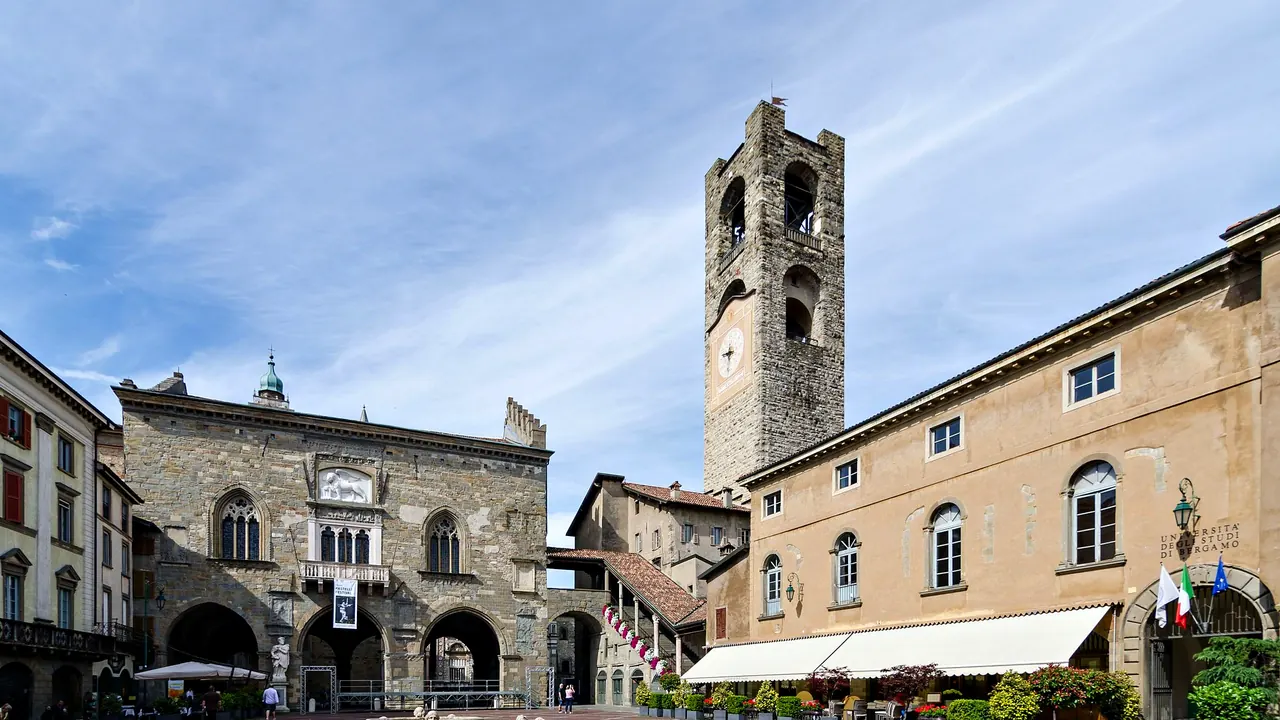
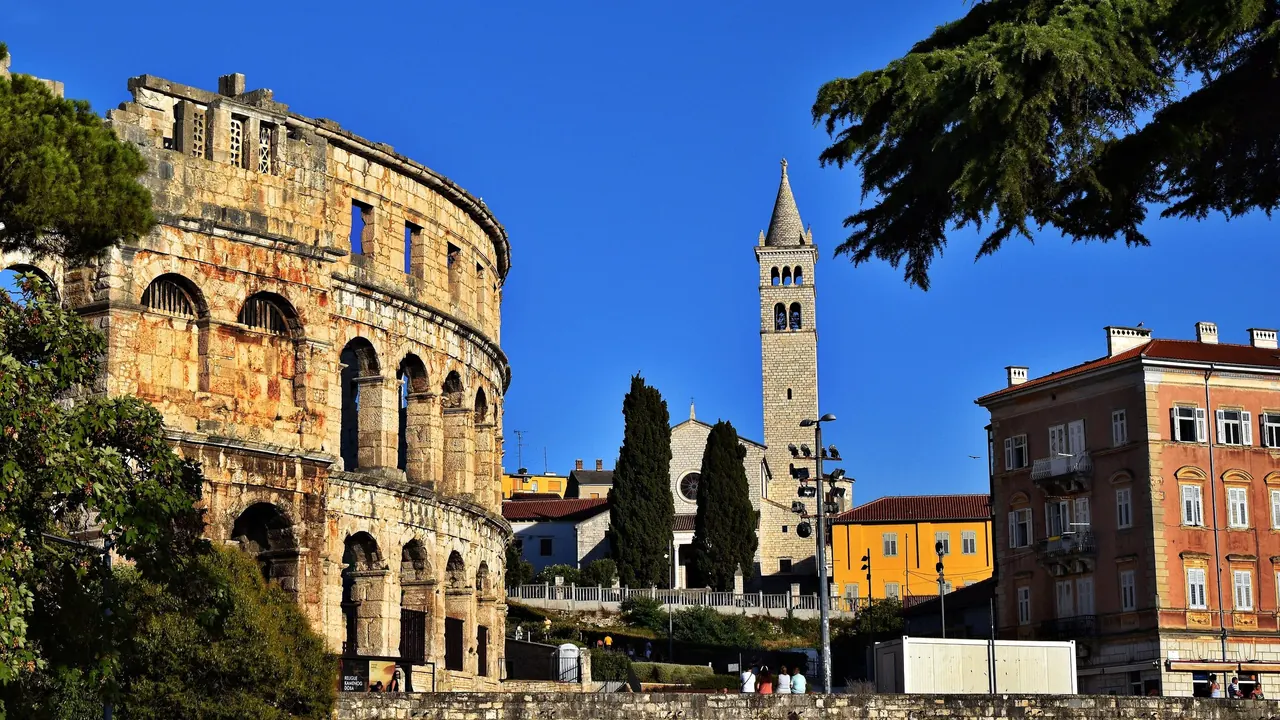
Photos: Bergamo by Steffen Schmitz, CC BY-SA 4.0, cropped; Pula by Miroslav.vajdic, CC BY-SA 4.0, cropped.
Bergamo or Pula?
Our verdict in twelve categories, each scored against the same fixed benchmark cities, and the climate month by month, so you can choose for your trip.
Choose Bergamo for
- wellness
- getting around
- shopping
Bergamo is for travellers who want an almost complete walled hilltop town, a picture gallery of real weight and an easy rail link to Milan, the lakes and Verona. It makes a better base for a week of touring than for lying in the sun. The Orobie valleys, the spa town of San Pellegrino and an autumn of Donizetti opera give it depth well beyond high summer.
Choose Pula for
- beaches
- nightlife
- families
Choose Pula when the sea is the point of the trip. Clear water, pine-shaded rocky coves and the wild headland of Kamenjak fill long summer days, and the Roman Arena gives the evenings a setting few towns can match. Plan on hiring a car, though, because Rovinj, the Istrian hill towns and the best bays are hard to reach by bus.
Scoreboard
Twelve categories on one fixed scale from 0 to 100. The shaded stretch is the gap between the two.
Your match
Pick a travel style or drag the sliders, and both match scores follow your weighting.
Wins on wellness and getting around with your weighting.
Wins on beaches and nightlife with your weighting.
What matters to you?
Category by category
What the scores mean for a trip.
Beaches & swimming
Bergamo has no coast at all. Summer swimming means a drive or train to Lake Iseo, where Sarnico and Lovere have grassy lidos, or to the Lecco arm of Lake Como. It is a good escape from a hot day rather than a reason to choose the city.
Pula puts the open Adriatic right on its doorstep. The shores are rocks, platforms and pebble coves rather than sand, much like the lakes, but the water is far clearer and the setting wilder, above all at Kamenjak with its cliff ledges and islets. Pack water shoes for the urchins. The sheltered, shallow bays of Medulin suit small children.
Food & drink
Both cities eat well, and the difference is mountain against sea. Bergamo cooks Lombard upland food: casoncelli in butter and sage, polenta with braised meat and game, and valley cheeses such as Taleggio and Strachitunt, with Valcalepio and Franciacorta to drink. The Città Alta has the trattorias and pastry shops, and the province has a fine-dining side that Pula lacks.
Pula's table is Istrian, with truffle pasta, scampi buzara, grilled squid, pršut, Malvazija and Teran. Inside the town the choice is narrower and leans towards tourist menus near the Arena. The best meals are a drive away, in konobas in the hinterland villages and by the coastal harbours.
Culture & sights
Bergamo gives more to see. Its whole upper town survives inside UNESCO-listed Venetian walls, with Piazza Vecchia, Santa Maria Maggiore and the marble front of the Cappella Colleoni set close together. Below the hill, the Accademia Carrara adds Mantegna, Lotto and Raphael, which makes it a gallery visit as much as a townscape.
Pula's strength is Roman. The Arena is one of the most complete amphitheatres anywhere, and the Temple of Augustus and the Arch of the Sergii are still standing. The Habsburg naval forts add a later layer. It is an outstanding single monument with a pleasant old town around it, but there is no art collection to match Bergamo's.
Nightlife
Neither city is built for going out, but Pula has a bit more life in summer. On warm weekends its evenings move from terraces by the Forum to beach bars on Verudela and in Medulin, and a few small clubs stay open late. Out of season it goes as quiet as Bergamo.
Bergamo's evenings are steadier all year and more grown-up: a long aperitivo, then wine bars along Via XX Settembre or in Borgo Santa Caterina, or drinks on the walls of the upper town in summer. Most nights end around midnight, and anyone wanting clubs takes the train to Milan.
Nature & outdoors
Bergamo has the real mountains. Paths climb from the upper town through the Colli park to San Vigilio, and to the north Val Brembana and Val Seriana lead into the Orobie Alps, with rifugi, high lakes, summer hiking and small ski areas in winter. The lakes add sailing and shoreline cycling.
Pula's outdoors is low and coastal. The draws are macchia, pine and the car-free cliffs of Kamenjak, with dinosaur footprints along the shore, plus sea kayaking, windsurfing at Premantura and wreck diving. The nearest proper hills are on Učka, an hour and a half away.
Day trips
Bergamo is the stronger base, mostly because so much of it can be done by train. Milan's Duomo and Last Supper are under an hour away, and Brescia, Lecco and the Lake Como towns are as close or closer. Verona and Cremona make easy full days. Crespi d'Adda and Monte Isola on Lake Iseo add quieter outings.
Pula has a fine list of its own: Venetian Rovinj, the Byzantine mosaics of Poreč, the hilltop villages of Motovun and Hum with their truffle country, and the Brijuni islands by boat from Fažana. The catch is that nearly all of them need a car.
Good for families
Children are comfortable in both, but the days look different. In Pula they are spent by the sea, in the shallow bays of Medulin and Premantura, with the aquarium in a Habsburg fort and the Arena's underground passages to explore. Rocky shores and summer heat take some managing, though.
Bergamo turns on the funicular rides, gelato on the walls and outings to Leolandia's miniature Italy or the animals at Le Cornelle. Buggies struggle on the cobbled upper-town lanes, and the lakes and valleys round out a longer stay.
Getting around
Bergamo is much easier without a car. Funiculars link the lower town, the Città Alta and San Vigilio, buses run to the airport and the station, a light-rail line runs up Val Seriana, and trains run direct to Milan, Brescia and Lecco.
Pula's flat centre is quick to walk, and buses reach Verudela. Beyond the city, though, the slow railway and sparse regional buses leave visitors dependent on a car or scooter, and parking is tight in summer.
Shopping & style
Bergamo offers more, though it is no fashion destination. The arcades of Via XX Settembre and the Sentierone have mid-range Italian labels, and the main lane of the upper town is lined with cheese shops, salumi counters and wine sellers. Milan is under an hour away for anything grander.
Pula's shopping is mostly edible: olive oil, truffle products, honey, rakija and pršut from the market hall or straight from the farms. The old-town street has little beyond chains and souvenirs.
Affordability
Overall costs are much the same, but they change through the year in different ways. Bergamo is steady: lower-town hotels are fair for a base, buses and the funicular are cheap, and only the Città Alta and summer weekends push prices up.
Pula changes more with the season. Private apartments and konobas make spring and autumn good value, while July and August rooms cost as much as on Western European coasts. Car hire and boat trips add to the bill.
Live music & performing arts
Bergamo has the fuller programme, built on its native composer. The Teatro Donizetti stages opera, concerts and theatre through the season, and its autumn Donizetti festival draws dedicated opera fans. The Teatro Sociale and the spring Bergamo Jazz festival add to the programme, and La Scala is an evening's train ride away.
Pula has one great setting. On summer nights the Arena hosts touring concerts, classical galas and film festival screenings under the Roman arches. The rest of the year is thin: Croatian-language drama and visiting productions at the Istrian National Theatre, the odd concert and a few bars with live bands.
Wellness & relaxation
Bergamo has proper spa towns within easy reach. San Pellegrino Terme's Belle Époque baths are about forty minutes up Val Brembana, and Trescore Balneario has sulphur springs used since Roman times. The upper town is very calm in the early morning.
Pula has no thermal tradition, so wellness means the pools and saunas of the resort hotels on Verudela and in Medulin. Its own way to slow down is long coffees on the Forum and evening walks under the coastal pines.
When should you go?
Pick your month. The climate figures are measured averages, not a forecast.
Bergamo in July
Pula in July
Daytime high, °C
Rainfall in the month, mm
Where the figures come from
Bergamo has no rain gauge within 25 km of the centre, so its rainfall comes from a gridded climate dataset read at the city rather than from a gauge further away.
Bergamo's sunshine is measured 64 km from the centre, at Lugano.
Pula's temperatures are measured 87 km from the centre, at Trieste.
Pula has no rain gauge within 25 km of the centre, so its rainfall comes from a gridded climate dataset read at the city rather than from a gauge further away.
Temperature and rainfall are climate normals, averaged over the years shown. Bergamo: 1991-2020 normals, Bergamo / Orio Al Serio (3.9 km from centre). Pula: 1991-2020 normals, Trieste (87 km from centre).
Bergamo and Pula follow almost the same temperature curve, both peaking at about 29°C in July and August, but the rain falls quite differently. Bergamo is wet for much of the year. May and June bring frequent showers, and September to November are the wettest months of all, each well over 100mm. April is the most comfortable time to walk the steep lanes of the upper town, because it is mild and drier than the months that follow. Midsummer makes the climb hot work, and September stays warm but is often wet. Winters are cool and fairly dry.
Pula stays dry and very sunny through the summer, with about 300 hours of sunshine in July. The sea is warm enough for swimming from June to September and reaches about 25°C in August. The rain sets in from October, November is its wettest month, and its winters are a couple of degrees milder than Bergamo's.
Which traveller are you?
On a beach and sun trip, Pula is the clear choice, with clear Adriatic water, dry summers and the coves of Kamenjak and Medulin. Bergamo has only the lake lidos at Iseo or Lecco, which are a pleasant day out but not a reason to stay.
For a culture and arts trip, Bergamo offers more. The walled Città Alta, the Cappella Colleoni and the Accademia Carrara's Raphael and Bellini sit alongside a real opera house, with Milan's Brera and La Scala an hour away by train.
On a relaxing and wellness trip, Bergamo has the genuine spa culture, with the Belle Époque baths of San Pellegrino and the Roman-era springs of Trescore close by. In Pula, slowing down means resort hotel spas and walks along the pine-shaded coast.
Before you go
| Measure | Bergamo | Pula |
|---|---|---|
| Official language | Italian | Croatian |
| Currency | Euro (EUR) | Euro (EUR) |
| Sockets | CFL230 V, 50 Hz | CF230 V, 50 Hz |
| Driving side | Right | Right |
| Time zone | UTC+1, UTC+2 in summer | UTC+1, UTC+2 in summer |
| Emergency number | 112 | 112 |
| Elevation | 249 m | 5 m |
| Main airport | Il Caravaggio International Airport (BGY)4 km from centre146 non-stop destinations | Pula Airport (PUY)7 km from centre34 non-stop destinations |
| Public holidays this year | 13 days | 14 days |
By the numbers
| Measure | Bergamo | Pula |
|---|---|---|
| City population | 119,534 | 52,220 |
| People per km² | 2,973 | 971 |
| Museums within 10 km | 21 | 4 |
| UNESCO World Heritage sites within 50 km | 6 | 1 |
| Swim season, months above 21 °C | - | 4 months |
Where else could you go?
Every comparison below shares a destination with this one, so you can follow Bergamo or Pula somewhere new.