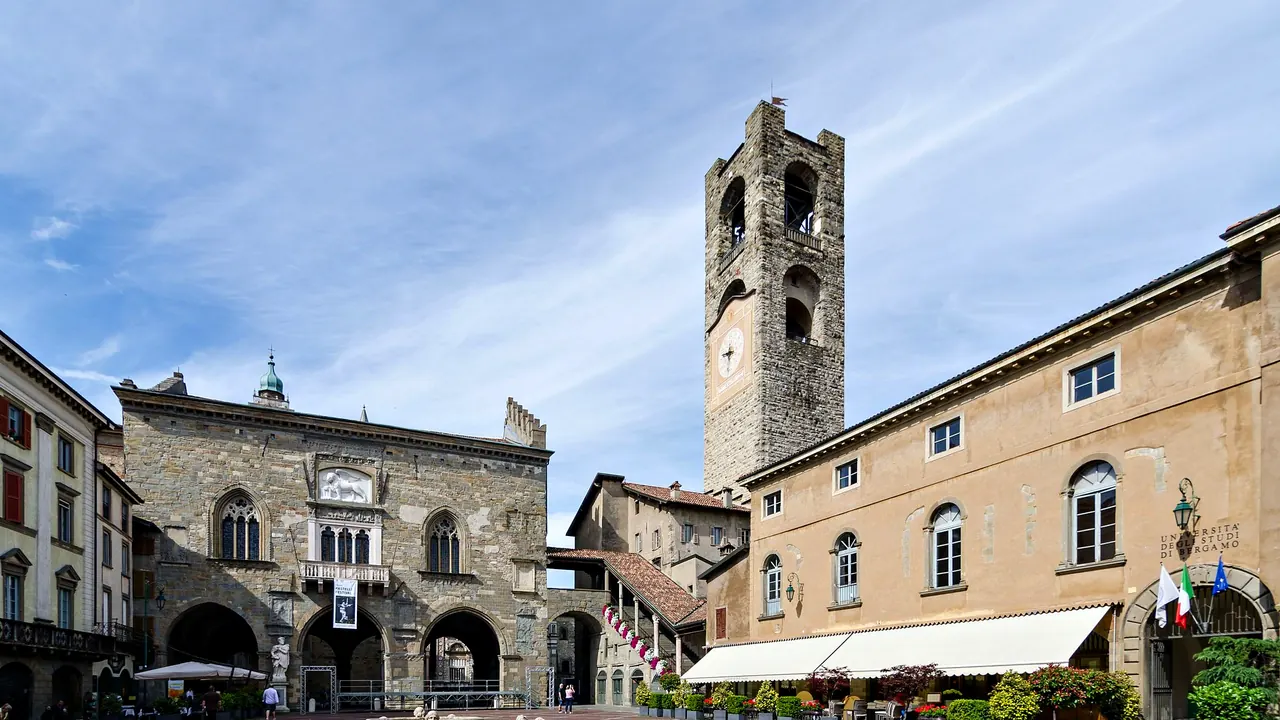
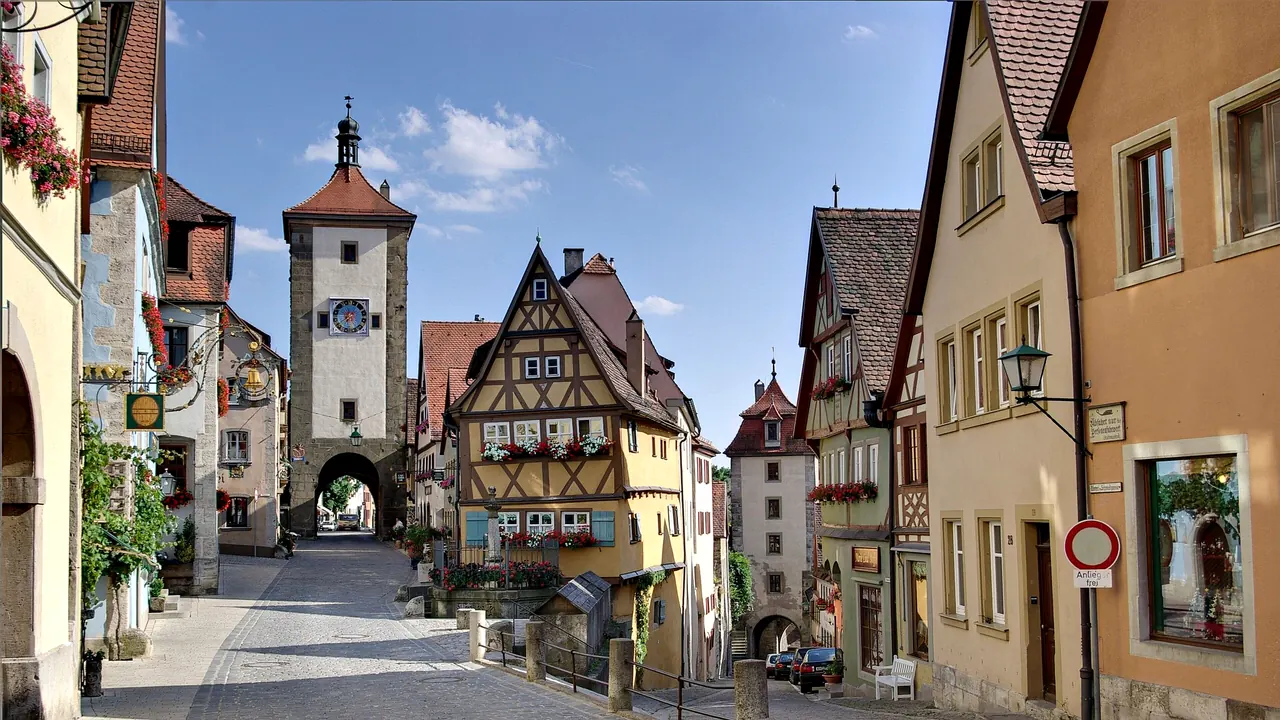
Photos: Bergamo by Steffen Schmitz, CC BY-SA 4.0, cropped; Rothenburg ob der Tauber by Berthold Werner, Public domain.
Bergamo or Rothenburg ob der Tauber?
Our verdict in twelve categories, each scored against the same fixed benchmark cities, and the climate month by month, so you can choose for your trip.
Choose Bergamo for
- nature and the outdoors
- food and drink
- live music and the arts
Bergamo suits travellers who want a base with range. It has a walled hilltop town and a gallery of real stature below it, Lombard cooking built on mountain cheeses, the Orobie Alps and two lakes close by, and direct trains to Milan and Brescia. It holds a week easily and gives you better meals, livelier evenings and more varied outdoor days than its German rival.
Choose Rothenburg ob der Tauber for
Rothenburg ob der Tauber does not lead in any category we score.
Rothenburg is for someone who wants to spend a night or two inside one intact medieval town: walking the covered ramparts at dusk, following the night watchman with his lantern, and seeing the lanes empty once the day visitors leave. Food, evenings and entertainment are narrower, and the town is at its most distinctive in December, when the Christmas market fills the Marktplatz. With a car, the other Romantic Road towns are close by.
Scoreboard
Twelve categories on one fixed scale from 0 to 100. The shaded stretch is the gap between the two.
Your match
Pick a travel style or drag the sliders, and both match scores follow your weighting.
Wins on nature and the outdoors and food and drink with your weighting.
Has no clear advantage with the weighting you have chosen.
What matters to you?
Category by category
What the scores mean for a trip.
Beaches & swimming
Bergamo has the better swimming, though neither town has a coast. Lake Iseo's lidos at Sarnico and Lovere and the Lecco arm of Lake Como are within reach, with water near 23°C in July. You spread your towel on grass or stone there, not sand.
Rothenburg offers its outdoor pool, or about an hour's drive to the man-made Franconian lakes such as the Altmühlsee, which have grassy bathing areas. That will do for a hot afternoon, but it is no reason to visit.
Food & drink
Bergamo eats far better. Its mountain cooking runs from casoncelli in butter and sage to polenta with game and mushrooms. The valleys behind it produce Taleggio, Branzi and Strachitunt, and Valcalepio and Franciacorta fill the glasses. There is a fine-dining tier too, though little beyond Italian food.
Rothenburg's kitchen is solid Franconian fare: Schäufele, bratwurst and dumplings, with Silvaner from the round Bocksbeutel bottle. Many places around the Marktplatz cater to tour groups, so the better meals are in family guesthouses and wine taverns away from the square. The sugary Schneeball is more photogenic than delicious.
Culture & sights
Both are walled towns that most people come to see, but they offer different kinds of visit. Rothenburg is a single medieval whole, with almost nothing modern inside its walls. You walk its covered rampart, look down the Plönlein and step into St Jakob's to see Riemenschneider's Holy Blood Altar, and the Medieval Crime Museum adds a grim, absorbing hour.
Bergamo has a little more depth. Its Città Alta, ringed by UNESCO-listed Venetian walls, has the Cappella Colleoni and Santa Maria Maggiore, and the lower town adds the Accademia Carrara, with Raphael, Bellini and Mantegna. That turns a picturesque visit into a serious art stop as well.
Nightlife
Bergamo's evenings are modest but real. There is aperitivo along Via XX Settembre and in Borgo Santa Caterina, wine bars, a few student haunts, and summer drinks on the walls of the upper town, usually ending around midnight. Rothenburg's main evening event is the night watchman's walking tour, followed by a glass in an inn. For anything bigger you go to Milan from Bergamo, or to Würzburg or Nuremberg from Rothenburg.
Nature & outdoors
Bergamo sits at the foot of the Alps. Woodland paths climb from the upper town to San Vigilio, and the Orobie valleys hold rifugi, high lakes and demanding summer hikes, with small ski areas such as Foppolo in winter. Lakes Iseo and Como add sailing and lakeside cycling.
Rothenburg's countryside is gentle. Paths drop from the walls into the Tauber valley, past mills and the little Topplerschlösschen, and the family-friendly Tauber valley cycle path runs through vineyards downstream. It is lovely in blossom season, but there are no mountains or big lakes.
Day trips
Bergamo has the richer range of excursions, and they are easier to reach. Milan, with the Duomo, the Last Supper and the Brera, is under an hour by train. Lake Como and Lake Iseo, with the car-free island of Monte Isola, are closer still, and so are Crespi d'Adda and the Franciacorta vineyards. Brescia, Cremona and Verona make longer days out by rail.
Rothenburg's excursions are good but narrower, and most of them are more old towns. Dinkelsbühl, Nördlingen in its meteorite crater, Schwäbisch Hall and the Weikersheim palace gardens are all within about an hour by car, and so are Würzburg's Residenz and Nuremberg's castle. Without a car, most of them are slow to reach.
Good for families
Bergamo has more to fill a family stay. Children like the two funiculars, gelato on the Venetian walls and playgrounds in the parks, and Leolandia's rides and Le Cornelle's animals are both a short drive away. The lakes and valleys can fill the remaining days.
Rothenburg works like a storybook for a day or two: climbing the Rathaus tower, walking the ramparts and following the night watchman. Older children often love the Crime Museum. After that there is little made for children. Both towns have cobbles that are hard work with a pushchair.
Getting around
Inside their walls, both towns are best on foot. Rothenburg's old town is the simpler of the two: you can cross it in about fifteen minutes, with cars kept outside the gates. Bergamo splits into a flat lower town and a hilltop upper town. The funicular links them and saves you the steep climb.
Beyond the centre, Bergamo is much better connected. It has city buses, a quick bus to the airport, a light-rail line into Val Seriana and direct trains to Milan, Brescia and Lecco. Rothenburg sits at the end of a branch line that usually means changing at Steinach, and its regional buses are sparse.
Shopping & style
Bergamo gives you more range. The arcaded Via XX Settembre and the Sentierone in the lower town have Italian chains and mid-range fashion. The narrow main lane of the Città Alta is a run of cheese shops, bakeries and wine sellers, which makes it the place to buy local cheeses and salumi to take home. For luxury labels, Milan is under an hour away.
Rothenburg's Herrngasse and Schmiedgasse sell mostly to visitors. Seasonal decorations take up much of the space, alongside teddy bears, cuckoo clocks, pewter, Franconian wine and boxes of Schneeballen. Fashion and everyday shops are almost absent, so it suits souvenir hunting rather than a shopping trip.
Affordability
Bergamo is a little easier on the budget. Lower-town hotels are fairly priced, trattorias and aperitivo bars are reasonable, and buses and the funicular cost little. Rooms inside the Città Alta are more expensive.
Rothenburg's prices are those of small-town Germany plus a tourist premium. You feel it most in guesthouses and Marktplatz meals inside the walls, especially in December and on summer weekends. Beer and wine in the inns stay reasonable, and staying in a village outside the walls saves a good deal.
Live music & performing arts
Bergamo has a real stage life built around Donizetti, who was born there. The Teatro Donizetti runs a season of opera, concerts and theatre, with an autumn festival of his works, and Bergamo Jazz has a long history each spring. La Scala in Milan is close enough for an evening.
Rothenburg's performances mostly look back at its own past. The costumed Meistertrunk play retells the town's rescue in the Thirty Years' War, and there are summer open-air productions and organ concerts in St Jakob's. Most evenings have no show at all.
Wellness & relaxation
Neither town has a bathing tradition of its own, and both are at their most peaceful early in the morning and in the evening, when a walk on the walls feels unhurried. Bergamo's spas are closer and more distinctive: San Pellegrino Terme, a Belle Époque resort about forty minutes up Val Brembana, and the Roman-era sulphur springs at Trescore Balneario. From Rothenburg, Bad Windsheim's salt-water pool and the older spa town of Bad Mergentheim are each up to an hour's drive away.
When should you go?
Pick your month. The climate figures are measured averages, not a forecast.
Bergamo in July
Rothenburg ob der Tauber in July
Daytime high, °C
Rainfall in the month, mm
Where the figures come from
Bergamo has no rain gauge within 25 km of the centre, so its rainfall comes from a gridded climate dataset read at the city rather than from a gauge further away.
Bergamo's sunshine is measured 64 km from the centre, at Lugano.
Rothenburg ob der Tauber's sunshine is measured 27 km from the centre, at Feuchtwangen-heilbronn.
Temperature and rainfall are climate normals, averaged over the years shown. Bergamo: 1991-2020 normals, Bergamo / Orio Al Serio (3.9 km from centre). Rothenburg ob der Tauber: 1991-2020 normals, Rothenburg ob der Tauber (0.9 km from centre).
Bergamo is the warmer of the two through the year. July and August reach about 29°C, which is warm enough for lake swimming but heavy going on the steep lanes of the Città Alta at midday. Rain is the catch. It builds from May and is heaviest from September to November, at around 125mm a month, so autumn sightseeing comes with plenty of wet days. Late spring and early autumn are the most comfortable months for walking, and winter is mild by Rothenburg's standards.
Rothenburg's summers are gentler, peaking at about 25°C, and its rainfall is lower and more even across the year, so May to September is reliably pleasant for the walls and the Tauber valley. Winter is a different matter. December highs hover around 4°C and the town gets barely 41 hours of sunshine that month, less than half of Bergamo's. That is the price of visiting at Christmas market time.
Which traveller are you?
For a food and nightlife trip, Bergamo is the clear choice. Casoncelli, Taleggio and Franciacorta outclass Rothenburg's coach-party menus around the Marktplatz, and a long aperitivo in Borgo Santa Caterina beats a town that is silent by eleven.
On an outdoors trip, Bergamo wins again. Paths climb from the upper town into the Colli di Bergamo, and Val Brembana and Val Seriana lead into the Orobie Alps, with rifugi and high lakes. Rothenburg offers pleasant but gentle Tauber valley walks and cycling.
For a December trip built around Christmas markets and decorations, Rothenburg has what Bergamo lacks. Its Marktplatz market is among Germany's most atmospheric, and shops on the Herrngasse sell glass baubles, nutcrackers and Erzgebirge carvings all year. Pack for the cold.
Before you go
| Measure | Bergamo | Rothenburg ob der Tauber |
|---|---|---|
| Official language | Italian | German |
| Currency | Euro (EUR) | Euro (EUR) |
| Sockets | CFL230 V, 50 Hz | CF230 V, 50 Hz |
| Driving side | Right | Right |
| Time zone | UTC+1, UTC+2 in summer | UTC+1, UTC+2 in summer |
| Emergency number | 112 | 112 |
| Elevation | 249 m | 430 m |
| Main airport | Il Caravaggio International Airport (BGY)4 km from centre146 non-stop destinations | Nuremberg Airport (NUE)66 km from centre56 non-stop destinations |
| Public holidays this year | 13 days | 12 days |
By the numbers
| Measure | Bergamo | Rothenburg ob der Tauber |
|---|---|---|
| City population | 119,534 | 11,331 |
| People per km² | 2,973 | 272 |
| Museums within 10 km | 21 | 6 |
| UNESCO World Heritage sites within 50 km | 6 | 2 |
Where else could you go?
Every comparison below shares a destination with this one, so you can follow Bergamo or Rothenburg ob der Tauber somewhere new.
- Milanvs Bergamo
- Comovs Bergamo
- Luganovs Bergamo
- Nurembergvs Rothenburg ob der Tauber
- Bambergvs Rothenburg ob der Tauber
- Stuttgartvs Rothenburg ob der Tauber