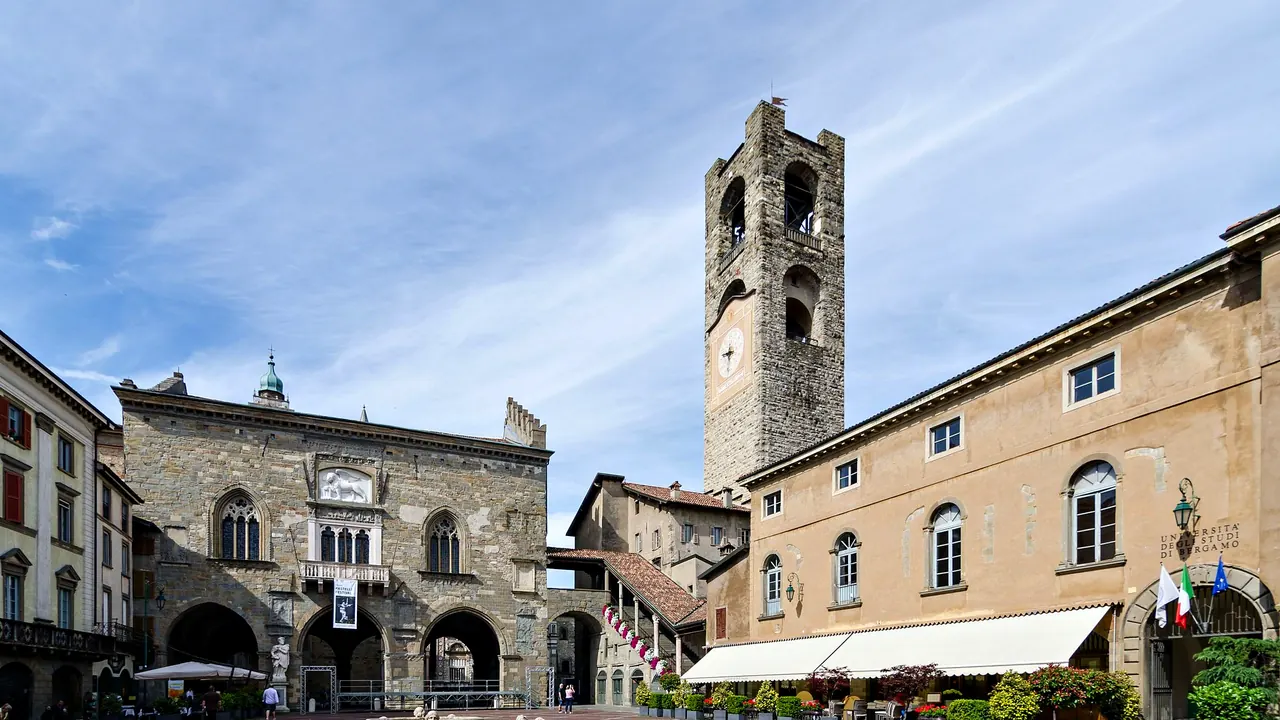
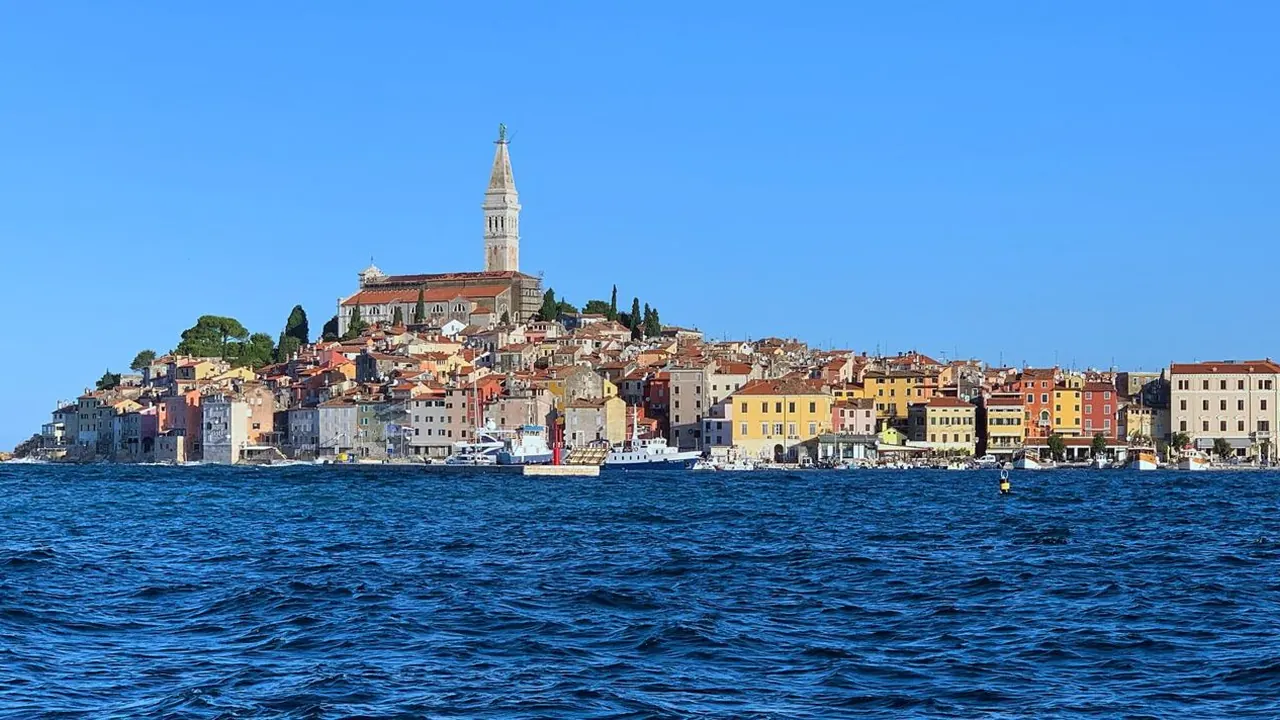
Photos: Bergamo by Steffen Schmitz, CC BY-SA 4.0, cropped; Rovinj by Vyacheslav Bukharov, CC BY-SA 4.0, cropped.
Bergamo or Rovinj?
Our verdict in twelve categories, each scored against the same fixed benchmark cities, and the climate month by month, so you can choose for your trip.
Choose Bergamo for
- culture and sights
- live music and the arts
- day trips
Bergamo suits a trip built around sights and day trips. The walled Città Alta and the Accademia Carrara give it real cultural weight. Milan, the lakes and Verona are all within easy rail reach, and the Orobie Alps start at the edge of town. It is also cheaper to stay in, and opera at the Teatro Donizetti gives it evenings that Rovinj cannot match.
Choose Rovinj for
- beaches
Choose Rovinj for a summer by the sea. Its draw is clear Adriatic water off limestone ledges, the pinewoods of the Golden Cape, long fish dinners on the harbour and a drink on the rocks at sunset. It suits couples who want to slow down in one pretty town and are happy to pay more in high summer and hire a car to see the rest of Istria.
Scoreboard
Twelve categories on one fixed scale from 0 to 100. The shaded stretch is the gap between the two.
Your match
Pick a travel style or drag the sliders, and both match scores follow your weighting.
Wins on culture and sights and live music and the arts with your weighting.
Wins on beaches with your weighting.
What matters to you?
Category by category
What the scores mean for a trip.
Beaches & swimming
Rovinj swims from its own shore. Rock ledges, small pebble coves and bathing platforms run for kilometres into the Golden Cape. The water is very clear, and taxi boats cross to quieter coves on the islands. There is little sand, so bring water shoes.
Bergamo has no coast at all. On a hot day you go out to the lidos of Lake Iseo or the Lecco arm of Lake Como, which make a pleasant day out on pebble and grass but are not a reason to choose Bergamo.
Food & drink
Bergamo's cooking has more depth. There is casoncelli with butter and sage, polenta with braised meats and game, and valley cheeses such as Taleggio and Strachitunt sold at the counters of the upper town, with Franciacorta sparkling wine from just over the border.
Rovinj cooks from the sea and from Istria's truffle woods: scampi buzara, fuži with truffle and Malvazija from the hinterland, with the best meals often in country konobas a drive away. Harbour menus are mostly written for passing visitors, so eating well takes more care in choosing than in Bergamo's trattorias.
Culture & sights
Bergamo has far more to see. The Città Alta is an almost complete walled town inside UNESCO-listed Venetian ramparts, with Santa Maria Maggiore and the marble front of the Cappella Colleoni beside Piazza Vecchia. Below the hill, the Accademia Carrara holds Raphael, Bellini and Mantegna.
Rovinj has one beautiful set piece: pastel houses climbing the old island to St Euphemia, whose bell tower you can climb for the view. Add the Batana House and the small town museum and you have filled an afternoon, where Bergamo needs a day or two.
Nightlife
Neither town is for clubbing, but Bergamo has a little more going on after dark. Students keep a handful of bars busy around Via XX Settembre and Borgo Santa Caterina, and Milan is close for a real night out.
Rovinj's evening is a long dinner and then a drink on the rocks at sunset. A few cocktail bars on the waterfront stay busy in summer, but the town is quiet by midnight and largely shuts down out of season.
Nature & outdoors
Bergamo has mountains on its doorstep. The Colli di Bergamo climb from the upper town to San Vigilio, and Val Brembana and Val Seriana lead into the Orobie Alps, with rifugi, high lakes and serious summer hiking. There is small-scale skiing in winter and sailing and cycling on two lakes.
Rovinj's outdoors is gentler and centred on the sea. Flat paths run through the Golden Cape pines, the archipelago is good for kayaking and diving, and boats go up the steep green Lim Fjord. Nothing here is high or wild, but the water gives Rovinj something Bergamo lacks.
Day trips
Both towns make good bases, but Bergamo's reach is wider and easier. Milan, Lake Como, Lake Iseo with Monte Isola, Brescia and Verona are all within a train ride, and Crespi d'Adda is half an hour away.
Istria fits a lot into a small area: Pula's amphitheatre, the mosaics of the Euphrasian Basilica at Porec, the hill towns of Motovun and Hum, and the Brijuni islands. With no railway, though, most of these trips from Rovinj need a car.
Good for families
Both are small, safe towns where children are easy to manage, and both have steep cobbled old towns that are hard work with a pushchair. Bergamo's highlights for children are the funicular rides and the walls, and outside the city there are Leolandia's rides for younger children and the Le Cornelle wildlife park.
In Rovinj the days are boat trips, gelato on the harbour and family resorts with pools and playgrounds. The rocky shore means water shoes and close watching for small swimmers.
Getting around
Bergamo is easier to get around once you go beyond the centre. Funiculars link the lower town, the Città Alta and San Vigilio, and buses serve the station and the airport. Direct trains run to Milan, Brescia and Lecco, so only the upper valleys and the lake shores really need a car.
Rovinj is simple on foot, with a car-free old town and a promenade out to the swimming rocks. But there is no railway, and Istria's hill towns and wineries are effectively reachable only by car.
Shopping & style
Neither is a shopping destination, but Bergamo has more range. There are chains and mid-range fashion under the arcades of Via XX Settembre and the Sentierone, delicatessens and cheese shops in the upper town, and Milan's fashion streets less than an hour away.
Rovinj's shopping is small and regional: truffle products, olive oil and Teran wine. The galleries and artists' studios along Grisia are the most characterful part, and little is open outside summer.
Affordability
Bergamo is the cheaper stay. Lower-town hotels and trattorias are fairly priced and the funicular and buses cost little. Only rooms in the Città Alta and summer weekends push costs up.
Rovinj is at the expensive end of the Croatian coast. Harbour restaurants charge for the view, and fish sold by weight adds up quickly. Private apartments, campsites, bakery lunches and travelling outside July and August all help.
Live music & performing arts
Here Bergamo is in a different league. It is Donizetti's birthplace, and the Teatro Donizetti has an opera season and an autumn festival of his works. The smaller Teatro Sociale is in the upper town, Bergamo Jazz has run for many springs, and La Scala is close enough for an evening.
Rovinj has summer concerts in St Euphemia, open-air music by the harbour and the occasional performance of bitinada singing, and very little beyond that. For bigger shows you go to Pula's arena.
Wellness & relaxation
Bergamo has real spa towns within reach: the Belle Époque thermal spa at San Pellegrino Terme up Val Brembana, and the sulphur springs of Trescore Balneario, used since Roman times. Rovinj has no bathing tradition of its own, so spa treatments mean the wellness areas of the resort hotels along the Golden Cape.
What Rovinj offers is a slow pace of late swims and evening walks in the pines, best in May, June and September before or after the summer crowds. In Bergamo the calm is in quiet early mornings on the walls of the upper town.
When should you go?
Pick your month. The climate figures are measured averages, not a forecast.
Bergamo in July
Rovinj in July
Daytime high, °C
Rainfall in the month, mm
Where the figures come from
Bergamo has no rain gauge within 25 km of the centre, so its rainfall comes from a gridded climate dataset read at the city rather than from a gauge further away.
Bergamo's sunshine is measured 64 km from the centre, at Lugano.
Rovinj's temperatures are measured 64 km from the centre, at Trieste.
Rovinj has no rain gauge within 25 km of the centre, so its rainfall comes from a gridded climate dataset read at the city rather than from a gauge further away.
Temperature and rainfall are climate normals, averaged over the years shown. Bergamo: 1991-2020 normals, Bergamo / Orio Al Serio (3.9 km from centre). Rovinj: 1991-2020 normals, Trieste (63.7 km from centre).
Bergamo and Rovinj share almost the same temperatures, with highs of about 29°C in July and August, but Bergamo is the wetter of the two for most of the year. Rain picks up in May and stays fairly steady through summer, and September to November are the wettest months, each above 120mm. April is the safest choice for walking the upper town, mild at around 18°C and drier than the months that follow. May, early June and September feel just as pleasant but bring a real chance of wet days, so pack for showers. July and August are Bergamo's sunniest months but hot work on the steep lanes, and in winter it is a few degrees colder than the coast.
Rovinj stays fairly dry through summer, with about 44mm in July, which is also its sunniest month. The sea is warm enough for swimming from June to September and reaches 26°C in August. Rain builds from September and peaks in November. Late spring and early autumn are the times for walking and cycling in the Golden Cape. Winter is mild but short on sunshine.
Which traveller are you?
For a beach and sun trip, Rovinj is the obvious pick. You can swim straight off the rocks below the old town or in the Golden Cape coves, and taxi boats reach the islands. Bergamo's nearest swimming is a day out to the lakes.
On a culture and arts trip, Bergamo gives far more. There is the UNESCO-listed walled Città Alta, the Old Masters of the Accademia Carrara and opera at the Teatro Donizetti, and Milan and Verona are close by train. Rovinj's old town is lovely but takes about an afternoon.
On a trip on a tight budget, Bergamo goes further. Lower-town hotels and trattorias are fairly priced, and cheap trains reach Milan and the lakes. Rovinj is one of the dearer stops on the Croatian coast, and outside town you mostly need a car.
Before you go
| Measure | Bergamo | Rovinj |
|---|---|---|
| Official language | Italian | Croatian |
| Currency | Euro (EUR) | Euro (EUR) |
| Sockets | CFL230 V, 50 Hz | CF230 V, 50 Hz |
| Driving side | Right | Right |
| Time zone | UTC+1, UTC+2 in summer | UTC+1, UTC+2 in summer |
| Emergency number | 112 | 112 |
| Elevation | 249 m | 0 m |
| Main airport | Il Caravaggio International Airport (BGY)4 km from centre146 non-stop destinations | Pula Airport (PUY)31 km from centre34 non-stop destinations |
| Public holidays this year | 13 days | 14 days |
By the numbers
| Measure | Bergamo | Rovinj |
|---|---|---|
| City population | 119,534 | 12,968 |
| People per km² | 2,973 | - |
| Museums within 10 km | 21 | 1 |
| UNESCO World Heritage sites within 50 km | 6 | 1 |
| Swim season, months above 21 °C | - | 4 months |
Where else could you go?
Every comparison below shares a destination with this one, so you can follow Bergamo or Rovinj somewhere new.