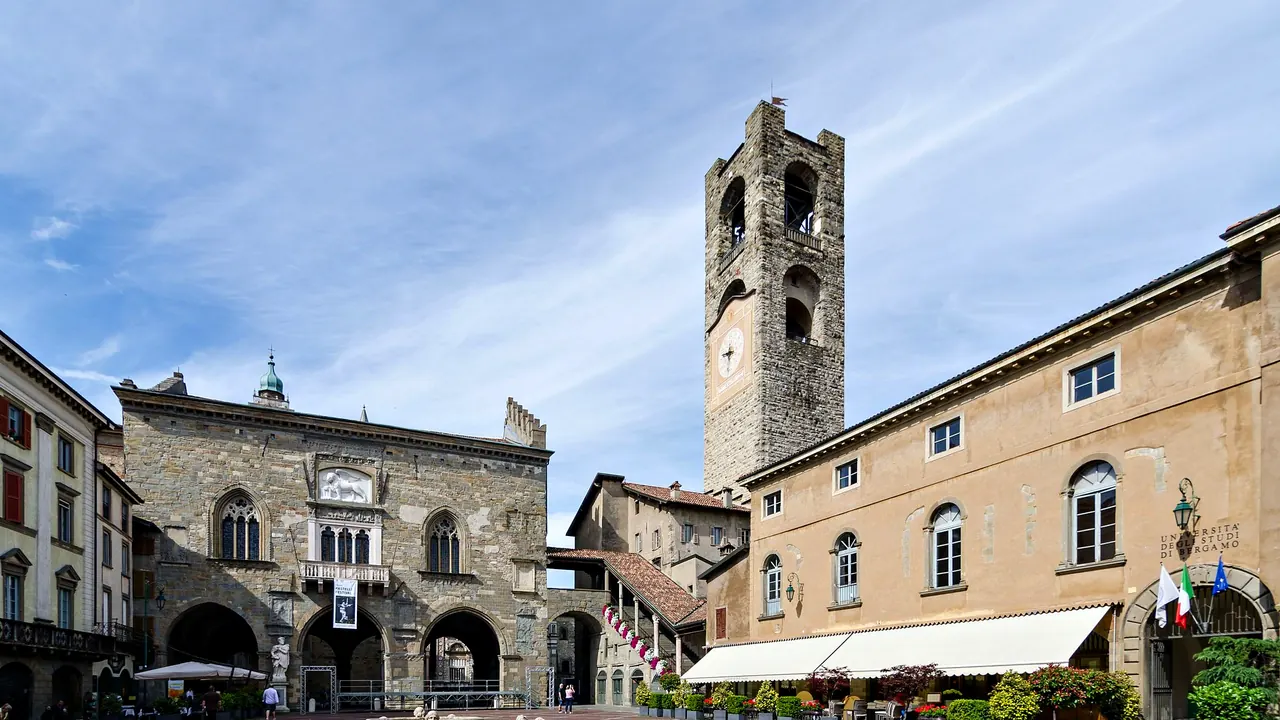
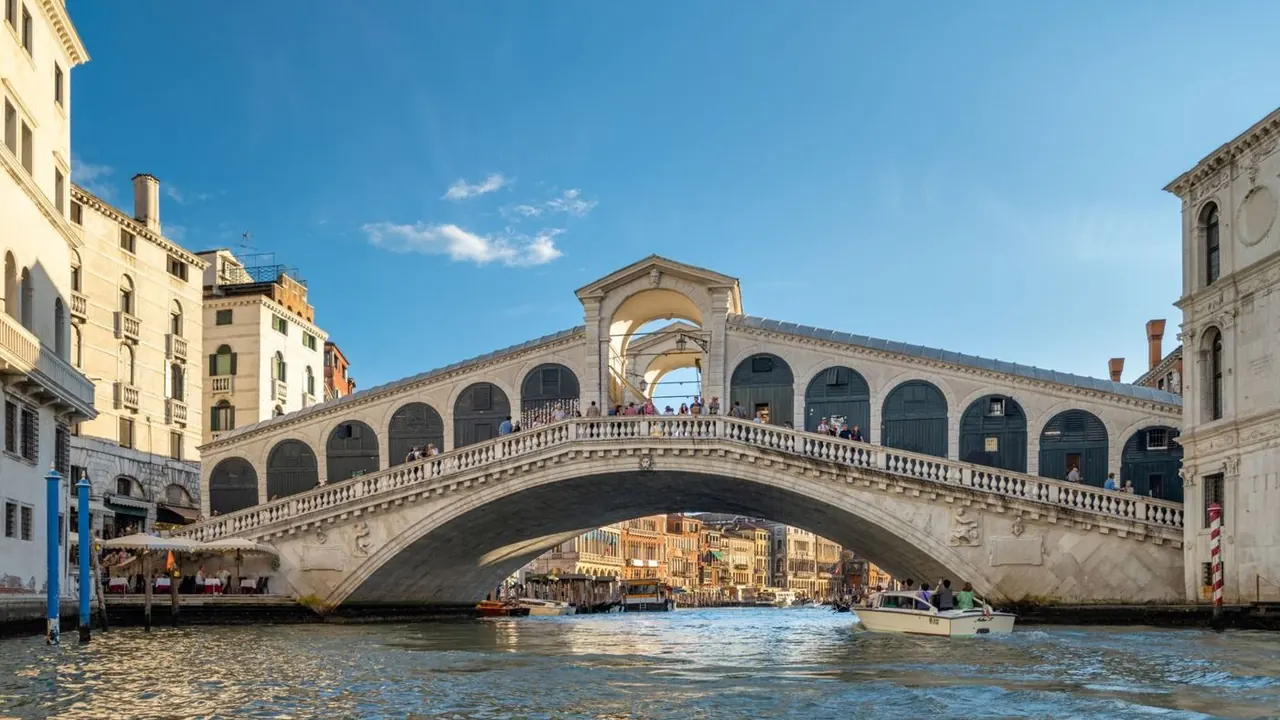
Photos: Bergamo by Steffen Schmitz, CC BY-SA 4.0, cropped; Venice by David Vives, Pexels License.
Bergamo or Venice?
Our verdict in twelve categories, each scored against the same fixed benchmark cities, and the climate month by month, so you can choose for your trip.
Choose Bergamo for
- prices
- nature and the outdoors
- wellness
Bergamo suits travellers who want a handsome old town without the crush or the cost. The walled Città Alta fills a day or two, and the stay is really about what lies around it: the Orobie Alps rising behind the city, Lakes Iseo and Como within an hour, Milan and Verona by train. It works best for walkers, families and anyone touring Lombardy from one well-priced base.
Choose Venice for
- beaches
- culture and sights
- live music and the arts
Venice is the choice when the art and architecture are the whole point of the trip. Here the city itself is the masterpiece, with Titian, Tintoretto and the great Venetian painters in its churches and galleries, La Fenice in the evening and a sandy beach on the Lido. In return you get high prices and crowded main routes, so the reward goes to those who are happy to walk the quieter sestieri early and late.
Scoreboard
Twelve categories on one fixed scale from 0 to 100. The shaded stretch is the gap between the two.
Your match
Pick a travel style or drag the sliders, and both match scores follow your weighting.
Too close to call, level with your weighting
Wins on prices and nature and the outdoors with your weighting.
Wins on beaches and culture and sights with your weighting.
What matters to you?
Category by category
What the scores mean for a trip.
Beaches & swimming
Neither city is a beach destination, but Venice has a proper one close by. The Lido is a short boat ride away, with kilometres of fine sand and shallow, warm Adriatic water that suits children. Quieter Pellestrina and the big resorts of Jesolo and Sottomarina are within about an hour.
Bergamo has no sea at all. Swimming there means a lake day at Sarnico or Lovere on Lake Iseo, or on the Lecco arm of Como, from pebble, grass or concrete platforms. The lakes make a fine hot-weather outing, but they are not a beach vacation.
Food & drink
The food is equally good in both, but it is very different. Bergamo cooks Lombard mountain food: casoncelli in butter and sage, polenta with braised meat and game, and some of Italy's finest cheeses from the valleys, Taleggio and Strachitunt among them. The pleasure is a slow sit-down meal in a Città Alta trattoria.
Venice eats from the lagoon and often standing up, with cicchetti and a spritz at the counter of a bacaro near the Rialto, then cuttlefish risotto in its own ink. The difference lies in the effort. Bergamo's old streets are reliable, while in Venice the picture-menu places on the main routes mean good meals have to be sought out.
Culture & sights
Venice is on another level here. The whole city is the monument: San Marco, the Doge's Palace and the Grand Canal, plus a depth of painting that runs from the Accademia to Titian in the Frari and Tintoretto at San Rocco, with the Biennale on top. You could spend a week and still miss things.
Bergamo is a fine counterpart on a smaller scale. Its intact walled hilltop town, the Colleoni chapel and Santa Maria Maggiore, and the Accademia Carrara's Raphael and Bellini are worth the trip, but they fit comfortably into a day or two.
Nightlife
Both cities wind down around midnight, and the evening in each is built on the aperitivo. In Bergamo it carries on in wine bars and pubs along Via XX Settembre and in Borgo Santa Caterina, or on the walls on summer nights. Students keep a few places going, and a handful of clubs sit on the city's edge.
Venice has no club district, only a few late bars. Its late crowd gathers in Campo Santa Margherita and along the Misericordia, and after that the pleasure is a silent walk by the canals. For a real night out, Bergamo has Milan under an hour away by train, while Venice looks to the mainland or to Jesolo's beach clubs in summer.
Nature & outdoors
Bergamo is much the better base for the outdoors. Paths climb straight from the upper town through the Colli park, and Val Brembana and Val Seriana lead into the Orobie Alps, with rifugi, high lakes and small ski areas such as Foppolo. The lakes add sailing and cycling, though a car helps for the mountains.
In Venice the outdoors means the lagoon: salt marshes around Torcello with egrets and flamingos, kayaking, rowing lessons and flat rides along the Lido's sea walls. Real hills are an hour away, and the Dolomites more than two.
Day trips
Both cities make excellent bases, each for its own region. From Bergamo the draw is Lombardy: Milan's Duomo and Last Supper under an hour away, Lake Como and Lake Iseo's Monte Isola, the factory village of Crespi d'Adda, Brescia and the Franciacorta vineyards.
Venice opens up the Veneto instead, with Giotto in Padua, Palladio in Vicenza and along the Brenta, and the Prosecco hills. It also has island trips that need no train, to Murano, Burano and Torcello. Verona is an easy day from either.
Good for families
Bergamo is the easier city with children. It is calm and compact, the two funiculars feel like rides in themselves, the walls make a good gelato walk, and parks have playgrounds. Leolandia and the Le Cornelle wildlife park are short drives away. Only the upper town's cobbled slopes are tough with a buggy.
Venice excites children, with boats instead of buses and no traffic, and the Lido beach and Murano's glass-blowing are hits. Day to day it is harder work, with stepped bridges, packed summer routes and few playgrounds. It suits a short stay with older children best.
Getting around
Both are easy once you are in the centre, but they work in completely different ways. Bergamo is a city on two levels joined by funiculars, with buses to the station and an airport a short ride away. Direct trains run to Milan, Brescia and Lecco, though a car saves time in the valleys.
Venice runs on foot and by water. Everything central is within a long walk, and vaporetti and traghetti cover the rest. The price is hundreds of stepped bridges, which are hard on suitcases and wheels, and slow, crowded boats on the main lines.
Shopping & style
Venice gives shoppers much more to find. Its crafts have centuries behind them: Murano glass, Burano lace, papier-mâché masks, marbled paper and furlane slippers, best bought in the workshops of Dorsoduro, Castello and Murano rather than from the imitation stalls on the main routes. The big fashion names cluster near San Marco.
Bergamo's best buys are edible: Taleggio, salumi and Valcalepio wine from the delicatessens on the upper town's main lane. Below, the Sentierone offers chains and mid-range fashion, and anyone after designer labels goes to Milan.
Affordability
Bergamo is far kinder on the wallet. It is comfortable rather than cheap, but lower-town hotels and trattorias are fairly priced and local transport costs little. Only rooms inside the Città Alta and summer weekends push costs up.
Venice is among the most expensive places to stay in Italy. Hotels, boats and entry to most sights and churches all add up, and sitting down on the main piazza is notoriously costly. Cicchetti at the counter, a quieter sestiere or a bed in Mestre, and a winter visit all ease the bill.
Live music & performing arts
Venice has the stronger stage. La Fenice is one of Italy's great opera houses, sharing a full season of opera, ballet and concerts with the Malibran, and the Biennale adds contemporary music, theatre and dance. On most evenings there is also Vivaldi in a church, sometimes excellent and sometimes routine.
Bergamo's stage life centres on its own composer, Donizetti. The Teatro Donizetti holds a regular season and the autumn festival of his operas, while Bergamo Jazz brightens the spring. Outside those, the programme is modest, though La Scala is an easy evening trip.
Wellness & relaxation
Bergamo has the edge for a restful stay. San Pellegrino Terme, a Belle Époque spa town, is about forty minutes up Val Brembana, and the sulphur springs at Trescore Balneario are older still. The Città Alta is quiet at either end of the day.
Venice's spas are mostly hotel spas in palazzi or on the Lido and Giudecca, and the nearest thermal pools are at Abano, about an hour away. The calm here comes from the absence of traffic: Castello, Cannaregio and Giudecca are hushed at dawn, while San Marco by day is anything but.
When should you go?
Pick your month. The climate figures are measured averages, not a forecast.
Bergamo in July
Venice in July
Daytime high, °C
Rainfall in the month, mm
Where the figures come from
Bergamo has no rain gauge within 25 km of the centre, so its rainfall comes from a gridded climate dataset read at the city rather than from a gauge further away.
Bergamo's sunshine is measured 64 km from the centre, at Lugano.
Temperature and rainfall are climate normals, averaged over the years shown. Bergamo: 1991-2020 normals, Bergamo / Orio Al Serio (3.9 km from centre). Venice: 1991-2020 (sunshine 1971-2000, rainfall 1981-2010) normals, Venezia / Tessera (6.7 km from centre).
The two cities have almost the same temperatures through the year. Both reach about 29°C in July and August, pleasant by a lake or on the Lido but sticky for long days on foot, and both drop to single figures in winter. Late spring and September are the best months for walking either one. Bergamo, up against the Alps, is wetter in every month, especially from May onwards, and its autumn is the soggiest stretch, at about 129mm in October. Winter favours Bergamo for light, though: from October to February it gets more sunshine than Venice, whose lagoon winters are the greyer of the two.
For swimming, Venice has the edge. The Adriatic off the Lido is warm from late June to September, about 25°C in July, and Venice's high summer is sunnier than Bergamo's. Bergamo's lake swimming covers roughly the same summer weeks, with the water at its warmest in July.
Which traveller are you?
On a culture and arts trip, Venice is the clear pick. A whole city of palaces and churches on water, the Accademia, the Frari and San Rocco, the Biennale and La Fenice add up to more than a week. Bergamo's upper town and the Carrara take a couple of days.
On a tight budget, Bergamo makes far more sense. Lower-town hotels and trattorias are fairly priced, and buses and the funicular cost little. Venice is among Italy's most expensive stays, with visitor-priced boats and paid entry to most sights.
On an outdoors trip, choose Bergamo. Woodland paths climb straight from the upper town to San Vigilio, the Orobie valleys hold rifugi and high lakes, and both nearby lakes offer sailing and cycling. Venice's outdoors is the flat lagoon, good for birds and kayaks.
Before you go
| Measure | Bergamo | Venice |
|---|---|---|
| Official language | Italian | Italian |
| Currency | Euro (EUR) | Euro (EUR) |
| Sockets | CFL230 V, 50 Hz | CFL230 V, 50 Hz |
| Driving side | Right | Right |
| Time zone | UTC+1, UTC+2 in summer | UTC+1, UTC+2 in summer |
| Emergency number | 112 | 112 |
| Elevation | 249 m | 2 m |
| Main airport | Il Caravaggio International Airport (BGY)4 km from centre146 non-stop destinations | Venice Marco Polo Airport (VCE)7 km from centre103 non-stop destinations |
| Public holidays this year | 13 days | 13 days |
By the numbers
| Measure | Bergamo | Venice |
|---|---|---|
| City population | 119,534 | 250,369 |
| People per km² | 2,973 | 602 |
| Museums within 10 km | 21 | 52 |
| UNESCO World Heritage sites within 50 km | 6 | 5 |
| Swim season, months above 21 °C | - | 4 months |
Where else could you go?
Every comparison below shares a destination with this one, so you can follow Bergamo or Venice somewhere new.