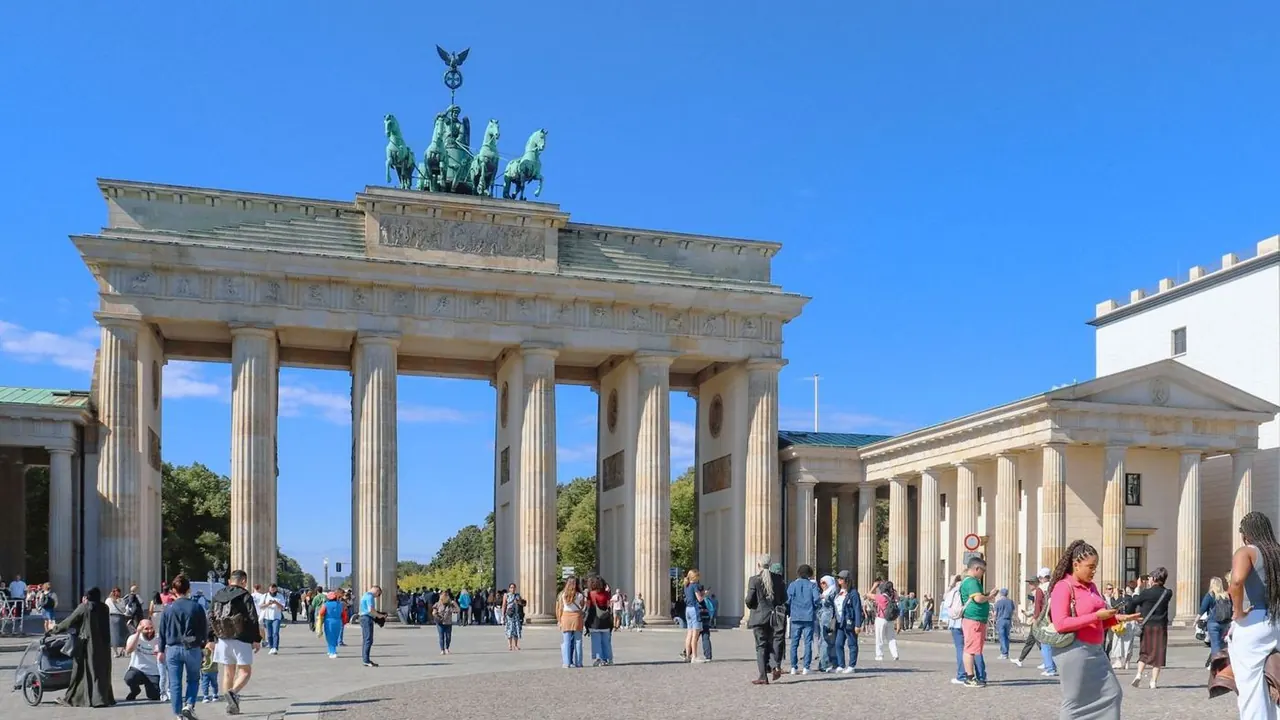
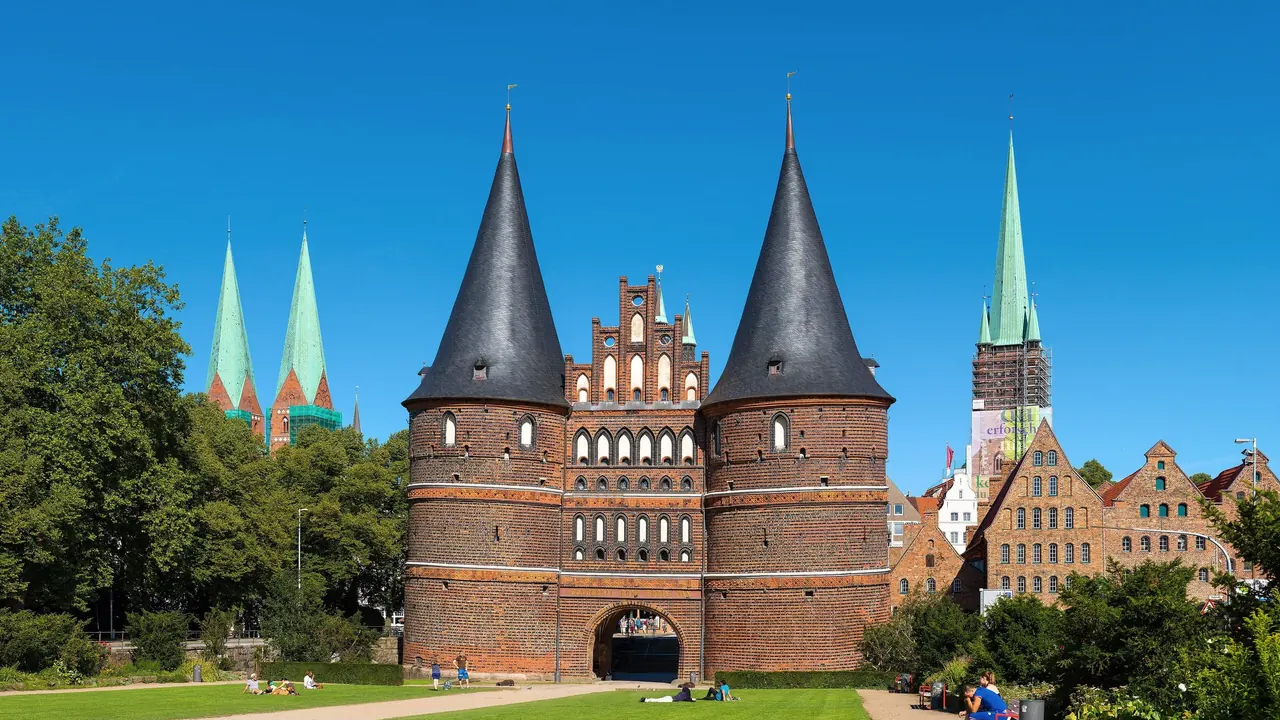
Photos: Berlin by Claudia Solano, Pexels License; Lubeck by Christian Wolf (www.c-w-design.de), CC BY-SA 3.0 DE, cropped.
Berlin or Lubeck?
Our verdict in twelve categories, each scored against the same fixed benchmark cities, and the climate month by month, so you can choose for your trip.
Choose Berlin for
- nightlife
- live music and the arts
- shopping
Berlin is the choice for a trip built around evenings and big institutions. Its clubs, opera houses and orchestras draw people from all over the world, and its museums and twentieth-century memorials go deeper than anything a smaller city can offer. It also eats and shops far more widely, from Turkish grill houses to Sunday flea markets. Expect to cross a large city by train and to stay up late.
Choose Lubeck for
- prices
Lübeck suits a slower, smaller trip. The brick Gothic old town on its island can be walked end to end, and it repays two unhurried days among the merchants' houses, courtyards and church spires. Travemünde puts a real Baltic beach twenty minutes away, so in summer you can pair a city break with a few seaside afternoons. Don't come for nightlife or a big cultural calendar.
Scoreboard
Twelve categories on one fixed scale from 0 to 100. The shaded stretch is the gap between the two.
Your match
Pick a travel style or drag the sliders, and both match scores follow your weighting.
Wins on nightlife and live music and the arts with your weighting.
Wins on prices with your weighting.
What matters to you?
Category by category
What the scores mean for a trip.
Beaches & swimming
Neither city is a beach destination, and both are good only for summer swimming, but the water is different. Berlin's swimming is in fresh water: the long sandy lido at Wannsee, the Müggelsee and small forest lakes like Schlachtensee, all reached by S-Bahn, and a little warmer in high summer.
Lübeck has the actual Baltic. Travemünde's sandy beach and the resorts along the bay have calm, shallow, tide-free sea, which is cooler than Berlin's lakes but gives you a proper seaside day with promenades.
Food & drink
Berlin's strength is range. Decades of Turkish, Vietnamese, Levantine and Korean cooking, market halls in Kreuzberg, beer gardens and a serious fine-dining tier mean you can eat somewhere different every meal.
Lübeck has a narrower but distinctive table: marzipan in cafés by the town hall, smoked herring and fish sandwiches from harbour kiosks, cellar-aged Rotspon and dinner in the old sea captains' guild house. It is worth tasting, but after a few days the choice runs short in a way Berlin's never does.
Culture & sights
Berlin is the heavier hitter. Museum Island, the Gemäldegalerie and Charlottenburg Palace hold world-class collections, and the Reichstag, the Wall Memorial and the Topography of Terror let you follow the twentieth century on the spot. What it lacks is a handsome old town.
Lübeck has exactly that: a nearly intact Hanseatic island of brick churches, the Holstentor and gabled merchants' houses, which is a pleasure simply to walk through. Its museums on the Hanseatic League, Thomas Mann and Günter Grass are good, but it is a two-day set, where Berlin can fill a week.
Nightlife
This is the widest gap between the two. Berlin's techno clubs in old power stations and factories have no closing time and run from Saturday into Monday, and Kreuzberg, Friedrichshain and Neukölln have Kneipen and cocktail bars open at almost any hour.
Lübeck's evenings are a glass of wine in the old town or a drink by the Obertrave, with the Travemünde promenade a bit livelier in summer. Most of the city is in bed by midnight, and locals after a night out take the train to Hamburg.
Nature & outdoors
Both sit in flat, green, lake-dotted country without mountains, so the difference lies in the setting. Berlin's green space is inside the city: the Tiergarten, the old Tempelhof runways, the Grunewald forest and the Havel lakes, plus the Wall Trail for cycling.
Lübeck looks to the coast and the river. You can canoe the reedy Wakenitz, walk the clay cliffs of the Brodtener Steilufer above the Baltic and sail on the bay, with the Holstein Switzerland lakes within an hour.
Day trips
The two are about level, and each has one outstanding trip out. From Berlin it is Potsdam's palaces and gardens at Sanssouci, half an hour away. Wittenberg, Leipzig, Dessau's Bauhaus and Dresden are further afield.
Lübeck's main trip is Hamburg, under an hour away, for its harbour and Speicherstadt. Wismar and the island castle at Schwerin are around an hour off, and Ratzeburg's lake cathedral and Kiel are closer. Berlin's choices lean towards palaces and big-city history, Lübeck's towards small towns, lakes and the sea.
Good for families
Berlin gives children more to do all year. There are two large zoos and an aquarium, a dinosaur skeleton at the Natural History Museum, hands-on trains and planes at the Museum of Technology, and playgrounds everywhere. Its flat streets make life easy with a pram.
Lübeck is at its best for families in summer. A shallow, calm beach at Travemünde and the Hansa-Park amusement park half an hour along the coast make a good seaside week. Outside the warm months there is little made for children, and wet days fall back on the museums.
Getting around
Berlin has the better network: U-Bahn, S-Bahn, trams and buses on one ticket, trains through the night at weekends, and flat streets with bike lanes. You will need it, because Mitte, Kreuzberg, Prenzlauer Berg and Charlottenburg are separate centres.
Lübeck needs much less. The old town is an island about 2km long, mostly pedestrianised and walkable from the station. Buses and a short train ride cover Travemünde, though some cobbles and fewer services mean it is less convenient beyond the centre.
Shopping & style
Berlin is the stronger shopping city. Big brands line the Kurfürstendamm, KaDeWe has its famous food hall, and you'll find young designers around Hackescher Markt, record and vintage shops in Kreuzberg, and the Mauerpark and Boxhagener Platz flea markets on Sundays.
Lübeck has a high street of chain stores along Breite Strasse and Königstrasse, a few craft shops and galleries in the side passages, and marzipan as the souvenir everyone takes home. For anything more, people go to Hamburg.
Affordability
Overall costs are similar, but the pressure points differ. Berlin is cheap for its size, with döner, Vietnamese canteens and corner bars, but hotel rates rise during trade fairs and on summer weekends, and museum entry soon adds up on a culture-heavy trip.
In Lübeck, old-town rooms are moderately priced and the old town itself costs nothing to walk. The extra cost comes at the coast: Travemünde and the bay resorts get noticeably dearer and book up in July and August.
Live music & performing arts
Berlin is in another league. It has three opera houses, the Berlin Philharmonic in Scharoun's Philharmonie, the Konzerthaus, famous theatre companies and the Friedrichstadt-Palast revue, plus jazz cellars and experimental venues, so there is something to see every night.
Lübeck has a good provincial calendar. Theater Lübeck stages opera and drama, and you can hear the Philharmonic, recitals from the music academy and the Schleswig-Holstein festival in summer. Its gem is organ music in the Marienkirche, where Buxtehude played.
Wellness & relaxation
Berlin does more for anyone who wants to unwind, mainly through German sauna culture. Large, clothes-free sauna complexes offer ritual infusions, and the columned Stadtbad Neukölln is the most atmospheric place to sweat. Brandenburg's thermal resorts are an hour away.
Lübeck's calm comes from the place itself: quiet courtyards, riverside benches and the old seaside spa tradition of Travemünde, with wellness hotels and a seawater pool along the bay. It makes a restful few days, but not a spa trip.
When should you go?
Pick your month. The climate figures are measured averages, not a forecast.
Berlin in July
Lubeck in July
Daytime high, °C
Rainfall in the month, mm
Temperature and rainfall are climate normals, averaged over the years shown. Berlin: 1991-2020 normals, Berlin / Alexanderplatz (0.9 km from centre). Lubeck: 1991-2020 normals, Luebeck-Blankensee (6 km from centre).
The two cities share a north German climate, so the best months are the same: May to September, with highs around 25°C in Berlin's July and August and a degree cooler in Lübeck. From November to March both are cold, grey and short of daylight, fine for museums but poor for long walks. Berlin is a little sunnier through the summer. Its wettest month is July, at 76mm, when short heavy showers are common.
Lübeck is the damper of the two through the year, and August, at 71mm, is as wet as any month. It is the only one of the pair on the sea. The Baltic reaches about 19°C in August, so from late June to early September it is swimmable on a warm day, though bracing, and too cold the rest of the year. Berlin's lakes warm up a little more in high summer.
Which traveller are you?
On a food and nightlife trip, choose Berlin without hesitation. You can go from döner in Kreuzberg and Vietnamese canteens to warehouse techno clubs that run all weekend. Lübeck offers marzipan, herring and quiet wine bars, and is mostly asleep by midnight.
For a culture and arts trip, Berlin offers far more. It has three opera houses, the Berlin Philharmonic, Museum Island and the memorials of a divided city. Lübeck has a lovely UNESCO old town and organ concerts in the Marienkirche, but you will have seen most of it in two days.
On a beach and sun trip, Lübeck has the sea itself. Travemünde's sandy Baltic shore, with its wicker beach chairs, is twenty minutes away by train, and calm water suits paddling. Berlin has lake lidos such as Wannsee, but the coast is about three hours off.
Before you go
| Measure | Berlin | Lubeck |
|---|---|---|
| Official language | German | German |
| Currency | Euro (EUR) | Euro (EUR) |
| Sockets | CF230 V, 50 Hz | CF230 V, 50 Hz |
| Driving side | Right | Right |
| Time zone | UTC+1, UTC+2 in summer | UTC+1, UTC+2 in summer |
| Emergency number | 112 | 112 |
| Elevation | 34 m | 13 m |
| Main airport | Berlin Brandenburg Airport (BER)19 km from centre161 non-stop destinations | Hamburg Helmut Schmidt Airport (HAM)53 km from centre120 non-stop destinations |
| Public holidays this year | 10 days | 10 days |
By the numbers
| Measure | Berlin | Lubeck |
|---|---|---|
| City population | 3,700,577 | 217,061 |
| People per km² | 4,153 | 1,013 |
| Museums within 10 km | 157 | 23 |
| UNESCO World Heritage sites within 50 km | 4 | 1 |
| Swim season, months above 21 °C | - | None |
Where else could you go?
Every comparison below shares a destination with this one, so you can follow Berlin or Lubeck somewhere new.