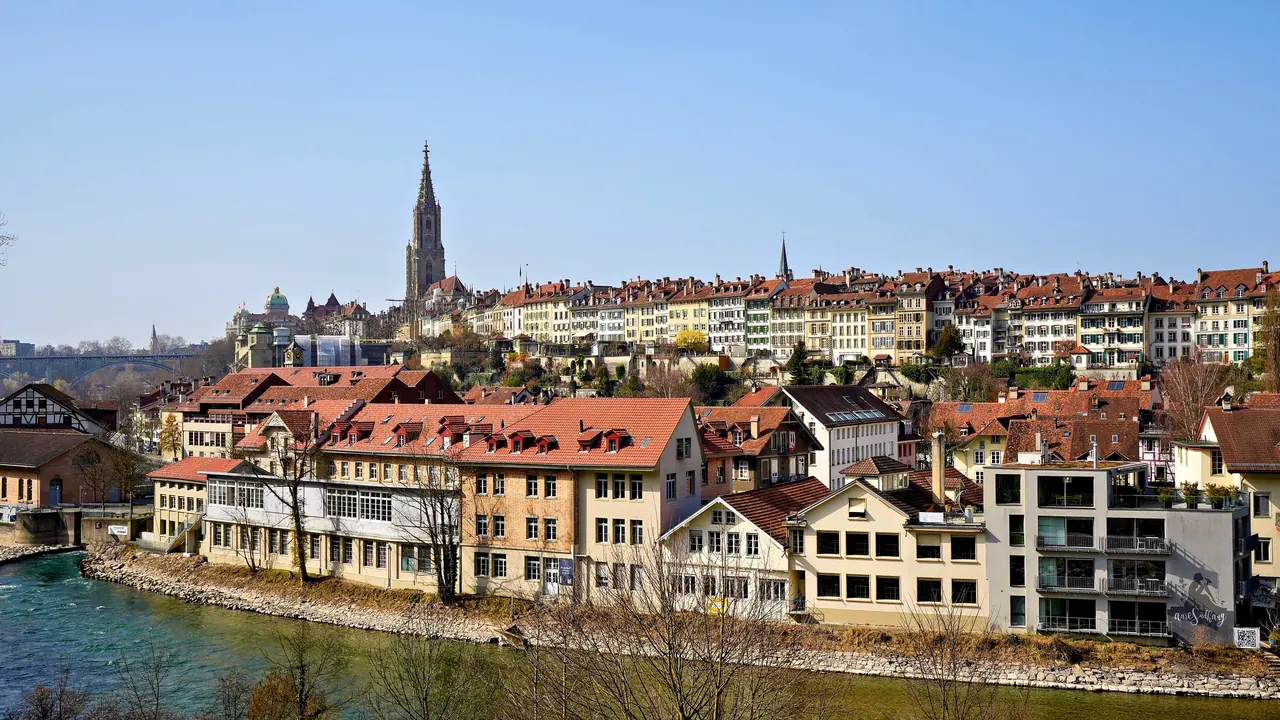
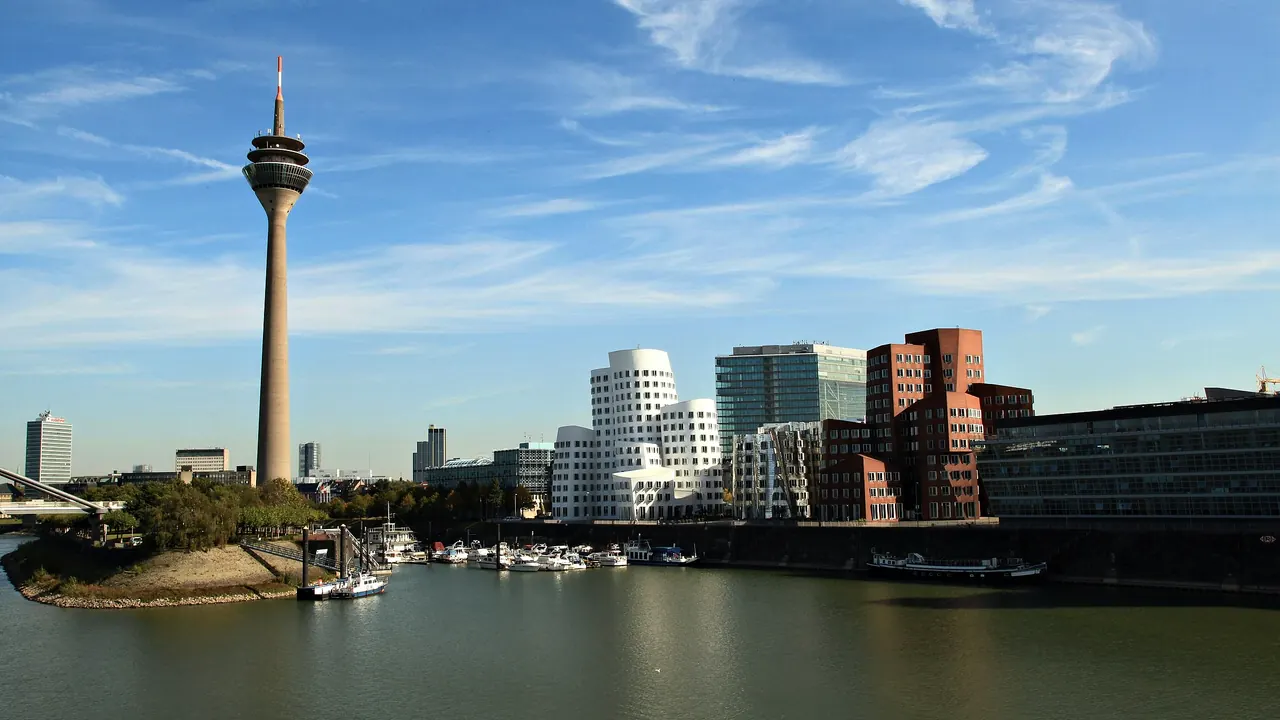
Photos: Bern by Beat Bieri, Pexels License; Dusseldorf by Frank Vincentz, CC BY-SA 3.0, cropped.
Bern or Dusseldorf?
Our verdict in twelve categories, each scored against the same fixed benchmark cities, and the climate month by month, so you can choose for your trip.
Choose Bern for
- nature and the outdoors
- beaches
- getting around
Bern suits a slower, scenic trip. Its compact old town of arcades and fountains is a World Heritage Site, the river is swimmable on a summer afternoon, and the Eiger and Jungfrau are close enough for a day in the high mountains. It is best for walkers, hikers and anyone who wants to use a well-connected rail hub to see a different Swiss town each day, as long as the very high cost of almost everything is not a problem.
Choose Dusseldorf for
- prices
- nightlife
- food and drink
Düsseldorf is the pick for evenings and appetite. It has Altbier in the Altstadt brewhouses, noodle counters in the Japanese quarter, the Königsallee and a deeper opera and theatre programme, which make it the livelier city break, and it is far easier on the wallet. What it gives up is old buildings and scenery: the Rhine meadows are pleasant, but there are no mountains and no swimming in the river.
Scoreboard
Twelve categories on one fixed scale from 0 to 100. The shaded stretch is the gap between the two.
Your match
Pick a travel style or drag the sliders, and both match scores follow your weighting.
Too close to call, 1 point apart
Wins on nature and the outdoors and beaches with your weighting.
Wins on prices and nightlife with your weighting.
What matters to you?
Category by category
What the scores mean for a trip.
Beaches & swimming
Neither city has a sea, but Bern has a real summer swimming culture. Locals walk upstream from the Marzili lido, jump into the cold, fast Aare and let it carry them back past the Federal Palace, and Lake Thun's bathing spots are a short train ride away. It suits confident swimmers, and only from June to early September.
In Düsseldorf the Rhine is off limits because of its currents and shipping, so a swim means going out to Unterbacher See or one of the region's outdoor pools. That makes a pleasant summer afternoon, not a reason to visit.
Food & drink
Bern's food is hearty and traditional. Think the Berner Platte of smoked meats, rösti and fondue in vaulted cellars under the arcades, Emmental cheese at the markets and very good chocolate. It is satisfying for a few days, but the range is narrow and every meal out is a real expense.
Düsseldorf is the more rewarding place to eat. The Altstadt brewhouses serve sauerbraten and Halve Hahn with Altbier and the city's sharp mustard. The Japanese quarter around Immermannstrasse adds ramen counters, izakaya and bakeries of a kind Bern cannot match.
Culture & sights
In Bern the whole old town is the attraction. Its UNESCO-listed loop of sandstone arcades holds painted fountains, the Zytglogge and the Minster, and the Zentrum Paul Klee and Einstein's flat on Kramgasse add depth beyond the streets.
Düsseldorf is about galleries more than buildings. The state art collection, split between a classic modern wing and a contemporary one under a glass dome, and the Kunstpalast make it a serious art city, and Klee fans will find a fine group of his works here too. But wartime bombing left little historic fabric, so Benrath Palace and the leaning Gehry buildings in the Medienhafen have to do most of the work for sightseers.
Nightlife
Bern's evenings are quiet. There are cellar bars under the arcades, a few busy streets near the station at weekends and riverside terraces in summer, and the Reitschule is there for anyone after a rougher late night. Midweek, the city goes to bed early.
Düsseldorf goes out far harder. On weekend nights the few hundred pubs and brewhouses of the Altstadt spill into a standing street party, while Carlstadt and the Medienhafen have calmer cocktail bars. At Carnival the whole city is out in costume for days.
Nature & outdoors
This is where Bern pulls furthest ahead. The Eiger, Mönch and Jungfrau are on the horizon from the old town, and the Jungfrau region is about an hour away for alpine hiking, cable cars and winter skiing. Lake Thun, the Gurten and the wooded paths along the Aare are much closer.
Düsseldorf's countryside is flat and gentle. Cycle paths follow the grassy Rhine meadows to Kaiserswerth, Grafenberg forest and the Neandertal are on the edge of town, and the Bergisches Land and the Siebengebirge are further out. It is good for a ride or a walk, but nothing like the Alps.
Day trips
Both are excellent bases, and Bern has a slight edge because its connections are so easy. The Swiss rail network puts Lucerne, Basel and Zurich about an hour away. A string of small historic towns, including Fribourg, Murten, Thun and Solothurn, is even closer, with Gruyères and the Lavaux terraces for longer days.
Düsseldorf's trips lead to the cities and heritage of the Rhineland and beyond. Cologne cathedral is under half an hour away, and Bonn, the Brühl palaces, the Zollverein colliery, Aachen and Dutch Maastricht are all within reach. You get more big-city variety there, and more lakes, mountains and small towns from Bern.
Good for families
Both are safe, orderly and easy with a pushchair, so the difference is in what children do. Bern is about animals and fresh air: the bear park, the Dählhölzli zoo along the Aare, the playground on the Gurten and the shallow pools at the Marzili, though the river itself is for strong swimmers only.
Düsseldorf has more indoor attractions and bigger outings. It has the Aquazoo Löbbecke and the tilted windows of the Rheinturm, and Phantasialand and Movie Park are about an hour away. At Carnival, sweets are thrown into the crowd from the parades.
Getting around
Bern could hardly be easier. You can walk the old town end to end in about twenty minutes, the arcades keep you dry, and the station sits at its top, so rail day trips take no effort. Trams, buses and short funiculars handle the steep climbs up from the river.
Düsseldorf is compact and flat too. Trams and light rail link the Altstadt, the Königsallee and the Medienhafen, and trains reach the airport in minutes. Its regional network reaches much further, but the fare zones take some working out.
Shopping & style
Bern is pleasant for browsing rather than a reason to go. Under the arcades of Marktgasse and Kramgasse you find Swiss chains, watches and chocolate, and the cellar shops of Gerechtigkeitsgasse sell antiques, books and crafts. There is little fashion or luxury.
Düsseldorf is the shopping city of the two. Luxury flagships and jewellers line the canal along the Königsallee, the big department stores and the Kö-Bogen cover the mainstream, and Flingern and the Japanese quarter add boutiques, design and stationery.
Affordability
Bern is very expensive across the board: hotels, dinners and even a beer on a terrace cost well above most of Europe. Free pleasures soften the bill, such as the bear park, the river paths and tours of the Federal Palace, and hotel guests usually get a pass for local transport.
Düsseldorf's hotels are pricey, especially during trade-fair weeks, but everyday spending is much gentler. Brewhouse meals, Japanese noodle lunches and fairly priced transport mean a stay there costs clearly less than the same days in Bern.
Live music & performing arts
Bern offers what you would expect of a small capital. The Stadttheater stages opera, ballet and German drama, the symphony orchestra plays at the Casino and the Dampfzentrale hosts new dance, with a jazz festival each spring and the Gurtenfestival in July. That fills an evening but rarely shapes a trip.
Düsseldorf goes deeper. The Deutsche Oper am Rhein, the Tonhalle in its domed former planetarium and the Schauspielhaus give it a fuller programme all year, though the theatre is mostly for German speakers. As Kraftwerk's home city, it also has a place in the history of electronic music.
Wellness & relaxation
Neither city is a spa destination, and both are easy places to slow down. Bern's calm comes from quiet Sundays, long lunches by the river and a thermal complex on its western edge. For serious pampering, there are mountain spa hotels in the Bernese Oberland.
Düsseldorf relies on the German sauna habit, mostly mixed and without swimwear in the public baths. Larger thermal complexes and historic Aachen are within reach, and the weekend Altstadt is its one noisy corner.
When should you go?
Pick your month. The climate figures are measured averages, not a forecast.
Bern in July
Dusseldorf in July
Daytime high, °C
Rainfall in the month, mm
Where the figures come from
Bern has no rain gauge within 25 km of the centre, so its rainfall comes from a gridded climate dataset read at the city rather than from a gauge further away.
Bern's sunshine is measured 71 km from the centre, at Herten.
Temperature and rainfall are climate normals, averaged over the years shown. Bern: 2010-2020 (sunshine 1991-2020, rainfall 1991-2020) normals, Bern / Bern - Belp Airport (5.5 km from centre). Dusseldorf: 1991-2020 normals, Düsseldorf (8.3 km from centre).
The two cities follow almost the same temperature curve. Winters are chilly and grey, with highs around 5°C, springs are mild, and summers peak in July and August in the mid-twenties. Bern is a touch warmer and clearly sunnier in high summer, with about 254 hours of sun in July. This is also when the Aare is warm enough to swim, roughly from June to early September. The catch is rain: from May to August Bern gets well over 100mm a month, so summer days there often bring a wet spell.
Düsseldorf's rain is spread more evenly through the year, and April is its driest month at 47mm, which makes late spring good for walking the Rhine promenade. In both cities May, June and September are the most comfortable months for sightseeing on foot. From November to February the short, dull days push a visit indoors, to museums, cellar bars and brewhouses.
Which traveller are you?
For an outdoors trip, Bern is the clear choice. The Jungfrau region is about an hour away by train, with alpine hikes and cable cars, Lake Thun is closer still, and the Gurten and the Aare paths start in town. Düsseldorf offers only flat Rhine cycling and gentle hills.
On a food and nightlife trip, Düsseldorf wins easily. Altbier in the Altstadt brewhouses, ramen and izakaya around Immermannstrasse, and weekend streets that stay full past midnight give far more to do than Bern's cellar bars, where weeknights end early.
On a tight budget, Düsseldorf is the safer bet. Brewhouse meals, Japanese noodle lunches and fairly priced transport keep costs down, as long as you avoid trade-fair weeks. Bern is very expensive across the board, and even with a free tram pass and supermarket lunches the bill climbs fast.
Before you go
| Measure | Bern | Dusseldorf |
|---|---|---|
| Official language | French, German, Italian, Romansh | German |
| Currency | Swiss Franc (CHF) | Euro (EUR) |
| Sockets | CJ230 V, 50 Hz | CF230 V, 50 Hz |
| Driving side | Right | Right |
| Time zone | UTC+1, UTC+2 in summer | UTC+1, UTC+2 in summer |
| Emergency number | 112 | 112 |
| Elevation | 542 m | 38 m |
| Main airport | Zürich Airport (ZRH)101 km from centre226 non-stop destinations | Düsseldorf Airport (DUS)7 km from centre182 non-stop destinations |
| Public holidays this year | 10 days | 11 days |
By the numbers
| Measure | Bern | Dusseldorf |
|---|---|---|
| City population | 136,988 | 619,444 |
| People per km² | 2,655 | 2,849 |
| Museums within 10 km | 30 | 25 |
| UNESCO World Heritage sites within 50 km | 2 | 4 |
Where else could you go?
Every comparison below shares a destination with this one, so you can follow Bern or Dusseldorf somewhere new.