Photos: Bern by Beat Bieri, Pexels License; Hallstatt by C.Stadler/Bwag, CC BY-SA 4.0, cropped.
Bern or Hallstatt?
Our verdict in twelve categories, each scored against the same fixed benchmark cities, and the climate month by month, so you can choose for your trip.
Choose Bern for
- live music and the arts
- shopping
- nightlife
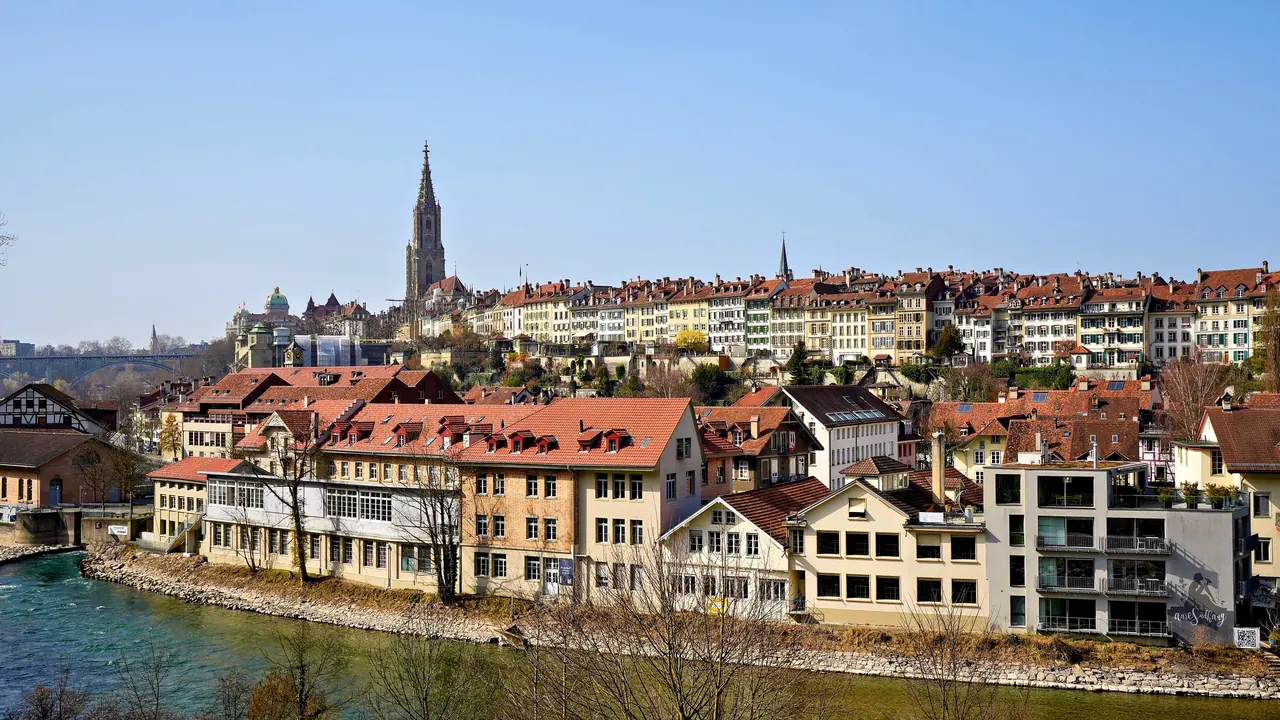
Bern suits travellers who want a proper small city with the mountains in reach. You get a UNESCO old town of arcades and fountains, museums that go further than you would expect, cellar bars, a concert hall and an opera house. On top of that, the best rail connections in Switzerland let you sleep in the same bed and see Lucerne one day, Gruyères the next and the Jungfrau region after that. It is the better pick for a varied week, for families, and for anyone who would rather not drive.
Choose Hallstatt for
- prices
- nature and the outdoors
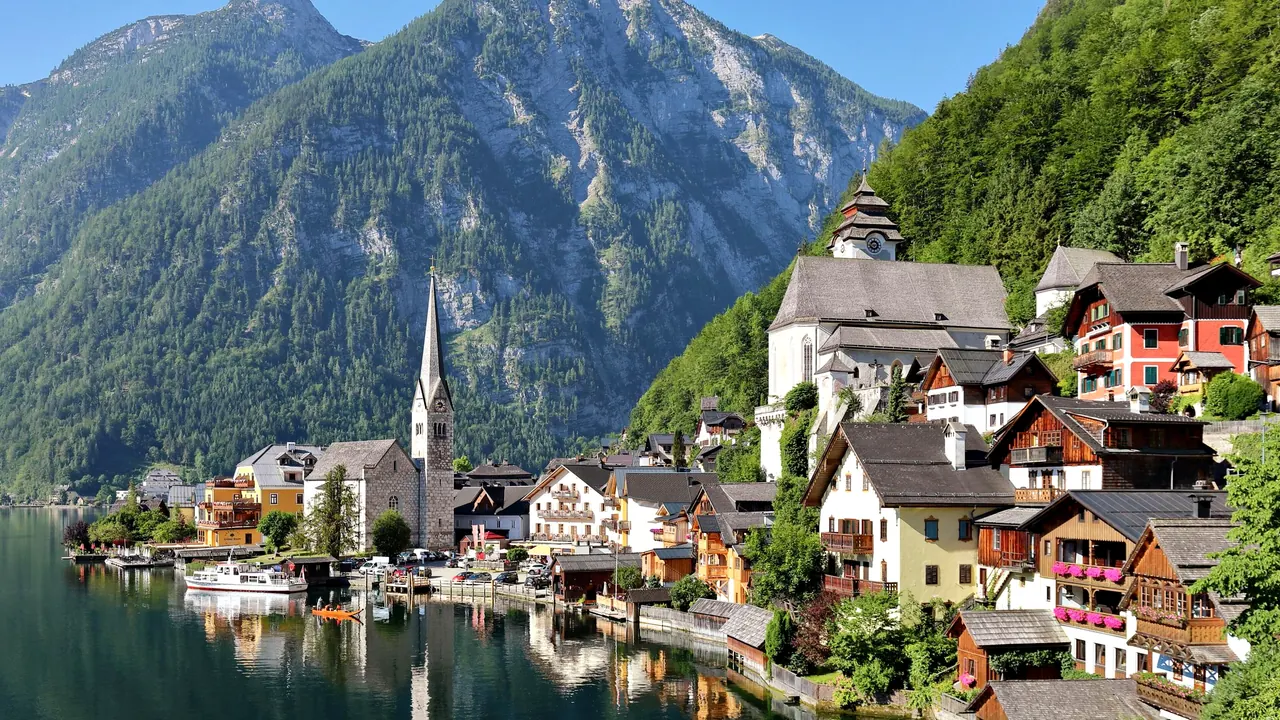
Hallstatt is for people who come mainly for the landscape and are happy for evenings to be quiet. The lake under the Dachstein, the ice caves, the Krippenstein plateau and the walk to the Gosausee give it the edge for hikers and photographers. Once the day visitors leave, the village is very still. The trade-off is a single lane with few restaurants and no nightlife, and getting out to the rest of the Salzkammergut is much easier with a car.
Scoreboard
Twelve categories on one fixed scale from 0 to 100. The shaded stretch is the gap between the two.
Your match
Pick a travel style or drag the sliders, and both match scores follow your weighting.
Wins on live music and the arts and shopping with your weighting.
Wins on prices and nature and the outdoors with your weighting.
What matters to you?
Category by category
What the scores mean for a trip.
Beaches & swimming
Neither has a beach, but Bern makes more of its water. The summer ritual is to walk upstream from the Marzili, jump into the fast green Aare and drift back past the Federal Palace. The riverside lidos have lawns and pools, and Lake Thun's bathing spots are a short train ride away.
Hallstätter See stays cold and deep, with only a small jetty area in the village and the lido at Obertraun. Here a swim is a bracing extra after a hike, and serious lake bathers head north to the Wolfgangsee.
Food & drink
Bern is no food capital, but it gives you options. You can work through the Berner Platte, rösti and veal in cream in old guildhalls and arcade cellars, buy Emmental cheese and bread at the Bundesplatz markets, and eat good chocolate, with a reasonable spread of Italian and Asian kitchens on top.
Hallstatt has a few guesthouse dining rooms serving schnitzel and dumplings. The one dish worth seeking out is char or whitefish from the lake. There is no market, and for anything more ambitious, such as the imperial-era patisseries, you go to Bad Ischl.
Culture & sights
Both are UNESCO sites, but on different scales. In Bern the whole capital's old town is the attraction: arcades, Renaissance fountains, the Zytglogge, the Minster tower and the Federal Palace. Add the Klee collection and Switzerland's oldest art museum and you have two solid days.
Hallstatt's culture is deep in time rather than broad. Seven thousand years of salt mining, the Iron Age finds that named a whole era of European prehistory, and the Beinhaus skulls make a memorable half day or full day. After that the sightseeing runs out.
Nightlife
Bern is quiet by city standards, but it does have a night out. There are cellar bars under the arcades, a weekend crowd on Aarbergergasse, riverside terraces in summer and the Reitschule for late, rough-edged parties.
Hallstatt has none of this. Evenings mean dinner, a glass of wine by the water and a dark walk along the lake, which is exactly why some people stay the night.
Nature & outdoors
Bern's outdoors is gentler, and most of it you reach from the city. Lake Thun is nearer than the high peaks and has lakeside paths and boats. The Gurten gives an easy walk above the rooftops, and cycling routes cross the farmland towards the rolling Emmental and the Jura ridges. For winter skiing you take the train into the Bernese Oberland, and the city itself often sits under grey cloud while the slopes higher up are in sun.
Hallstatt comes out ahead because the serious terrain needs no journey at all. In summer there are via ferratas on the rock above the lake, cycling around the shore and paddling on still water. In winter there is freeride and ski touring on the Krippenstein, with groomed pistes at Dachstein West near Gosau. The cost is Alpine weather: mist can sit on the lake for days, so plans need some slack, but on a clear morning few places look better.
Day trips
Bern is one of the easiest day-trip bases in Switzerland. Zurich, Basel and Lucerne are each about an hour away by train, and Fribourg, Murten, Thun, Solothurn and Neuchâtel are nearer still. From Fribourg it is a short trip on to Gruyères and its cheese dairies. The trains run so often that you rarely have to plan around them.
Hallstatt's outings are lovely in their own way: the Habsburg spa town of Bad Ischl and its Kaiservilla, St Wolfgang's altarpiece, Gmunden's lake castle, and Salzburg for a long day. But buses are sparse, and without a car each trip takes planning.
Good for families
Bern is the easier place to bring children. The bear park, the Dählhölzli zoo along the river, the Natural History Museum dioramas and the Gurten playground spread out over several relaxed days, and trams take pushchairs without fuss. The fast-flowing Aare is the main thing to keep children away from.
In Hallstatt, the salt mine's miners' slides and the ice caves are real highlights for older children. The crowded, steep single lane is hard work with toddlers, though, and many families base themselves in Obertraun instead.
Getting around
Both centres are walkable. The difference is everything beyond them. Bern's main station sits at the top of the old town, and trams, buses and little funiculars link the arcades with the riverside quarter. You will not miss a car for a moment.
Hallstatt village takes minutes to cross on foot, up steep steps. Arriving is another matter: the train stops on the far shore and a boat ferries you over, regional buses thin out outside summer, and many visitors end up hiring a car.
Shopping & style
Bern has a real if modest high street. Spitalgasse, Marktgasse and Kramgasse run under the arcades with watch and chocolate shops, while the cellar shops on Gerechtigkeitsgasse sell antiques, books and design pieces. A big shopping centre on the western edge covers the mainstream brands.
Hallstatt has one souvenir lane. Salt from the mine is the only buy you would not find elsewhere, alongside carved wood and schnapps.
Affordability
Neither is cheap, but Bern costs more. Everything, from plain business hotels to a beer on a terrace, is priced at Swiss levels. A free tram pass from your hotel, free Federal Palace tours and supermarket lunches help soften it.
Hallstatt charges resort prices for its handful of lakeside rooms, and the salt mine and cable car tickets add up. The easy fix is to stay in Obertraun, Bad Goisern or Bad Ischl and come in for the day.
Live music & performing arts
Bern has a small capital's stage life: German-language opera and ballet at the Stadttheater, the symphony orchestra at the Casino, new dance at the Dampfzentrale, a spring jazz festival and the Gurtenfestival in July.
Hallstatt has a brass band at feast days and the occasional church concert. For a real performance you would drive to Salzburg or to the summer operetta in Bad Ischl.
Wellness & relaxation
For winding down, the two come out about even, but in different ways. Bern offers city spa time: a large thermal complex on its western edge, a hammam-style spa in the old town, and quiet Sundays with long riverside lunches.
Hallstatt has little more than hotel saunas. What it offers instead is stillness at dawn and after dark, plus nineteenth-century brine baths half an hour away in Bad Ischl. Expect a crowded lane around midday.
When should you go?
Pick your month. The climate figures are measured averages, not a forecast.
Bern in July
Hallstatt in July
Daytime high, °C
Rainfall in the month, mm
Where the figures come from
Bern has no rain gauge within 25 km of the centre, so its rainfall comes from a gridded climate dataset read at the city rather than from a gauge further away.
Bern's sunshine is measured 41 km from the centre, at Payerne.
Hallstatt's temperatures are measured 56 km from the centre, at Salzburg.
Hallstatt has no rain gauge within 25 km of the centre, so its rainfall comes from a gridded climate dataset read at the city rather than from a gauge further away.
Temperature and rainfall are climate normals, averaged over the years shown. Bern: 2010-2020 (sunshine 1961-1990, rainfall 1991-2020) normals, Bern / Bern - Belp Airport (5.5 km from centre). Hallstatt: 1991-2020 normals, Salzburg (55.5 km from centre).
The two places follow almost the same temperature curve. Both are cold and grey from November to February, and comfortable for walking in April, May, September and October. From June to August they are warm, with highs around 26°C in Bern and 25°C in Hallstatt, and neither gets too hot for the streets. Swimming differs more than the air does. Bern's riverside lidos and the Aare are in use from June to early September. Hallstätter See warms slowly and reaches about 20°C at best, and only in July and August, so its swimming window is shorter and much less reliable.
Rain is the bigger difference. Hallstatt lies against the northern edge of the Alps and is much the wetter of the two, with about 178mm in July against roughly 105mm in Bern. Its summers are also less sunny, so a summer stay there needs flexible days for the high viewpoints. Bern gets the brighter summer days. In midwinter Hallstatt sees a little more sun, which suits snow trips on the Dachstein better than strolls around the village.
Which traveller are you?
On a culture and arts trip, Bern is the clear choice. Its UNESCO old town, the Zentrum Paul Klee, the Kunstmuseum and the Einstein sites fill two full days. In the evenings there is opera at the Stadttheater or the symphony orchestra at the Casino. Hallstatt has a rich half day of prehistory and painted skulls.
For an outdoors trip, Hallstatt has the stronger setting. Mountain country starts right at the edge of the village, with the Krippenstein cable car, the Dachstein ice caves, Echerntal waterfalls, the Gosausee and hut-to-hut routes all close at hand. Bern reaches the Jungfrau region by train, but that is an hour away.
On a food and nightlife trip, Bern gives you far more to work with. There are guildhall dining rooms, fondue in vaulted cellars, Emmental cheese at the markets, bars along Aarbergergasse and late parties at the Reitschule. Hallstatt has lake fish, a few terraces, and kitchens that close early.
Before you go
| Measure | Bern | Hallstatt |
|---|---|---|
| Official language | French, German, Italian, Romansh | German, Austrian Sign Language |
| Currency | Swiss Franc (CHF) | Euro (EUR) |
| Sockets | CJ230 V, 50 Hz | CF230 V, 50 Hz |
| Driving side | Right | Right |
| Time zone | UTC+1, UTC+2 in summer | UTC+1, UTC+2 in summer |
| Emergency number | 112 | 112 |
| Elevation | 542 m | 511 m |
| Main airport | Zürich Airport (ZRH)101 km from centre226 non-stop destinations | Salzburg Airport (SZG)55 km from centre64 non-stop destinations |
| Public holidays this year | 10 days | 16 days |
By the numbers
| Measure | Bern | Hallstatt |
|---|---|---|
| City population | 136,988 | 741 |
| People per km² | 2,655 | 12 |
| Museums within 10 km | 30 | 3 |
| UNESCO World Heritage sites within 50 km | 2 | 2 |
Where else could you go?
Every comparison below shares a destination with this one, so you can follow Bern or Hallstatt somewhere new.