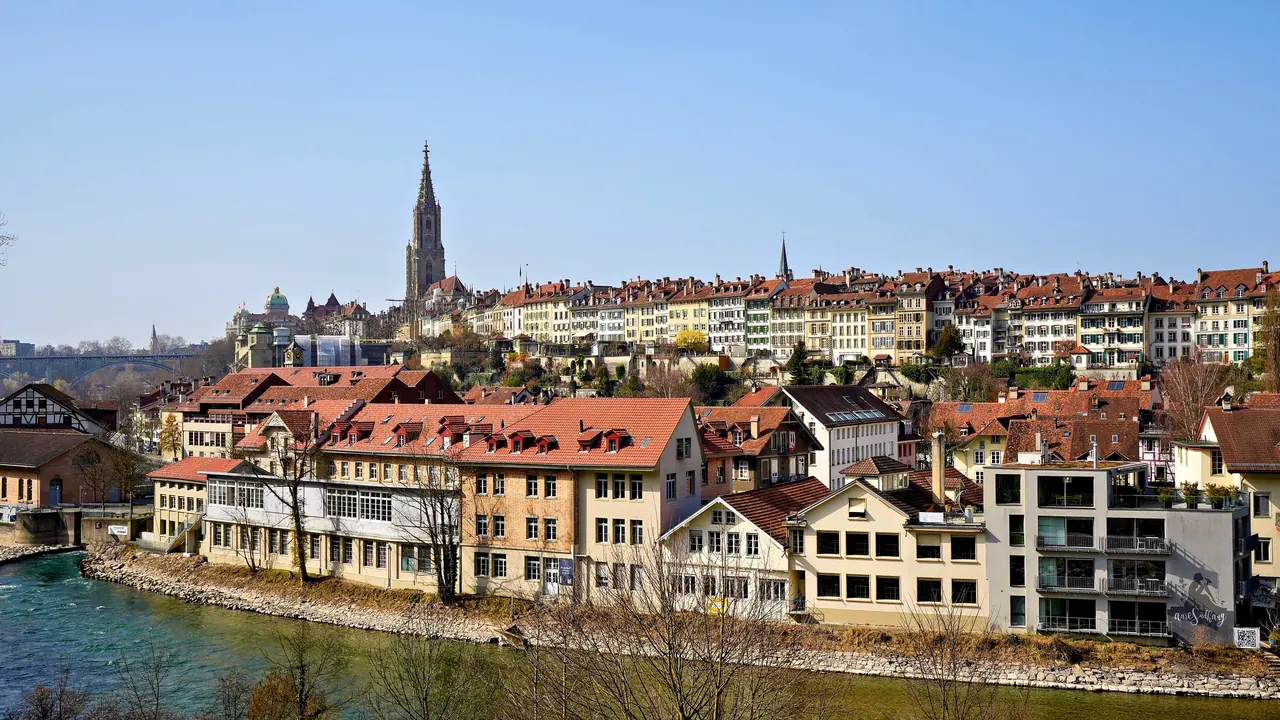
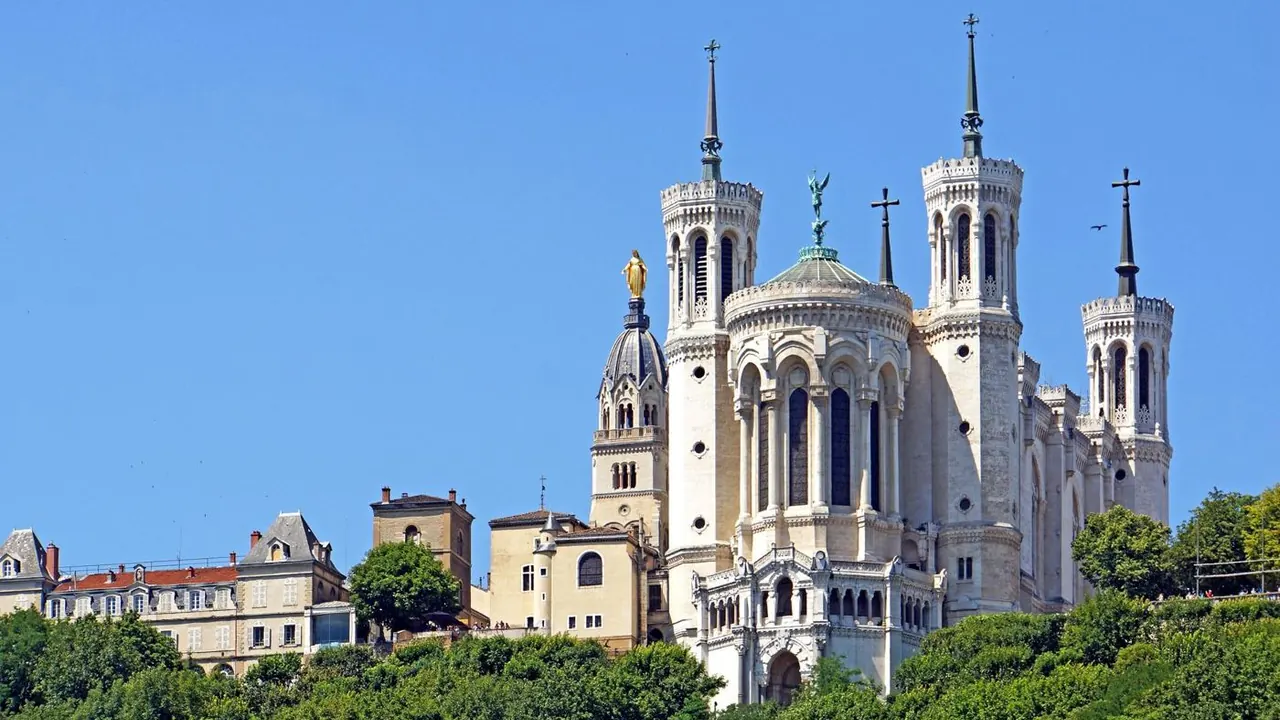
Photos: Bern by Beat Bieri, Pexels License; Lyon by Dennis G. Jarvis, CC BY-SA 2.0, cropped.
Bern or Lyon?
Our verdict in twelve categories, each scored against the same fixed benchmark cities, and the climate month by month, so you can choose for your trip.
Choose Bern for
- beaches
- nature and the outdoors
- getting around
Bern suits travellers who want the Alps within easy reach and a calm, compact base to explore them from. You can walk the old town in an afternoon, and trains go straight out to lakes, peaks and other Swiss towns. On summer days you can drift down the Aare past the parliament building. You will pay heavily for all of it, and you will eat well rather than memorably.
Choose Lyon for
- food and drink
- prices
- nightlife
Lyon is the better choice if meals, evenings and a bigger city are the point of the trip. Its bouchons and markets set it apart from almost anywhere. The Roman hill, the Renaissance quarter and its major art museum give it more to see, and its stages and bars have more going on. It also costs a good deal less. On the other hand, it has nowhere to swim in town and the mountains are a drive away.
Scoreboard
Twelve categories on one fixed scale from 0 to 100. The shaded stretch is the gap between the two.
Your match
Pick a travel style or drag the sliders, and both match scores follow your weighting.
Wins on beaches and nature and the outdoors with your weighting.
Wins on food and drink and prices with your weighting.
What matters to you?
Category by category
What the scores mean for a trip.
Beaches & swimming
Neither city is on the sea, but Bern makes far more of its water. In summer you can walk upstream from the Marzili, jump into the Aare and ride the cold green current back into town, then dry off on the lawns of the riverside lidos. The current is strong and suits confident swimmers only, but Lake Thun has calmer bathing twenty minutes away by train.
In Lyon the rivers are for sitting beside, not swimming in. The local choice is the bathing lake at Miribel-Jonage on the city's edge. The clearer water of Annecy and the Lac du Bourget makes a day out rather than part of the stay.
Food & drink
This is where Lyon pulls furthest ahead. Its bouchons serve quenelles, andouillette and praline tart with a pot of local red wine, and generous set lunches open the door to a long fine-dining tradition. Les Halles Paul Bocuse and the Saône markets are worth a visit in themselves, and the Beaujolais and northern Rhône vineyards are close by.
Bern's food is hearty but simple: the Berner Platte, rösti and fondue in old guildhall dining rooms and arcade cellars, Emmental cheese at the markets and excellent chocolate. There is less choice and dinners cost much more, so food adds to a trip here rather than being a reason to go.
Culture & sights
Bern's sights come in one compact, beautiful package: the arcaded UNESCO old town on its loop of the Aare, the Minster, the Zytglogge and the Federal Palace. On top of that are a Klee collection and an Einstein museum that are better than you would expect in a city this size. Two days covers it.
Lyon has more layers and a longer history. It runs from the Roman theatres on Fourvière through the Renaissance lanes and traboules of Vieux Lyon to Croix-Rousse, the old silk-weavers' hill. The Musée des Beaux-Arts holds a major collection, and the city needs several full days to see properly.
Nightlife
Lyon has the livelier evenings by some distance. Students fill the wine bars of the Presqu'île and the pubs of Vieux Lyon, and barges on the Rhône double as bars and clubs. Clubs towards Gerland and the Confluence give it a serious electronic music scene.
In Bern, going out means vaulted cellar bars and Aarbergergasse. These are busy at weekends, but on weeknights the city goes quiet early. The Reitschule is the one rough-edged late option, and on summer evenings people move out to the terraces along the Aare.
Nature & outdoors
Bern has the Alps in view and within reach. The Eiger, Mönch and Jungfrau rise on the horizon, and Interlaken is about an hour away by train for high-mountain walking, cable cars and skiing. The Gurten funicular and the wooded paths along the Aare start almost in the centre.
Lyon's outdoor life is more urban and gentler: the car-free Rhône quays, the boating lake in the Parc de la Tête d'Or, and walks in the Monts d'Or and the Beaujolais hills. Chartreuse and Vercors have serious hiking, but you need to drive there, and the ski resorts are about two hours away.
Day trips
Both make good bases, but Bern's place at the centre of the Swiss rail network gives it the edge. Lucerne, Basel and Zurich are each about an hour away, and Fribourg and Gruyères are close. The lakeside towns of Murten, Thun and Neuchâtel are nearer still, and you never need to plan around connections.
From Lyon, the day trips are mostly about wine and old towns: Roman Vienne twenty minutes away, medieval Pérouges, the Beaujolais villages, and further out Cluny and Beaune. Annecy and the Alpine towns take longer, and some of the countryside is easier to reach with a car.
Good for families
Both are safe, easy cities for children, and they differ more in what they offer than in how good they are. Bern is smaller and calmer, with the bear park, the Dählhölzli zoo along the river, the playground on the Gurten and shallow children's pools at the Marzili. The river itself is not safe for young swimmers.
Lyon has more variety for a longer stay. The Parc de la Tête d'Or has a free zoo, pony rides and pedalos, the Musée des Confluences has dinosaur skeletons, and there is an aquarium and Guignol puppet shows. Its stepped lanes on the hills are harder going with a pushchair.
Getting around
Bern is the simpler city to get around. You can walk its centre from the station to the bear park in about twenty minutes, with the arcades keeping off the rain. Trams, buses and short funiculars cover the rest, with Swiss punctuality.
Lyon is larger and relies on a mix of metro, tram, funiculars and bike-share. The flat Presqu'île is pleasant on foot, but getting up to Fourvière or Croix-Rousse often means a steep climb or a change of line.
Shopping & style
Lyon has the wider choice. Chains line the rue de la République, luxury labels gather around Place des Jacobins and Part-Dieu has a very large mall. On the slopes of Croix-Rousse you will find silk and small designer workshops.
Bern's arcaded streets are pleasant for watches, chocolate and Swiss chains, and the cellar shops around Gerechtigkeitsgasse sell antiques, books and crafts. There is little in the way of fashion or luxury.
Affordability
The gap here is wide. Bern costs far more than most of Europe for rooms, meals and even a beer on a terrace. Visitors on a budget rely on supermarket takeaway counters, market stalls, the transport pass most hotels give guests and the many free sights.
Lyon is not cheap either, but set lunches in its bouchons are generous and rooms are reasonably priced except during trade fairs and the Fête des Lumières. The zoo is free. The same money goes noticeably further here.
Live music & performing arts
Lyon has much more on stage. Its glass-vaulted Opéra is home to well-regarded opera and ballet companies, and the Maison de la Danse and the Biennale make dance its specialism. The summer performances in the Roman theatres on Fourvière are worth planning a visit around.
Bern has German-language opera and drama at the Stadttheater, its symphony orchestra at the Casino and contemporary dance at the Dampfzentrale. There is also a spring jazz festival and the Gurtenfestival in July. That gives you a good evening out, but not a reason to go.
Wellness & relaxation
Bern makes spa time easier to fit into a city stay. A large thermal bath and wellness complex on its western edge has warm pools, saunas and steam rooms, and the old town adds a hammam-style spa. For something more serious, the mountain spa hotels of the Bernese Oberland are within easy reach by train. Its quiet arcades and still Sundays add to the calm.
Lyon's restful side comes more from its rhythm than from its spas: long lunches and slow Sunday mornings by the Saône. In town there are a few hammams and hotel spas and the open-air pool on the Rhône quays. For real thermal bathing you need a day out to Aix-les-Bains, about an hour and a half away.
When should you go?
Pick your month. The climate figures are measured averages, not a forecast.
Bern in July
Lyon in July
Daytime high, °C
Rainfall in the month, mm
Where the figures come from
Bern has no rain gauge within 25 km of the centre, so its rainfall comes from a gridded climate dataset read at the city rather than from a gauge further away.
Bern's sunshine is measured 71 km from the centre, at Herten.
Temperature and rainfall are climate normals, averaged over the years shown. Bern: 2010-2020 (sunshine 1991-2020, rainfall 1991-2020) normals, Bern / Bern - Belp Airport (5.5 km from centre). Lyon: 1991-2020 normals, Lyon / Bron (10.6 km from centre).
Both cities are at their best from late May to September, but their weather follows different patterns. Bern is the cooler of the two, with highs of around 26°C in July and August. That is warm enough for floating down the Aare from June to early September. Its wettest stretch comes in early summer, with close to 118mm in May, so expect showers between the sunny days. Winters are grey and cold, around 5°C, though the arcades keep you dry while you walk.
Lyon runs a couple of degrees warmer and reaches 28°C in high summer, which can feel heavy on the Presqu'île in the afternoon. It also gets more sunshine through most of the year. Its summers are drier than Bern's, and the rain comes in autumn instead, peaking at 101mm in October. Spring and September are the most comfortable months for climbing its hills on foot.
Which traveller are you?
For a food and nightlife trip, Lyon is the clear choice. Bouchons, Les Halles Paul Bocuse and the nearby Beaujolais make every meal an event. Afterwards, the wine bars of the Presqu'île and the barges on the Rhône stay busy long after Bern has gone quiet.
On an outdoors trip, Bern comes out ahead. The Jungfrau region is about an hour away by train and Lake Thun is closer still, while the Gurten and the Aare paths start in town. Lyon's countryside is gentler, and you mostly need a car to reach it.
On a tight budget, Lyon is far easier. Generous set lunches, moderate transport fares and a free zoo make the money go further. Bern costs far more than most of Europe, and the hotel transport pass and free sights only soften that.
Before you go
| Measure | Bern | Lyon |
|---|---|---|
| Official language | French, German, Italian, Romansh | French |
| Currency | Swiss Franc (CHF) | Euro (EUR) |
| Sockets | CJ230 V, 50 Hz | CE230 V, 50 Hz |
| Driving side | Right | Right |
| Time zone | UTC+1, UTC+2 in summer | UTC+1, UTC+2 in summer |
| Emergency number | 112 | 112 |
| Elevation | 542 m | 160 m |
| Main airport | Zürich Airport (ZRH)101 km from centre226 non-stop destinations | Lyon Saint-Exupéry Airport (LYS)20 km from centre141 non-stop destinations |
| Public holidays this year | 10 days | 11 days |
By the numbers
| Measure | Bern | Lyon |
|---|---|---|
| City population | 136,988 | 519,127 |
| People per km² | 2,655 | 10,838 |
| Museums within 10 km | 30 | 43 |
| UNESCO World Heritage sites within 50 km | 2 | 2 |
Where else could you go?
Every comparison below shares a destination with this one, so you can follow Bern or Lyon somewhere new.