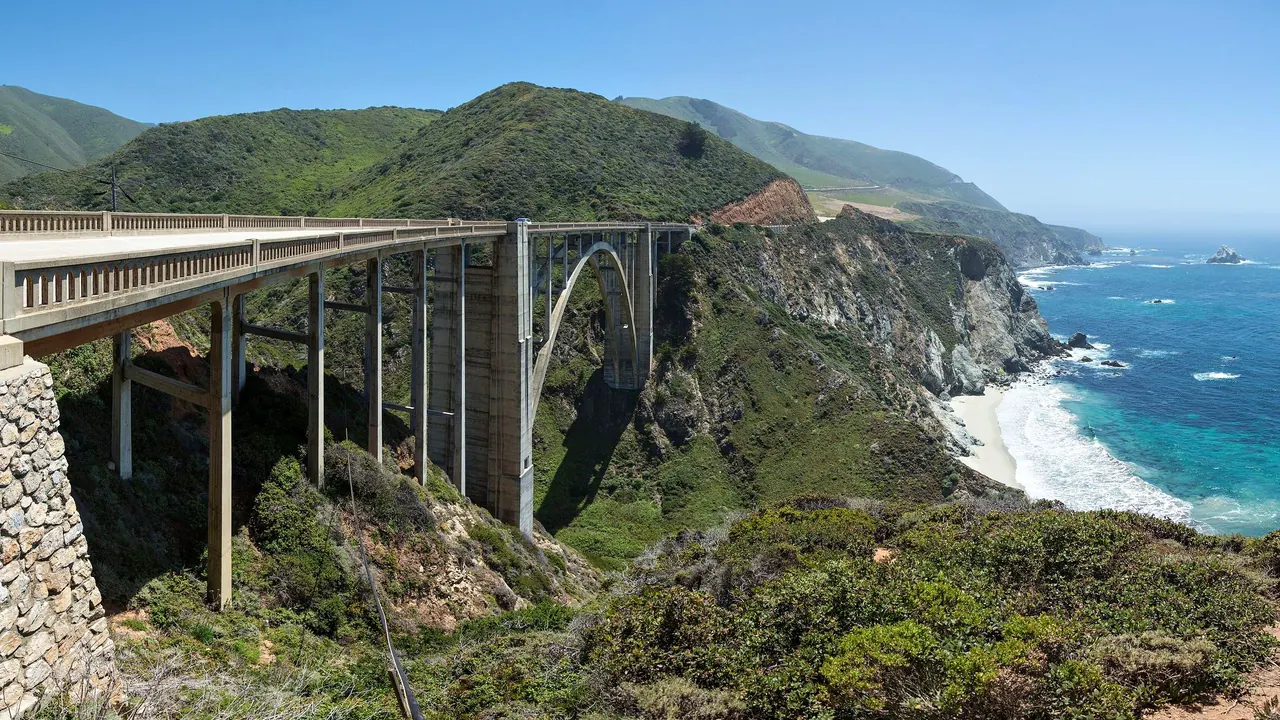
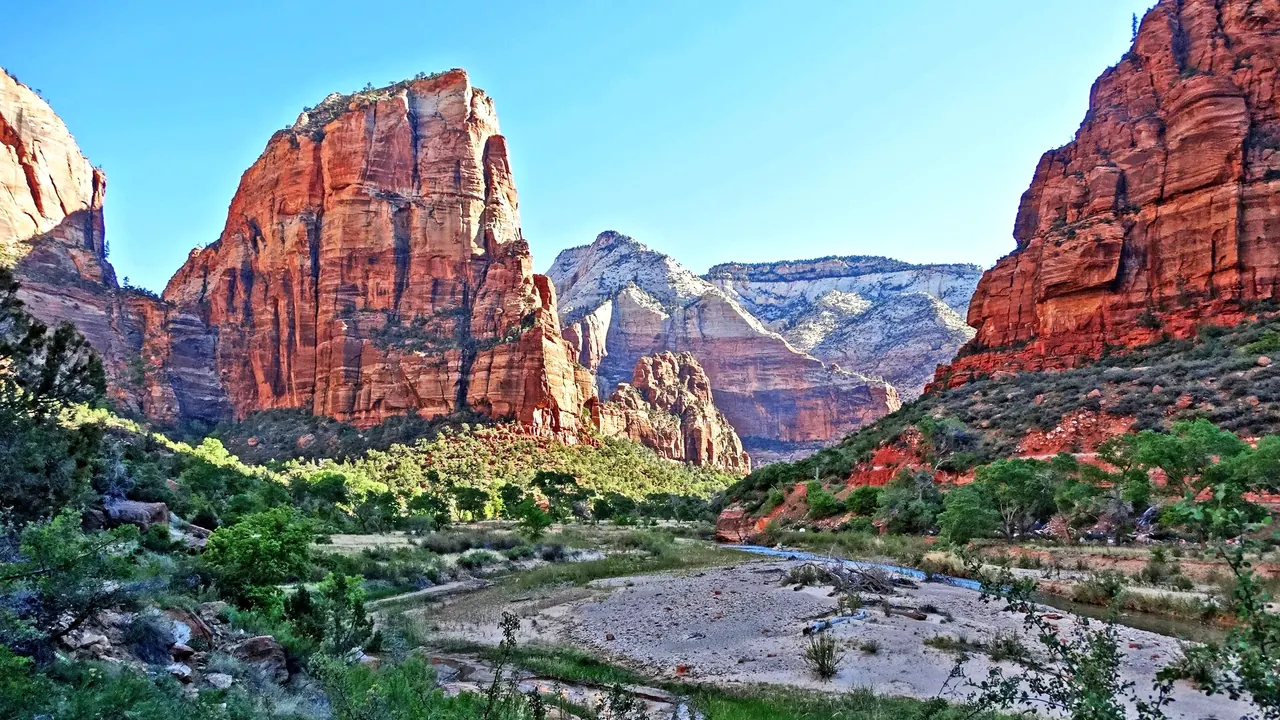
Photos: Big Sur by Diliff, CC BY-SA 3.0, cropped; Zion by inkknife_2000 (7.5 million views +), CC BY-SA 2.0, cropped.
Big Sur or Zion?
Our verdict in twelve categories, each scored against the same fixed benchmark cities, and the climate month by month, so you can choose for your trip.
Choose Big Sur for
- wellness
- day trips
Big Sur is the better choice for a slow, restorative stay on a spectacular coast, for travellers who will pay well for a cliff-top room, a spa with an ocean view and nights of real quiet. It suits couples more than families. It also has Carmel, Monterey and Hearst Castle at either end for days when you want a town, a mission or a mansion rather than another viewpoint.
Choose Zion for
- getting around
- prices
- families
Zion works better for an active trip on a sensible budget, and it is much easier with children. The free shuttles take the strain out of the main canyon, the hiking costs nothing once you are inside, and cheaper beds in Hurricane and St. George are close by. Summer evenings add something Big Sur lacks, with open-air musicals and Shakespeare within reach.
Scoreboard
Twelve categories on one fixed scale from 0 to 100. The shaded stretch is the gap between the two.
Your match
Pick a travel style or drag the sliders, and both match scores follow your weighting.
Wins on wellness and day trips with your weighting.
Wins on getting around and prices with your weighting.
What matters to you?
Category by category
What the scores mean for a trip.
Beaches & swimming
Neither is a swimming destination, but they disappoint in different ways. Big Sur has real coastline, with Pfeiffer Beach's purple sand and rock arch and the coves at Garrapata, but the Pacific is cold, heavy and full of rip currents, so the beaches are for walking and sitting.
Zion has no coast at all. Its swimming happens at the reservoirs around Hurricane, where Sand Hollow's red-sand shores have properly warm water through the summer months. If you want to get wet rather than look at the waves, the desert does better than the ocean here.
Food & drink
Food is a supporting act in both places, but the styles differ. Big Sur eats at lodges and cliff-edge dining rooms with Californian menus and Central Coast wine, expensive and spread far apart, so many people save the serious meals for Carmel or Monterey.
Zion is casual: burgers, pizza and Southwestern plates on Springdale's main road, early cafés for hikers, and a lot of self-catering from Hurricane supermarkets. Utah's liquor rules keep drinking modest too, so a long, wine-led lunch above the ocean is a Big Sur pleasure.
Culture & sights
Both have thin cultural offerings, and the landscape outshines the history in each. Big Sur's culture is about bohemian mood rather than buildings: Bixby Bridge, the Point Sur Lightstation and the Henry Miller Memorial Library, which recalls the coast's writers and Beat-era drifters.
Zion has a little more to visit. The Human History Museum covers the Southern Paiute and the Mormon settlers, and the 1930 tunnel has its galleries cut into the cliff. Outside the park there are the ghost town of Grafton and the pioneer temple and dinosaur tracks in St. George. Both fill a few hours at most.
Nightlife
After dark both places go quiet, and the night sky is the entertainment. In Big Sur a lodge bar or roadside tavern serves a drink with dinner, but the unlit, twisting highway puts most people off a second round. Springdale has a couple of brewpub patios and an early-to-bed hiking crowd, and anyone after a real night out has to drive to Monterey or Las Vegas.
Nature & outdoors
These are two of the great American landscapes, and the choice is mountains meeting the sea or a desert canyon. Big Sur's Santa Lucia range falls straight into the Pacific, with redwood canyons, waterfalls and wildlife you will remember: condors over the ridges, otters in the kelp, migrating whales and elephant seals at Piedras Blancas.
Zion is about sandstone walls and hikes known worldwide: wading the Narrows, the chained ridge of Angels Landing and canyoneering through slots, with Kolob Canyons and Bryce Canyon's hoodoos nearby for quieter ground. Big Sur suits scenic drives and short walks to viewpoints, while Zion suits days spent on the trail.
Day trips
Big Sur has much better outings beyond its own scenery. At the northern end are Carmel's galleries and mission, Monterey's Cannery Row and aquarium, and the Carmel Valley wineries. To the south are Hearst Castle and the village of Cambria. The catch is the slow coast road, so most people visit whichever end is closer.
From Zion, the trips worth making are mostly other parks. Towns such as St. George, Cedar City and Kanab, and the ranch fort at Pipe Spring, give a few hours of frontier history rather than a full day out.
Good for families
Zion is the more forgiving family choice. Free shuttles, a flat trail you can cycle, river paddling at the end of the Riverside Walk and ranger programmes give children plenty to do, and spring or autumn keep the heat manageable.
Big Sur works mainly for families who camp. The redwood campgrounds by the Big Sur River and the otters and elephant seals are real highlights, but cold, rough water, unfenced cliffs and car-sick hairpins make many parents base themselves in Monterey instead.
Getting around
Zion is far easier to get around. In the busy months free shuttles run along the scenic drive to each trailhead and link Springdale's hotels to the gate, so you can leave the car parked for days. Elsewhere the roads are good and the distances short.
Big Sur depends entirely on Highway 1, a narrow road of hairpins and summer traffic with few petrol stations and patchy signal. When landslides cut it after wet winters, a short trip can turn into a long inland detour.
Shopping & style
Shopping is an afterthought in both places. Big Sur offers roadside craft shops, a couple of galleries and general stores, with Carmel the place to browse properly. Zion's shops are more useful: Springdale's outfitters rent dry suits and canyoneering gear for the Narrows alongside Native American jewellery and pottery, and St. George adds ordinary malls and outlets.
Affordability
Big Sur is the far more expensive stay. Rooms are scarce, even plain cabins cost luxury prices, and everything trucked in along the single road carries a premium. Camping is the main way to save, and sites book up months ahead.
Zion's gateway lodges are pricey in season too, but once you are there the main activities cost little: a park pass covering several days, free shuttles and hikes that cost nothing. Sleeping in Hurricane or St. George and visiting in winter cut costs much further.
Live music & performing arts
Zion offers much more for an evening out in summer. The Tuacahn amphitheatre stages Broadway musicals beneath red cliffs near Ivins, and the Utah Shakespeare Festival in Cedar City runs a respected repertory season. Springdale adds concerts and films under the canyon walls.
Big Sur has readings, films and occasional concerts at the Henry Miller Memorial Library and some lodges, and little else. For serious programmes you have to drive up to Monterey's jazz festival or Carmel's Bach festival.
Wellness & relaxation
Big Sur is the stronger retreat. Esalen's spring-fed stone baths above the surf are central to its long history as a retreat coast, the cliff-top resorts run proper ocean-view spas, and the lack of a town or phone signal makes rest close to unavoidable. It is costly and has to be booked well ahead.
Zion's restful side lies just outside the park, at the destination spa resorts among the red rock around Ivins and the lodge spas in Springdale. Inside the park, crowds and demanding trails mean calm comes mainly at dawn and dusk.
When should you go?
Pick your month. The climate figures are measured averages, not a forecast.
Big Sur in July
Zion in July
Daytime high, °C
Rainfall in the month, mm
Where the figures come from
Big Sur's temperatures are measured 42 km from the centre, at Monterey / Pacific Grove Acres.
Big Sur has no rain gauge within 25 km of the centre, so its rainfall comes from a gridded climate dataset read at the destination rather than from a gauge further away.
Zion's temperatures are measured 26 km from the centre, at Colorado City / Centennial Park.
Zion's station stands 298 m above the place it is measured for, so that place is likely a little warmer than the figures say.
Zion has no rain gauge within 25 km of the centre, so its rainfall comes from a gridded climate dataset read at the destination rather than from a gauge further away.
Temperature and rainfall are climate normals, averaged over the years shown. Big Sur: 1991-2020 normals, Monterey / Pacific Grove Acres (41.9 km from centre). Zion: 2014-2025 (rainfall 1991-2020) normals, Colorado City / Centennial Park (25.5 km from centre).
The two climates barely overlap. On the Big Sur coast daytime highs stay mild all year, peaking around 23°C from August to October. Rain is the thing to watch: winters are very wet, with about 205mm in December, and that is when landslides close the road. From May to September it is almost dry, and the clear autumn is the best window. The Pacific stays near 13°C in every month, so even in high summer the sea is for looking at.
Zion is a land of extremes. July reaches about 36°C, which makes exposed trails punishing from June to August, and January highs fall to about 10°C, with quiet and sometimes snowy canyons. Rain is light all year, with a small rise in late summer when storms bring the risk of flash floods. April, May, September and October are the comfortable months for hiking. Big Sur is at its best from late spring through autumn, while Zion's best months sit on either side of its hot summer.
Which traveller are you?
On a relaxing and wellness trip, Big Sur is the clear pick. Esalen's hot-spring baths, ocean-view spa treatments and long, dark, quiet nights suit several unhurried days, while Zion's crowded trails and heat push you into early starts.
On a family trip with children, Zion is the easier base. Between hikes there are warm summer swims at the Sand Hollow reservoir, the visitor centre exhibits and the dinosaur tracks in St. George, whereas Big Sur has nothing built for children at all.
For a trip on a tight budget, Zion is far kinder. The main extras are a hire car and guided canyoneering, and a self-guided day in the Narrows can replace the guide. In Big Sur, state park parking fees mount up day after day, so thrifty travellers sleep in Monterey or San Simeon and drive in.
Before you go
| Measure | Big Sur | Zion |
|---|---|---|
| Currency | US Dollar (USD) | US Dollar (USD) |
| Sockets | AB120 V, 60 Hz | AB120 V, 60 Hz |
| Driving side | Right | Right |
| Time zone | UTC-8, UTC-7 in summer | UTC-7, UTC-6 in summer |
| Emergency number | 911 | 911 |
| Main airport | Monterey Regional Airport (MRY)11 non-stop destinations | Harry Reid International Airport (LAS)160 non-stop destinations |
| Public holidays this year | 13 days | 12 days |
By the numbers
| Measure | Big Sur | Zion |
|---|---|---|
| Swim season, months above 21 °C | None | - |
Where else could you go?
Every comparison below shares a destination with this one, so you can follow Big Sur or Zion somewhere new.
- Carmel-by-the-Seavs Big Sur
- Montereyvs Big Sur
- Bryce Canyonvs Zion
- Grand Canyonvs Zion
- Napa Valleyvs Big Sur
- Yosemitevs Big Sur