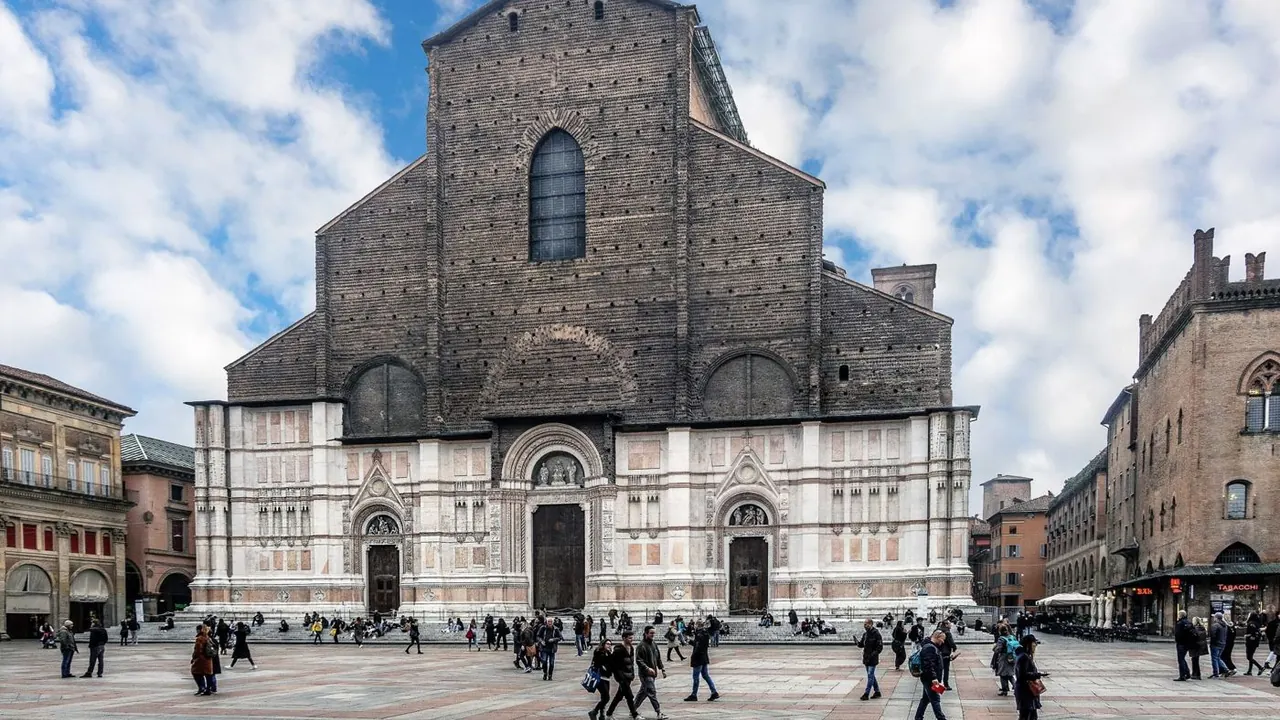
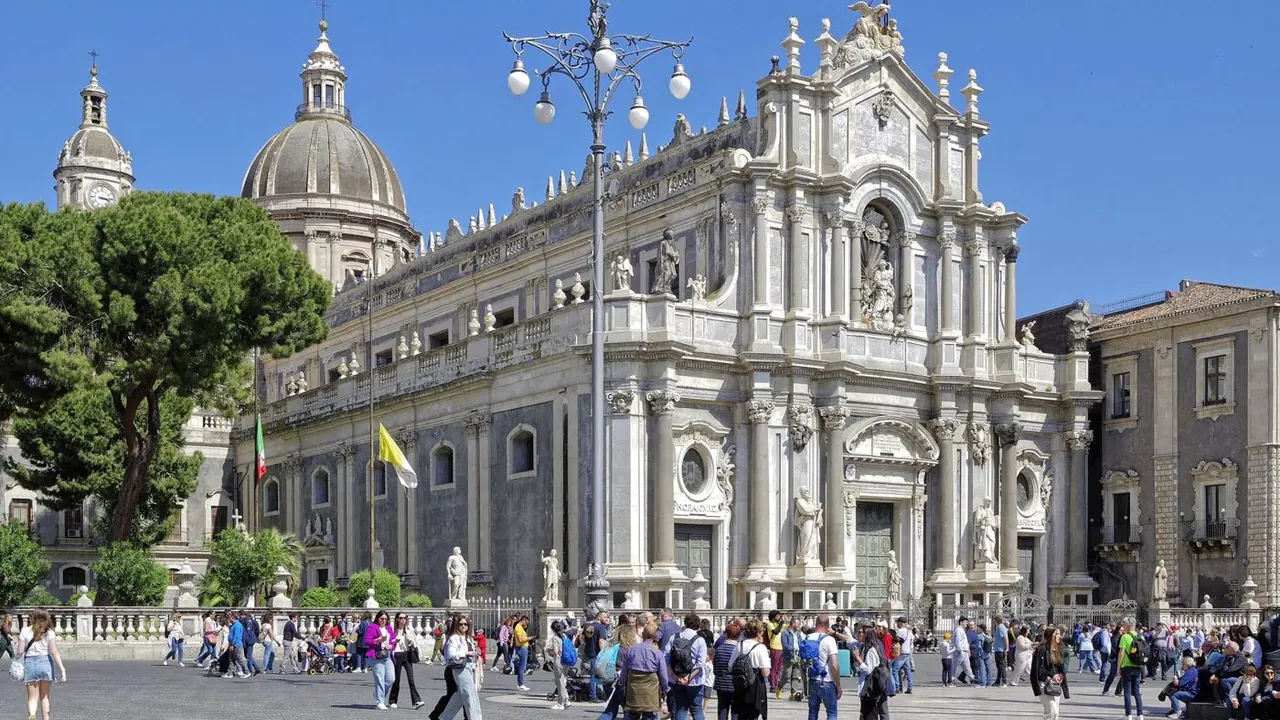
Photos: Bologna by Vanni Lazzari, CC BY-SA 4.0, cropped; Catania by Berthold Werner, CC BY-SA 4.0, cropped.
Bologna or Catania?
Our verdict in twelve categories, each scored against the same fixed benchmark cities, and the climate month by month, so you can choose for your trip.
Choose Bologna for
- getting around
- culture and sights
- shopping
Bologna suits a traveller who wants to eat seriously, walk a compact medieval city under its porticoes and spend part of the trip on trains to Florence, Ravenna, Parma or Venice. You don't need a car to manage it. It rewards an interest in art, history and Emilian cooking far more than a wish for sun and sea.
Choose Catania for
- beaches
- nature and the outdoors
- prices
Choose Catania if the vacation should mix a city with the sea and a live volcano. You can swim off the lava rocks of the Riviera dei Ciclopi, spend a day among Etna's craters and eat street food around the Pescheria. That makes it the warmer, wilder and somewhat cheaper trip, though you'll want a hire car and some patience with the traffic.
Scoreboard
Twelve categories on one fixed scale from 0 to 100. The shaded stretch is the gap between the two.
Your match
Pick a travel style or drag the sliders, and both match scores follow your weighting.
Too close to call, level with your weighting
Wins on getting around and culture and sights with your weighting.
Wins on beaches and nature and the outdoors with your weighting.
What matters to you?
Category by category
What the scores mean for a trip.
Beaches & swimming
There is no real contest. Bologna is inland, and a swim means an hour's train to Rimini or Cervia. There the Adriatic is warm and shallow, but it is lined with rows of rented umbrellas and the water is often greenish.
Catania has the sea on its doorstep in two forms. The long sandy beach of La Playa is the easy option, and on the black lava coast at Aci Castello and Aci Trezza you climb down ladders into clear water beside the sea stacks. Neither is Sicily's prettiest shore, but together they make swimming a daily part of the trip from June into October.
Food & drink
Both are serious food cities, but they eat in different ways. Bologna is the home of sit-down Emilian cooking: hand-rolled tagliatelle al ragù, tortellini in brodo and mortadella in old osterie, with Parmigiano and balsamic vinegar made nearby. For a trip built around long lunches it has the deeper tradition, though there is little beyond Emilian food and it feels heavy in the heat.
Catania eats standing up and outdoors. There are arancini and crispelle from the tavola calda counters, granita with brioche for breakfast and horse meat grilled over smoke on Via Plebiscito. The Pescheria is a far louder market than the Quadrilatero, and Etna's volcanic wines give the table its own character.
Culture & sights
Bologna gives you more to see and more depth. Its medieval centre of brick towers and nearly 40km of porticoes is remarkably intact. Around Piazza Maggiore, San Petronio and Santo Stefano you'll also find the anatomical theatre in the Archiginnasio and a fine collection of Bolognese painting in the Pinacoteca.
Catania's appeal is the late-baroque city rebuilt in black lava and pale limestone after the earthquake of 1693. It shows best in Piazza del Duomo, along Via dei Crociferi and in the vast San Nicolò monastery, with Roman remains below the streets. Its museums are slighter, though the Feast of Sant'Agata in February is a spectacle Bologna cannot match.
Nightlife
Both are university cities where nights out are young, cheap and informal. Bologna's evenings revolve around bars and taverns: crowds standing outside on Piazza Verdi, the long run of pubs on Via del Pratello, and wine bars after aperitivo. It falls almost silent in August.
Catania stays out later. In summer the action shifts to the beach clubs of La Playa, which become open-air dance floors, so it is at its liveliest just when Bologna empties. In winter it settles into weekend bar-hopping around Piazza Bellini.
Nature & outdoors
Etna gives Catania a landscape Bologna has nothing to match. The volcano rises to about 3,300m, often smoking, less than an hour away. Its slopes have crater trails, lava fields and beech woods. Further north you can wade through the Alcantara Gorge, and you can kayak among the basalt stacks off the coast.
Bologna's outdoors are milder. The Colli Bolognesi and the arcaded climb to San Luca make easy walks from the centre, and the higher Apennines lie about an hour and a half south. North of town there is only flat farmland.
Day trips
Northern Italy's main rail lines meet at Bologna, so more is within easy reach without a car. Florence is about half an hour away by fast train. Ravenna, Ferrara, Modena and Parma are short hops, and even Venice and Verona work as day trips.
Catania is a fine base for eastern Sicily, with places of real quality in reach: Ortigia and the Greek theatre at Siracusa, Taormina above the sea, the baroque towns of Noto, Modica and Ragusa, and the mosaics at Piazza Armerina. Getting there is the difference. Buses reach the main towns, but you really need a hire car for the baroque circuit.
Good for families
Neither city is built around children, and both need outings to fill the days. Bologna is the easier city to walk with a pushchair: it is flat, largely closed to cars and shaded by the porticoes. Its sights are aimed at adults, though, and Mirabilandia or the beach mean a full day away.
Catania's streets are harder work, with traffic, narrow pavements and little shade. On the other hand, the gently shelving sand of La Playa and the Etnaland water park are close by, and walking on old craters is a real adventure for older children.
Getting around
Bologna is much easier to move around. The centre is compact, flat and mostly closed to cars, the arcades keep walkers out of sun and rain, and the main station is at the edge of the old town.
Catania's core along Via Etnea and around the cathedral is walkable too, but beyond it things get tiring. There is a single metro line, buses crawl through heavy traffic and drivers often don't stop for pedestrians. Many visitors hire a car for Etna and the baroque towns, then struggle to park it in the centre.
Shopping & style
Food is the main thing to take home from both, but Bologna has the broader shopping. Beyond the mortadella and Parmigiano of the Quadrilatero, it has a small luxury cluster on Via Farini and in the Galleria Cavour, an antiques market in Piazza Santo Stefano, and bookshops and vintage stores around the university.
Catania has the chain stores of Via Etnea and little in the way of fashion or design. Its markets are livelier, though, with La Fiera selling everything daily. Bronte pistachio cream, Etna wine and Caltagirone ceramics are the things to pack.
Affordability
Catania is the easier of the two on the budget, though neither is a bargain. Bologna eats well for its price, with aperitivo food and trattoria meals cheaper than in Italy's main tourist cities. Its hotels, however, are priced like the rest of prosperous northern Italy and become scarce during the big trade fairs.
In Catania, street food makes a full meal for little money, guesthouses in the old centre are reasonable outside July and August, and buses and the metro are cheap. Guided trips to the summit, beach-club sunbeds and a hire car are the costs that add up.
Live music & performing arts
Each has a historic opera house worth an evening: Bologna's Teatro Comunale, and the Teatro Massimo Bellini in Catania, the composer's birthplace. Beyond that they differ in kind. Bologna, a UNESCO City of Music, adds basement jazz clubs most nights, student gigs, and summer concerts and films in Piazza Maggiore.
Catania's distinctive art is the opera dei pupi, Sicilian puppet theatre with marionettes of knights and Saracens. In summer, concerts move into courtyards and the region's ancient theatres. Outside the opera season, it has less live music to fill the evenings.
Wellness & relaxation
Neither is a place to come for rest, but Bologna is the calmer of the two. Its pace is unhurried for a city, and thermal pools are close by at Castel San Pietro Terme, about twenty minutes away, and at Porretta Terme in its green Apennine valley.
Catania is noisier, with constant traffic and no bathing tradition, so spa time means a hotel or resort on the coast or on Etna's lower slopes. A granita breakfast and the evening passeggiata slow the day down, and the villages on the volcano are quieter places to stay.
When should you go?
Pick your month. The climate figures are measured averages, not a forecast.
Bologna in July
Catania in July
Daytime high, °C
Rainfall in the month, mm
Where the figures come from
Bologna has no rain gauge within 25 km of the centre, so its rainfall comes from a gridded climate dataset read at the city rather than from a gauge further away.
Bologna's sunshine is measured 82 km from the centre, at Cervia.
Catania's sunshine is measured 88 km from the centre, at Messina.
Temperature and rainfall are climate normals, averaged over the years shown. Bologna: 1991-2020 normals, Bologna / Borgo Panigale (5.5 km from centre). Catania: 1991-2020 normals, Catania / Fontanarossa (5.2 km from centre).
Bologna is at its best in spring and autumn. May and late September are ideal for walking the porticoes. July and August reach around 32°C with heavy, humid air, and in winter highs near 7°C make January grey and chilly. The wettest stretch runs from September to November, although the arcades take the edge off the rain.
Catania is warmer all year. Winter days of around 17°C make it a reasonable choice for sightseeing from December to March, though November and December bring the most rain. Summer is almost dry and very sunny. August highs of around 32°C make walking the streets at midday hard going. The sea is warm enough for swimming from June, reaches 26°C in August and stays pleasant into October. That makes early June and late September to October the best times to combine the beach with sightseeing.
Which traveller are you?
On a beach and sun trip, Catania is the obvious choice. The sand at La Playa and the clear water off the lava platforms at Aci Trezza are close to town. From Bologna, the sea means an hour's train to the crowded lidos of Rimini.
For an outdoors trip, Catania wins again. Etna offers crater walks, trails over lava flows and winter skiing within an hour, and there is snorkelling along the lava coast. Bologna offers gentler hill paths to San Luca and the start of the Via degli Dei.
For a short city break, Bologna is the better fit. Its flat centre, largely closed to traffic, puts the Two Towers, Santo Stefano and the food shops of the Quadrilatero within an easy walk. In Catania, traffic and slow buses eat into a brief stay.
Before you go
| Measure | Bologna | Catania |
|---|---|---|
| Official language | Italian | Italian |
| Currency | Euro (EUR) | Euro (EUR) |
| Sockets | CFL230 V, 50 Hz | CFL230 V, 50 Hz |
| Driving side | Right | Right |
| Time zone | UTC+1, UTC+2 in summer | UTC+1, UTC+2 in summer |
| Emergency number | 112 | 112 |
| Elevation | 54 m | 7 m |
| Main airport | Bologna Guglielmo Marconi Airport (BLQ)6 km from centre98 non-stop destinations | Catania-Fontanarossa Airport (CTA)4 km from centre96 non-stop destinations |
| Public holidays this year | 13 days | 13 days |
By the numbers
| Measure | Bologna | Catania |
|---|---|---|
| City population | 387,971 | 311,584 |
| People per km² | 2,754 | 1,704 |
| Museums within 10 km | 68 | 25 |
| UNESCO World Heritage sites within 50 km | 3 | 3 |
| Swim season, months above 21 °C | - | 5 months |
Where else could you go?
Every comparison below shares a destination with this one, so you can follow Bologna or Catania somewhere new.