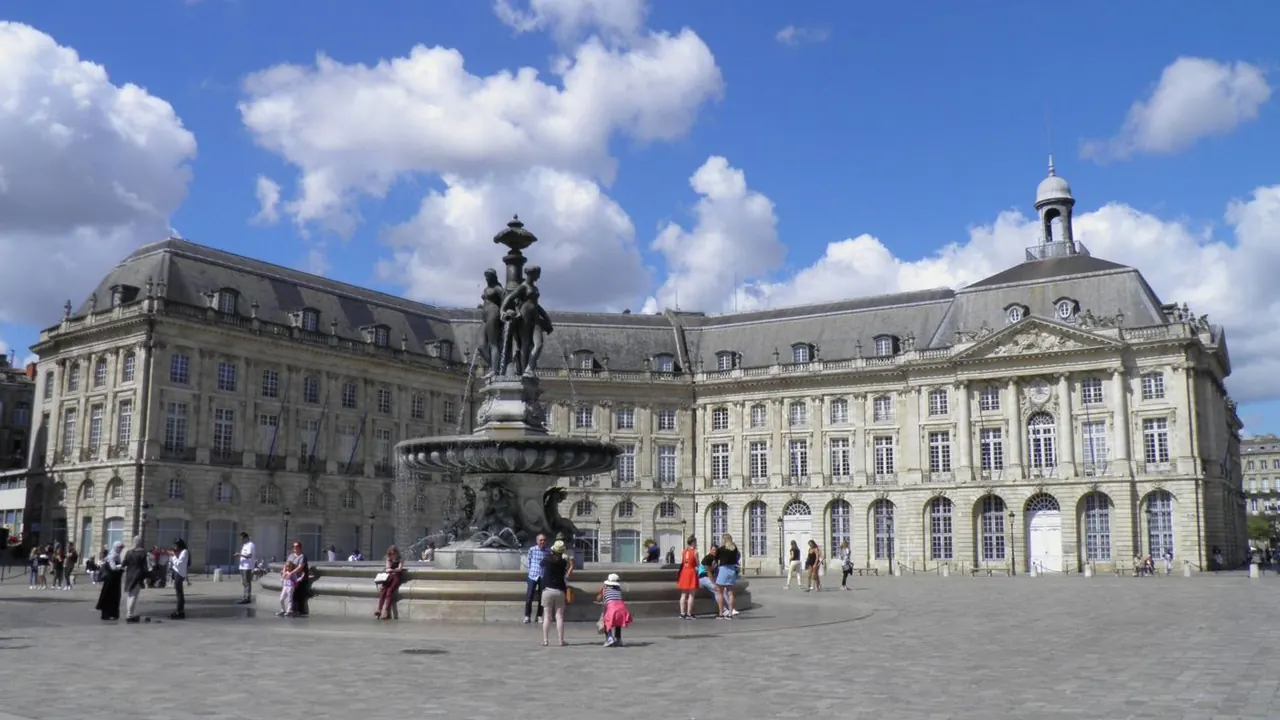
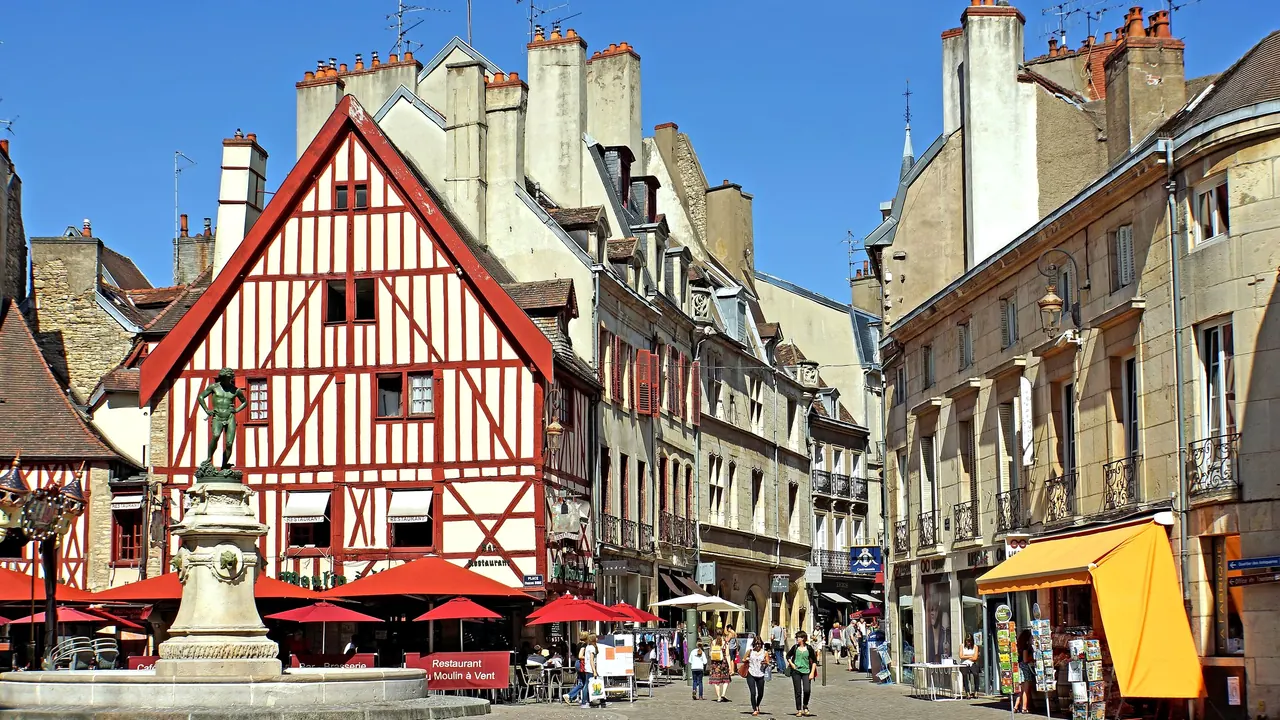
Photos: Bordeaux by Gzen92, CC BY-SA 4.0, cropped; Dijon by Dennis G. Jarvis, CC BY-SA 2.0, cropped.
Bordeaux or Dijon?
Our verdict in twelve categories, each scored against the same fixed benchmark cities, and the climate month by month, so you can choose for your trip.
Choose Bordeaux for
- beaches
- nightlife
- families
Bordeaux is the broader choice. It is a grand riverside city with the Atlantic about an hour away, a richer table, more to do after dark and more to keep children busy. It suits a week that mixes walks through its classical streets with oysters at Arcachon and a day at a surf beach or the Dune du Pilat.
Choose Dijon for
- prices
Pick Dijon for a smaller, cheaper and quieter base in the heart of Burgundy. You can cross its medieval ducal centre on foot in minutes, the Côte de Nuits begins at the edge of town and the evenings end early. That makes it a good fit for couples who want wine villages, regional cooking and slow afternoons rather than beaches or late nights.
Scoreboard
Twelve categories on one fixed scale from 0 to 100. The shaded stretch is the gap between the two.
Your match
Pick a travel style or drag the sliders, and both match scores follow your weighting.
Wins on beaches and nightlife with your weighting.
Wins on prices with your weighting.
What matters to you?
Category by category
What the scores mean for a trip.
Beaches & swimming
Neither city has a beach in town, but Bordeaux has the Atlantic about an hour away. You can choose between the long surf beaches at Lacanau and along the Médoc, or the sheltered basin at Arcachon and the sand below the Dune du Pilat. Both make good days out in July and August.
Dijon is several hours from any coast. Lac Kir, a reservoir with a bathing area that is supervised in summer, is fine for a hot afternoon, but anyone who wants to swim in the sea should choose Bordeaux.
Food & drink
Both are serious wine cities with classic French cooking, but Bordeaux offers more range over a stay. Its food runs from Arcachon oysters and lamprey to Landes duck. Its wine bars pour Médoc, Saint-Émilion and Sauternes side by side, and its brasseries and modern bistros are spread across several quarters.
Dijon is narrower and more traditional, with boeuf bourguignon, snails, jambon persillé, mustard and cassis, all centred on the iron hall of Les Halles. Its particular pleasure is village Burgundies by the glass, poured a short drive from the slopes they come from.
Culture & sights
The two are close here, but the kind of sightseeing differs. In Bordeaux the main sight is the whole 18th-century city curving along the Garonne, a classical ensemble best taken slowly from the Place de la Bourse to Saint-Michel. Its museums are solid rather than famous.
Dijon is older and more intimate. It was a medieval ducal capital, and its centre is all half-timbered houses, gargoyles on Notre-Dame and the carved Valois tombs inside the Palace of the Dukes. Bordeaux takes a day or so longer to see properly.
Nightlife
Bordeaux has more nights in it. The evening can start on the terraces of Saint-Pierre, in the cheap student bars of Place de la Victoire or on boats along the Garonne, and finish on a proper club strip on the Quai de Paludate that runs until morning.
In Dijon, going out means the small bars and pubs of Rue Berbisey and the terraces near Place Émile Zola. It is livelier than its size suggests in term time, but there are few clubs, and outside term the streets are quiet by around midnight.
Nature & outdoors
Bordeaux's best landscapes are on the coast. There is the Dune du Pilat, the tidal flats and bird island of the Arcachon basin, and a real surfing shore along the Médoc, and flat greenways lead from the city all the way to the ocean.
Dijon has better walking on its doorstep, with trails and climbing cliffs in the wooded combes west of town and wilder hills in the Morvan. It has nothing to match the dune or the open Atlantic, though, so Bordeaux gives the more varied days outdoors.
Day trips
Both cities make excellent bases for wine country, and they differ in what lies around them. Bordeaux's trips spread wide: Saint-Émilion by train, the château country of the Médoc, Sauternes, and the seaside villas of Arcachon, with Cognac and Biarritz at the edge of a day.
Dijon's trips are closer together and more rural. The Route des Grands Crus leads to Beaune, about twenty minutes away by train, and further out are the Cistercian abbey of Fontenay, Semur-en-Auxois and Vézelay. Bordeaux pairs wine with the sea, Dijon pairs it with abbeys and medieval hill towns.
Good for families
Bordeaux gives children more to do. The Miroir d'eau turns into a giant paddling pool on hot days, Cap Sciences runs hands-on exhibitions, and the coast adds the climb up the Dune du Pilat and the calm Arcachon beaches.
Dijon is safe, small and relaxed, with a planetarium at the Jardin de l'Arquebuse and paddling at Lac Kir. Beyond that there is little made for children, and they will tire of its tastings and fine-art museums sooner.
Getting around
You won't need a car in either city, since both have flat, walkable centres and trams. The difference is scale. Bordeaux's sights stretch along a few kilometres of riverbank, so you will use the trams and bike lanes, while in Dijon the station, market and palace are minutes apart on foot.
For wine country, Dijon has the regional line to Beaune and Bordeaux has trains to Saint-Émilion. Elsewhere, both need a car, a bike or a tour. Dijon is also well under two hours from Paris by TGV.
Shopping & style
Bordeaux has much more choice. The kilometre-long Rue Sainte-Catherine carries the chains, the Triangle d'Or has the luxury labels and Rue Notre-Dame in Chartrons has antique dealers. Its wine cellars, which ship abroad, are worth a visit in their own right.
Dijon's shopping is mostly things to eat and drink: mustard, pain d'épices, cassis and Burgundy wine, with Les Halles the place for cheese. Rue de la Liberté covers the basics, but fashion shoppers will find little.
Affordability
Dijon is easier on the wallet. Hotel rooms are moderately priced, wine by the glass is cheap for France, and the compact centre means you spend almost nothing on getting around.
Bordeaux costs more, and central rooms climb further in summer and during the big wine events. In both cities, set lunch menus are the sensible way to eat well, and tastings, tours and good bottles are where the money goes.
Live music & performing arts
Bordeaux has the grander stage. The gilded Grand Théâtre of 1780 is home to the city's opera and ballet, and the national orchestra, a jazz and world-music hall and an arena for touring acts round out the scene.
Dijon has a solid season for its size. Its opera company performs both in its own Grand Théâtre and in an Auditorium known for its acoustics, and there is a national drama centre. In both cities, the seasons pause in summer.
Wellness & relaxation
Neither city has thermal baths or a bathing culture, but Bordeaux offers more. Spa hotels among the vineyards just outside the city offer vinotherapy and make a proper retreat for a day or two, and the thermal waters of Dax are about an hour and a half away.
In Dijon, spa options come down to a few hotels, some offering grape-based treatments. Its calm comes from the provincial pace instead, with quiet squares and slow afternoons in the vineyards.
When should you go?
Pick your month. The climate figures are measured averages, not a forecast.
Bordeaux in July
Dijon in July
Daytime high, °C
Rainfall in the month, mm
Temperature and rainfall are climate normals, averaged over the years shown. Bordeaux: 1991-2020 normals, Bordeaux / Merignac (9.5 km from centre). Dijon: 1991-2020 normals, Dijon (7 km from centre).
Bordeaux has the milder year. Summers are warm in both cities, reaching about 28°C in Bordeaux in August, and July and August are the months for swimming on the Atlantic coast. Spring and early autumn are the best times for walking around Bordeaux, and it stays pleasant well into October. Its weak point is winter rain: November is the wettest month, at 114mm, and the grey days run on through December.
Dijon has a more continental climate. Winters are colder and darker, with highs near 6°C in December and January and little sunshine, although less rain falls than in Bordeaux. Its season runs from May to September, with warm, sunny days for cycling through the vineyards. June and September are the most comfortable months for exploring on foot, since May and October bring more rain.
Which traveller are you?
On a beach and sun trip, Bordeaux is the only real option of the two. The surf beaches at Lacanau are about an hour away and the calm water of the Arcachon basin suits children, while Dijon's nearest swim is the reservoir at Lac Kir.
For a food and nightlife trip, Bordeaux has the edge: oysters at the Capucins, entrecôte grilled over vine cuttings, wine bars around Saint-Pierre and Chartrons, then clubs on the Quai de Paludate until morning. Dijon cooks superbly, but its evenings mostly end by midnight.
On a trip on a tight budget, Dijon stretches further. A frugal week there means picnics from Les Halles, the signed cycle route to Beaune instead of a paid tour, and the regional train along the wine route. In Bordeaux, the Médoc châteaux usually need a car or a guided tour.
Before you go
| Measure | Bordeaux | Dijon |
|---|---|---|
| Official language | French | French |
| Currency | Euro (EUR) | Euro (EUR) |
| Sockets | CE230 V, 50 Hz | CE230 V, 50 Hz |
| Driving side | Right | Right |
| Time zone | UTC+1, UTC+2 in summer | UTC+1, UTC+2 in summer |
| Emergency number | 112 | 112 |
| Elevation | 1 m | 220 m |
| Main airport | Bordeaux–Mérignac Airport (BOD)11 km from centre95 non-stop destinations | Lyon Saint-Exupéry Airport (LYS)178 km from centre141 non-stop destinations |
| Public holidays this year | 11 days | 11 days |
By the numbers
| Measure | Bordeaux | Dijon |
|---|---|---|
| City population | 267,991 | 161,830 |
| People per km² | 5,425 | 3,890 |
| Museums within 10 km | 18 | 8 |
| UNESCO World Heritage sites within 50 km | 4 | 1 |
Where else could you go?
Every comparison below shares a destination with this one, so you can follow Bordeaux or Dijon somewhere new.