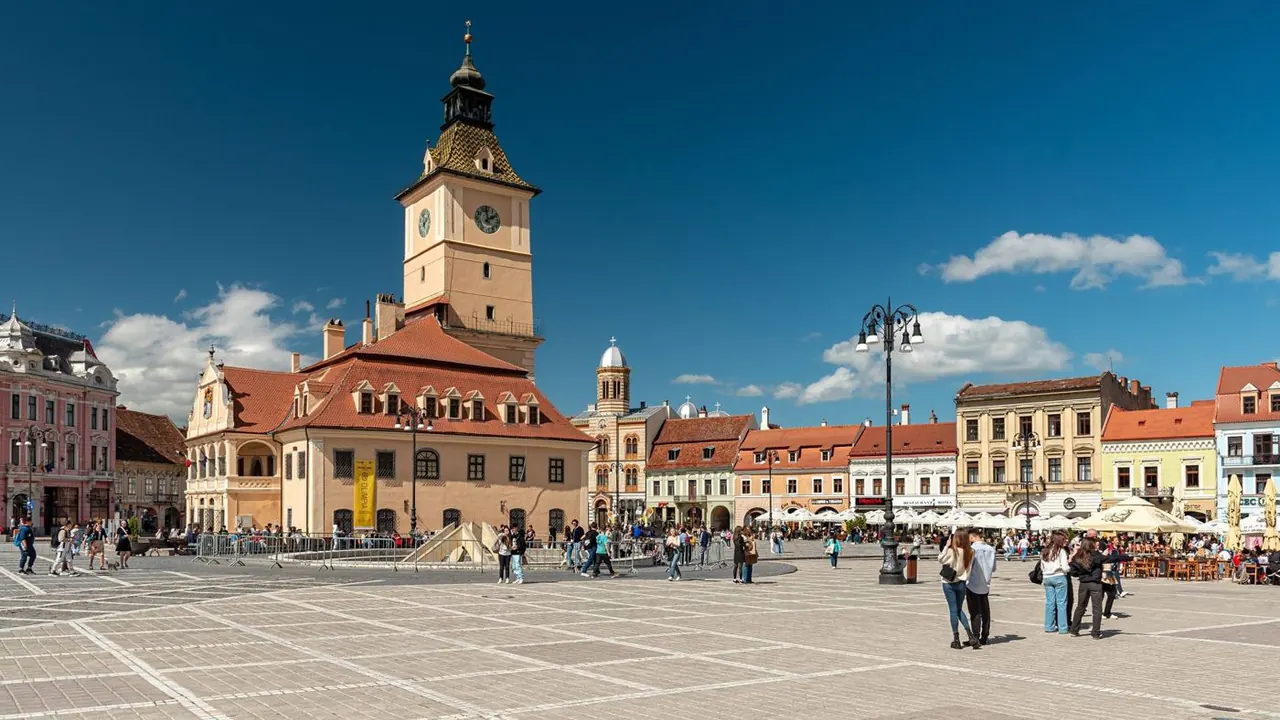
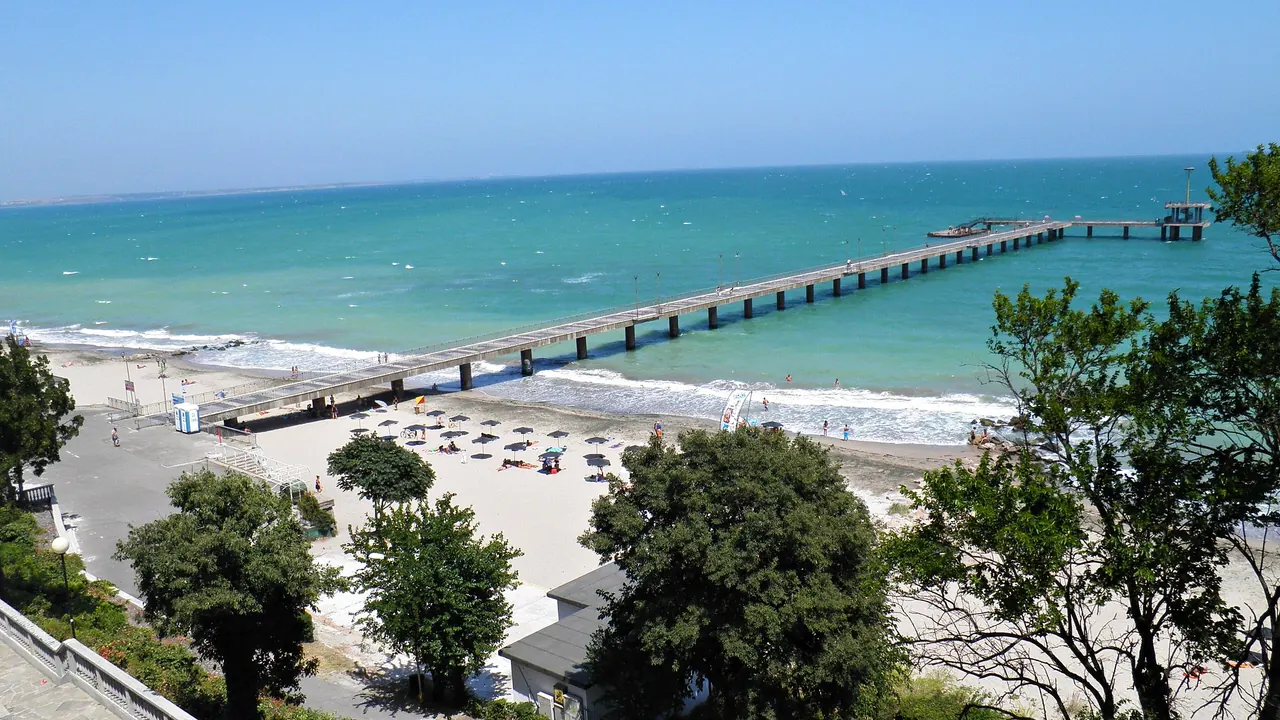
Photos: Brasov by Jorge Franganillo, CC BY 2.0, cropped; Burgas by Mister No, CC BY 3.0, cropped.
Brasov or Burgas?
Our verdict in twelve categories, each scored against the same fixed benchmark cities, and the climate month by month, so you can choose for your trip.
Choose Brasov for
- nature and the outdoors
- culture and sights
- day trips
Brasov suits travellers who want mountains and history in the same stay. Its walled Saxon old town, with the Black Church at its centre, sits right under forested Tampa hill. Bear watching, ski slopes and Carpathian ridges are close at hand, and a ring of castles and fortified churches runs from Bran to Sighisoara. It is a base for walking, skiing and day trips rather than for lying still, and it works in winter as well as summer.
Choose Burgas for
- beaches
- wellness
- food and drink
For a summer trip built around the sea, Burgas is the clear pick. A long beach lies a short walk from the centre, and the coast on either side runs from the small bays of Sozopol to the party strip of Sunny Beach. The salt lakes add mud cures, mineral springs and great flocks of migrating birds. Outside the warm months it gives a visitor far less to do than its Transylvanian counterpart.
Scoreboard
Twelve categories on one fixed scale from 0 to 100. The shaded stretch is the gap between the two.
Your match
Pick a travel style or drag the sliders, and both match scores follow your weighting.
Too close to call, 1 point apart
Wins on nature and the outdoors and culture and sights with your weighting.
Wins on beaches and wellness with your weighting.
What matters to you?
Category by category
What the scores mean for a trip.
Beaches & swimming
This is the widest gap between the two cities. Brasov lies in the Carpathians, several hours from the Black Sea, so swimming there means a hotel pool, the water park or a chilly mountain lake.
Burgas has a long beach of dark, iron-rich sand below the Sea Garden, a short walk from the centre, with calmer stretches at Sarafovo and Kraimorie when the port feels too close. Within an hour you can choose between the little bays of Sozopol and the broad sands of Sunny Beach and Nessebar.
Food & drink
Both cities serve honest, filling regional food without giving you a reason to travel for it. Brasov's cooking is Transylvanian and inland: sour soups, sarmale with polenta, smoked sausages, sheep's cheese and papanasi, eaten in cellar rooms beneath the old merchant houses around Council Square.
Burgas cooks with the sea in mind. Fried sprats, bluefish, turbot and mussels from the gulf, served at plain harbourside places, are the dishes to order, with wine from the Pomorie vineyards alongside. International cooking is thin in both cities, and the beach promenade in Burgas leans towards standard menus aimed at summer visitors.
Culture & sights
Brasov has the richer historic centre by some way. You can walk through its walled Saxon centre around Council Square and the great Gothic Black Church with its Anatolian carpets. The bastions and towers along Tampa hill still stand, and the Schei quarter keeps the first Romanian-language school. Together they make a coherent old town.
Burgas is a modern port. Its interest lies in the Sea Garden, a few small regional museums and two outlying sites: St Anastasia Island across the bay and the Roman and Ottoman baths of Aquae Calidae. Each city can be seen in a day or two, but you will fill those days more fully in Brasov.
Nightlife
Neither city stays up very late, and the main difference is the season. In Brasov the evenings happen in cellar bars, craft beer pubs and terraces around Council Square. Students fill them at weekends and skiers add some après-ski noise in winter, so the town ticks over all year.
Burgas is livelier in summer, when the beach bars along the Sea Garden fill up and a few clubs stay open into the small hours. Out of season it goes quiet. Its real advantage is Sunny Beach, forty minutes up the coast, for anyone who wants to dance until dawn.
Nature & outdoors
Brasov is the outdoor destination of the two. Forested Tampa hill rises from the old town, Poiana Brasov lies about 12km up the road for skiing and summer hiking, and the Bucegi and Piatra Craiului ranges, with plateaus above 2,000m, are within an hour. Guided bear watching in the Carpathian forests is something Burgas cannot match.
Burgas's nature is flat and coastal. Four lakes and lagoons lie on the Via Pontica migration route, where storks, pelicans and flamingos gather in late summer and autumn. That makes it excellent for birdwatchers, cyclists and kitesurfers, with the low wooded hills of Strandzha to the south, but there are no mountains to climb.
Day trips
Brasov has a remarkable range of excursions around it. Bran and Rasnov are within half an hour. The fortified Saxon churches lie at Prejmer, Harman and Viscri, Peles Castle is at Sinaia, and the walled citadel of Sighisoara is a full day out. The villages are much easier with a car or a tour.
The outings from Burgas run along the coast, mainly to UNESCO-listed Nessebar and the wooden old quarter of Sozopol, plus Pomorie's salt museum and Thracian tomb. Varna is within reach, but Plovdiv and the other great inland sites are too far, so the choice is narrower.
Good for families
Both cities suit children at an easy pace, but in different seasons. Brasov offers small adventures all year: the Tampa cable car, a forest rope park, a water park with indoor pools, the castles at Bran and Rasnov, a bear sanctuary near Zarnesti and sledging in winter. Its cobbles and steep lanes are hard going with a pushchair, though.
Burgas is a summer choice. It is built around warm, gently shelving water, soft sand and the shady playgrounds of the Sea Garden, and the flat centre is easy with a pushchair. Outside summer there is little to keep a family busy.
Getting around
Both centres are small and easy to walk, so the difference lies in the days out. Brasov's old town can be crossed in a quarter of an hour, and buses run up to Poiana Brasov while trains reach Sinaia and Sighisoara. The castles and trailheads depend on slow, infrequent rural buses.
Burgas is flat, easy to cycle along the seafront and has its airport close to town. Coast buses reach the resorts, but in high summer they fill up and the coast road gets congested.
Shopping & style
Neither city is worth choosing for its shopping. In Brasov, Republicii Street mixes chains with Dracula trinkets, painted eggs and embroidered blouses, but the best things to bring home are sheep's cheese, plum brandy and honey. Burgas has pedestrian streets and malls for everyday needs, and its best take-home buys are rose oil, rose cosmetics, Pomorie sea salt and local wine.
Affordability
The extra costs fall in different places. In Brasov they come from the restaurants on Council Square and lift passes at Poiana Brasov in peak winter. Guesthouses, trains and hearty meals stay cheap, and the Transylvanian countryside costs less again than the old town.
In Burgas the expensive weeks are July and August, when rooms on the coast fill up and cost more, so book ahead for those. Grilled fish, local wine and coast buses are inexpensive all year, and a modest budget goes a long way in either city.
Live music & performing arts
The two stage scenes are similar in size, and neither is a reason to travel on its own. In Brasov the evening most worth planning around is an organ recital under the Gothic vaults of the Black Church, which needs no Romanian at all. The philharmonic and the modest opera company, which keeps to familiar works and operetta, are just as easy for a visitor to follow, but plays at the drama theatre are performed in Romanian.
Burgas puts more of its music outdoors. In summer, festivals bring open-air stages to the Sea Garden and the sand, with orchestral evenings on some nights and big rock and pop crowds on others. Its State Opera adds ballet, which works for visitors who speak no Bulgarian, but spoken theatre is harder to follow. Inland in Strandzha, the nestinari still dance barefoot on embers as part of village custom, not as a show put on for visitors.
Wellness & relaxation
Brasov has no bathing tradition of its own. Unwinding there means hotel spas up at Poiana Brasov, the saunas at the water park and the slow pace of a small mountain town. Romania's mineral-spring towns are further out in the Carpathians.
Burgas is the better choice for a restorative stay. Hot springs at its northern edge have been used since Roman times, and the black, salty mud of the Atanasovsko and Pomorie lakes goes into sanatorium wraps or is simply smeared on at the shore and left to dry. For polished spa hotels, look to Pomorie and the larger resorts.
When should you go?
Pick your month. The climate figures are measured averages, not a forecast.
Brasov in July
Burgas in July
Daytime high, °C
Rainfall in the month, mm
Where the figures come from
Brasov has no rain gauge within 25 km of the centre, so its rainfall comes from a gridded climate dataset read at the city rather than from a gauge further away.
Burgas's sunshine is measured 86 km from the centre, at Varna.
Temperature and rainfall are climate normals, averaged over the years shown. Brasov: 2016-2025 (rainfall 1991-2020) normals, Brasov (3 km from centre). Burgas: 1991-2020 (rainfall 1981-2010) normals, Burgas (2.4 km from centre).
Brasov has a mountain-basin climate. Winters are cold and snowy, with January highs around 2°C, so that season belongs to the slopes at Poiana Brasov rather than to strolling the old town. From late spring to early autumn the weather is good for walking and hiking, though June and July are the wettest months, at about 81mm each. September and early October bring mild days and the beech slopes changing colour, which makes them perhaps the most pleasant time to visit.
Burgas is milder in winter and hotter in summer, with August highs near 29°C and long, sunny days through July and August. The sea decides the season. It is comfortable from late June to mid-September and warmest in August at about 25°C. The wettest weather comes in late autumn rather than early summer and peaks in November at around 72mm. In practice the two cities follow almost opposite calendars: Burgas is for high summer, while Brasov works through the shoulder seasons and in snow.
Which traveller are you?
On a beach and sun trip, Burgas wins outright. Its long beach of soft sand starts near the centre, the shallow water warms through summer, and the bays of Sozopol and Primorsko are close by. Brasov is several hours from any sea.
For an outdoors trip, Brasov is the stronger base. Tampa hill rises from the town walls, Poiana Brasov offers hiking, mountain biking and skiing, and the Bucegi and Piatra Craiului ranges are within an hour. Burgas has birdwatching lakes but no mountains.
On a relaxing and wellness trip, Burgas has the edge. Its mineral springs have been used since Roman times, local sanatoria use the black mud of its lakes, and the Sea Garden makes for long, slow evening walks. Brasov relies on hotel spas.
Before you go
| Measure | Brasov | Burgas |
|---|---|---|
| Official language | Romanian | Bulgarian |
| Currency | Romanian Leu (RON) | Euro (EUR) |
| Sockets | CF230 V, 50 Hz | CF230 V, 50 Hz |
| Driving side | Right | Right |
| Time zone | UTC+2, UTC+3 in summer | UTC+2, UTC+3 in summer |
| Emergency number | 112 | 112 |
| Elevation | 600 m | 30 m |
| Main airport | Brașov-Ghimbav International Airport (GHV)9 km from centre14 non-stop destinations | Burgas Airport (BOJ)8 km from centre69 non-stop destinations |
| Public holidays this year | 17 days | 15 days |
By the numbers
| Measure | Brasov | Burgas |
|---|---|---|
| City population | 237,589 | 189,086 |
| People per km² | 1,281 | 746 |
| Museums within 10 km | 8 | 7 |
| UNESCO World Heritage sites within 50 km | 1 | 1 |
| Swim season, months above 21 °C | - | 4 months |
Where else could you go?
Every comparison below shares a destination with this one, so you can follow Brasov or Burgas somewhere new.