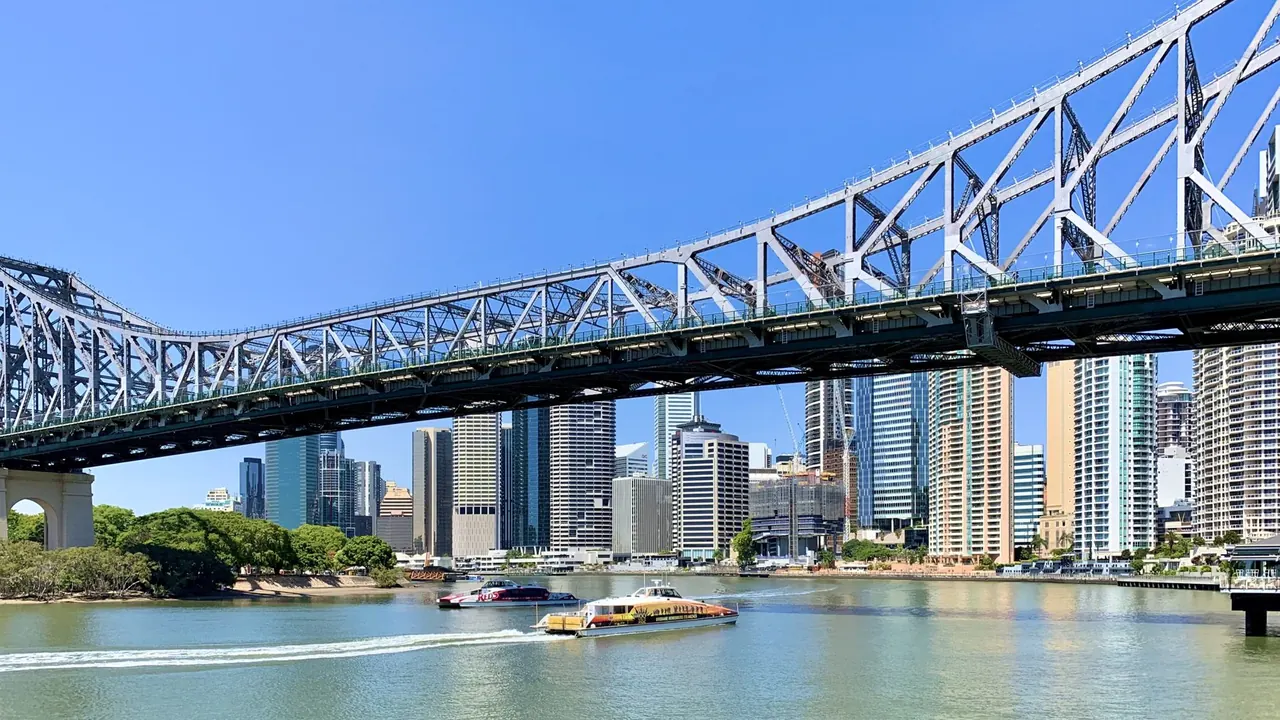
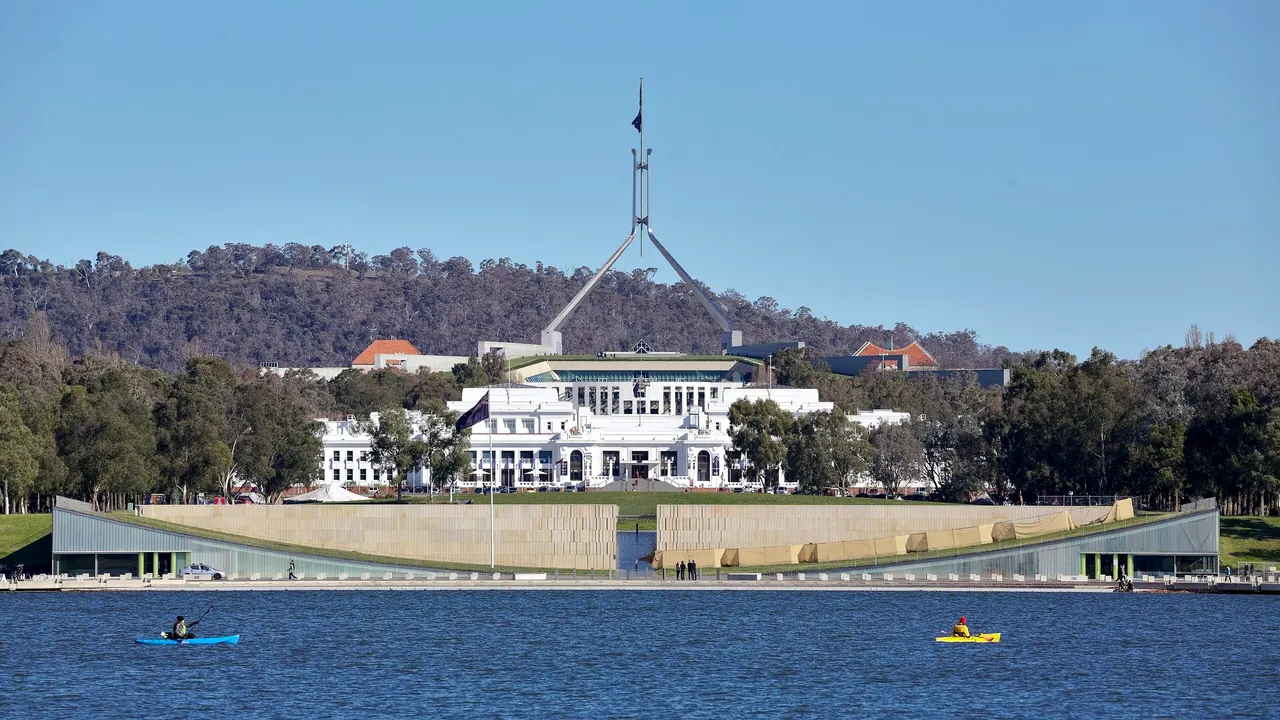
Photos: Brisbane by Kgbo, CC BY-SA 4.0, cropped; Canberra by Thennicke, CC BY-SA 4.0, cropped.
Brisbane or Canberra?
Our verdict in twelve categories, each scored against the same fixed benchmark cities, and the climate month by month, so you can choose for your trip.
Choose Brisbane for
- beaches
- nightlife
- getting around
Brisbane is the better pick for a warm, outdoor trip. River ferries carry you between the inner districts, surf beaches lie about an hour away on two coasts, and the World Heritage rainforest is within a day's reach. In the evenings Fortitude Valley gives you a proper night out. Families do especially well here, with the South Bank lagoon, koalas at Lone Pine and the Gold Coast theme parks all within range.
Choose Canberra for
- culture and sights
- prices
Choose Canberra if the point of the trip is the nation itself. Parliament House, the War Memorial, the National Gallery and the National Museum sit close together around the lake, most of them free, and the eucalypt hills and cool-climate wineries are a short drive away. It is a quiet city with no sea and early nights, so it suits a focused few days of museums and walking better than a long, lazy stay.
Scoreboard
Twelve categories on one fixed scale from 0 to 100. The shaded stretch is the gap between the two.
Your match
Pick a travel style or drag the sliders, and both match scores follow your weighting.
Wins on beaches and nightlife with your weighting.
Wins on culture and sights and prices with your weighting.
What matters to you?
Category by category
What the scores mean for a trip.
Beaches & swimming
Neither city has a beach of its own, but Brisbane comes far closer. The Gold Coast and Sunshine Coast surf beaches are about an hour away in each direction, North Stradbroke and Moreton islands are a ferry ride across the bay, and in town the South Bank lagoon lets you swim with sand underfoot.
Canberra's sea is two hours away over the mountains at Batemans Bay, which makes it a separate trip. Summer swimming there means river spots such as Casuarina Sands and Kambah Pool, which have no lifeguards and changing currents, and Lake Burley Griffin often closes because of algae.
Food & drink
Brisbane eats more widely. It has tropical produce, Moreton Bay bugs and prawns, and several distinct dining areas: James Street and Fortitude Valley for polished dining rooms, West End for cheap immigrant cooking, and the Newstead and Teneriffe warehouses for small breweries. Night food markets make for easy evenings.
Canberra's dining is pleasant but compact. It centres on brunch in Braddon, the older restaurant strips of Kingston and Manuka, and the Asian kitchens of Dickson. Its strong suit is wine: cool-climate shiraz-viognier and riesling from cellar doors around Murrumbateman, under forty minutes out, and Brisbane has nothing like it.
Culture & sights
Canberra is the stronger choice for sights, because the city exists to house the national institutions. Parliament House, the Australian War Memorial, the National Gallery, the Portrait Gallery, the National Library and the National Museum can fill several full days. Griffin's lake-centred plan is a sight in its own right from Mount Ainslie.
Brisbane's culture is concentrated in one place, the Cultural Centre at South Bank, where the Gallery of Modern Art and its Asia-Pacific collection are the high point. Add the sandstone colonial buildings, the Story Bridge and the timber Queenslanders of Paddington and New Farm, and two or three days covers it.
Nightlife
Brisbane has a real district for going out in Fortitude Valley, where pubs, rooftop bars and clubs fill up at weekends. West End adds neighbourhood pubs, and the CBD has riverside terraces. Venues still close earlier than in a bigger city, but the warm evenings keep people outdoors.
In Canberra an evening out usually means a drink after dinner in Braddon's Lonsdale Street or in Kingston, plus a few student venues near the bus interchange at weekends. Outside term time and parliamentary sitting weeks the city can feel very still.
Nature & outdoors
Both are green cities with bush close at hand, but Brisbane's surroundings have more variety. There is the World Heritage rainforest of Lamington and Springbrook, with its waterfalls and glow worms, and the volcanic Glass House Mountains. Moreton Bay adds dolphins, turtles, sand dunes and humpback whales passing in winter.
Canberra's nature is drier and more open. Eucalypt hills inside the city have kangaroos grazing at dusk, and about forty minutes away the granite summits of Namadgi rise above 1,800m, with Aboriginal rock-art sites and snow in winter. It is cooler walking country, but it has no sea and no rainforest.
Day trips
Brisbane's days out head for the coast and the hills: the Gold Coast, chic Noosa on its river mouth, and the gallery villages of Montville, Maleny and Tamborine Mountain. They are about beaches and scenery rather than history.
Canberra offers the opposite, a ring of small country towns with more heritage. These run from gold-rush Braidwood to Victorian Goulburn and the Southern Highlands villages, with wine days in the Yass Valley as well. They make agreeable drives, but none pulls visitors the way Brisbane's coastlines do.
Good for families
A day with children in Brisbane can start at the free South Bank lagoon, with its sandy edge, and carry on next door at the Queensland Museum's hands-on science centre. Then there are the koalas at Lone Pine and the river ferries, which children enjoy as a ride in themselves. The Gold Coast theme parks and Australia Zoo are each about an hour away. In summer, plan the days around the midday heat.
Canberra is quieter and less crowded, and Questacon, the national science centre, can take up most of a day. The National Zoo and Aquarium and the kangaroos and emus at Tidbinbilla fill out the rest. There is no beach and no theme park, though, and a car makes days with small children much easier.
Getting around
Brisbane's compact inner districts are joined by the river, and the CityCat ferries double as a sightseeing ride. Suburban trains reach the bay and the Gold Coast on the same fare system as the ferries and buses, though the hinterland still calls for a car.
Canberra was built for driving. Its institutions are spread along wide avenues around the lake, and the single light rail line runs only from the northern suburbs into Civic. Buses thin out in the evenings and at weekends. Cycling on the off-road lakeside paths is a pleasant alternative, but for the wineries and Namadgi you need a car.
Shopping & style
Neither city is worth the trip for its shops, but Brisbane gives a shopper more ground to cover. Its centre combines the big department stores with older arcades and a short stretch of designer names. Two further districts each have a character of their own: James Street for Australian fashion and homewares, and Paddington's ridge road for antiques and vintage. Between them they fill a varied afternoon of browsing, not just a single errand.
Canberra has much less choice. Most everyday shopping happens in one large mall in Civic, a few independent labels in Braddon are the main alternative, and there is no designer street at all. Its best buys are souvenirs rather than clothes: handmade pieces from the Sunday makers' market at the Old Bus Depot in Kingston, and the prints and objects sold in the national institutions' shops.
Affordability
Both cities charge full Australian prices for meals, drinks and taxis, so neither feels cheap. Where they differ is in how you save. Brisbane has cheap public transport, free galleries and a free lagoon, so you can manage well without a car.
Canberra's great national institutions are almost all free to enter, and hotel rooms often get cheaper at weekends once the official travellers go home. Against that, most visitors end up paying to hire a car.
Live music & performing arts
Brisbane has the fuller stage. The Queensland Performing Arts Centre is home to the state's symphony orchestra and its opera, ballet and theatre companies. The Powerhouse in New Farm adds comedy and cabaret, Fortitude Valley's venues carry on a long tradition of local bands, and the Brisbane Festival fills September.
Canberra has a symphony season and touring shows at the Canberra Theatre Centre, but many big tours leave it off their route. Its standout is the National Folk Festival at Easter, which is worth timing a visit around if you like traditional music.
Wellness & relaxation
Neither city has a bathing tradition, and in both the spas are mostly in hotels. Brisbane has the edge thanks to its heritage open-air pools, such as the Spring Hill Baths, and the spa lodges in the hinterland rainforest about an hour and a half away.
Canberra's restfulness comes simply from its quiet: calm mornings by the lake, plenty of green space and early evenings, but little to build a retreat around.
When should you go?
Pick your month. The climate figures are measured averages, not a forecast.
Brisbane in July
Canberra in July
Daytime high, °C
Rainfall in the month, mm
Temperature and rainfall are climate normals, averaged over the years shown. Brisbane: 1991-2020 normals, Brisbane (4.5 km from centre). Canberra: 1991-2020 normals, Canberra (6.7 km from centre).
Brisbane is warm all year. Winter highs of around 22°C make June to September the best time for walking the city and the hinterland, with plenty of sunshine and little rain. Summer is hot and humid, and February brings about 151mm of rain, much of it in storms. The sea is at its warmest from December to April, around 26°C, which is the best time for the coasts.
Canberra has proper seasons. Summer is hot and very sunny, and winter is frosty, with July highs of about 12°C and the shortest sunshine hours of the year. Autumn and spring, roughly March to April and October to November, are the most comfortable months for walking around the lake and in the hills. Rain is light and spread evenly through the year. In practice Brisbane works as an escape from winter, and Canberra is at its best in the seasons either side of summer.
Which traveller are you?
On a beach and sun trip, Brisbane is the clear choice. The Gold Coast and Sunshine Coast surf beaches are about an hour away, and the bay islands are a ferry ride out. Canberra's coast is two hours away over the mountains, and its swimming is in rivers.
For a culture and arts trip built around museums, Canberra wins. Parliament House, the War Memorial, the National Gallery and the National Museum stand around the lake and most cost nothing to enter. Brisbane's single South Bank cluster has nothing like that depth.
On a food and nightlife trip, Brisbane has far more to offer: cheap immigrant cooking in West End, warehouse breweries in Newstead, night food markets and a weekend crowd in Fortitude Valley. Canberra pours good cool-climate wine but goes to bed early.
Before you go
| Measure | Brisbane | Canberra |
|---|---|---|
| Official language | English | English |
| Currency | Australian Dollar (AUD) | Australian Dollar (AUD) |
| Sockets | I230 V, 50 Hz | I230 V, 50 Hz |
| Driving side | Left | Left |
| Time zone | UTC+10 | UTC+10, UTC+11 in summer |
| Emergency number | 000 | 000 |
| Elevation | 0 m | 578 m |
| Main airport | Brisbane International Airport (BNE)13 km from centre88 non-stop destinations | Canberra Airport (CBR)6 km from centre11 non-stop destinations |
| Public holidays this year | 11 days | 13 days |
By the numbers
| Measure | Brisbane | Canberra |
|---|---|---|
| City population | 2,706,966 | 381,488 |
| People per km² | 171 | 809 |
| Museums within 10 km | 17 | 20 |
| UNESCO World Heritage sites within 50 km | 0 | 0 |
| Swim season, months above 21 °C | 9 months | - |
Where else could you go?
Every comparison below shares a destination with this one, so you can follow Brisbane or Canberra somewhere new.
- Gold Coastvs Brisbane
- Noosavs Brisbane
- Byron Bayvs Brisbane
- Sydneyvs Canberra
- Melbournevs Canberra
- Sydneyvs Brisbane