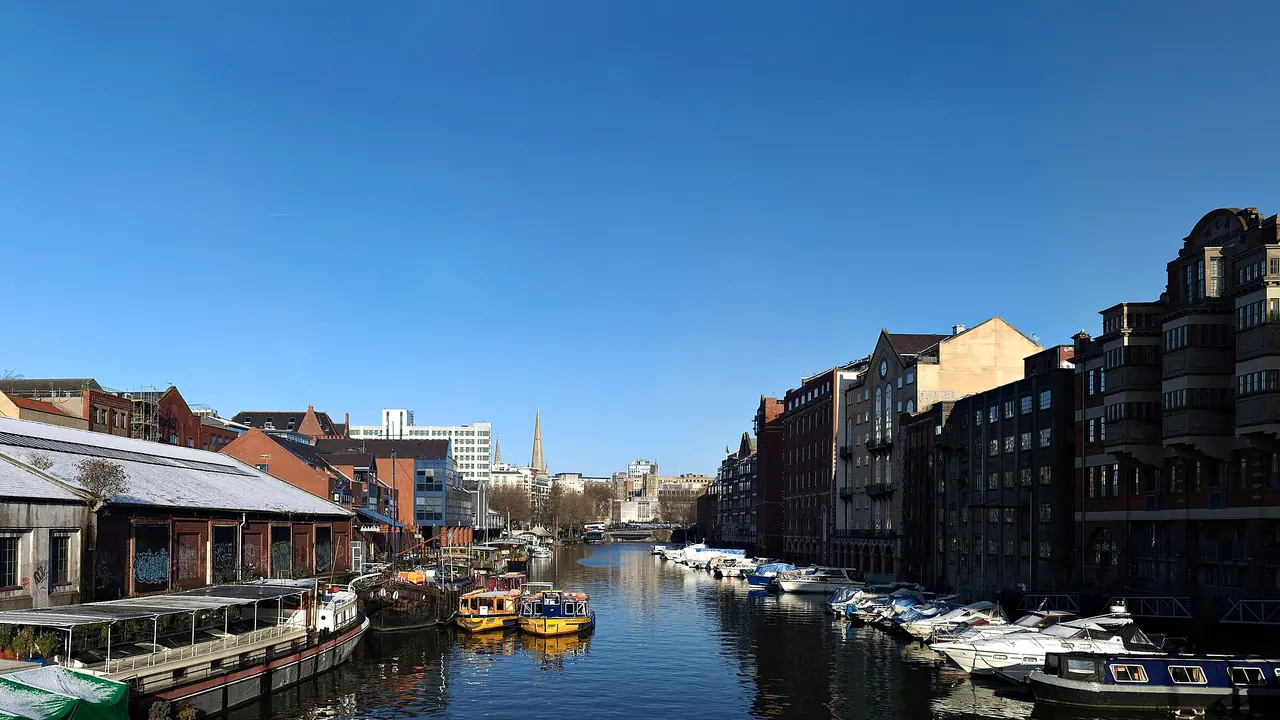
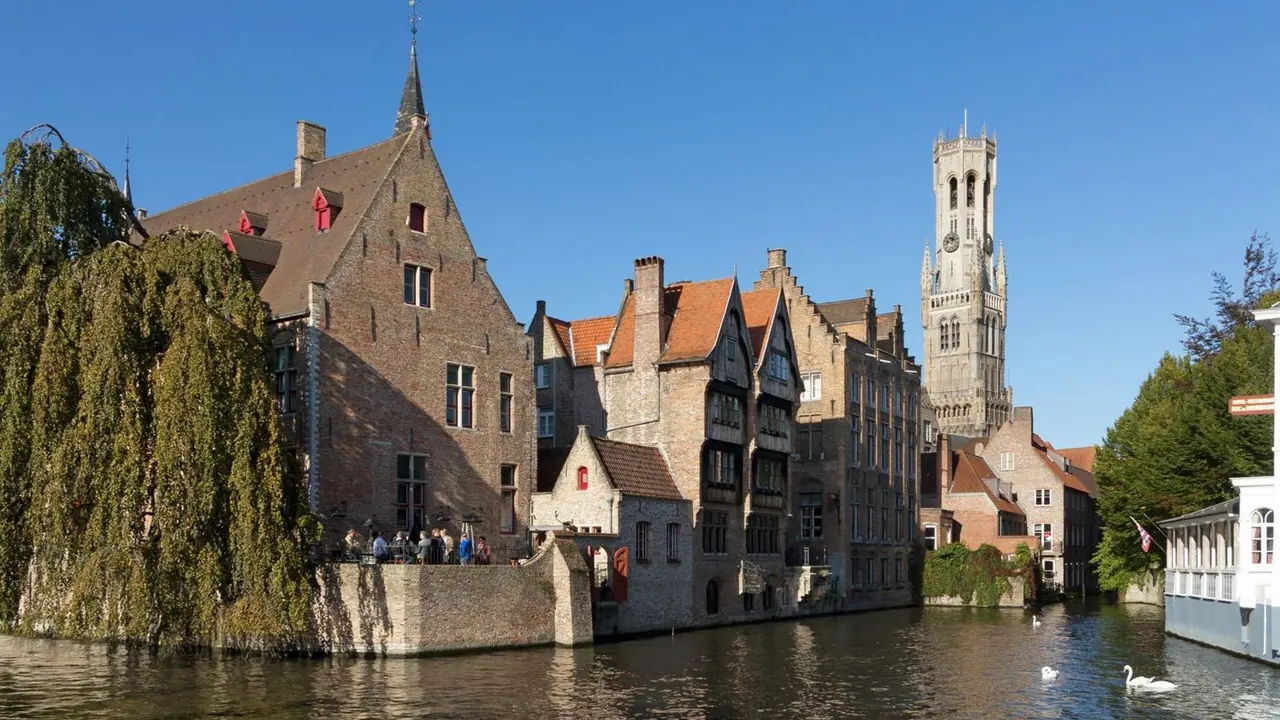
Photos: Bristol by NotFromUtrecht, CC BY-SA 3.0, cropped; Bruges by Michielverbeek, CC BY-SA 4.0, cropped.
Bristol or Bruges?
Our verdict in twelve categories, each scored against the same fixed benchmark cities, and the climate month by month, so you can choose for your trip.
Choose Bristol for
- nightlife
- nature and the outdoors
- live music and the arts
Bristol suits travellers who want a working city with energy after dark and green space on the doorstep. Its clubs, live music venues and Georgian theatre give the evenings real weight. The Avon Gorge, Ashton Court and the Mendips put walking, climbing and cycling within easy reach. Bath and the Cotswolds round out a stay of several days.
Choose Bruges for
- getting around
- culture and sights
- beaches
Choose Bruges for a short, unhurried trip built around medieval streets, Flemish painting and Belgian beer. The whole old town fits inside a flat ring of canals that you can cross on foot. Fast trains to Ghent, Brussels and Antwerp make it an easy base for seeing more of Flanders. It is a city for quiet evenings in a beer café, not for late nights.
Scoreboard
Twelve categories on one fixed scale from 0 to 100. The shaded stretch is the gap between the two.
Your match
Pick a travel style or drag the sliders, and both match scores follow your weighting.
Wins on nightlife and nature and the outdoors with your weighting.
Wins on getting around and culture and sights with your weighting.
What matters to you?
Category by category
What the scores mean for a trip.
Beaches & swimming
Neither city is a beach destination, but Bruges comes closer. A short train ride to Blankenberge brings you to the coast tram and a long line of wide sandy beaches, good for a sunny half-day by the North Sea.
From Bristol, the Severn estuary offers mud flats and silty water, and the tide goes out a long way at Weston-super-Mare. The appeal is cold-water dipping in tidal pools such as Clevedon's marine lake. Proper swimming beaches mean a long drive into Devon, Cornwall or Gower.
Food & drink
The two eat equally well but in very different ways. Bristol is a city for grazing: St Nicholas Market, container kitchens on the harbour, the bakeries of Gloucester Road, plus West Country cider and craft taprooms.
Bruges has the stronger identity. Trappist and abbey beers, mussels with frites, beef stewed in beer and serious chocolate all belong to the place. The catch is that the restaurants around the Markt cater to day-trippers, so the good meals are on the side streets.
Culture & sights
Bruges is clearly the richer place for sightseeing. Its whole UNESCO-listed centre is the attraction: the Belfry over the Markt, the Burg with the Basilica of the Holy Blood, and the Begijnhof. The art is in the same league, with Van Eyck at the Groeninge and Memling in the medieval hospital.
Bristol's sights are more scattered and tell a story of trade and engineering. Brunel's SS Great Britain and the Clifton Suspension Bridge lead the way, followed by St Mary Redcliffe and M Shed's honest account of the port's past. Banksy's street art in Stokes Croft offers a modern counterpoint that Bruges has no answer to.
Nightlife
Bristol is the clear choice for going out. Its sound-system heritage fills warehouse and railway-arch clubs around Temple Meads, and a large student population keeps weekends running late. Stokes Croft adds scruffier, more creative bars.
Bruges offers a different kind of evening: a long session over strong ales in a brown café or cellar bar near the Eiermarkt, then a walk along the lit canals. There are only one or two small clubs, and the centre goes quiet early on weeknights.
Nature & outdoors
Bristol has much more to offer outdoors. The limestone cliffs of the Avon Gorge, the deer park at Ashton Court and the mountain-bike trails in Leigh Woods are all in the city itself. The Mendips are under an hour away, and Exmoor and the Brecon Beacons are within reach for real upland hiking.
Around Bruges the land is flat polder with poplar-lined canals. That makes it lovely for an easy ride to Damme or birdwatching at the Zwin salt marsh, but there are no hills or forests to explore.
Day trips
Both are excellent bases, and Bruges has a slight edge because Belgium is compact and its trains are frequent. Ghent, Brussels and Antwerp each offer a full city of art and architecture within easy rail reach, and Ypres and the Westhoek battlefields add a moving day of history.
Bristol's excursions are more rural and varied. Bath is a quarter of an hour by train, and Wells and Glastonbury lie to the south. Cardiff is just across the Severn, the Cotswold villages are to the east, and Stonehenge and Avebury make a full day. Several of these are easier with a car.
Good for families
Bristol is slightly the better choice with children. Its harbourside cluster of the SS Great Britain, the We The Curious science centre and the aquarium, linked by little ferries, copes well with rainy days. The wildlife park and the open space of the Downs add more.
Bruges appeals to younger children in shorter bursts: canal boats, carriage rides, swans on the Minnewater and the Boudewijn Seapark. The beaches are close for sandcastles. In both cities pushchairs struggle, on Bristol's steep hills and on Bruges's cobbles.
Getting around
Bruges is far easier to get around. The old town is flat, largely car-free and walkable from end to end in about half an hour, hired bikes are the natural way to travel, and trains leave often for the rest of Flanders. Only the cobbles slow things down.
Bristol's core is walkable too, and the harbour ferries help. Clifton is a steep climb, though, and with no tram or metro, longer journeys mean buses stuck in traffic.
Shopping & style
Shopping is a modest pleasure in both, and neither city is worth a trip for it. Bristol has more range: Cabot Circus for chains, Gloucester Road for records, delis and vintage clothes, and boutiques along Park Street up to Clifton.
Bruges is mostly about things to eat and drink, such as pralines, beer with matching glasses and bobbin lace. Choose your lace carefully, since much of it is imported. The weekend markets on 't Zand and along the Dijver are pleasant for a browse.
Affordability
Both are expensive for their size and cost about the same overall, but you save in different ways. In Bristol, most of the main museums and churches are free and market food is cheap, though hotel rates rise at weekends.
In Bruges the cost is in rooms inside the canal ring and meals on the main squares. Staying midweek or near the station and eating on the side streets saves the most, and the beer is good value for its quality.
Live music & performing arts
Bristol offers clearly more on stage. The Bristol Old Vic still performs in its Georgian auditorium, the Hippodrome takes touring musicals and ballet, and the Tobacco Factory stages fringe Shakespeare. Above all, small venues host bands, jazz and electronic acts most nights.
Bruges is narrower but more specialised. The Concertgebouw is known for early and chamber music, the summer early-music festival draws listeners from across Europe, and the Belfry carillon plays over the town. Live music in bars is thin.
Wellness & relaxation
Neither city has a spa tradition of its own, so they are broadly level. Bristol has the better options for bathing: the heated Victorian lido in Clifton, cold-water dips along the Severn, and Bath's thermal rooftop pool a short train ride away.
Bruges offers calm rather than treatments. Early mornings in the Begijnhof, evenings by the Minnewater and the quiet streets of Sint-Anna are as restful as any city walk, as long as you avoid the main streets on summer afternoons.
When should you go?
Pick your month. The climate figures are measured averages, not a forecast.
Bristol in July
Bruges in July
Daytime high, °C
Rainfall in the month, mm
Where the figures come from
Bristol's station stands 178 m above the city centre, so the centre is likely a little warmer than the figures say.
Bristol has no rain gauge within 25 km of the centre, so its rainfall comes from a gridded climate dataset read at the city rather than from a gauge further away.
Bristol's sunshine is measured 43 km from the centre, at Lyneham.
Bruges has no rain gauge within 25 km of the centre, so its rainfall comes from a gridded climate dataset read at the city rather than from a gauge further away.
Bruges's sunshine is measured 37 km from the centre, at Vlissingen.
Temperature and rainfall are climate normals, averaged over the years shown. Bristol: 1991-2020 normals, Lulsgate Bottom (11.8 km from centre). Bruges: 2009-2025 (sunshine 1991-2020, rainfall 1991-2020) normals, Zeebrugge / Zeemanshaard (15.8 km from centre).
Both climates are mild and damp, and neither city ever gets warm enough for a proper beach trip. Bristol peaks at about 20°C in July, and Bruges at about 21°C in July and August. The sea off both reaches only 18°C to 19°C in late summer, so a swim is a brisk dip. Bruges is noticeably sunnier from spring through summer, and its brightest months are May and June.
For walking the streets, May to September is the most comfortable stretch in both cities, and neither is ever too hot. In Bristol the rain is fairly even from February to September. The heaviest falls come from October to December, at close to 97mm a month, and January is still wet. Bruges has dry springs, with March and April the driest months of the year, which makes them good for cycling the polders. Its wetter spells come earlier, in July and August, and again from October to December. October stays mild in both, a little more so in Bruges. Winter days are cold in both cities, with highs in single figures from December to February, and in Bristol through March as well.
Which traveller are you?
On a culture and arts trip, Bruges is the better choice. The canal-ringed medieval centre is intact, and the Groeninge Museum, the Memlings at St John's Hospital and the Michelangelo Madonna are all a short walk apart. Ghent and Brussels add more art, each within an hour by train.
For a food and nightlife trip, Bristol wins clearly. Market stalls and harbourside street food lead into a club scene rooted in drum and bass and dubstep, with warehouse venues that run late. Bruges offers superb beer, but its centre is mostly asleep by midnight.
On an outdoors trip, Bristol gives far more to do. You can climb in the Avon Gorge, walk in Leigh Woods, cycle the railway path to Bath and go caving in Cheddar Gorge. Bruges has only flat polder for gentle bike rides and blustery dune walks.
Before you go
| Measure | Bristol | Bruges |
|---|---|---|
| Official language | English | French, German, Dutch |
| Currency | Pound Sterling (GBP) | Euro (EUR) |
| Sockets | G230 V, 50 Hz | CE230 V, 50 Hz |
| Driving side | Left | Right |
| Time zone | UTC, UTC+1 in summer | UTC+1, UTC+2 in summer |
| Emergency number | 112 or 999 | 112 |
| Elevation | 11 m | 2 m |
| Main airport | Bristol Airport (BRS)11 km from centre117 non-stop destinations | Brussels Airport (BRU)94 km from centre191 non-stop destinations |
| Public holidays this year | 8 days | 14 days |
By the numbers
| Measure | Bristol | Bruges |
|---|---|---|
| City population | 472,465 | 118,509 |
| People per km² | 4,311 | 840 |
| Museums within 10 km | 23 | 38 |
| UNESCO World Heritage sites within 50 km | 3 | 4 |
| Swim season, months above 21 °C | None | None |
Where else could you go?
Every comparison below shares a destination with this one, so you can follow Bristol or Bruges somewhere new.