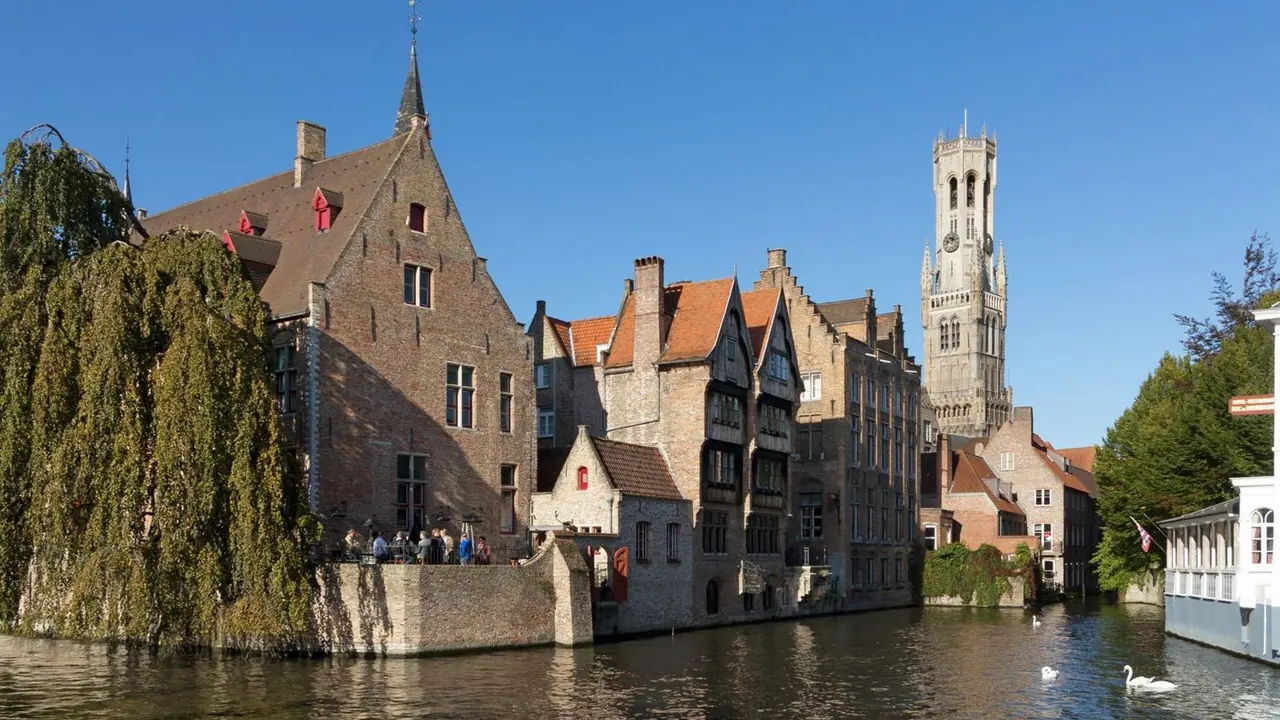
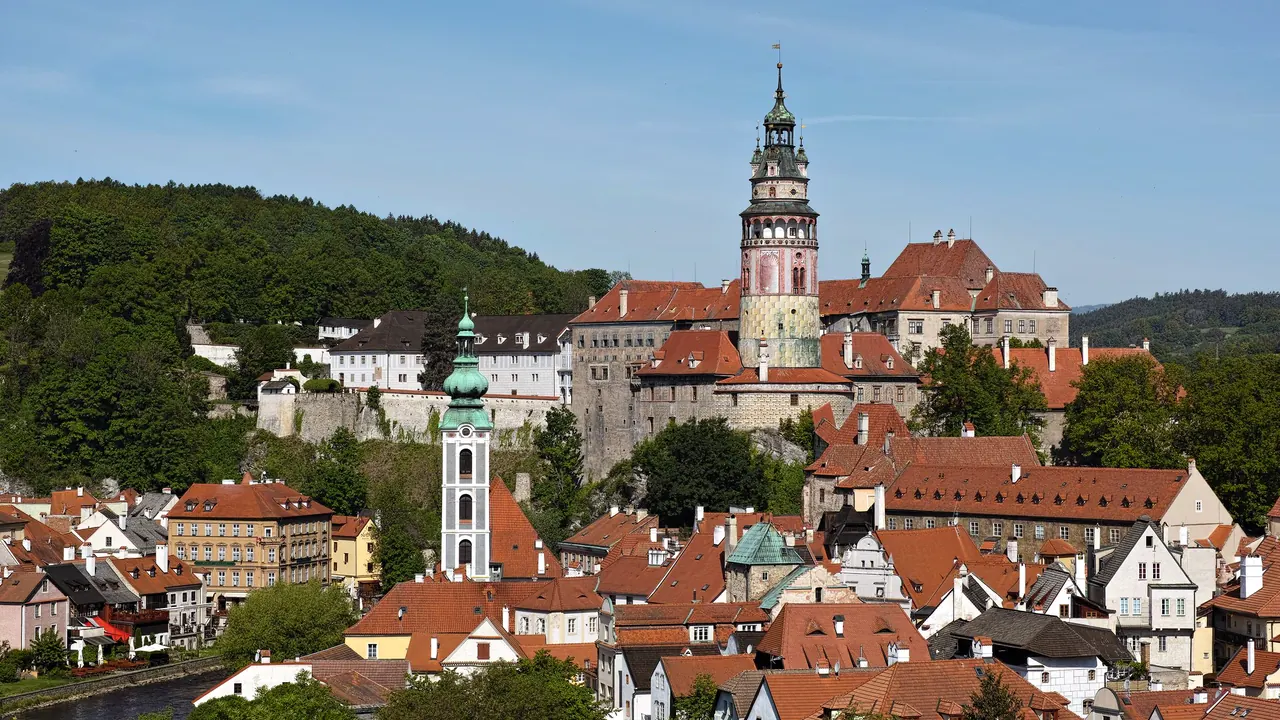
Photos: Bruges by Michielverbeek, CC BY-SA 4.0, cropped; Cesky Krumlov by Xth-Floor, CC BY-SA 4.0, cropped.
Bruges or Cesky Krumlov?
Our verdict in twelve categories, each scored against the same fixed benchmark cities, and the climate month by month, so you can choose for your trip.
Choose Bruges for
- food and drink
- day trips
- shopping
Bruges suits the traveller who wants a fuller few days: a finer art collection, Belgian beer and Flemish cooking with more range, and a train station that puts Ghent, Brussels, Antwerp and the coast within easy reach. It is flat, compact and easy to manage without a car, though you pay more for the room and the meal.
Choose Cesky Krumlov for
- nature and the outdoors
- prices
Cesky Krumlov is the choice for a slower, cheaper stay with the countryside close by. The castle and the painted houses on a bend of the Vltava take a day or two. After that the river, the Bohemian Forest and the Lipno lake give you canoeing, walking and cycling that the flat polders around Bruges cannot match. Evenings are quieter still, and a hired car helps a great deal.
Scoreboard
Twelve categories on one fixed scale from 0 to 100. The shaded stretch is the gap between the two.
Your match
Pick a travel style or drag the sliders, and both match scores follow your weighting.
Wins on food and drink and day trips with your weighting.
Wins on nature and the outdoors and prices with your weighting.
What matters to you?
Category by category
What the scores mean for a trip.
Beaches & swimming
Neither is a beach destination, and both treat swimming as a summer half-day out. What you swim in differs. From Bruges a short train ride brings you to Blankenberge and the long, flat sandy beaches on the coast tram line, but the North Sea is cool, windy and better for paddling.
Cesky Krumlov has no sea at all. Its swimming is at the Lipno reservoir, half an hour's drive away, with grassy and sandy shores and slightly warmer lake water in high summer. Bruges has the edge for a classic day by the sea.
Food & drink
Bruges eats and drinks considerably better. Belgian beer is the centrepiece, served in wood-panelled cafés with each brew in its own glass, and around it come mussels with frites, beer-braised beef, waterzooi, serious chocolate and a fine-dining tier in the farmhouses outside town.
Cesky Krumlov keeps to hearty South Bohemian cooking: duck, pork and svíčková with dumplings, river trout and forest game, eaten in vaulted cellars or on river terraces. The town's own beer is excellent, but the choice is narrow. In both places the menus on the main lanes are written for day-trippers, so walk a few streets further.
Culture & sights
Both are UNESCO-listed old towns, and Bruges has more to see. Beyond its canals, guildhalls, Belfry and Begijnhof, it has real collections: the Flemish Primitives in the Groeninge Museum, the Memlings at St John's Hospital and a Michelangelo Madonna in the Church of Our Lady.
Cesky Krumlov is more of a single set piece. The castle, with its painted tower, Cloak Bridge and rare Baroque theatre, dominates the river bend, and the appeal lies in the intact townscape more than in what hangs on the walls. Expect a day or two in either, with early mornings best before the crowds arrive.
Nightlife
Neither town is for clubbing, but Bruges keeps going longer. Students help fill the beer cafés around the Eiermarkt and 't Zand late into the night, a few music bars add some noise, and one or two small clubs open at weekends.
In Cesky Krumlov the evening is a few pubs and cellar bars, some full of backpackers, plus riverside terraces in summer. There are no clubs, and out of season the lanes go quiet early.
Nature & outdoors
Cesky Krumlov is clearly the better base for time outdoors. You can spend a day canoeing or rafting down the wooded meanders of the Vltava, and the spruce woods and peat bogs of the Bohemian Forest national park begin half an hour away, with long walking and cycling routes and cross-country skiing in winter.
Around Bruges the land is flat polder, lovely for an easy bike ride along the poplar-lined towpath to Damme or a birdwatching walk in the Zwin salt marsh. There are no hills or forests, so it fills an afternoon rather than a trip.
Day trips
Bruges is one of the best bases in the region, because Belgium is small and trains are frequent. Ghent is under half an hour away, Brussels about an hour and Antwerp a little further, while the coast, Damme and the First World War sites around Ypres add variety.
Cesky Krumlov has a good South Bohemian circuit: the arcaded square of České Budějovice, Hluboká castle, the farmhouses of Holašovice and the fish-pond spa town of Třeboň. Most of it is far easier by car, and Prague is too far for a comfortable day.
Good for families
Bruges works somewhat better with children. Boat rides, carriages, the chocolate and frites museums and the swans on the Minnewater fill short outings, and Boudewijn Seapark and the sandy beaches are close for a fuller day.
Cesky Krumlov has the storybook castle with bears in its moat and a gentle family raft trip as its highlight, plus Lipno's treetop walk nearby. Both towns are small and safe, but Krumlov's lanes are steeper as well as cobbled, which makes a pushchair even harder work there.
Getting around
Inside town the two are alike: compact, largely car-free and cobbled, though Krumlov adds the climb to the castle. The difference shows once you leave. Bruges is flat enough to cycle anywhere, and its station puts the big Flemish cities and the coast within easy reach by train.
From Cesky Krumlov, regional buses and trains reach České Budějovice, but the forest, the lake and the smaller castles are poorly served, so most visitors hire a car or join tours.
Shopping & style
Bruges offers more, though mostly to eat or drink. There are chocolate makers on every street, specialist beer shops, bobbin lace and a high street of chains along Steenstraat, plus the Saturday market on 't Zand and the flea market by the Dijver.
Cesky Krumlov is almost entirely souvenirs: Bohemian glass, garnets, marionettes, wooden toys and green moldavite, with a few ceramics workshops. Neither has fashion worth a trip.
Affordability
Cesky Krumlov is clearly the cheaper stay. Family guesthouses in old houses and Czech meals with local beer keep daily costs moderate, although rooms with castle views and the separately priced castle tours add up.
Bruges is expensive, especially for canal-ring hotels at weekends and in summer and for meals on the main squares. Staying midweek or near the station helps, but it still costs noticeably more than Krumlov.
Live music & performing arts
Bruges has more to attend through the year. The Concertgebouw stages early music, chamber music and contemporary dance, the Stadsschouwburg hosts theatre, and the Belfry carillon plays over the rooftops. Ghent and Brussels are close for a bigger evening.
Cesky Krumlov's performances are mostly a summer affair. Its open-air castle-garden theatre with a revolving auditorium and its classical music festival are memorable, but for most of the year there is little on.
Wellness & relaxation
Neither has a bathing tradition, and both offer hotel spas and quiet hours rather than proper treatments. Bruges has a wider choice of day spas and calm corners such as the Begijnhof, Minnewater and the Sint-Anna district even at midday.
Cesky Krumlov's peace comes in the evenings and in winter, when the old town empties. Its beer baths are a local curiosity, and Třeboň's peat baths are within reach for a real spa day.
When should you go?
Pick your month. The climate figures are measured averages, not a forecast.
Bruges in July
Cesky Krumlov in July
Daytime high, °C
Rainfall in the month, mm
Where the figures come from
Bruges has no rain gauge within 25 km of the centre, so its rainfall comes from a gridded climate dataset read at the city rather than from a gauge further away.
Bruges's sunshine is measured 37 km from the centre, at Vlissingen.
Cesky Krumlov's temperatures are measured 50 km from the centre, at Grainet-Rehberg.
Cesky Krumlov has no rain gauge within 25 km of the centre, so its rainfall comes from a gridded climate dataset read at the city rather than from a gauge further away.
Temperature and rainfall are climate normals, averaged over the years shown. Bruges: 2009-2025 (sunshine 1991-2020, rainfall 1991-2020) normals, Zeebrugge / Zeemanshaard (15.8 km from centre). Cesky Krumlov: 1991-2020 normals, Grainet-Rehberg (50.3 km from centre).
Bruges has a mild sea climate with no real extremes. Summers are pleasant for walking rather than hot, with highs of about 21°C in July and August, and the North Sea only reaches about 19°C, so a swim is a brisk one. Spring is the driest and one of the sunniest times, from April to June. From autumn into winter the rain gets heavier and the days grey and short, but it rarely gets truly cold.
Cesky Krumlov has a more continental pattern. Summers are slightly warmer, around 23°C, and very good for the river and the forest, but July is also the wettest month, with about 111mm. Winters are clearly colder than in Bruges, with daytime highs near freezing from December to February, which suits a quiet snowy stay or cross-country skiing more than long walks. Late May to September is the best stretch for an active trip, and spring or September works well in both towns.
Which traveller are you?
On a food and nightlife trip, Bruges is the better pick. Its brown cafés and cellar bars pour long lists of Trappist and abbey beers late into the evening, and mussels, stews and chocolate give it far more to eat than Krumlov's roast pork and dumplings.
For an outdoors trip, Cesky Krumlov wins easily. You can float down the Vltava by canoe, walk or cycle in the Bohemian Forest, climb Klet for the views and sail on Lipno. Bruges offers flat canal-side cycling and little else.
On a tight budget, Cesky Krumlov stretches the money much further. Family guesthouses, local beer and Czech meals stay moderately priced, while Bruges is an expensive small city whose canal-ring hotels and square-side restaurants charge for their location.
Before you go
| Measure | Bruges | Cesky Krumlov |
|---|---|---|
| Official language | French, German, Dutch | Czech |
| Currency | Euro (EUR) | Czech Koruna (CZK) |
| Sockets | CE230 V, 50 Hz | CE230 V, 50 Hz |
| Driving side | Right | Right |
| Time zone | UTC+1, UTC+2 in summer | UTC+1, UTC+2 in summer |
| Emergency number | 112 | 112 |
| Elevation | 2 m | 492 m |
| Main airport | Brussels Airport (BRU)94 km from centre192 non-stop destinations | Václav Havel Airport Prague (PRG)143 km from centre178 non-stop destinations |
| Public holidays this year | 14 days | 13 days |
By the numbers
| Measure | Bruges | Cesky Krumlov |
|---|---|---|
| City population | 118,509 | 12,797 |
| People per km² | 840 | 576 |
| Museums within 10 km | 38 | 4 |
| UNESCO World Heritage sites within 50 km | 4 | 2 |
| Swim season, months above 21 °C | None | - |
Where else could you go?
Every comparison below shares a destination with this one, so you can follow Bruges or Cesky Krumlov somewhere new.