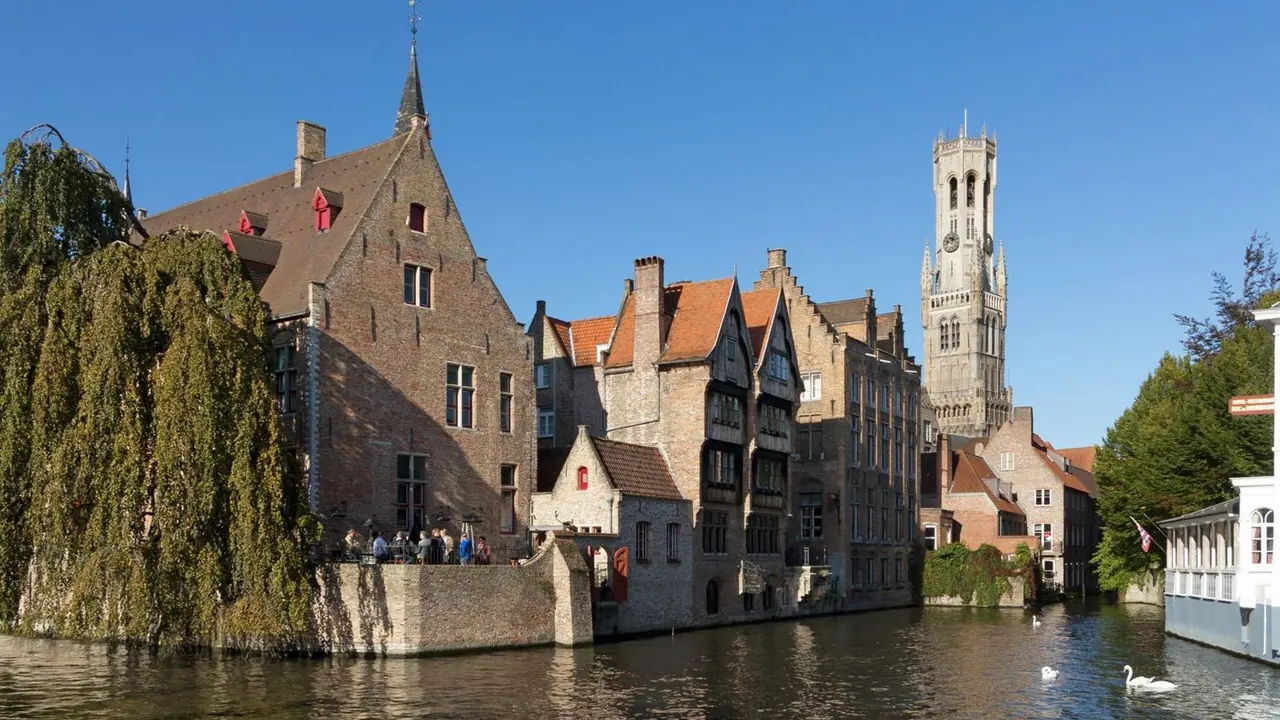
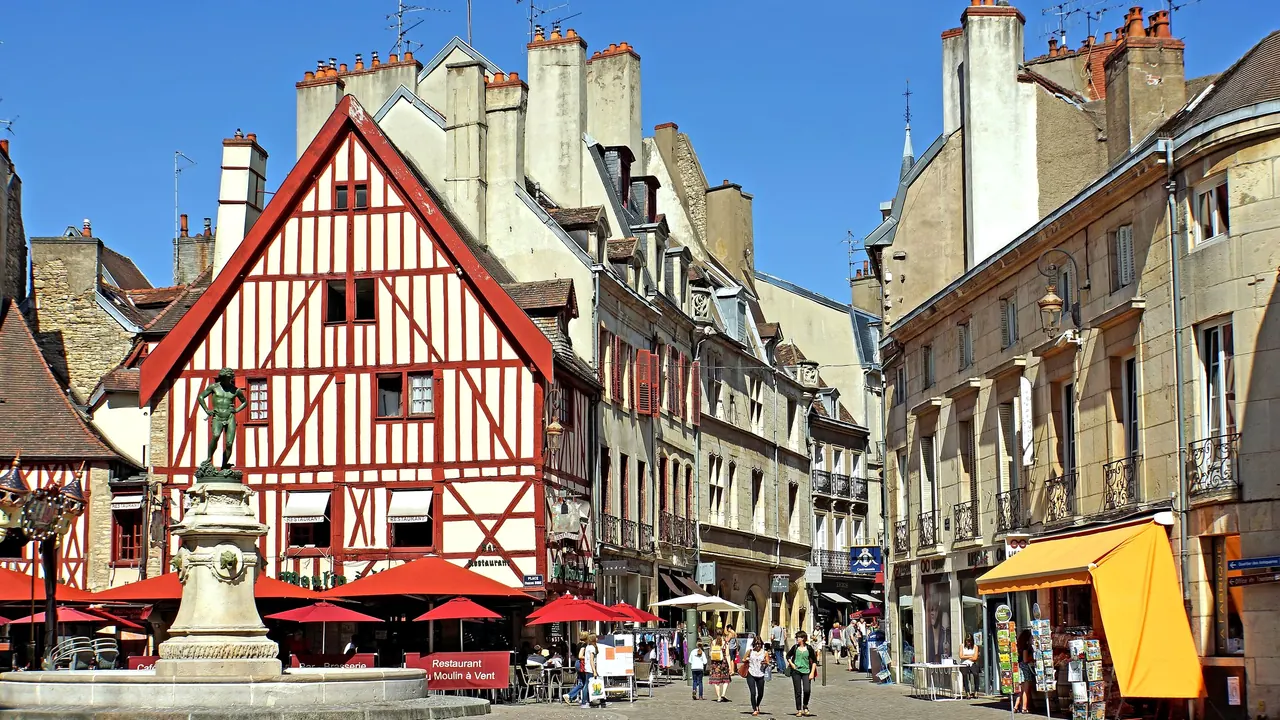
Photos: Bruges by Michielverbeek, CC BY-SA 4.0, cropped; Dijon by Dennis G. Jarvis, CC BY-SA 2.0, cropped.
Bruges or Dijon?
Our verdict in twelve categories, each scored against the same fixed benchmark cities, and the climate month by month, so you can choose for your trip.
Choose Bruges for
- beaches
- families
- wellness
Bruges suits a traveller who wants a medieval city that looks the way it did five centuries ago, with Flemish Primitive paintings to match. It also suits someone happy to use it as a base, since Ghent, Brussels, Antwerp and the coast are all a short train ride away. Families do well here too, with canal boats, the Belfry climb and the beach close by. The cost is high prices and crowded streets on summer afternoons.
Choose Dijon for
- prices
- food and drink
- nature and the outdoors
Dijon is the better pick if you travel to eat and drink. It sits right at the start of the Burgundy vineyards, with Les Halles at its centre and village wines poured by the glass. Rooms and set lunches cost less than in Bruges, summers are warmer and sunnier, and the limestone combes and the vineyard cycle route to Beaune offer more to do outdoors.
Scoreboard
Twelve categories on one fixed scale from 0 to 100. The shaded stretch is the gap between the two.
Your match
Pick a travel style or drag the sliders, and both match scores follow your weighting.
Too close to call, 2 points apart
Wins on beaches and families with your weighting.
Wins on prices and food and drink with your weighting.
What matters to you?
Category by category
What the scores mean for a trip.
Beaches & swimming
Neither is a beach destination, but Bruges at least has the sea close by. Blankenberge is a short train ride away, and the coast tram links a long run of wide sandy beaches, good for a windy half-day and a quick dip in August.
Dijon is several hours from any coast. On a hot day the nearest you get is the supervised lawn-and-sand bathing area at Lac Kir, a lake on the western edge of town.
Food & drink
Dijon eats better. Boeuf bourguignon, jambon persillé, Époisses and Bresse poultry from Les Halles, mustard, cassis and Burgundy village wines poured by the glass make it a city where every meal can be the main event.
Bruges is all about beer, with Trappist and abbey ales served in old brown cafés alongside mussels, frites and chocolate. Its restaurants are weaker, though: the main squares mostly serve set menus to day-trippers, so you need to go looking on the side streets to eat well.
Culture & sights
Bruges has the stronger sightseeing. Its entire canal-ringed centre is a preserved medieval townscape, and the art is first-rate: van Eyck in the Groeninge, Memling at St John's Hospital and a Michelangelo Madonna in the Church of Our Lady.
Dijon has plenty to offer, starting with the ducal palace and its carved Valois tombs, then the half-timbered streets, the owl on Notre-Dame and Sluter's Well of Moses. It is a city of handsome detail rather than a single overwhelming whole, and it is far less crowded.
Nightlife
Both are quiet in the evening, and the difference is in the drink. Bruges is for a long session of strong ales in a vaulted cellar, followed by a walk along the lit canals. Dijon's large student population fills the small bars of Rue Berbisey and the terraces around Place Émile Zola, and a night out there is more likely to mean wine and a late dinner. Neither city is for clubbing.
Nature & outdoors
Dijon has more varied country close by. The wooded combes just west of town have walking trails and climbing cliffs, the signed cycle route runs through the Côte de Nuits vineyards, and the granite hills of the Morvan are within reach for a day out.
Bruges has flat polder land, which makes for lovely easy cycling along the poplar-lined canal to Damme, plus birdlife at the Zwin salt marsh. There is no relief at all, though, so expect an afternoon on a bike rather than a walking vacation.
Day trips
Both make excellent bases, and Bruges has the edge because nearly everything is by train. Ghent is under half an hour away, and Brussels, Antwerp, the coast and the Ypres battlefields all make easy days out without a car.
Dijon's day trips centre on wine. The Route des Grands Crus leads to Beaune, and Fontenay Abbey and Semur-en-Auxois lie to the north-west. Beaune and Besançon are easy by train, but most of the wine villages call for a car, a bike or a tour.
Good for families
Bruges gives children more to do. Boat rides, horse-drawn carriages, the Belfry steps and the chocolate museum fill short outings, and there is an amusement park on the edge of town and a coastline of sandcastle beaches. The cobbles are hard work with a pushchair, though.
Dijon is relaxed and safe, with the planetarium at the Jardin de l'Arquebuse, the play areas of the Parc de la Colombière and paddling at Lac Kir. After that, the vineyards and fine-art museums are mainly for the adults.
Getting around
Both centres are compact and easy on foot, and Bruges is slightly simpler. You can cross the flat, largely car-free old town in about half an hour, bikes are the local way to get about, and frequent trains make day trips easy. The cobbles are the only nuisance. Dijon adds two tram lines and a fast TGV link to Paris, but for the wine villages you will want a car, a bike or a tour.
Shopping & style
Both cities are for edible souvenirs rather than fashion. In Bruges that means pralines, specialist beer shops and bobbin lace, though much of the lace is imported. In Dijon it means mustard in dozens of flavours, pain d'épices, cassis and Burgundy from the cellars, with cheese from Les Halles. For browsing, Bruges has a Saturday market and a flea market on the canal, while Dijon has antiques shops in the lanes off Rue de la Liberté.
Affordability
Dijon is noticeably easier on the wallet. Rooms are moderately priced, bistro set lunches are good value and wine by the glass is cheap, so the bill only climbs when you book serious restaurants and wine tours.
Bruges is expensive for its size, especially hotels inside the canal ring at weekends and in summer. You can cut costs by staying midweek, sleeping near the station and eating away from the Markt.
Live music & performing arts
The two are roughly level, but they offer different things. Bruges is known for early music and chamber music at its Concertgebouw, with a summer festival of early music and the Belfry carillon sounding over the rooftops.
Dijon has opera, with a company performing in the Grand Théâtre and the acoustically admired Auditorium, plus a national drama centre. Its season follows the academic year and thins out in summer, which is exactly when Bruges's festival is on.
Wellness & relaxation
Neither has a spa culture, but Bruges offers more calm to seek out. Early in the morning the Begijnhof, the Minnewater and the quiet Sint-Anna quarter are very peaceful, and there are a few day spas. Dijon's restfulness comes from its pace: long lunches, quiet squares and slow afternoons in the vineyards, with grape-based treatments at a few hotels.
When should you go?
Pick your month. The climate figures are measured averages, not a forecast.
Bruges in July
Dijon in July
Daytime high, °C
Rainfall in the month, mm
Where the figures come from
Bruges has no rain gauge within 25 km of the centre, so its rainfall comes from a gridded climate dataset read at the city rather than from a gauge further away.
Bruges's sunshine is measured 37 km from the centre, at Vlissingen.
Temperature and rainfall are climate normals, averaged over the years shown. Bruges: 2009-2025 (sunshine 1991-2020, rainfall 1991-2020) normals, Zeebrugge / Zeemanshaard (15.8 km from centre). Dijon: 1991-2020 normals, Dijon (7 km from centre).
Bruges has a mild, cool climate. Summer highs only reach about 21°C in July and August, and late summer is the only time the North Sea, at around 19°C, invites more than a paddle. From August to December it is often wet, with close to 90mm of rain in several of those months. Its sunniest stretch runs from April to August, so late spring is a good time for walking the canals before the wetter months arrive.
Dijon is warmer in summer, with July highs around 27°C and more sunshine than Bruges. Hot afternoons can feel heavy in the stone streets, though they suit Lac Kir. May and the late autumn months are its wettest. In spring and September it is comfortable for walking and cycling through the vineyards, while winter in both cities is cold, grey and short of light.
Which traveller are you?
On a family trip with children, Bruges keeps everyone busier. Short outings fill the days in a small, safe city, and the sea is close for a change of scene, whereas Dijon's days are mostly planned around the adults.
For a trip on a tight budget, Dijon goes further. Days of good food and walking cost little and leave room for a cellar tasting, whereas a cheap stay in Bruges means giving up the rooms inside the canal ring that make it special.
On a food and nightlife trip, Dijon wins at the table, where Burgundian cooking and wine make each meal worth planning. The evenings are a closer call: Bruges suits a slow night of strong ale, Dijon student bars and late dinners.
Before you go
| Measure | Bruges | Dijon |
|---|---|---|
| Official language | French, German, Dutch | French |
| Currency | Euro (EUR) | Euro (EUR) |
| Sockets | CE230 V, 50 Hz | CE230 V, 50 Hz |
| Driving side | Right | Right |
| Time zone | UTC+1, UTC+2 in summer | UTC+1, UTC+2 in summer |
| Emergency number | 112 | 112 |
| Elevation | 2 m | 220 m |
| Main airport | Brussels Airport (BRU)94 km from centre191 non-stop destinations | Lyon Saint-Exupéry Airport (LYS)178 km from centre141 non-stop destinations |
| Public holidays this year | 14 days | 11 days |
By the numbers
| Measure | Bruges | Dijon |
|---|---|---|
| City population | 118,509 | 161,830 |
| People per km² | 840 | 3,890 |
| Museums within 10 km | 38 | 8 |
| UNESCO World Heritage sites within 50 km | 3 | 1 |
| Swim season, months above 21 °C | None | - |
Where else could you go?
Every comparison below shares a destination with this one, so you can follow Bruges or Dijon somewhere new.