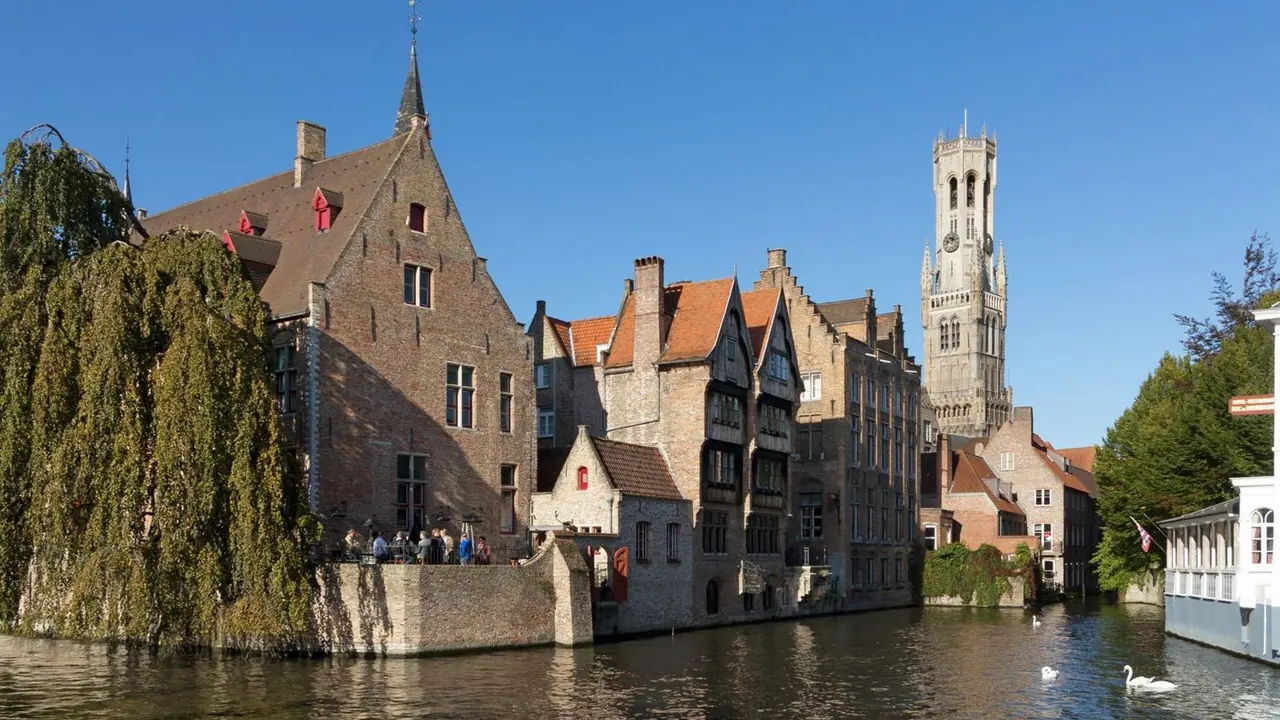
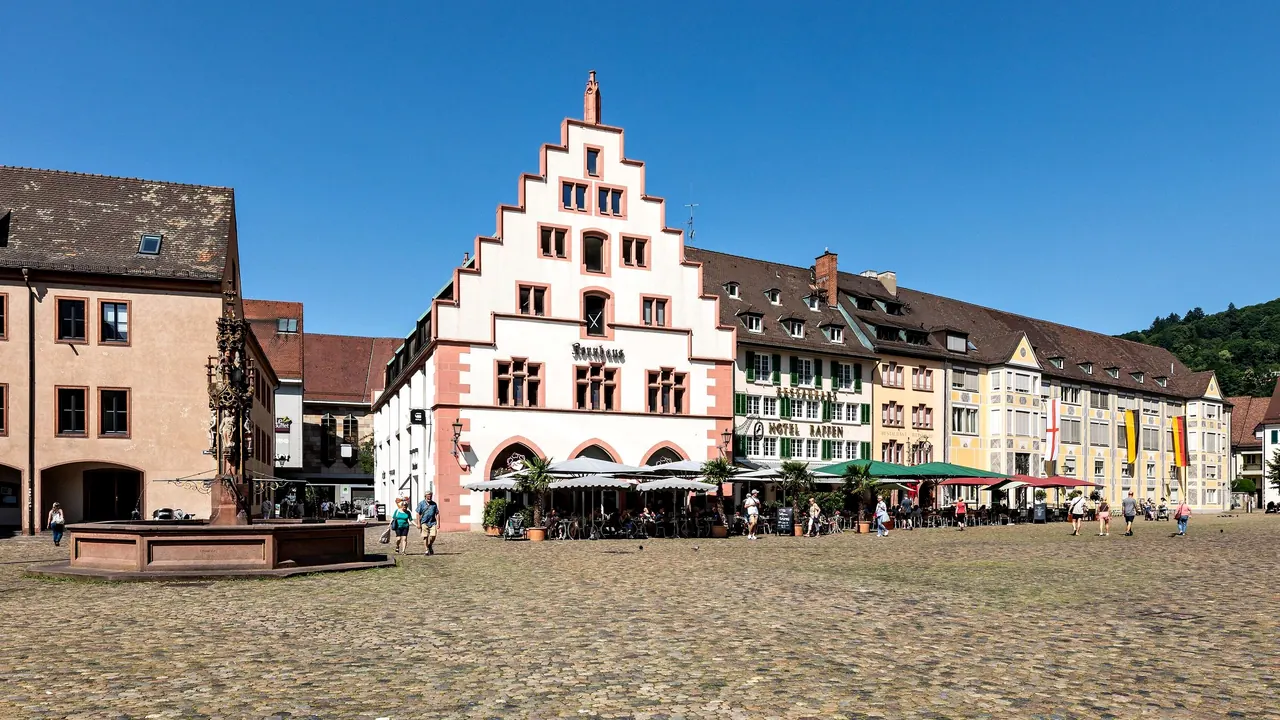
Photos: Bruges by Michielverbeek, CC BY-SA 4.0, cropped; Freiburg by Dietmar Rabich, CC BY-SA 4.0, cropped.
Bruges or Freiburg?
Our verdict in twelve categories, each scored against the same fixed benchmark cities, and the climate month by month, so you can choose for your trip.
Choose Bruges for
- culture and sights
- beaches
- day trips
Bruges is for travellers who want a medieval city to wander and look at: canals, brick guildhalls, van Eyck and Memling in their original setting, and long evenings over Trappist ales in old brown cafés. It suits a romantic weekend or a culture trip. With Ghent, Brussels and Antwerp all a short train ride away, a longer stay works well as a base for touring Flanders.
Choose Freiburg for
- nature and the outdoors
- wellness
- families
If you want to be outdoors as much as in town, pick Freiburg. The Black Forest begins at the edge of the city, with cable car rides, mountain hikes and vineyard cycling, and the thermal baths of southern Baden are close by. It is also the easier place to bring children, and its student population gives the evenings more life.
Scoreboard
Twelve categories on one fixed scale from 0 to 100. The shaded stretch is the gap between the two.
Your match
Pick a travel style or drag the sliders, and both match scores follow your weighting.
Wins on culture and sights and beaches with your weighting.
Wins on nature and the outdoors and wellness with your weighting.
What matters to you?
Category by category
What the scores mean for a trip.
Beaches & swimming
Neither city is a beach destination, but Bruges at least has the sea within reach. A short train ride takes you to Blankenberge, and from there the coast tram runs past wide, flat sandy beaches. The North Sea stays cool and is often windy, so expect a paddle and a walk on the promenade rather than a proper swim.
Freiburg is far inland, so swimming means the gravel lakes on the Rhine plain, the cooler Black Forest lakes of Titisee and Schluchsee, or the city's open-air pools. The gravel pits warm up nicely in summer, but their shores are grass, not sand.
Food & drink
The two are evenly matched for food, and the real difference is in the glass. Bruges is a beer city, with long lists of Trappist and abbey ales in wood-panelled cafés. The food is mussels with frites, beef stewed in beer, waterzooi and chocolate everywhere, but the set-menu restaurants on the main squares are best avoided.
Freiburg drinks dry Pinot from the Kaiserstuhl and Markgräflerland, and its Baden cooking leans towards France: Flammkuchen, Schäufele, Black Forest trout and spring asparagus. Its best everyday eating is the morning market around the Münster. In both cities, much of the finest cooking is found in the countryside just outside town.
Culture & sights
Bruges is clearly the better cultural trip. Its entire centre is a preserved medieval city of canals, guildhalls and stepped gables, with the Belfry, the Burg and the Begijnhof. The art is first-rate too: van Eyck in the Groeninge Museum, Memling in St John's Hospital and Michelangelo's Madonna in the Church of Our Lady.
Freiburg has one great monument in the red sandstone Münster, plus the Augustinermuseum and the charm of the Bächle and the old city gates. Much of its old town was rebuilt after wartime bombing, though, so it feels historic rather than truly old. Each city takes a couple of days, and Bruges packs far more into them.
Nightlife
Freiburg has the livelier evenings, thanks to its large student population. There are pubs, wine bars and beer gardens around the Martinstor, crowds sit out along the Dreisam on summer nights, and a few clubs cover techno and indie. It is noticeably busier in term-time.
Bruges is quieter and more romantic after dark. A night out means a long session in a brown café or a vaulted cellar bar around the Eiermarkt or 't Zand, followed by a walk along the lit canals. On weeknights most of the centre is asleep by midnight, and anyone after late clubs will be disappointed.
Nature & outdoors
This is where the two cities differ most. In Freiburg the Black Forest begins at the edge of town. The Schlossberg rises right behind the old town, a cable car climbs the Schauinsland to about 1,280m, and the Feldberg is about an hour away for summer hikes and winter skiing. Gorge walks and vineyard rides on the Kaiserstuhl add to the choice.
Bruges sits in flat polder country. It is lovely for an easy ride along the poplar-lined canal to Damme or a birdwatching walk in the Zwin salt marsh, but with no hills or forest it offers gentle afternoons rather than real outdoor days.
Day trips
Both are excellent bases, and Bruges has the edge for the number of great cities close by. Ghent is under half an hour away by train, Brussels about an hour and Antwerp a little further. Ypres and the First World War memorials of the Westhoek are also within easy reach.
Freiburg offers more variety across three countries: Basel in about 45 minutes, Colmar and the half-timbered Alsace villages, Strasbourg, and Baden-Baden to the north. Some of the Alsace trips are much easier by car, while almost everything from Bruges can be reached on frequent trains.
Good for families
Freiburg is the better choice with children. Europa-Park, Germany's largest theme park, is about 40 minutes away. The free Mundenhof animal park, the Schauinsland cable car, the summer lakes and toy boats in the Bächle channels easily fill a week, although there is little to do indoors on rainy days.
Bruges works for a shorter stay. Children enjoy the canal boats, the carriage rides, the climb up the Belfry and Boudewijn Seapark, and there are sandcastles on the nearby coast. Beyond that its attractions are mostly paintings and churches, and pushchairs struggle on the cobbles.
Getting around
Both cities are small, flat and largely car-free, and both are natural places to cycle. Bruges is the purer walking town: the whole canal ring takes about half an hour to cross on foot, and the station is just outside it.
Freiburg has a wider reach. A dense tram network runs to the suburbs and the cable car, regional trains climb the Höllental into the Black Forest, and many hotels give guests a card for local buses and trains. In Bruges, the cobbles are the main nuisance for suitcases.
Shopping & style
Neither city is worth a trip for shopping, but Bruges has the better things to take home. There are chocolate makers on every street, specialist beer shops with bottles and glasses from across Belgium, and bobbin lace, though much of the lace is imported. The Saturday market on 't Zand and the flea market by the Dijver are pleasant to browse.
Freiburg's Kaiser-Joseph-Strasse is mostly chains. The more interesting shops are the independent boutiques and bookshops in the Gerberau and Konviktstrasse quarters, and the souvenirs are cuckoo clocks, wood carvings and wine from the Münster market. Serious shoppers go to Basel.
Affordability
Bruges is the dearer of the two, though not by much. Rooms inside the canal ring are priced for a constant flow of visitors, especially at weekends and in summer, and the restaurants around the Markt charge a lot for very ordinary meals. Coming midweek, sleeping near the station and eating a few streets back from the squares all help, and the beer is fair value for what is in the glass.
Freiburg is no bargain for a bed either, and when the city fills up some visitors stay out in the Black Forest villages instead. Where it pulls ahead of Bruges is in daily spending, because it has no tourist-priced square to avoid. A sausage roll from the market stalls, an evening in a wine tavern or dinner in the student quarter costs little, and the Münster and the old town are free to enjoy. A day trip across the border to Basel is the one outing that will cost noticeably more.
Live music & performing arts
Both cities have more on stage than their size suggests, but the emphasis differs. Bruges leans towards early and chamber music at its Concertgebouw and its long-running summer festival of early music, with the Belfry carillon playing over the rooftops. It has no opera company.
Freiburg has opera, drama and dance in repertory at the Theater Freiburg, the Freiburger Barockorchester at the Konzerthaus, a small student jazz scene and the summer Zelt-Musik-Festival. Both are rewarding for period-instrument music, but only Freiburg has opera.
Wellness & relaxation
Freiburg is in spa country, and that settles it. There is a thermal bath with saunas on the city's eastern edge and a large thermal complex at Bad Krozingen, about twenty minutes south. Badenweiler has a modern bath beside the ruins of a Roman one, and Baden-Baden is an hour away by train.
Bruges has no bathing tradition of its own, only hotel and day spas. Its calm depends on timing: the canals, the Begijnhof and the Minnewater are peaceful early and late in the day, and the Sint-Anna quarter stays quiet, while the main streets are crowded on summer afternoons.
When should you go?
Pick your month. The climate figures are measured averages, not a forecast.
Bruges in July
Freiburg in July
Daytime high, °C
Rainfall in the month, mm
Where the figures come from
Bruges has no rain gauge within 25 km of the centre, so its rainfall comes from a gridded climate dataset read at the city rather than from a gauge further away.
Bruges's sunshine is measured 37 km from the centre, at Vlissingen.
Temperature and rainfall are climate normals, averaged over the years shown. Bruges: 2009-2025 (sunshine 1991-2020, rainfall 1991-2020) normals, Zeebrugge / Zeemanshaard (15.8 km from centre). Freiburg: 1991-2020 normals, Freiburg (0.6 km from centre).
Bruges is mild all summer and never truly hot. Highs reach about 21°C in July and August, which makes for comfortable walking at any hour, and the North Sea is at its warmest in August at about 19°C, fine for a brisk dip. Late spring and early summer are the sunniest stretch. From August the rain builds, and autumn and early winter stay wet, at close to 89mm a month.
Freiburg warms up earlier and gets hotter. April is already pleasant for walking and hiking, and July brings highs of around 27°C, good for the lakes but warm for sightseeing in the middle of the day. July is also its sunniest month. May is the wettest month, at about 103mm, while the winters are drier. In both cities the months from November to February are cold and grey, so spring and early autumn are the best times for walking around the streets.
Which traveller are you?
For a culture and arts trip, Bruges is the stronger pick. Its whole centre is a medieval UNESCO site, the Flemish Primitives hang in the Groeninge Museum and St John's Hospital, and the Van Eyck altarpiece in Ghent is under half an hour away by train.
On an outdoors trip, Freiburg wins easily. The Black Forest starts at the edge of town, with ridge trails on the Schauinsland, hiking and winter snow on the Feldberg, excellent mountain biking and vineyard rides on the Kaiserstuhl. Around Bruges there is only flat canal-side cycling.
On a family trip with children, Freiburg is easier to fill for a whole week. Europa-Park is about 40 minutes away, and the Mundenhof animal park, the swimming lakes and the Schauinsland cable car add plenty more. Bruges suits a shorter stay, before the churches and cobbles wear thin.
Before you go
| Measure | Bruges | Freiburg |
|---|---|---|
| Official language | French, German, Dutch | German |
| Currency | Euro (EUR) | Euro (EUR) |
| Sockets | CE230 V, 50 Hz | CF230 V, 50 Hz |
| Driving side | Right | Right |
| Time zone | UTC+1, UTC+2 in summer | UTC+1, UTC+2 in summer |
| Emergency number | 112 | 112 |
| Elevation | 2 m | 278 m |
| Main airport | Brussels Airport (BRU)94 km from centre191 non-stop destinations | EuroAirport Basel–Mulhouse–Freiburg (BSL)50 km from centre112 non-stop destinations |
| Public holidays this year | 14 days | 12 days |
By the numbers
| Measure | Bruges | Freiburg |
|---|---|---|
| City population | 118,509 | 238,299 |
| People per km² | 840 | 1,558 |
| Museums within 10 km | 38 | 13 |
| UNESCO World Heritage sites within 50 km | 4 | 2 |
| Swim season, months above 21 °C | None | - |
Where else could you go?
Every comparison below shares a destination with this one, so you can follow Bruges or Freiburg somewhere new.