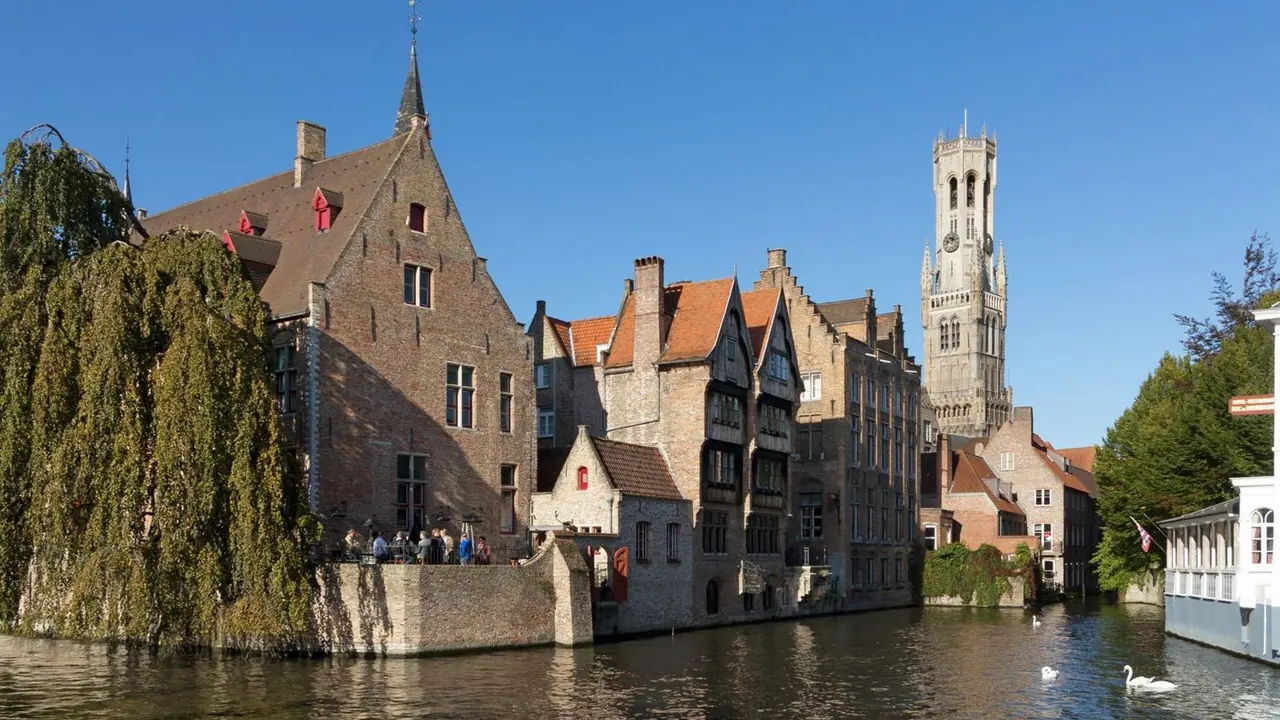
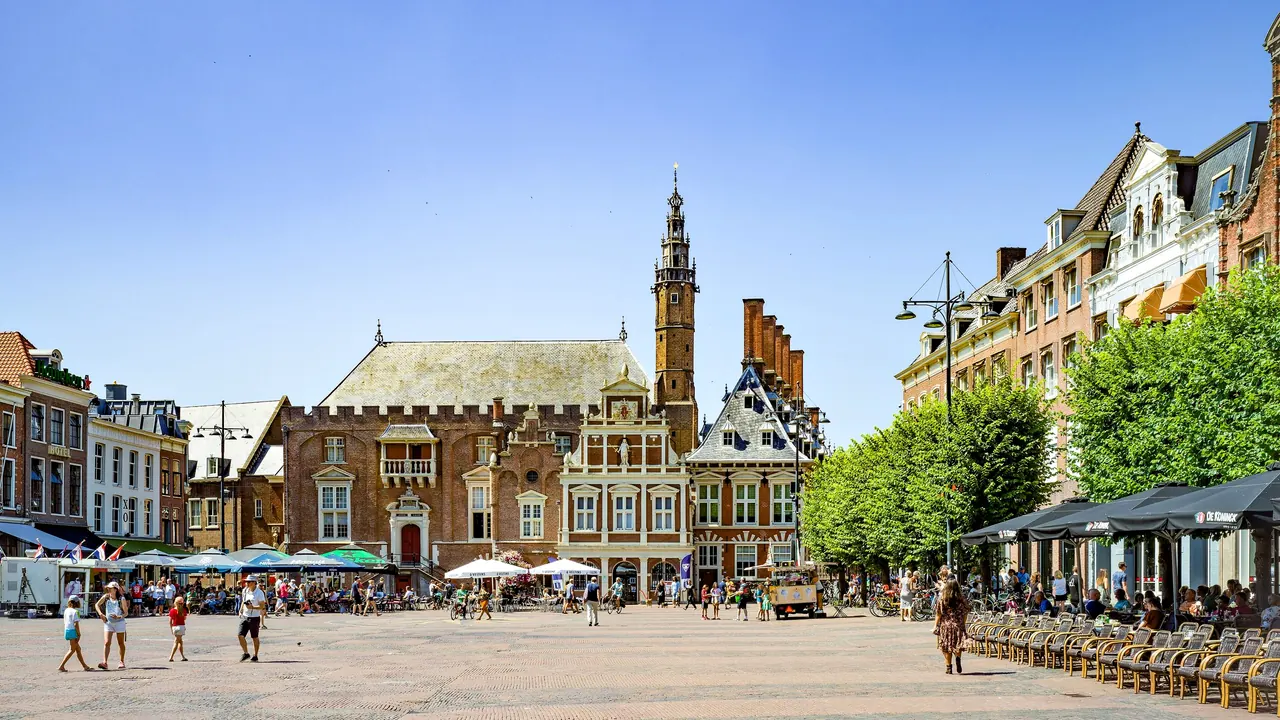
Photos: Bruges by Michielverbeek, CC BY-SA 4.0, cropped; Haarlem by Moroder, CC BY-SA 4.0, cropped.
Bruges or Haarlem?
Our verdict in twelve categories, each scored against the same fixed benchmark cities, and the climate month by month, so you can choose for your trip.
Choose Bruges for
- culture and sights
- food and drink
- prices
Bruges is the stronger pick if the medieval city and its art are the point of the trip. You get the canal ring, the Belfry and the Burg, van Eyck and Memling, and a Michelangelo in the Church of Our Lady. It also suits anyone who travels to eat and drink. Belgian beer cafés, mussels, beef stewed in beer and a serious chocolate culture give it more to taste than Haarlem's plainer Dutch cooking.
Choose Haarlem for
- nature and the outdoors
- shopping
- nightlife
Choose Haarlem for a handsome old town with real countryside right outside it. The dunes, woods and lakes of Zuid-Kennemerland start at the edge of town, the spring bulb fields lie to the south, and the lanes around the Grote Markt are much better for browsing independent shops. It is quieter and greener, and Amsterdam is a short train ride away whenever you want a big city.
Scoreboard
Twelve categories on one fixed scale from 0 to 100. The shaded stretch is the gap between the two.
Your match
Pick a travel style or drag the sliders, and both match scores follow your weighting.
Too close to call, 2 points apart
Wins on culture and sights and food and drink with your weighting.
Wins on nature and the outdoors and shopping with your weighting.
What matters to you?
Category by category
What the scores mean for a trip.
Beaches & swimming
Neither town is a beach destination. Both sit near the same cool, windy North Sea, where a summer afternoon means a paddle and a walk rather than a proper swim.
What differs is the shore. From Bruges you take the train to Blankenberge, then ride the coast tram along an almost unbroken line of resort beaches with promenades. Haarlem's sand is easier to reach: Zandvoort is a short train ride away, and the quieter dune-backed beach at Bloemendaal is a bike ride through the dunes, with pavilions along the sand in summer.
Food & drink
Bruges gives food lovers more to work with. Belgian beer is the main event, poured in wood-panelled cafés with long lists of Trappist and abbey brews. Around it come mussels and frites, beef stewed in beer, waterzooi and chocolate in shop window after shop window. Its weak spot is the set-menu restaurants on the main squares.
Haarlem eats well but plainly. You get terrace and brown-café meals, herring and kibbeling at the Saturday market, and good craft beer on tap. It lacks the regional dishes and street snacks that give Bruges its flavour, and its top tier of restaurants is small.
Culture & sights
Bruges is the richer city for sightseeing. Its whole canal-ringed centre is a UNESCO site, and the Markt, the Burg and the Begijnhof form one of Europe's most complete medieval townscapes. Its art is first-rate, from van Eyck in the Groeninge to Memling in St John's Hospital. The price is crowds of day-trippers filling the narrow streets by late morning in high season.
Haarlem's old centre is handsome and calmer. It is built around St Bavo and its Müller organ, the Frans Hals Museum and the curious oval room at Teylers. The hofjes hidden behind plain doors are its particular charm, but together it makes a pleasant historic town rather than a medieval showpiece.
Nightlife
Bruges does its evenings indoors and slowly. A good night means a long session over strong Trappist ales in an old brown café or a vaulted cellar bar, and students keep a few places around the Eiermarkt and 't Zand busy late. One or two small clubs open mainly at weekends. On weeknights most of the centre is asleep by midnight, which leaves the lit canals to you.
Haarlem's nights are spent more outdoors and in company. The terraces around the Grote Markt and the Botermarkt fill on summer evenings and at weekends, though here too most places close well before dawn. Its real advantage is Amsterdam, about fifteen minutes away by train, so a late night of clubbing is an easy extra rather than a separate trip.
Nature & outdoors
Haarlem has proper countryside on its doorstep. Zuid-Kennemerland National Park spreads dunes, pine and oak woods and small lakes out from the town's western edge, with Highland cattle, wild ponies and deer. The water-supply dunes to the south are known for their tame fallow deer, and in spring the bulb fields make a famous bike ride.
Bruges looks out on flat polder: poplar-lined canals, meadows and the towpath to Damme. It is lovely by bike but has no woods or wild ground. The Zwin salt marsh near Knokke is its one real nature reserve and a good place to watch birds.
Day trips
Both are superb bases in small countries with dense rail networks, so the difference lies in where the trains go. From Bruges you reach the Flemish art cities: Ghent in under half an hour, then Brussels and Antwerp. Add the First World War sites around Ypres and a hop into France at Lille.
Haarlem's list is Dutch. Amsterdam is close enough to visit again and again, and Leiden, the Mauritshuis in The Hague and Delft are all within easy reach. To the north are the cheese market at Alkmaar and the windmills of Zaanse Schans, and in spring Keukenhof is a short bus ride away.
Good for families
Both are small, flat, largely car-free towns that work well with children, so the choice comes down to what you want them doing. Bruges has more ready-made outings: canal boats, horse carriages, climbing the Belfry, the chocolate and frites museums and Boudewijn Seapark on the edge of town. The cobbles are hard work with a pushchair, though.
Haarlem has fewer attractions of its own but more room to run, with dunes, beach, playgrounds and national park visitor centres. Locals ride with cargo bikes and child seats, so families on bikes fit right in. For a zoo or a science museum, you head to Amsterdam.
Getting around
Getting about is equally easy in both. Each has a compact, flat centre where walking and cycling do the job, bikes are easy to hire and a car only gets in the way. The small differences are in the layout. Haarlem's station sits right at the edge of the old town, and bike paths run straight out to the dunes and the beach.
In Bruges the station is outside the canal ring, a fair walk or a short bus ride from the Markt. The cobbles are hard on suitcases and wheels, though you can still cross the egg-shaped centre on foot in about half an hour.
Shopping & style
Haarlem is the better town for shopping. Gierstraat, Kleine Houtstraat and Schagchelstraat, south and west of the Grote Markt, are lined with independent fashion, interior and design shops, bookshops and delis. On market days the main square fills with flowers and cheese.
Bruges shopping is more about things to eat or drink at home: pralines, and Belgian beers with their matching glasses. Bobbin lace is the local craft, though much of what is sold is imported. Its high street is mostly chains, and the flea market on the Dijver and the Saturday market on 't Zand are the best places to browse.
Affordability
Neither is a cheap place to stay. Both are priced like the rest of northwest Europe, with hotels that fill quickly. In Bruges the cost lies mainly in rooms inside the canal ring and meals on the main squares. Staying midweek, sleeping near the station and eating on the side streets bring the bill down noticeably, and the beer is fair value for its quality.
Haarlem's problem is a short supply of rooms. They fill early in tulip season and summer and tend to be small for what they cost. Lunches, market stalls and bakeries help, but regular train trips and museum tickets add up.
Live music & performing arts
Both offer more than their size suggests, and each has its own speciality. Bruges is known for early music, at the Concertgebouw and at its long-running summer festival. It also has chamber music, contemporary dance and the Belfry carillon playing over the rooftops.
Haarlem's speciality is the organ, with regular concerts on St Bavo's great instrument and an international organ festival. It adds classical concerts at the Philharmonie, mostly Dutch-language theatre and cabaret at the Stadsschouwburg, and a pop venue for touring bands. Neither has opera, so that means Ghent or Brussels from Bruges, and Amsterdam from Haarlem.
Wellness & relaxation
Bruges finds its calm in particular corners at particular hours, while Haarlem finds it in the open country on its doorstep. In Bruges the Begijnhof, the Minnewater park and the Sint-Anna and Langestraat quarters are peaceful early and late, and the east side stays calm even at midday. For treatments there are only a handful of hotel and day spas, and the main streets fill with people on summer afternoons.
Haarlem can draw on the strong Dutch sauna culture. There are large day-spa and sauna complexes in the wider region, often with outdoor pools and gardens, and smaller saunas in the town itself. Its canals and almshouse courtyards go quiet after dark, but most visitors unwind by walking or cycling out into the dunes.
When should you go?
Pick your month. The climate figures are measured averages, not a forecast.
Bruges in July
Haarlem in July
Daytime high, °C
Rainfall in the month, mm
Where the figures come from
Bruges has no rain gauge within 25 km of the centre, so its rainfall comes from a gridded climate dataset read at the city rather than from a gauge further away.
Bruges's sunshine is measured 37 km from the centre, at Vlissingen.
Haarlem has no rain gauge within 25 km of the centre, so its rainfall comes from a gridded climate dataset read at the city rather than from a gauge further away.
Haarlem's sunshine is measured 49 km from the centre, at De Bilt.
Temperature and rainfall are climate normals, averaged over the years shown. Bruges: 2009-2025 (sunshine 1991-2020, rainfall 1991-2020) normals, Zeebrugge / Zeemanshaard (15.8 km from centre). Haarlem: 1991-2020 normals, Amsterdam Airport Schiphol (12.7 km from centre).
Both towns have the same mild, damp North Sea climate, so neither ever gets too hot for walking the streets. Summer is the warm season, with July and August highs of about 21°C in Bruges and 22°C in Haarlem. It is also the only time the sea is fine for a quick dip, reaching about 19°C in August off both coasts. Winter is chilly and grey in both, with little sunshine.
The differences show in spring and autumn. Spring is the driest time in both towns, and Haarlem warms up a little faster in April and May, which suits the bulb season. Bruges gets more sunshine from spring right through summer. In autumn the rain builds in both from late summer, but Haarlem's October is the wettest month in either town, at about 109mm. That makes September and early October kinder in Bruges, which also stays sunnier then.
Which traveller are you?
On a culture and arts trip, Bruges is the better choice. Its whole centre is a protected medieval townscape. The Groeninge Museum, St John's Hospital and the Church of Our Lady hold Flemish Primitives and a Michelangelo that Haarlem's fine Frans Hals and Teylers museums cannot match.
For an outdoors trip, Haarlem wins clearly. The dunes, pine woods and lakes of Zuid-Kennemerland begin at its western edge, with wild ponies, deer and marked trails. Around Bruges there is flat polder and the Zwin marsh, good for an afternoon's cycle but little more.
On a shopping trip, Haarlem is the place to go. The lanes south and west of the Grote Markt are full of independent boutiques, design shops and delicatessens. Bruges mostly sells chocolate, beer and lace, and its high street is largely chains.
Before you go
| Measure | Bruges | Haarlem |
|---|---|---|
| Official language | French, German, Dutch | Dutch |
| Currency | Euro (EUR) | Euro (EUR) |
| Sockets | CE230 V, 50 Hz | CF230 V, 50 Hz |
| Driving side | Right | Right |
| Time zone | UTC+1, UTC+2 in summer | UTC+1, UTC+2 in summer |
| Emergency number | 112 | 112 |
| Elevation | 2 m | 2 m |
| Main airport | Brussels Airport (BRU)94 km from centre191 non-stop destinations | Amsterdam Airport Schiphol (AMS)12 km from centre287 non-stop destinations |
| Public holidays this year | 14 days | 11 days |
By the numbers
| Measure | Bruges | Haarlem |
|---|---|---|
| City population | 118,509 | 162,543 |
| People per km² | 840 | 5,064 |
| Museums within 10 km | 38 | 28 |
| UNESCO World Heritage sites within 50 km | 4 | 5 |
| Swim season, months above 21 °C | None | None |
Where else could you go?
Every comparison below shares a destination with this one, so you can follow Bruges or Haarlem somewhere new.
- Amsterdamvs Haarlem
- Ghentvs Bruges
- The Haguevs Haarlem
- Utrechtvs Haarlem
- Rotterdamvs Haarlem
- Lillevs Bruges