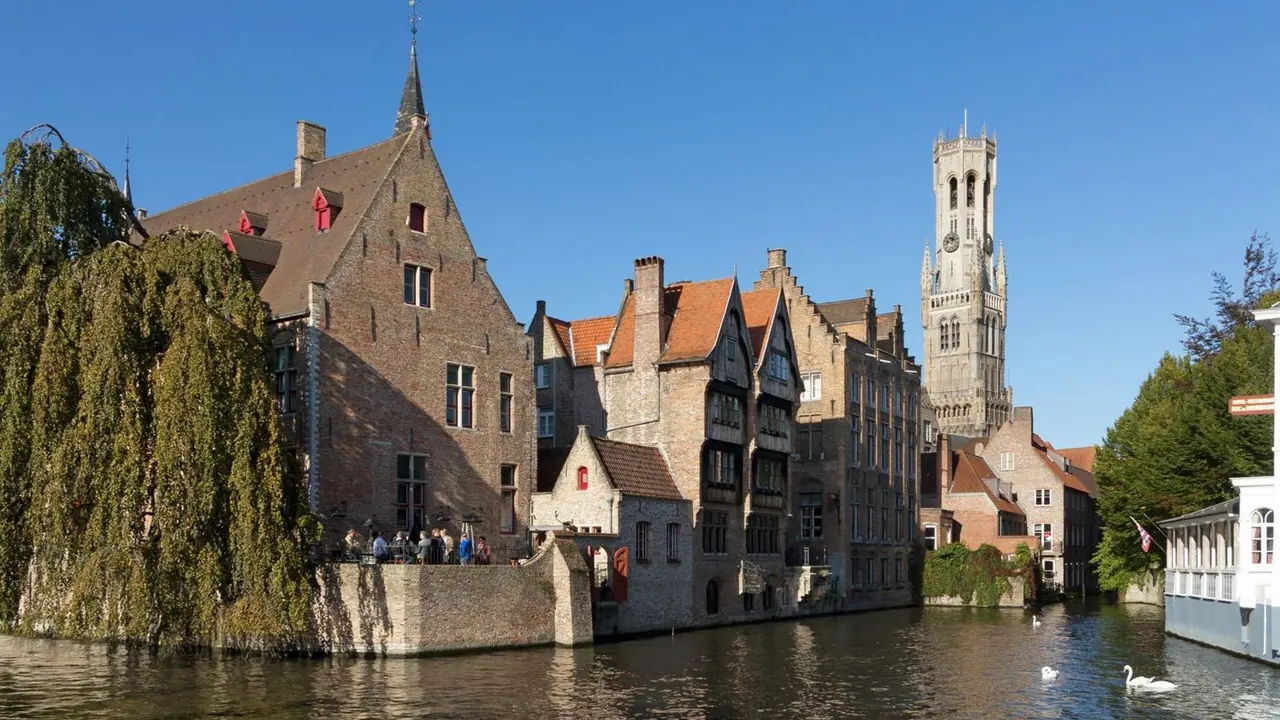
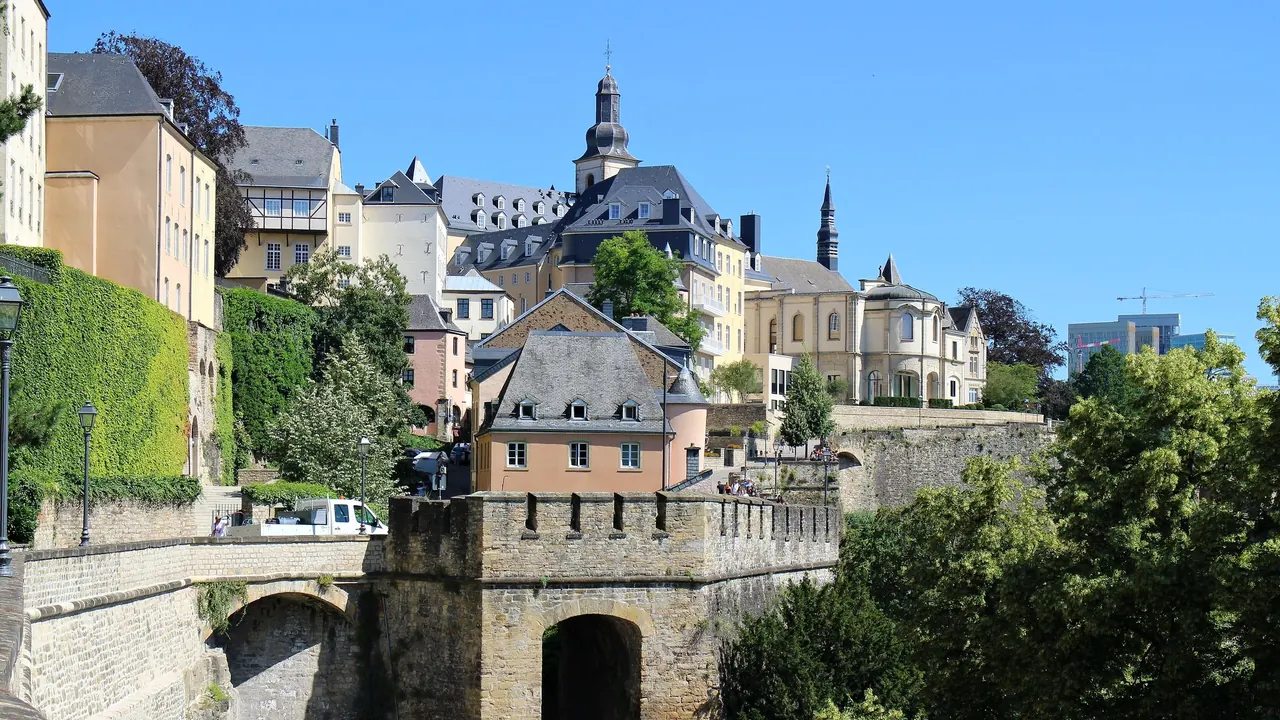
Photos: Bruges by Michielverbeek, CC BY-SA 4.0, cropped; Luxembourg by Suicasmo, CC BY-SA 4.0, cropped.
Bruges or Luxembourg?
Our verdict in twelve categories, each scored against the same fixed benchmark cities, and the climate month by month, so you can choose for your trip.
Choose Bruges for
- prices
- culture and sights
- beaches
Bruges is the pick for travellers who want art and architecture at the centre of the trip. It is a canal-ringed medieval town with Flemish masters in its museums and beer cafés for the evenings, and Ghent, Brussels and Antwerp are close enough by train to fill a longer stay. It is also somewhat kinder to the wallet, and the North Sea beaches are near enough for a summer afternoon.
Choose Luxembourg for
- nature and the outdoors
- live music and the arts
- wellness
Travellers who would rather spend part of each day outdoors will be happier in Luxembourg. The fortress city sits above wooded gorges that lead straight into green valleys, and the Müllerthal and the Ardennes are within easy reach. The Moselle adds wine villages and cycle paths. Mondorf's thermal baths and a proper concert hall make for a quieter, greener stay, and public transport is free everywhere.
Scoreboard
Twelve categories on one fixed scale from 0 to 100. The shaded stretch is the gap between the two.
Your match
Pick a travel style or drag the sliders, and both match scores follow your weighting.
Too close to call, 1 point apart
Wins on prices and culture and sights with your weighting.
Wins on nature and the outdoors and live music and the arts with your weighting.
What matters to you?
Category by category
What the scores mean for a trip.
Beaches & swimming
Neither is a beach destination, but Bruges at least has the sea within reach. A short train to Blankenberge and the coast tram open up a long line of wide, sandy North Sea beaches. The water is cool and often windy, so the coast suits paddling and promenade walks more than swimming.
Luxembourg has no coast at all, only lakes: the Upper Sûre reservoir about an hour north and the old gravel pits at Remerschen. The lake water is a touch warmer in high summer, but it makes a hot-day escape, not a seaside.
Food & drink
Bruges has a slight edge, and most of the difference is in the glass. The city is built around Belgian beer, poured in wood-panelled cafés alongside mussels with frites, beef stewed in beer and chocolate in shop after shop. The main squares serve set menus to day-trippers, though, so the better cooking is on the side streets.
Luxembourg pours Moselle Riesling and crémant instead, with French cooking in its better restaurants and long-running Portuguese and Italian neighbourhood places below them. Its fine dining is serious for a city its size, but cheap everyday eating is harder to find, and lunch is the meal to eat out.
Culture & sights
Bruges is the richer cultural trip. The whole canal-ringed centre is medieval, from the Belfry over the Markt to the walled Begijnhof, and the art inside is world class: van Eyck at the Groeninge, Memling in St John's Hospital and a Michelangelo Madonna in the Church of Our Lady.
Luxembourg's draw is its dramatic setting rather than its collections. You get fortress ramparts and the Bock casemates above the Alzette gorge, the Grund quarter below, and the palace and national museum on the plateau, with MUDAM adding contemporary art on Kirchberg. Each city takes about two days, but Bruges fits far more into them.
Nightlife
Neither city keeps late hours, and the evenings they offer are quite different. Bruges is for a slow, seated night: strong Trappist and abbey ales in a wood-panelled café or a cellar bar, with students keeping a few places busy late around the Eiermarkt and 't Zand, then a quiet walk home beside the canals. Clubbing barely goes beyond a couple of small venues that fill at weekends.
Luxembourg gives you a little more choice and a younger, more international crowd, many of them working in finance or for the European institutions. The old brewery buildings of the Rives de Clausen down in the valley gather bars and a few clubs in one spot, the Grund has stone-built pubs by the river, and Hollerich, near the station, stays open latest. Its big nights come earlier in the week than in Bruges, on Thursday and Friday, because many residents leave town at weekends.
Nature & outdoors
Luxembourg is clearly the better choice for time outdoors. Wooded gorges cut through the city itself. Half an hour away, the Müllerthal has mossy sandstone passages and beech forest on a long waymarked trail that splits into day stages, and further out the Ardennes hills and the Moselle cycle paths give plenty more.
Around Bruges the land is flat polder. That makes for easy cycling along the poplar-lined canal to Damme and birdwatching at the Zwin salt marsh, but it is not walking country.
Day trips
Both make excellent bases, and Bruges is the stronger one. Ghent is under half an hour by train, Brussels about an hour and Antwerp a little further, so three major Flemish cities are within easy reach. Damme by bike, the coast and the First World War memorials around Ypres add more.
Luxembourg's strength is crossing borders. Roman Trier and Gothic Metz are each under an hour away by train. Within the country, Vianden's castle, Echternach and the Moselle wine villages make gentler outings, all reached by free buses.
Good for families
For children the two are much alike: small, safe and calmer than a big capital, with enough for a few days rather than a week. Bruges has boat and carriage rides, swans at the Minnewater, the Boudewijn Seapark and sandcastles on the nearby coast, though the cobbles are hard work with a pushchair.
Luxembourg's adventure is the fortress, with tunnels in the rock and ramparts to explore, and lifts carry buggies down to the river. Its one attraction built for families is the small Parc Merveilleux at Bettembourg.
Getting around
Both are easy without a car, but in different ways. Bruges is flat, so you can walk across the canal ring in about half an hour or cycle it as locals do. The cobbles are the one real nuisance.
Luxembourg is built on several levels, so public lifts and a funicular link the plateau to the river quarters. Trams, buses and trains are free across the whole country, which makes outings to the north or the Moselle very simple.
Shopping & style
Neither city is worth a trip just for shopping, and the things to take home differ. Bruges sells chocolate, Belgian beer and bobbin lace, has chain stores on Steenstraat and holds a flea market along the Dijver. Luxembourg has more polish, with luxury labels on the Grand-Rue, a long-established porcelain outlet in Villeroy & Boch, and Moselle crémant as the best souvenir.
Affordability
Bruges is clearly the cheaper of the two, though it is not a bargain. Rooms inside the canal ring cost most at weekends and in summer, and restaurants on the main squares charge a lot for ordinary food. Eating a few streets away from the Markt brings the bill down noticeably.
In Luxembourg both a bed and a meal cost considerably more. Hotels are priced for business travellers and the European institutions, and restaurants for a well-paid workforce, well above the Western European norm. Unlike in Bruges, weekends can bring lower room rates once the business trade has left. A lunch menu is the way to eat well for less, and several museums are free. Many visitors sleep in Trier or Metz and come in by train for the day.
Live music & performing arts
Luxembourg has the broader programme. The Philharmonie on Kirchberg is home to the city's own orchestra and hosts touring soloists, the Grand Théâtre brings in opera and dance, and the Rotondes and the old abbey at Neimënster add concerts.
Bruges is more specialised. Its Concertgebouw and summer festival are known for early music, chamber music and contemporary dance, and the carillon rings over the rooftops, but there is no opera. For more choice, take the train to Ghent or Brussels.
Wellness & relaxation
Luxembourg has the edge thanks to Mondorf-les-Bains, a thermal spa set in parkland about half an hour away, and calm river walks through the Grund and the Pétrusse valley. Bruges has only hotel and day spas, though its canals, the Begijnhof and the Sint-Anna quarter are very peaceful early and late in the day, when the tour groups have gone.
When should you go?
Pick your month. The climate figures are measured averages, not a forecast.
Bruges in July
Luxembourg in July
Daytime high, °C
Rainfall in the month, mm
Where the figures come from
Bruges has no rain gauge within 25 km of the centre, so its rainfall comes from a gridded climate dataset read at the city rather than from a gauge further away.
Bruges's sunshine is measured 37 km from the centre, at Vlissingen.
Temperature and rainfall are climate normals, averaged over the years shown. Bruges: 2009-2025 (sunshine 1991-2020, rainfall 1991-2020) normals, Zeebrugge / Zeemanshaard (15.8 km from centre). Luxembourg: 1991-2020 normals, Luxembourg / Luxembourg (6.3 km from centre).
Both are at their best from May to September, but the summers differ. Luxembourg gets warmer, with July and August highs around 24°C and the most sunshine of the year, which suits forest walks and Moselle terraces. Bruges peaks at a milder 21°C, and the sea only reaches about 19°C in August, so the beach means a bracing dip on a sunny day rather than real swimming. The Flemish city is often brightest in May and June, before its rain builds through late summer.
From October the two part ways. Bruges turns wet, with close to 89mm a month into December, but stays a few degrees milder. Luxembourg's rain is spread more evenly through the year, but its winters are colder and darker, with January highs near 4°C and very little sun. Spring and early autumn are comfortable for walking in both, and autumn colour makes October especially good in Luxembourg's forests and vineyards.
Which traveller are you?
For a culture and arts trip, Bruges is the stronger choice. Its whole medieval centre is a sight in itself, and van Eyck, Memling and Michelangelo hang within a few streets of each other. Ghent and Brussels add more great art within an hour.
On an outdoors trip, Luxembourg wins easily. Wooded gorges run through the city, the Müllerthal's sandstone passages and beech forest are half an hour away, and the Ardennes and Moselle vineyards add hiking and cycling. Flat Flemish polder offers gentle bike rides and little more.
On a tight budget, neither is cheap, but Bruges stretches money further. It has a walkable free old town, inexpensive trains for day trips and cheaper rooms midweek or near the station. Luxembourg's free transport helps, but its hotels and restaurants cost considerably more.
Before you go
| Measure | Bruges | Luxembourg |
|---|---|---|
| Official language | French, German, Dutch | French, German, Luxembourgish |
| Currency | Euro (EUR) | Euro (EUR) |
| Sockets | CE230 V, 50 Hz | CF230 V, 50 Hz |
| Driving side | Right | Right |
| Time zone | UTC+1, UTC+2 in summer | UTC+1, UTC+2 in summer |
| Emergency number | 112 | 112 |
| Elevation | 2 m | 300 m |
| Main airport | Brussels Airport (BRU)94 km from centre191 non-stop destinations | Luxembourg-Findel International Airport (LUX)6 km from centre115 non-stop destinations |
| Public holidays this year | 14 days | 12 days |
By the numbers
| Measure | Bruges | Luxembourg |
|---|---|---|
| City population | 118,509 | 137,678 |
| People per km² | 840 | 2,663 |
| Museums within 10 km | 38 | 19 |
| UNESCO World Heritage sites within 50 km | 4 | 4 |
| Swim season, months above 21 °C | None | - |
Where else could you go?
Every comparison below shares a destination with this one, so you can follow Bruges or Luxembourg somewhere new.