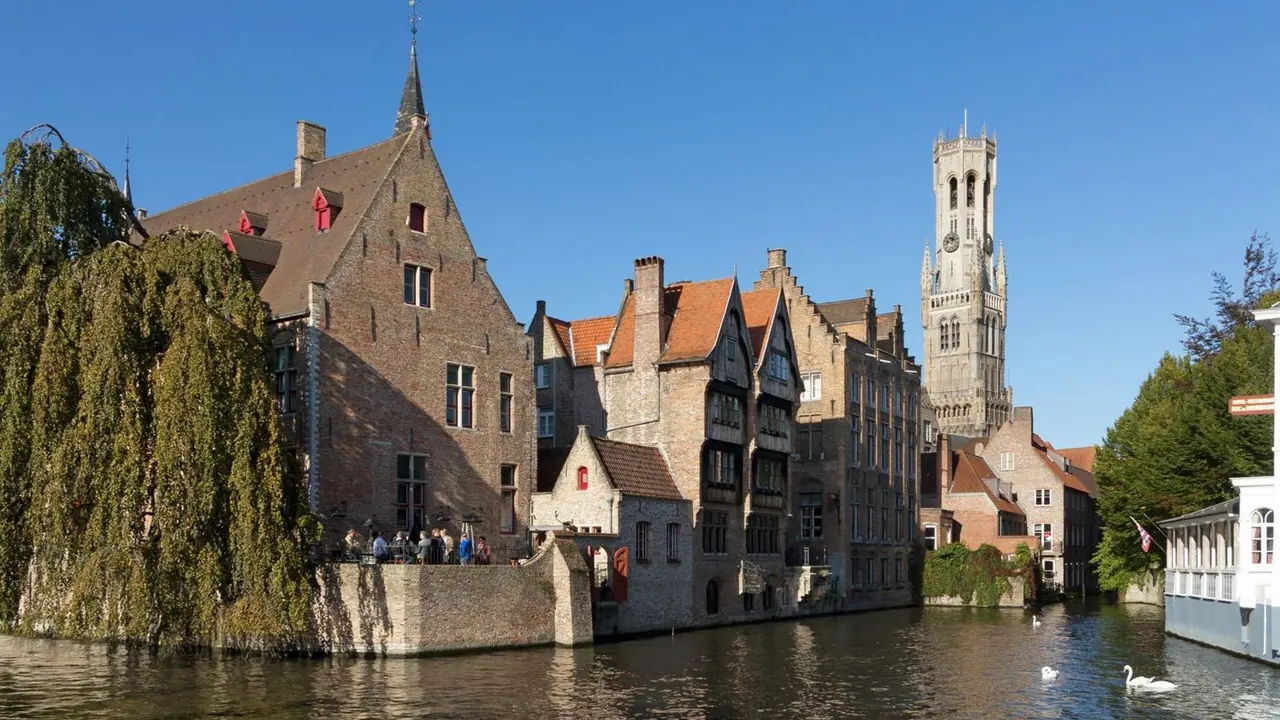
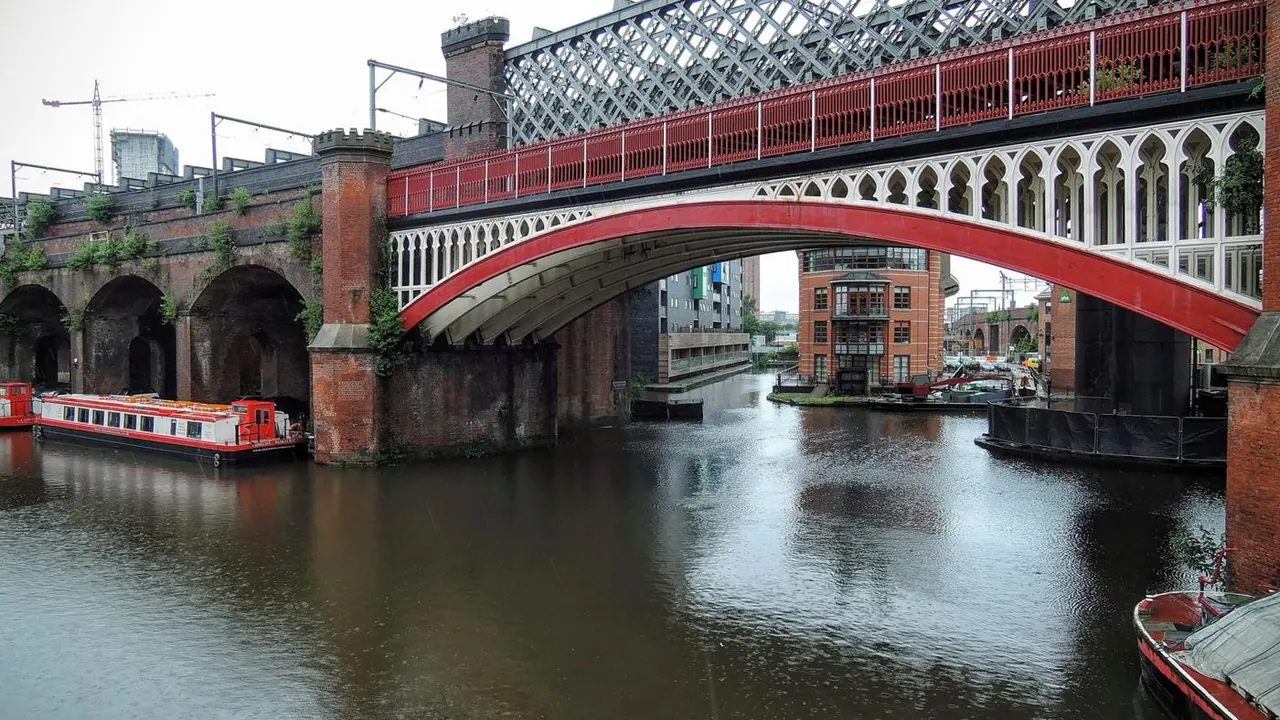
Photos: Bruges by Michielverbeek, CC BY-SA 4.0, cropped; Manchester by IIya Kuzhekin, CC BY 3.0, cropped.
Bruges or Manchester?
Our verdict in twelve categories, each scored against the same fixed benchmark cities, and the climate month by month, so you can choose for your trip.
Choose Bruges for
- culture and sights
- wellness
- beaches
Bruges suits a slower, more visual trip: a couple of days among canals, guildhalls and Flemish Primitive paintings, quiet evenings over Trappist ales, and then trains out to Ghent, Brussels or Antwerp. It is the better choice for couples, art lovers and anyone who wants calm after dark. In return you accept day-tripper crowds in the high season and a centre that is mostly asleep by midnight.
Choose Manchester for
- nightlife
- live music and the arts
- nature and the outdoors
Pick Manchester if the evenings matter as much as the days. Its gig circuit, the Hallé and the Royal Exchange, the bars of the Northern Quarter and the Gay Village give it far more to do after dark than Bruges has, and the Peak District's moorland starts on its eastern edge. You get industrial heritage instead of medieval beauty and broader shopping too. The cost is noise, rain and fewer quiet corners.
Scoreboard
Twelve categories on one fixed scale from 0 to 100. The shaded stretch is the gap between the two.
Your match
Pick a travel style or drag the sliders, and both match scores follow your weighting.
Wins on culture and sights and wellness with your weighting.
Wins on nightlife and live music and the arts with your weighting.
What matters to you?
Category by category
What the scores mean for a trip.
Beaches & swimming
Neither is a beach destination, but Bruges is much closer to the sand. Blankenberge is about fifteen minutes away by train, and the coast tram links wide, flat beaches and promenades all the way to Knokke, which makes a sunny August afternoon by the North Sea an easy extra.
Manchester's nearest coast is an hour or more away, at the dunes and pinewoods of Formby or the promenade at Blackpool, and the Irish Sea there is colder still. It makes a day out for sea air and fish and chips, not for swimming.
Food & drink
The two are close, and both are at their best with a glass in hand. In Bruges that means Trappist and abbey beers in wood-panelled cafés, with mussels, beef stewed in beer, waterzooi and chocolate. The squares around the Markt cater to day-trippers, though, and the everyday choice is narrow.
Manchester has no comparable local cuisine beyond pies and hotpot, but it has far more variety: Chinatown, the curry houses of Rusholme, food halls in the Ancoats mills and craft breweries under the railway arches. Choose Bruges for a distinctly Flemish meal and Manchester for range and cheap, filling meals.
Culture & sights
Bruges has the richer sightseeing by a wide margin. Its entire medieval centre is a World Heritage site, and within a short walk you find the Belfry, the Burg, the Begijnhof and paintings by Van Eyck and Memling of a quality few cities of any size can match.
Manchester's history belongs to the cotton era rather than the Middle Ages, seen in the neo-Gothic Town Hall, the John Rylands Library, the Ancoats mills and the Science and Industry Museum. Its galleries are good and mostly free, but none of its sights has the international standing of the best in Bruges.
Nightlife
Manchester is much the better night out. The warehouse bars and DJ rooms of the Northern Quarter, the long-established Gay Village on Canal Street and the dressier Deansgate crowd keep weekends going late, and in autumn and winter there are big warehouse raves.
Bruges offers a different kind of evening: a long session in a brown café or vaulted cellar over strong ales, then a walk along the lit canals. Dancing comes down to one or two small clubs, and most of the centre is quiet by midnight on weeknights.
Nature & outdoors
Manchester has real hill country on its doorstep. Trains reach Edale in under an hour for Kinder Scout and the ridge from Mam Tor, the West Pennine Moors lie to the north and the Lake District is a day out away, though rain and low cloud often come along.
Around Bruges the land is flat polder, ideal for an easy ride along the canal to Damme or a birdwatching walk at the Zwin salt marsh, but there is nothing to hike.
Day trips
Both make excellent bases, and Bruges has the edge in how much it offers within short journeys. Ghent is under half an hour away, Brussels about an hour and Antwerp a little further. The First World War cemeteries around Ypres add a sombre contrast to all those medieval centres.
Manchester's list is long as well: Liverpool and Chester within about an hour, York across the Pennines, and Chatsworth and Buxton in the Peak District. Its outings lean more towards countryside, Roman walls and stately homes than Belgium's run of great art cities.
Good for families
There is little between them for families, but what they offer differs. Bruges is small, safe and walkable, with boat rides, swans on the Minnewater and sandcastles at Blankenberge. The cobbles and summer crowds are hard on pushchairs, though, and the main sights are paintings and churches.
Manchester relies on free indoor museums with working engines and dinosaurs, the aquarium at the Trafford Centre with a real-snow slope beside it, and stadium tours, all useful on rainy days. The centre is rowdier at weekends, and the bigger draws, such as Chester Zoo, take a full day.
Getting around
Bruges is easier mainly because it is so small. You can cross the whole old town inside the canal ring on foot in about half an hour, the centre is flat and largely car-free, and hiring a bike is the local way to get about. The cobbles are the main nuisance, especially with a suitcase.
Manchester's centre is walkable too, but reaching Salford Quays, Old Trafford or the airport means the Metrolink trams or buses. These get crowded when big events are on, and the rain often makes walking less pleasant.
Shopping & style
Manchester is the better place to shop, with real breadth. Market Street and Exchange Square have the big names and two upmarket department stores, King Street and Spinningfields add designer labels, and the vintage and record shops of the Northern Quarter, along with Afflecks, give it a character of its own.
In Bruges, shopping is mostly for things to eat and drink: chocolate, specialist beers and their glasses, with lace as the traditional craft. The high street is largely chains, and the Saturday market on 't Zand and the flea market on the Dijver are pleasant to browse but not a reason to go.
Affordability
Neither city is cheap, but Manchester is a little easier on the budget. Its free museums, curry houses and Chinatown help balance hotel rates that jump on football and concert nights.
In Bruges, the hotels inside the canal ring and the restaurants on the main squares are priced for a constant flow of visitors, especially at weekends and in summer. Staying midweek or near the station and eating on the side streets helps, and the beer and the day-trip trains are fair value.
Live music & performing arts
Manchester is far stronger for an evening at a concert or the theatre. The Hallé and the BBC Philharmonic both play at the Bridgewater Hall, the Royal Exchange stages theatre in the round inside the old cotton trading hall, and the gig circuit runs from back rooms in the Northern Quarter to one of Europe's largest arenas.
Bruges takes music seriously but is small. The Concertgebouw specialises in early music, chamber music and contemporary dance, the Stadsschouwburg hosts touring theatre, and the Belfry carillon plays over the rooftops. For more choice, people take the train to Ghent or Brussels.
Wellness & relaxation
Bruges is the calmer place to unwind, though not because of spas, which in both cities come down to hotel and day spas. What it offers is quiet: the Begijnhof, the canals and the Minnewater park early and late in the day, and the Sint-Anna neighbourhood even at midday.
Manchester is loud and busy, especially at weekends, and the grand Victoria Baths are a heritage visit rather than a place to swim. To rest properly there, you usually leave the city for the Peak District or the old spa town of Buxton.
When should you go?
Pick your month. The climate figures are measured averages, not a forecast.
Bruges in July
Manchester in July
Daytime high, °C
Rainfall in the month, mm
Where the figures come from
Bruges has no rain gauge within 25 km of the centre, so its rainfall comes from a gridded climate dataset read at the city rather than from a gauge further away.
Bruges's sunshine is measured 37 km from the centre, at Vlissingen.
Temperature and rainfall are climate normals, averaged over the years shown. Bruges: 2009-2025 (sunshine 1991-2020, rainfall 1991-2020) normals, Zeebrugge / Zeemanshaard (15.8 km from centre). Manchester: 1991-2020 normals, Manchester Airport (14.8 km from centre).
Both cities have a mild, damp north-west European climate, and neither is ever too hot for walking. Summer is the best season in each. Bruges reaches about 21°C in July and August, and Manchester is a degree or so cooler. Bruges is clearly sunnier from April to August, and its spring is drier: April is its driest month at about 43mm, while Manchester stays wet all year. The sea off the Belgian coast warms to about 19°C in August, a couple of degrees above the Irish Sea near Manchester, but neither invites more than a quick dip.
The biggest difference comes in autumn. In Bruges the rain increases from July into winter but stays fairly even. Manchester's rain peaks in October at about 95mm, with short, grey days leading into a cold, dull winter in both cities. May, June and September are pleasant for walking the streets in either city. For time on the beach, Bruges in high summer is the only real option.
Which traveller are you?
For a culture and arts trip built around sights, Bruges is the stronger choice. Its whole canal-ringed centre is medieval and protected, and the Groeninge Museum, St John's Hospital and Michelangelo's Madonna fit world-class art into a short walk. Manchester's strengths lie more in concerts and theatre.
On a food and nightlife trip, Manchester wins clearly. At the table they are close, Belgian beer and Flemish cooking against curry houses and food halls, but the Northern Quarter, Canal Street and the warehouse raves keep going long after Bruges has gone to bed.
On a relaxing and wellness trip, Bruges is the gentler choice. Neither city has a spa tradition, but the Begijnhof, the Minnewater and the Sint-Anna streets are peaceful early and late, while Manchester is loud and sends its own visitors to Buxton to unwind.
Before you go
| Measure | Bruges | Manchester |
|---|---|---|
| Official language | French, German, Dutch | English |
| Currency | Euro (EUR) | Pound Sterling (GBP) |
| Sockets | CE230 V, 50 Hz | G230 V, 50 Hz |
| Driving side | Right | Left |
| Time zone | UTC+1, UTC+2 in summer | UTC, UTC+1 in summer |
| Emergency number | 112 | 112 or 999 |
| Elevation | 2 m | 38 m |
| Main airport | Brussels Airport (BRU)94 km from centre191 non-stop destinations | Manchester Airport (MAN)15 km from centre211 non-stop destinations |
| Public holidays this year | 14 days | 8 days |
By the numbers
| Measure | Bruges | Manchester |
|---|---|---|
| City population | 118,509 | 547,627 |
| People per km² | 840 | 4,737 |
| Museums within 10 km | 38 | 28 |
| UNESCO World Heritage sites within 50 km | 3 | 2 |
| Swim season, months above 21 °C | None | None |
Where else could you go?
Every comparison below shares a destination with this one, so you can follow Bruges or Manchester somewhere new.