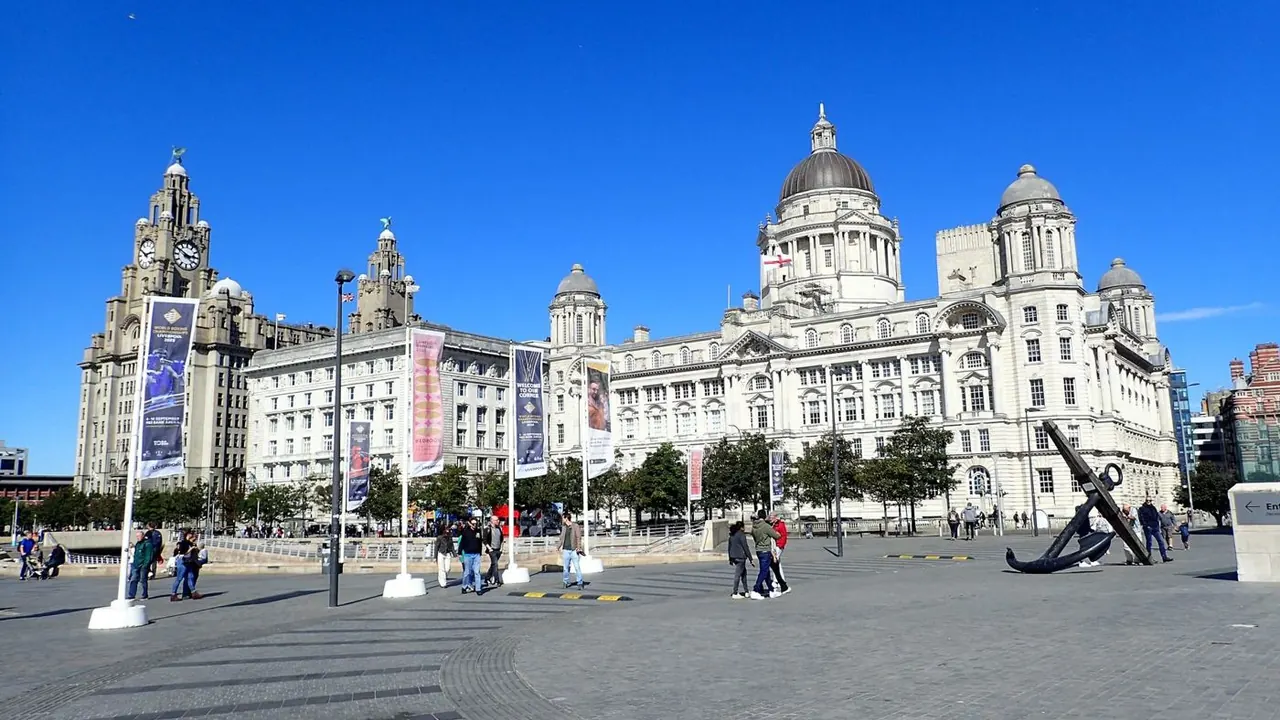
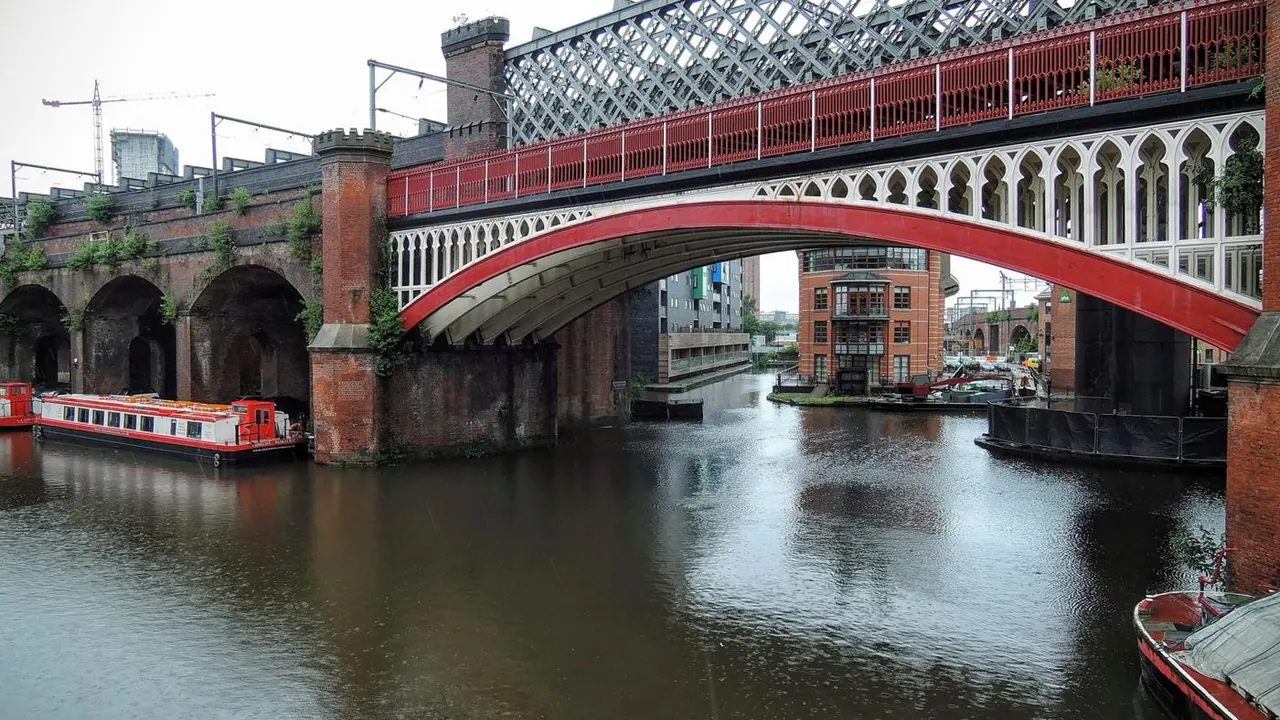
Photos: Liverpool by Marathon, CC BY-SA 2.0, cropped; Manchester by IIya Kuzhekin, CC BY 3.0, cropped.
Liverpool or Manchester?
Our verdict in twelve categories, each scored against the same fixed benchmark cities, and the climate month by month, so you can choose for your trip.
Choose Liverpool for
- culture and sights
- beaches
- prices
Liverpool suits a traveller who wants one clear city story told along its waterfront: the Three Graces at the Pier Head, the Royal Albert Dock with its maritime and slavery museums, and the two cathedrals at either end of Hope Street. It is the slightly cheaper stay, its sights fit comfortably into a long weekend, and Crosby and Formby are a short train ride away for a windy walk by the sea.
Choose Manchester for
- day trips
- nature and the outdoors
- shopping
Pick Manchester if your evenings and your days out matter more than the monuments. Its gig circuit, two orchestras and Northern Quarter bars go deeper. The Peak District begins on the city's edge, and the rail hub puts York, Chester and Liverpool itself within easy reach. It is the better base for a longer stay that mixes city nights with moorland walks.
Scoreboard
Twelve categories on one fixed scale from 0 to 100. The shaded stretch is the gap between the two.
Your match
Pick a travel style or drag the sliders, and both match scores follow your weighting.
Too close to call, 2 points apart
Wins on culture and sights and beaches with your weighting.
Wins on day trips and nature and the outdoors with your weighting.
What matters to you?
Category by category
What the scores mean for a trip.
Beaches & swimming
Neither city is a beach destination, but Liverpool at least has the coast on its doorstep. Merseyrail runs out to Crosby, where Gormley's iron figures stand on the tidal flats, and on to the dunes at Formby. New Brighton and the marine lake at West Kirby are across the river.
Manchester has to borrow the same shore, with Formby or the promenade at Blackpool an hour or more away by train. On either side the sea is cold and the tide goes a long way out, so the beach is for walking and sunsets rather than swimming.
Food & drink
Neither city is a reason to travel for food, and the two are close, but they lean different ways. Liverpool has a dish of its own in scouse, served in pubs with pickled red cabbage. Its most interesting eating is on Bold Street and in the street-food halls of the Baltic Triangle.
Manchester has more range than identity: the South Asian restaurants of Rusholme's Wilmslow Road, one of Britain's larger Chinatowns, and food halls in converted Ancoats mills. Its strongest card is drink, with craft breweries under the railway arches, while Liverpool's pride is its Victorian gin palaces and backstreet locals.
Culture & sights
Liverpool has the more memorable set of sights. The Three Graces and the Grade I warehouses of the Royal Albert Dock make a waterfront with real presence, and the maritime and slavery museums give it weight. Add St George's Hall, the World Museum and the two cathedrals, and you have two or three full days.
Manchester tells the story of the cotton era instead, through the neo-Gothic Town Hall, the John Rylands Library and the Science and Industry Museum on the old railway station site. It rewards anyone curious about industry and politics, but nothing there matches Liverpool's river frontage. Both cities have fine Pre-Raphaelite paintings, at the Walker and at the Manchester Art Gallery.
Nightlife
Both are serious cities for a night out, but Manchester has more depth. The Northern Quarter's grid of warehouses is packed with cocktail bars, dive bars and small DJ rooms. The Gay Village on Canal Street is one of Europe's oldest, and in autumn and winter big warehouse raves keep up the city's dance-music pedigree.
Liverpool's nights are more about the crowd. Concert Square and Seel Street fill at weekends, with stag and hen groups much in evidence, and Mathew Street is the louder tourist strip. The Baltic Triangle and Lark Lane are its options for something less rowdy.
Nature & outdoors
Manchester has the hills, and that is the real difference. The Hope Valley line reaches Edale in under an hour for walks onto Kinder Scout, the West Pennine Moors lie to the north, and Heaton Park gives the city a huge stretch of woodland and grass.
Liverpool's outdoors is flatter and by the water: Sefton Park and its palm house, the Mersey promenade, the Formby pinewoods with their red squirrels, and the Wirral Way out to the Dee estuary. Real mountains are about two hours away.
Day trips
Manchester sits at the centre of the northern rail network, and that gives it the longer list. York, Chester and Liverpool are each about an hour or so by train. Closer in, the Peak District adds Buxton, Bakewell and Chatsworth, and Haworth and Saltaire are within reach too.
Liverpool does well with Chester, Port Sunlight and the Southport promenade, and Manchester is under an hour away. Beyond Conwy and Llandudno on the North Wales coast, though, the choice quickly runs thin.
Good for families
Both cities work with children, largely because so many museums are free, so the difference is in the kind of day. Liverpool offers the World Museum's dinosaurs and planetarium, a flat, pedestrian waterfront and the Mersey ferry, with Knowsley Safari Park on the edge of town.
Manchester leans indoors. It has working engines at the Science and Industry Museum, an aquarium and an indoor snow slope at the Trafford Centre, and stadium tours for young football fans. Chester Zoo is an easy outing from either city, and in both centres late weekend evenings are best avoided.
Getting around
Both centres are compact enough to walk, so the difference is in how you get further out. Liverpool relies on Merseyrail's underground loop and coastal lines, plus the ferry. That suits trips to Crosby, Formby and the Wirral but leaves Sefton Park and Anfield to the buses.
Manchester has the Metrolink trams to Salford Quays, Old Trafford and the airport, and its centre is flatter than Liverpool's climb to Hope Street. Its weak spot is crowded trams on big event days.
Shopping & style
Manchester is the stronger choice for a shopping trip, as the main retail city of northern England. It has designer labels on King Street and in Spinningfields, two upmarket department stores and the vast Trafford Centre. The Northern Quarter adds the indoor stalls of Afflecks, with record and vintage shops nearby.
Liverpool covers the high street well through the open-air streets of Liverpool ONE, and Bold Street has its own vintage clothes and records, but there is little luxury fashion. Beatles memorabilia is the Liverpool souvenir, and football shirts sell in both cities.
Affordability
Liverpool is the slightly cheaper stay. Hotels are generally easier on the budget than in Manchester, pubs serve good-value meals, and the small centre means you spend little on transport.
In both cities, free museums keep sightseeing cheap and eating out costs the usual British amount, though Manchester's curry houses and Chinatown make a cheap meal easy to find. Rooms in both rise sharply on match weekends and big concert nights, and in Liverpool also around the Grand National at Aintree.
Live music & performing arts
Music runs deep in both cities, but Manchester has the fuller programme. The Hallé and the BBC Philharmonic both play at the Bridgewater Hall, the gig circuit runs from tiny back rooms to a huge arena, and the Royal Exchange puts on theatre in the round inside the old cotton trading hall.
Liverpool has the Cavern on Mathew Street and live bands most nights, the Royal Liverpool Philharmonic in its art deco hall, and respected home-grown theatre at the Everyman and the Playhouse. Neither city has a resident opera company.
Wellness & relaxation
Neither city is a place to rest, though Liverpool offers a few more quiet moments: an unhurried ferry crossing, a walk in Sefton Park, an afternoon in the free galleries. The coast and the Wirral are close by for a gentler base.
Manchester is the more relentless of the two, and its grand Victoria Baths are a heritage visit rather than a place to swim. For real rest from there, take the train to Buxton or out into the Peak District.
When should you go?
Pick your month. The climate figures are measured averages, not a forecast.
Liverpool in July
Manchester in July
Daytime high, °C
Rainfall in the month, mm
Where the figures come from
Liverpool's temperatures are measured 47 km from the centre, at Manchester Airport.
Liverpool has no rain gauge within 25 km of the centre, so its rainfall comes from a gridded climate dataset read at the city rather than from a gauge further away.
Temperature and rainfall are climate normals, averaged over the years shown. Liverpool: 1991-2020 normals, Manchester Airport (47.4 km from centre). Manchester: 1991-2020 normals, Manchester Airport (14.8 km from centre).
The two cities share the same climate, so the season will not decide between them. Summer is mild rather than hot, with highs of around 21°C in July, and May to August bring the most sunshine. The Irish Sea warms to only about 17°C in August, so the coast near either city is for walking, not swimming.
Rain falls all year, but autumn is the wettest stretch, with October reaching about 85mm. From December to February the days are short and grey, with highs of only 7°C or 8°C. Late spring and early autumn are the most comfortable months for walking the streets. May to September give the best chance of a clear day on Manchester's moors, though waterproofs belong in the bag in any month.
Which traveller are you?
On a culture and arts trip, Liverpool is the better choice for sights. The Three Graces, the Albert Dock museums, the Walker Art Gallery and two very different cathedrals fill a few days. Manchester comes out ahead only if concerts and theatre matter more than monuments.
For an outdoors trip, Manchester is clearly the base. Trains reach Edale in under an hour for Kinder Scout and the ridge from Mam Tor. Liverpool's green spaces all stay flat, from Sefton Park to the Formby dunes and the Wirral Way.
On a trip on a tight budget, Liverpool stretches the money a little further. Plan the days around its free museums, from the Albert Dock to the Walker, and spend an afternoon among Gormley's iron figures at Crosby, which costs only a Merseyrail fare.
Before you go
| Measure | Liverpool | Manchester |
|---|---|---|
| Official language | English | English |
| Currency | Pound Sterling (GBP) | Pound Sterling (GBP) |
| Sockets | G230 V, 50 Hz | G230 V, 50 Hz |
| Driving side | Left | Left |
| Time zone | UTC, UTC+1 in summer | UTC, UTC+1 in summer |
| Emergency number | 112 or 999 | 112 or 999 |
| Elevation | 70 m | 38 m |
| Main airport | Liverpool John Lennon Airport (LPL)12 km from centre75 non-stop destinations | Manchester Airport (MAN)15 km from centre211 non-stop destinations |
| Public holidays this year | 8 days | 8 days |
By the numbers
| Measure | Liverpool | Manchester |
|---|---|---|
| City population | 513,441 | 547,627 |
| People per km² | 4,592 | 4,737 |
| Museums within 10 km | 31 | 28 |
| UNESCO World Heritage sites within 50 km | 2 | 2 |
| Swim season, months above 21 °C | None | None |
Where else could you go?
Every comparison below shares a destination with this one, so you can follow Liverpool or Manchester somewhere new.